Unknown's avatar

About @DrDanNicholls

CEO of The White Horse Federation Thoughts and ideas do not necessarily reflect that of The White Horse Federation

Stretch and Challenge | CLF Conference

Slide1

It is probably true… that consistently, deliberately and purposefully pitching learning just beyond a child’s present ability, that point between confusion and boredom, is perhaps the hardest part of teaching. This requires a depth of awareness of where each child is and specifically what each individual needs to do next to learn and make progress.

It is also probably true… that good lessons have the ability to stretch and challenge 80+% of children, whereas a great set of lessons stretches and challenges a different 80% each lesson. This requires teachers to become expert coaches who have a depth of subject and age-related knowledge, formatively assesses and use effective feedback to know where each child is with their learning, has the ability to use this to plan for progress, has an in-built ethic of excellence and the in-lesson awareness to intervene with effective questioning, explanation and modelling. Effective coaching happens when there is a consistent application of these elements over time, so that…

“…success is not a random act. It arises out of a predictable and powerful set of circumstances and opportunities (provided by teachers and others).” (Malcolm Gladwell)

The following reflects some of the best practices across the Federation and identifies the key aspects for securing stretch and challenge in all classrooms…


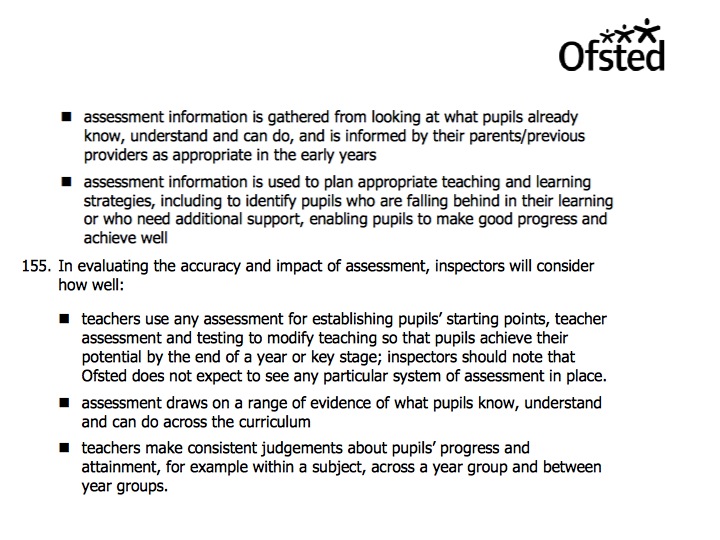
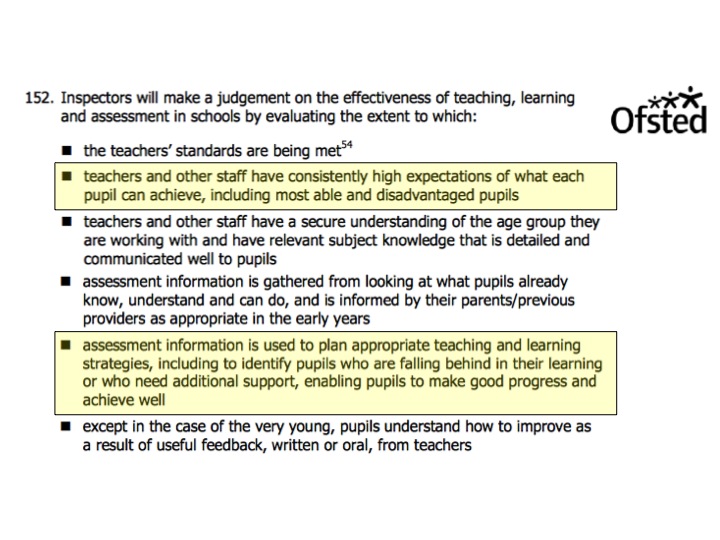
What if… Ofsted are right? that the stretch and challenge of all children should be based on having consistently high standards of what each pupil can achieve, including the most able and disadvantaged…and assessment that informs planning for pupils who are falling behind in their learning or who need additional support enabling pupils to make good progress and achieve well?
Slide1

…and that when looking at books… there is the level of challenge and evidence that pupils have to grapple appropriately with content, not necessarily “getting it right” first time the work is not too easy?

Slide2

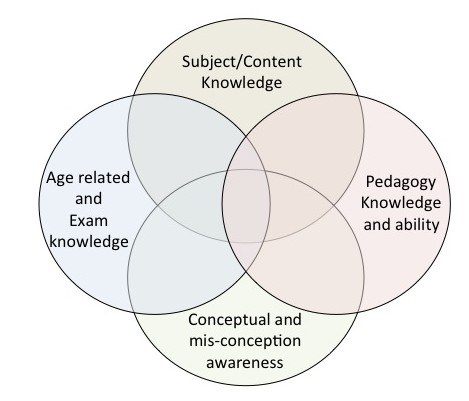
What if… the ability to plan for and to challenge and stretch children is impossible without a depth of knowledge that encompasses…

  • subject/age-related understanding of standards and expectations – that enables appropriate pitch as well as igniting an interest and passion around specific and well-ordered content?
  • a deep understanding of the key concepts and importantly the key mis-conceptions that are built into the progression of a subject or area of learning?
  • knowledge of exam and age-related expectations to provide precise planning, task setting that ensure that children are stretched and challenged around the appropriate content?
  • Knowledge of pedagogy – how to plan to pitch learning, plan lessons, activities and other elements of pedagogy to secure progress.

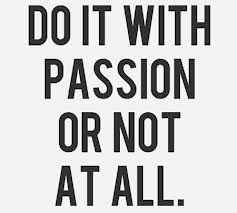
What if.. one of the key levers in stretching and challenging children is the subject passion from teachers who inspire young people to achieve more. Teachers have huge influence – and with that opportunity comes great responsibility:
717296dd52443f5d014228877381418e

What if… this passion is particularly portrayed through the language we use? It is language that motivates and perhaps more importantly inspires interests that enhance young peoples lives. What if… we analysed our own use of language and identified phrases and approaches that automatically set limits (often unknowingly) on what children can achieve or indicate limits to what we believe is possible?

What if… planning to stretch and challenge requires:

  • lesson objectives that genuinely stretch children based on where they are in their learning.
  • feedback and previous progress is the basis for the planning of each lesson – teachers show the flexibility required to respond and pitch lessons by child.
  • flexibility within lessons enable learning, tasks, questioning to be altered to maintain challenge and pitch.
  • peer-to-peer learning is used to support and accelerate progress.
  • different tasks are required to stretch children who are at different points in their progression.
  • lessons and content need to increase in depth rather than breadth to support increased challenge and stretch.
  • absolute clarity around what the age-related or exam-expectations are to direct learning appropriately and stretch in the right areas.
  • have high expectations of what is possible and what children can achieve.
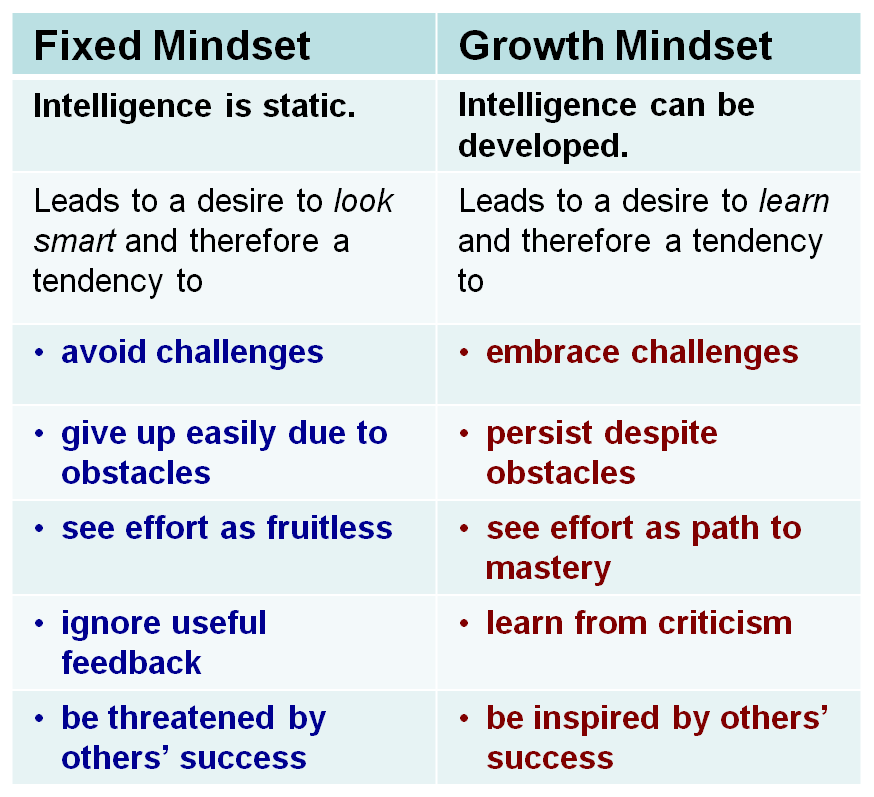
  • Build resilience in pupils who develop GRIT and a growth mindset to spend more time outside of their comfort zone.

comfort-zone-4

What if… children do not produce their best work often enough and tread water in the mediocre? It might be that we rarely stretch and challenge students to produce their very best work and that much of the work produced falls in the bottom quartile of what what they are capable of?

Slide1

What if… children were stretched and challenged to produce work that is skewed to the right, toward excellence and not left where it probably sits at present?

skewed

What if… there is an ongoing and accessible record of a child’s best pieces of work so that there is an immediate benchmark to build from (perhaps at the front of each book).

draft2

What if… children can fly if they truly believe they can? 

cc1ae1a0333adcd0ad428bd2046efa5d

The moment you doubt whether you can fly, you cease for ever to be able to do it.” (from, Peter Pan)

What if… teachers always started from the position that all children can achieve their potential? and What if… this was portrayed in the manner, language, optimism and challenge that teachers have for their classes/children?

What if… we understood that a child’s beliefs can limit what they believe to be possible and worse still that as teachers and educators our beliefs can also limit what others believe that can achieve?

“Tread carefully on the dreams of children; they are fragile”

“…and release them to achieve their podium position…”

podium

What if… to stretch and challenge individuals practise needs to be …intentional, aimed at improving performance, designed for (their) current skill level, combined with immediate feedback and repetitious.”  (Malcolm Gladwell) … enabling children to  over-perform.

What if… creating these conditions and the opportunity to stretch and challenge children requires teachers to be expert coaches who…

  1. Opportunity – creating the opportunity for children to learn and work just beyond their present ability.
  2. Competition from like-minded individuals – create a ethos and atmosphere of sharing and feedback that balances competition and co-operation.
  3. develop GRIT – supporting children to focus on long term goals, ignoring short-term distractions. Often re-doing and re-drafting for example.
  4. seek Deliberative practise – based on precise feedback support children to practise and apply understanding.

bell curve

What if… this seeks to…

“replace the patchwork of lucky breaks, context and arbitrary advantages that determine success…with a system (learning) that provides opportunities and the conditions for all to feel success.” (Malcolm Gladwell, adapted)

What if… planning, tasks and activities are informed by Blooms and SOLO taxonomy? That these frameworks support children to be appropriately stretched and challenged.

blooms_taxonomysolo-taxonomy-with-verbs

What if… we sought more often to escalate lessons and tasks from closed to open and (more often) to challenge children to apply, analyse, synthesis and evaluate their developing understanding. What if… too often children spend time doing what they can already do?

What if… we pitch lessons in the proximal zone? and that the real challenge is to plan learning so that as many children are kept in their proximal zone for as long as possible, just beyond what the child is capable of, supported by a peer) … or in a state of FLOW (that area between boredom and anxiety)?

What if… good lessons stretch and challenge 80% of students, but that in great lessons this is a different 80% each lesson? seeking to pitch and stretch all children over time… an ability that should not be under-estimated.

pz

figure1

What if… stretch and challenge also came from teaching to depth and seeking mastery around the key ideas and concepts.

More generally, in top performing education systems the curriculum is not mile-wide and inch-deep, but tends to be rigorous, with a few things taught well and in great depth.

stock-footage-deep-end-deep-end-of-the-pool-a-good-visual-metaphor-to-show-madness-forstock-footage-shallow-end-of-the-pool

What if… we stretched and challenged children based on a development of a growth mindset (Dweck) – where an anything is possible. What if… it was the absolute expectation that children had to meet the standards. …ensuring, of course, that we do not set the bar too low.

What if… we are prone to underestimating what children are capable of and that this can be highlighted through modest lesson objectives. What if… by setting the bar high and seeking marginal gains we can expect more from children.

“People with Growth Mindsets and who show GRIT achieve more when they engage in deliberative practice … it is this practice that achieve marginal gains (Steve Peters), inching toward excellence.”

marginal-gains

What if… teaching focused more on the journey; on stretching and challenging children to seek “near wins” (Sarah Evans)

“The pursuit of mastery is an ever onward almost.” … “Grit is not just simple elbow-grease term for rugged persistence. It is an often invisible display of endurance that lets you stay in an uncomfortable place, work hard to improve upon a given interest, and do it again and again.”(Sarah Evans)


Maybe then…  children will spend more time in their proximal zone thanks to the expertise and pedagogical understanding of the teacher. A teacher who consistently, deliberately and purposefully pitches learning just beyond a child’s present ability, that point between confusion and boredom, so that children are kept in flow more often. Teachers, as expert coaches, use assessment and formative feedback, strong subject and conceptual knowledge to use elements of pedagogy that stretch and challenge all children over time.

…and maybe then, as teachers, we can be the spark of numerous ignition stories that are born out of an unswerving desire to stretch and challenge pupils; increasing the chances of individuals to be inspired and fall helplessly in love with a future passion…

“Beneath every big talent lies an ignition story – the famously potent moment when a young person falls helplessly in love with their future passion.” Dan Coyle

Dan Nicholls

October 2015

Questioning (explanation and modelling) | CLF Conference

Slide1

It is probably true… that questioning is an incredibly powerful way to drive learning and accelerate progress – particularly those questions or explanations that unlock light bulb moments of personal discovery. When questioning is used in concert with quality explanation and modelling children get a new view of the world, increased access to knowledge, greater opportunity to understand and develop skills. It is perhaps these aspects of pedagogy that have the greatest ability to intervene, inject and steer greater gains in learning.

bulb

It is also probably true… that questioning is often the period in a learning episode where the true talent, ability and awareness of the teacher is shown. It reveals much about:

  • the on-going depth of planning to secure and intervene along the learning journey…an expert element of pedagogy – deliberately delivered, precise and targeted within a lesson and across a series of lessons.
  • the level of formative assessment based on effective feedback so that teaching is based on an the awareness of where children are, what they can do and precisely what is required to secure the next steps, the key concept or breakdown a misconception.
  • the depth of subject/age-related knowledge and passion they bring to the discussion.
  • the ability to intervene or change direction with impact to secure key concepts or tackle misconceptions.
  • the ability to build knowledge and understanding in a logical, spiralled and progressive way that support all children to make progress (or a different 80% each time)
  • the ability to differentiate through language, conscription and questioning, including the ability to judge and time, a question, an explanation or use modelling to close gaps.
  • the ability to stand back enough and facilitate to draw the knowledge and understanding that already exists in the room…provoking good discussion, debate and argument.

When it is at its best it is an awesome thing to witness and be a part of – a crafts-person tweaking, tinkering, picking, choosing, being precise and super-aware of student progress … using questioning, explanation and modelling expertly to enable children to feel the exhilaration of learning and the motivating feeling of progress.

fit-to-lead

This begs the question… what are the key aspects to developing great questioning and discussion as well as explanation and modelling to allow children to thrive, engage and make connections in learning and trigger sustained progress? How is this blended into an effective pedagogical approach?

The following reflects some of the best practices across the Federation and identifies the key aspects for securing questioning (explanation and modelling) in all classrooms…


What if… questioning, explanation and modelling can only have impact on learners and learning when it is based on a strong foundation of knowledge? Knowledge that encompasses…

  • subject/age-related understanding of standards and expectations – that enables appropriate pitch as well as igniting an interest and passion around specific and well-ordered content?
  • a deep understanding of the key concepts and importantly the key mis-conceptions that are built into the progression of a subject or area of learning?
  • Knowledge of exam and age-related expectations to provide precise questioning, explanation and modelling – with the end in mind?
  • Knowledge of pedagogy – how to blend questioning, explanation and modelling within and across lessons.

What if… we see passages of questioning/discussion and explanation as key aspects to stick around on as opposed to a part of the lesson to move through – it drives the learning as opposed to marking points in lessons or being purely a transition. These…

  • drive passion and intrigue for the subject or area of learning. Passion that can be contagious and demands interest to accelerate learning.
  • unlock mis-conceptions, particularly where children can hear others wrestle with cognitive conflict. Consolidates learning and enables key concepts to be grasped.
  • Seek to create and resolve (over time) cognitive conflict.
  • build learning deliberately and precisely and move to application and synthesis.
  • model discussion and the elements of enquiry.

stock-footage-deep-end-deep-end-of-the-pool-a-good-visual-metaphor-to-show-madness-for

What if… these are the key areas of questioning…

  • Wait time: so that we allow children the time to think and consider answers
  • Not to allow children an opt-out of thinking – carefully conscripting and demanding wide response – no-opt out policy.
  • What if we go to pairs sometimes to support more interaction and thinking about questions.
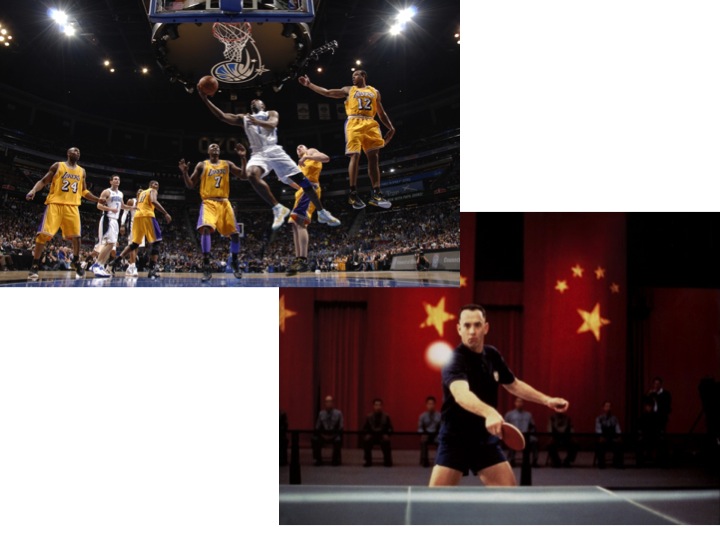
  • Build on answers – basketball questioning or asking children to build on or from what has just been offered. agree and build | disagree and explain | offer new idea. or pose | poise | ponce | bounce.
  • Encourage debate – step-back to allow genuine argument and debate. Using provocative questioning where appropriate.
  • Take time to dwell to depth on topics and ideas.
  • Be flight of foot – shifting discussion to address misconceptions.

Slide2

What if… we too often stifle, control and close down genuine debate and discussion? Just at the moment when children get inspired, passionate and even angry in debate we choose to close discussion down – concerned that there is a lack of control.

What if… we need to be more explicit about what children are aiming for; using modelling to de-mystify the purpose or aim of the learning? Too often children are spending too long discovering knowledge and not enough on application.

What if… we sat children in mixed gender pairs? So that girls who typically describe and explain are closer to risk taking and boys who typically describe and take risks are closer to greater explanation. Perhaps this would encourage more balanced discussion and learner-driven explanations (to class or pair).

What if… this is tightly woven into an Ethic of Excellence? the purpose, precision, rigour and timing of questioning immediately reveals the teachers desire to seek excellence, maintains a high bar and expects much from answers and discussion – expertly steering and intervening to maintain standards and encourage depth of pupil involvement? …the deliberate inclusion of explanation and modelling supports children in their quest for and understanding of excellence.

What if… questioning, explaining, modelling and planning was informed by Blooms and SOLO taxonomy? That these frameworks supported questioning that systematically supported children to understand more …and that this provides the framework for explanation, modelling and questioning etc.

blooms_taxonomysolo-taxonomy-with-verbs

What if… we sought more often to ask questions that moved from closed to open, but that also moved children (more often) to apply, analyse, synthesis and evaluate their developing understanding.

What if… questioning and explanation (and modelling) needs to be in the proximal zone? and that the real challenge is to pitch discussion and explanation so that as many children are kept in their proximal zone for as long as possible (discussing, explaining and applying knowledge just beyond what the child is capable of, supported by a peer) … or in a state of FLOW (that area between boredom and anxiety)?

What if… good lessons used questioning and explanation that is pitched and challenging for 80% of students, but that in great lessons this is a different 80% each lesson? Great teachers use effective formative feedback to build on prior learning and pitch questions and explanations in the proximal zone, whilst modelling the desired end point (or next near win)... an ability that should not be under-estimated.

pz

figure1

What if… great questioning replicates the connections in the brain? understanding that learning is a physical process – that the development of myelin in the brain (layers in picture below) enables neurons to fire and for things to be remembered or skills to be hard-wired … such that questioning, explanation and modelling engages children in deliberate practise and repetition to physically create connections in the brain that allow them to remember and master…developed, consolidated and practised (hardwired) through questioning (explanation and  modelling).

Myelin1

What if…questioning and explanation reflected the curve of forgetting? so that it returned and repeated episodes to consolidate understanding within an interleaved, layered, escalating spiral curriculum where children repeat and return to build on learning.

curve_0-500x231

What if… we understood that practise has to be deliberate to be effective and that this is accelerated where children are in the presence of an expert coach who exploits, questions, explanation and modelling; so that the teacher…

  • maximises reachfulness in the presence of an expert.
  • supports children to embrace the struggle – “You will become clever through your mistakes.”
  • and encourages theft – using questioning and discussion to support peer assisted performance.

What if… this is tightly woven into Effective Feedback and the need to Stretch and Challenge each child?

What if… questioning, explanation and modeling was “… intentional, aimed at improving performance, designed for (a student’s) current skill level, (aimed at excellence), combined with immediate feedback and repetitious.” (Malcolm Gladwell)

What if… explanation is best delivered in different ways to support all children to access the new knowledge, understanding and skills. Using VAK, but more importantly a variety of angles and approaches…as well as using other children in the class to explain new gains in learning – not only consolidating learning for the explainer, but offering a different explanation in peer-friendly language to the receiving child.


Maybe then… questioning (explanation and modelling) will trigger greater depth of learning, allow new ways of seeing and drive progress. The precision and deliberate delivery of these aspects of pedagogy will be based on strong formative assessment and feedback that enables appropriate pitch, stretch and challenge of children. An ethic of excellence will expect much of children their thinking, response, discussion and quality of answer … that happens in their proximal zone.

Maybe then… this aspect of pedagogy will provide the engine room of learning – where teachers tweak, tinker, pick, choose, are precise and super-aware of student progress … using questioning, explanation and modelling expertly to intervene and provoke response that enables children to feel the exhilaration of learning and the motivating feeling of progress.

Dan Nicholls

October 2015

Effective Feedback | CLF Conference

Slide1

It is probably true that effective feedback is the important aspect for improving performance and accelerating progress. Where an expert coach (teacher or other) offers feedback that is timely, specific, within the task and moves individuals to respond and take action, children see things differently and are supported to deliberately practise to make gains in knowledge, skill and understanding.

It is also probably true that we can be blinded into assuming that feedback is limited to the written variety in books (Silo effect). Whereas effective formative feedback should be used to inform all parts of teaching. This is the craft of teaching… where teachers use effective feedback to inform their pedagogy and base planning on an acute awareness of where children are and precisely what they require next to make progress.  Perhaps it is more a mindset and an approach rather than a strategy or a method.

blackbox-3

Which begs the question… what makes feedback effective so that it pervades all that we do and leverages gains in knowledge, understanding and skills?

The following reflects some of the best practices across the Federation and identifies the key aspects for securing effective feedback in all classrooms…


What if… effective feedback is more precise and leveraging when there is a depth of knowledge that teachers use as a framework/basis for feedback? What if… this knowledge encompassed…

  • subject/age-related understanding of standards and expectations – that also ignited an interest and passion around content?
  • a deep understanding of the key concepts and importantly the key mis-concepts that are built into a child’s progress in a subject or area?
  • Knowledge of exam and age-related expectations to provide precise feedback – with the end in mind?
  • Knowledge of pedagogy – the how do I teach for understanding?

What if… the Sutton Trust is right about the two key factors influencing great teaching, Content Knowledge (particularly concepts and misconceptions) and Quality Instruction (questioning and use of assessment – modelling, specific practice that is based on quality feedback)?…

Slide3

What if… feedback was focused within tasks and not bolted on to tasks?What if… we recognised that some of the best feedback happens within tasks…tweaking and suggesting … intervening (whole group, small group, individual) in the moment. Too often feedback is given outside of the event of learning and is not reflected in the planning of subsequent lessons –  so that students are unable to remember or link back to the cognitive challenge they were wrestling with.

Slide21

What if… Ofsted are right about the nature and required impact of assessment and feedback…

Slide1

What if… teachers spent more time planning lessons based on the formative assessment of present progress of pupils (perhaps always based on present progress in lessons and the learning demonstrated in books) to focus planning on closing gaps and addressing mis-conceptions … not just progressing through the scheme of work? Based on the precision of planning there is a discernible difference in the progress of each child. When lesson planning, details matter… (marking is feedback for planning.)

Slide28

What if… much of what is marked does not trigger the action and response required from the child to close gaps. In fact what if… a good proportion of written feedback is not read, not understood and not ultimately acted upon?

What if… the quality of books are judged on the progression in content, skills, understanding and application, rather than the amount and extent of marking – rewarding the closing of gaps, progression of learning and the quality of planning, whether this is achieved directly from written feedback, oral feedback, lesson planning or in the quality if teacher intervention within lessons and across lessons?

What if… teachers wrote less feedback and students wrote more in response – where feedback is responded to in lessons as a key part of the planning – time and commitment is made to close gaps by re-doing and redrafting, by consolidating and practising?

What if… Feedback was SMART –

  • specific – directly related to the skill gap, hole in knowledge, lack of understanding.
  • measurable – you will know when you can do this when…
  • achievable – set in the proximal zone for a child – it is the next step in their learning
  • realistic – specific enough and a gap that is closable in the next 20 minutes, lesson or two.
  • timed – it is acted upon in the present or as soon as possible after the event – and importantly actioned.

…and what if… the very best feedback has the potential to ignite motivation or better still enable a child to see the world, an idea, an approach through new eyes – so that it removes a barrier, unlocks a misconception and makes connections in the brain that support improvement. – seeking light bulb moments.

d3a6b2aafb7946d0ec5aacd42d4860e2

What if… effective feedback was clear with children so that they know what they are aiming for, the size of the gap and specifically what they need to do next to close the gap. (D. William) …children know what good performance looks like.

What if… summative assessment provides a very rich form of feedback – but that this is lost unless there is strong feedback, gap recognition and a move to action (DTT DIRT) that specifically closes gaps? What if…there is no opt out policy for individuals – who must use time in lessons to respond to feedback? (e.g. DTT, DIRT)

What if… we ensured that where feedback is given that this is not wasted … that subsequent lessons reflect the formative learning of the marking and feedback that has revealed exactly where each child is … so that lessons are well planned, crafted and directed to close the gaps … often re-doing and re-drafting to secure learning over time.

What if… we understood that learning is a physical process – that the development of myelin in the brain (layers in picture below) enables neurons to fire and for things to be remembered or skills to be hard-wired … such that only through effective feedback that engages in practise and repetition do we internalise and physically create connections in the brain that allows us to remember and master…making the most of the feedback?

Myelin1

What if…therefore, we used our understanding of the curve of forgetting to interleave curriculum and deliver a spiral curriculum that revisited and consolidated learning over time? Perhaps developing a layered, escalating spiral curriculum where children repeat and return to build on learning.

curve_0-500x231

What if… feedback needs to be in the proximal zone? and that the real challenge in teaching is to keep as many children in the proximal zone for as long as possible (explaining and applying knowledge just beyond what the child is capable of) … or in a state of FLOW (that area between boredom and anxiety)? What if… good lessons are pitched and challenging for 80% of students, but that in great lessons this is a different 80% each lesson? Pitch matters – sadly it varies by individual.

pz

figure1

What if… we understood that practise has to be deliberate to be effective and that this is accelerated where children are in the presence of an expert coach and effective feedback; a coach that…

  • maximises reachfulness in the presence of an expert.
  • supports children to embrace the struggle – “You will become clever through your mistakes.”
  • and encourages theft – using feedback and modelling to copy others.

What if… the real purpose of feedback is to support and engage children in purposeful practice or deep practice?….(Dan Coyle)

“We all have the ability to profoundly change our levels of talent, our level of skill. Where clusters of great talent emerge there has been a culture created where individuals are constantly reaching and repeating, making mistakes, receiving feedback, building better brains, faster more fluent brains…inside the brain myelin acts like insulation on the pathways and connections in the brain – each time we reach and repeat we earn another layer – signal speeds in the brain start to increase from 2 mph to 200 mph – neuro broadband – (or the difference between normal and great).”

Slide23

“…practice (is) intentional, aimed at improving performance, designed for (a student’s) current skill level, (aimed at excellence), combined with immediate feedback and repetitious.” (Malcolm Gladwell)

What if…teaching and feedback focused more on the journey; on the “near win?” (Sarah Evans)

“The pursuit of mastery is an ever onward almost.” … “Grit is not just simple elbow-grease term for rugged persistence. It is an often invisible display of endurance that lets you stay in an uncomfortable place,work hard to improve upon a given interest, and do it again and again.”(Sarah Evans)

What if… too often we give feedback and explanation that is not different from the first explanation or we ask children to simply re-do the same task – missing the opportunity to reframe and explain differently…increasing the chance of a child overcoming cognitive conflict?

What if.. questioning is one of the key ways to provide effective feedback and that through great explanation and modelling children receive on-going formative development and feedback based on exactly where the child is and what they need to know, do or understand next? – expert delivery of aspects of pedagogy that secures concepts and unlocks mis-concepts.

What if… when we have a really clear understanding of the curriculum, the journey, the key learning by age, the concepts and mis-concepts by stage – we can provide much more effective feedback against this wider framework?

What if… effective feedback is only secured where there is an ethic of excellence?

excellence

What if… effective feedback is everywhere – from a corridor conversation to our expectations to what is seen as acceptable in the Academy?


Maybe then…based on secure knowledge (subject/age related/exam/conceptual understanding) teaching will provide a range of formative feedback that importantly informs deeply the lesson planning, but also provides expert coaching to support children to actively respond and work in their proximal zone where repetition and deliberate practice supports progress.

Maybe then…there would be no opt-out for children who are compelled to respond and act-on feedback and that this is integral to the learning process as children receive feedback that is built in and not bolt-on to tasks (and takes many forms – is ubiquitous within the teaching – a thread through the employed pedagogy). Maybe then children will experience flow and, with the aid of an expert coach, improve through well targeted deliberate practice.

Perhaps that… describes the greatest challenge of pedagogy and that which transforms teaching effectiveness … delivered by practitioners whose awareness, knowledge and grasp of pedagogy and the integral role of effective feedback creates the conditions for over performance. (…for a different 80% in each lesson).

Dan Nicholls

October 2015

Middle Leadership | CLF Conference

It is probably true that Middle Leadership is the key role in an Academy for driving improvement. At its best it inspires children and staff to bring new light to what might be, improves quality of teaching, champions an enabling curriculum, drives up outcomes to deliver improved life chances for all (including the team members).

Slide04

It is also probably true that Middle Leadership is most effective when those concerned can be considered to be true experts in their field, when they lead by example with an ethic of excellence, and when they act in concert with their senior colleagues, supporting whole school improvement through highly effective day to day management…owning their curriculum, championing knowledge and learning, actively improving teaching and being clinical about improving outcomes.


Which begs the question: what are the key elements of middle leadership that makes the difference? The following What ifs… are inspired by the strong middle leadership that exist across the Federation.


What if middle leaders consistently created a culture within their team where risks could be taken and individual talents recognised, without losing the ability to challenge, to support, to direct and to critique? …a culture that creates the conditions where team members inspire and are inspired by their colleagues.

IMG_2084

What if middle leaders were respected and trusted in equal measure, so that their team members knew beyond all doubt that they would be receiving the best possible coaching and support to achieve outstanding outcomes through effective lessons? …where middle leaders are the champion of their team and subject/area.

Slide13

What if middle leaders were the first people in the organisation to offer feedback to their staff members, and the first to offer coaching to ensure the craft of teaching was honed and nurtured for each individual in their team? They are the agents of change who shift the quality of teaching.

What if middle leaders fully understood the crucial nature of their role in an Ofsted inspection, where the question on the Inspector’s lips might be ‘how is teaching more effective because of what this leader knows about achievement in this school?’

What if middle leaders championed the one chance that children have. Understanding the deep moral purpose that exists and generating urgency so that all children fulfil and reach their potential…taking seriously the need to reverse accumulated disadvantage for our disadvantaged children.

Slide08

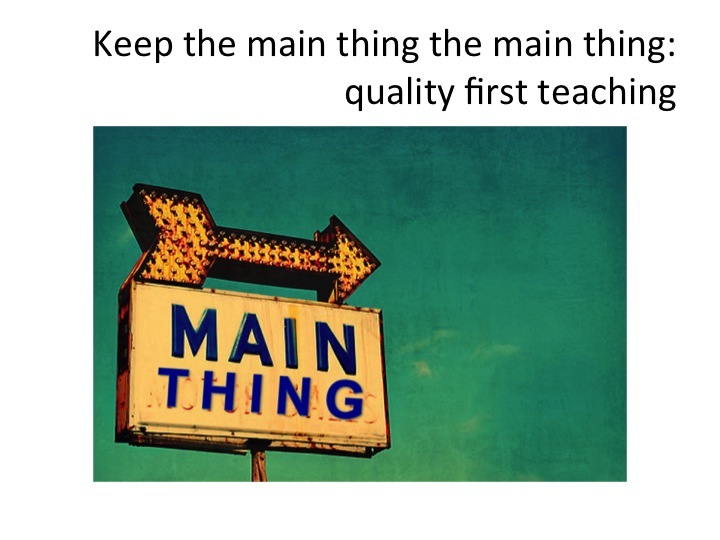
What if Middle Leaders understood that the key strategy for accelerating a child’s progress and enhancing life chances was the consistent delivery of quality first teaching every lesson, every day.

Slide14Slide17

What if middle leaders secured delivery of key elements of the signature pedagogy; where a depth of knowledge, an ethos of excellence, along with teaching that stretches and challenges, that questions to unlock understanding and delivers effective feedback, accelerates learning?

Slide1

What if Middle Leaders were champions of their curriculum; understanding the need to develop a layered/spiralled curriculum that explores and revisits areas to depth and assesses knowledge, skills and understanding against age related expectations?

What if Middle Leaders were champions of their subject and pedagogy? Understanding the need to ensure a depth of knowledge inspires, understands the key concepts and mis-concepts and how pedagogy can be applied to accelerate knowledge, skills and understanding?

Slide4Slide3

What if middle leaders knew about the performance of different student groups not only over the course of the year, but building on previous years in the same school, charting their progress and matching it to departmental interventions and foci over time? …targeting those children that fall behind and accelerating progress to close gaps in attainment.

Slide25

What if middle leaders walked the line between the ‘statesman-like’ approach of the senior leader and that of a supportive family member to those in their team? …supporting and challenging improvements in performance overtime, both deliberately and compassionately.

fit-to-lead

What if middle leaders prepared each meeting as they might a lesson, taking into account the learning experience for their colleagues, their diverse needs, the best way to structure the experience, to have seamless transitions, and a judicious mix of action, discussion, reflection, and imparting of information?

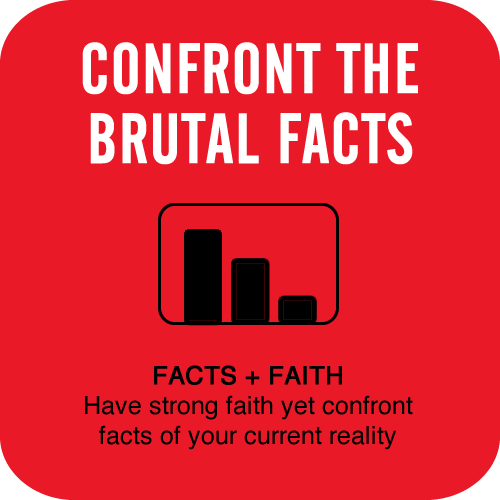
What if middle leaders had the confidence and competence to highlight areas of strength and weakness within the course of a school year or term, without waiting for external validation but seeking to collaborate with others to improve at an accelerated rate?

g2g-confront-facts

What if middle leaders sought to achieve a discernible difference in areas that they identify for improvement?

What if middle leaders were at once confident enough to deal with emerging issues, and humble enough to ask for perspective, support, even validation from their senior colleagues?

What if middle leaders understood that they start to become organisationally blind after six weeks? What if because of this understanding middle leaders connected and collaborated deeply within and beyond their own Academy?

blind-spot

What if middle leaders were able to ask for feedback not only from their line managers but from their own team and from their peers, knowing that feedback enables growth?


Maybe then individual subjects would develop at a fast pace, with outcomes for all students exceeding national expectations, and reducing achievement gaps between groups.

Maybe then teaching, our core business, would be consistently outstanding within each department and across each school. Set within an owned and inspiring curriculum.

Maybe then a generation of leaders would emerge that would have impact and influence well beyond their role.

…and Maybe then we would have the deepest job satisfaction, knowing we have performed unusually well and that our students are the real winners.

Slide08

Sally Apps and Dan Nicholls

October 2015

Ethic of Excellence | CLF Conference

Slide1

The following supports the “ethic of excellence” workshop at the CLF Conference, 2 November 2015…


It is probably true that:

“Once a student sees that he or she is capable of excellence, that student is never quite the same. There is a new self-image, a new notion of possibility. There is an appetite for excellence.” (Ron Berger)

It is also probably true that where an ethic of excellence runs through teaching and learning a child’s progress is accelerated and they outperform their peers. This maybe the most important aspect for driving up standards, accelerating progress, securing unusually good outcomes and giving all children a new sense of possibility; enhancing their life chances for the long term.

The following reflects some of the best practices across the Federation and identifies the key aspects for securing an ethic of excellence in all classrooms…


Slide23

What if… an ethic of excellence is measurable and tangible? That it can be judged from a short triangulation of teaching, books and student voice…and that where teachers have a strong ethic of excellence this is likely to be reflective of strong habits and a personal commitment to excellence.

What if… the ethic of excellence is revealed in the attitude of children toward their learning – that low-level disruption is not a feature – it is, in fact, socially unacceptable to not engage and seek to make progress in lessons.

“What if I fail to be the prophecy?” (Peter Pan)

“What if you fail to try?” (Tiger Lily)

(from the film Pan, 2015)

What if… the ethic of excellence is sought through the way the teacher and others inspire and inject passion around content (subject or age related) and learning; using language and praise to reinforce the expectation of excellence. (praise is not cheap).

Slide3

What if… the ethic of excellence is supported by the challenge and stretch that is evident in lessons supports children to reach beyond what they can do now, expecting students to work in their top 10% excellence zone.

What if… the ethic of excellence is seen in the quality of work and books; showing an  an attention to detail in the…

  • care and precision of presentation
  • quality and depth of writing and working
  • continuity and progression in the work over time that reflects a layered curriculum

What if Ofsted are right and that some of the key evidence of an ethic of excellence is seen in books.

Slide2

What if… the ethic of excellence is shown in a focus on depth rather than breadth and in routinely re-doing and re-drafting; seeking excellence. That teaching uses deliberate practice to inform teaching, so that:

practice (is) intentional, aimed at improving performance, designed for (a student’s) current skill level, (aimed at excellence), combined with immediate feedback and repetitious.” (Malcolm Gladwell)
excellence

What if… children do not produce their best work often enough? It might be that although students are capable of excellence we rarely support students to produce their very best work and that much of the work produced falls in the bottom quartile of what is possible for that individual. It might be true then that the opportunity to enable students to see what is possible rarely happens as students simply tread water in the mediocre.

Slide1

What if… students skewed their work right toward excellence (and teaching prioritised and supported this) and not left where it probably sits at present?

skewed

What if… there is an ongoing and accessible record of a child’s best pieces of work so that there is an immediate benchmark to build from.

draft2

What if… the ethic of excellence is seen in the feedback that is built into tasks/lessons and is specifically targeted at securing concepts and unravelling mis-conceptions…expecting much and targeting specifically where chidden can improve?

feedback

What if… the ethic of excellence supported by assessment (all forms) that is a coherent element of teaching – formatively driving progress and improvement toward excellence? Using mastery to support all children to secure the foundations and core knowledge, skills and understanding that will allow them to be academically and personally successful in and beyond education.

What if… the ethic of excellence is supported where teachers are persistent, and unswerving in raising standards (pass marks etc.) and deliberate in lessons and over-time in catching-up and closing gaps for those students who fall behind?; making a discernible difference to those that fall behind. 

What if… the ethic of excellence is embedded through teacher passion, subject knowledge, pedagogical knowledge, exam or age-related understanding and an insightful understanding of concepts and mis-concepts that are the foundation for driving children toward excellence? This is also evident in the schemes of work – progression of lessons – and within the layered/spiralled/escalating curriculum. Avoiding the skimming of content and the shallow learning.

What if… the ethic of excellence is shown in questioning that immediately reveals the teachers desire to seek excellence, maintain a high bar and expect much from answers and discussion – expertly steering and intervening to maintain standards and encourage depth of pupil involvement? …the deliberate inclusion of explanation and modelling supports children in their quest for excellence.

What if… in seeking an ethic of excellence we borrowed much from Dan Coyle’s insights and establish the conditions for ignition, (moments that inspire an ignition of internal motivation) and provide the feedback of an expert coach from within tasks to breakdown tasks and specifically remove misconceptions and seek accelerated improvement.

“we are often taught that talent begins with genetic gifts – that the talented are effortlessly able to perform feats that the rest of us just dream of. This is false. Talent begins with brief powerful encounters that spark motivation (ignition) by linking your identity to a high performing person or group (or self image). This is called ignition, and it consists of a tiny, world shifting thought lighting up your unconscious mind: I could be them (or do that, or achieve that – in fact look at my best work… my near wins).” (Dan Coyle)

What if… the ethic of excellence was reinforced by teachers and others who have an  unswerving ambition for all children and expecting much from all children, every lesson.

What if… the ethic of excellence is reflected across the Academy in all that we do – in our day-to-day expectations? (from uniform to ‘finishing conversations’ to politeness).

What if… an ethic of excellence was allied to growth mindset that sets the conditions and ethos for a class, cohort or Academy to stretch for excellence? (Dweck)

“People with Growth Mindsets and who show GRIT achieve more when they engage in deliberative practice … it is this practice that achieve marginal gains (Steve Peters), inching toward excellence.”

What if… we focused more on the journey; on the “near win”?(Sarah Evans)

“The pursuit of mastery is an ever onward almost.” … “Grit is not just simple elbow-grease term for rugged persistence. It is an often invisible display of endurance that lets you stay in an uncomfortable place, work hard to improve upon a given interest, and do it again and again.”(Sarah Evans)

What if… the ethic of excellence is exemplified by the classroom environment that reflects learning, progress and supports excellence? Display is inspired, the walls are useful, all areas are tidy and reflective of excellence… boards (and IWB) reflect organised and logical presentation of information that is timely and focused on the key learning for the lesson?

What if… the ethic of excellence is seen in the routines that are shared and owned by all – they are systematic and reflects the desire to make progress and learn?


Maybe then…children would see that they are capable of excellence, that this would change them forever and raise their personal benchmark. They would have a new self-image, a new notion of possibility and an appetite for excellence. Maybe observation and education would value the outcome, the quality, the closeness to excellence and be less fixated on observed practice.

“If you’re going to do something, I believe, you should do it well. You should sweat over it and make sure it’s strong and accurate and beautiful and you should be proud of it” (Ron Berger)

Dan Nicholls

October 2015

Thunks | simple questions that prompt a new view

Thunks… beguiling questions about everyday things that stop you in your tracks and suggest new ways to look at the world… earthrise

Earthrise: “The vast loneliness is awe-inspiring and it makes you realise just what you have back there on Earth.” (Jim Lovell)

Thunks have the ability to change our view, our thinking, our behaviours, our habits and the way we lead and teach; just like seeing earth from space changes perspective and forces us to reflect. The following is a herd of thunks designed to add ideas and viewpoints that stop and force reflection…prompting improvement in our leadership and teaching…

All teaching and leadership blogs are here


Thunk #3 | What if… motivation needs to be ignited?

i-4e84ae6655ead4d2602ed030e890aa1f-ShuttleLiftOff

“Beneath every big talent lies an ignition story – the famously potent moment when a young person falls helplessly in love with their future passion.” Dan Coyle

We all have them; the moments in our past that have shaped the present and will influence the future. It may be a teacher, a sportsperson, a hero, a film, a piece of work, art, riding a bike, running, a poem, essay, a realisation, a chance encounter. It can be like a lightning bolt that ignites something deep inside that motivates a lifetime of passion for something; it causes the heart to flutter and captures the imagination.

“Success is not a random act. It arises out of a predictable and powerful set of circumstances and opportunities.” (Malcolm Gladwell)

It is probably true that there are moments in our lives that create core memories that have disproportionate influence on who we are, what we do and who we become. The Disney Pixar film Inside Out is a great tale that revolves around those forming experiences that shape each of us.

screen-shot-2015-06-22-at-7-00-43-pm

In the film each memory that Riley has is diligently stored in the short and long term memory, occasionally forgotten and removed (hoovered in the movie). There are however key core memories – it is these that shape Riley’s personality islands…those few things that define who  she is, what is important to her and what she is passionate about. The mind replays the key igniting memories that reinforce this passion and drives the intrinsic motivation for deep practice.

inside-out-personality-islands

“Talent begins with brief powerful encounters that spark motivation (ignition) by linking your identity to a high performing person or group (or self image). This is called ignition, and it consists of a tiny, world shifting thought lighting up your unconscious mind: I could be them (or do that, or achieve that)” Dan Coyle

The emerging thunk is that these moments are a lot like falling in love — we can’t force it, but we can increase the odds slightly by doing a few basic things. As teachers and leaders how do we create the conditions and the opportunities that are more likely to provoke these lightning bolt moments for children and our peers?

These moments are: (from Dan Coyle)

  1. Serendipitous. Happen by chance, and thus contain an inherent sense of noticing and discovery.
  2. They are joyful. Crazily, obsessively, privately joyful. As if a new, secret world is being opened.
  3. The discovery is followed directly by action. Not to just admire, but to act, do and practise.

One key lever in education is subject knowledge or rather subject passion from teachers who inspire. Teachers have huge influence – and with that opportunity comes great responsibility:

717296dd52443f5d014228877381418e

The language we use is also extremely powerful. It is language that can create ignition points and perhaps more importantly can confirm and propagate these sparks into passions that drive the motivation to shape and enhance young peoples lives…

Screen Shot 2015-03-10 at 9.18.46 AM

“Tread carefully on the dreams of children; they are fragile”

So, create moments of joy, inspiring facts, details and experiences that ignite a passion, perhaps not seen or witnessed early but for ever changing the individual. After all…

“Once a student sees that he or she is capable of excellence, that student is never quite the same. There is a new self-image, a new notion of possibility. There is an appetite for excellence.” (Ron Berger)

It just might be that supporting children to achieve the best work they have ever done ignites the sort of motivation that creates a personality island and the deep passion to engage in the practice that enriches a lifetime.

How do we create core memories, lightning bolts, ignition moments or at least the conditions for them to happen more often?

How do we use language to support children’s dreams and passions?

We may not create olympic medalists, chess grandmasters or a world-class composers, but the fun is in the journey, in having a passion, an interest and generating the kind of joy that sparks an interest – Teachers have no idea the influence they have on others.

Go create ignition opportunities and sparks that will enrich and empower young people to be passionately interested about stuff… and reinforce these passions with your language.

you have the privilege of sparking remarkable futures.

soulnote_heartflutter_grande

August 2015


Thunk #2 | What if… Mission + Campaigning = Momentum?

Untitled

Michael Hayman and Nick Giles identify: Mission: “A driving desire to change things, a higher purpose that drives (improvement).” (best expressed in 5 words) Campaigning: “Turning the mission into a powerful reality, the activist mentality.” Momentum: “The measure of success moving and growing faster than the competition.” Are you a campaigner, an activist, a disruptor? …on a mission to secure the momentum you require to change the piece of the world that you want to improve? This is a refreshing view of change (particularly the link to activism) and what it takes to move to action and secure the level of change that will make the difference. But what does it take to be an activist/campaigner? Hayman and Giles identify:

  1. Drive (or refusal to give in): Do you have the drive to keep going when it is easier to stop or when people tell you it will not work? Remember that there is a default movement against change and an inherent fear of new/different. Set your mission with care – it needs to be simply expressed and the focus of your drive.
  2. Self improvement: Do you build in enough time to reflect and learn? Treat experience and opportunity as stepping stones forward as part of the ups and downs of a campaign.
  3. Communication: Without communication there is no campaign. Reinforce the mission and the purpose often – drive the mission daily…this is the flywheel. If it is not simple and compelling there will be no followers.
  4. Disruption: To achieve change you need to disrupt the current status quo: If your mission is to address dissatisfaction or a need for change and this is multiplied by a Vision (Mission) and First Steps (Campaign) and this is greater than the Resistance you will achieve Momentum. (based on Gleicher formula)change-graphicOvercoming the Resistance of status quo requires a disruptive drive to succeed in achieving non-reversable change.
  5. Persuasion: You will not achieve your mission alone – persuasion is the key to securing followers – it is followers that transforms a lone nut into a leader. You need a tipping point to secure change – persuade through the strength of purpose, mission and ambition – people follow those with a deep and unshakable belief about what they seek to change. Unwavering commitment to change.
  6. Connection: Connect and network widely to secure support, seek feedback and make things happen.
  7. Optimism: To overcome the status quo activists and campaigners need to be optimistic. The vast majority of people will give up before they realise the change they seek. Develop the ability to bounce.

“Go big or go home. Because it’s true. What do you have to lose?” (Eliza Dushku)

Maybe then: As educators and leaders we should assume the role of activist and trigger campaigns to achieve missions. This language underlines the inertia of the status quo and that if we really want to trigger change and make a big difference – irreversible change – then activism and campaigning is more appropriate representation of the energy and commitment required to overcome the inherent resistance and secure the improvement we seek.

Go forth and disrupt, commit to a mission that you love, use ridiculous amounts of drive, communicate for buy-in, create a movement through persuasion and connect with others to achieve a level of momentum that makes the change stick and irreversible.

Go big or go home

Further Reading: (“Mission” by Michael Hayman and Nick Giles is excellent and very applicable to educational leadership)

and this blog: Great Leaders create movements that stick | Amazing is what spreads 

August 2015


Thunk #1 | What if… leading change and improvement is all about the nudge? Nudge “Nudges are ways of influencing choice” (Hausman & Welch 2010) …a fundamental aspect in education. The behavioural insights team, led by David Halpern, commonly known as the “nudge unit” was set up by David Cameron to “help people make better choices for themselves… (by gentle prompting or nudging).” The art of leadership, teaching and sparking change is often in the ability of “nudging” new ways of acting, learning and thinking in others. Nudges are similar in nature to other powerful change agents: butterflies (Brighouse), bright spots (Heaths) or positive deviants (Sternin)… those outliers present in any population that, when amplified, have the power to leverage change and improvement. Thaler et al. highlight that there are influential strategies (nudges) that leaders can use as choice architects to influence choice and behaviour. So leaders are choice architects; determining the environment in which noticed and un-noticed features influence the decisions that staff and students make. Leaders have the ability to influence behaviours, create social epidemics and use “nudges” to influence individual and group behaviour. We are surrounded by nudges; good leaders see them, look for them and use them (often automatically), great leaders have an increased awareness of nudges and use them to spark change; clever, cheap and effective ways that change behaviours intrinsically – without forcing choices. Perhaps some obvious nudges are:

  • What is placed onto observation forms and is therefore rewarded.
  • Telling students how many marks they are away from the next grade and not their actual grade.
  • Shifting Satisfactory to Requires Improvement.
  • Removing levels.
  • Any new performance measure  – nudging by shifting the goal to where you want it and not wasting time supporting the how it can improve.
  • Any new category that classifies performance of Academies or MATs – nudges improvement toward set criteria.
  • Asking (not telling) others what they will contribute.
  • Warning bell moved earlier to nudge punctuality.
  • Accepting that change is the norm and not saying things like, “we just need stability”
  • Never talking negatively as a leader – nudging that positive ethos that is desired.
  • Being in every classroom everyday.
  • Providing enough seating at lunchtime.
  • Finding and promoting teaching bright spots.
  • Removing all graffiti immediately.
  • Using “we” and not “I” or “you” when collaborating.
  • Investing in signage/branding that describes the accepted behaviour.
  • Leading with Why and telling emotive stories of a compelling future.
  • Not talking about behaviour and only about learning.
  • Praising the good habits, only highlighting that which is desirable.

…you will have other nudges. As the choice architect of your organisation, team, classroom… 

  • do you recognise the nudges around you? …the nudges that influence you as well as the nudges that you use to influence others?
  • how do you use nudges? Do we think and plan long enough to seek softer ways (nudges) to achieve the changes we wish to see?
  • how can you nudge improvement?

(a Future Thunk: Do we understand and recognise the constraints that we have around us; constraints that control what we do, how we think and how we behave?)

 August 2015

Great Leaders create movements that stick | Amazing is what spreads

“The Tipping Point is that magic moment when an idea, trend, or social behaviour crosses a threshold, tips, and spreads like wildfire.  Just as a single sick person can start an epidemic of the flu, so too can a small but precisely targeted push cause a fashion trend, the popularity of a new product, or a drop in the crime rate” (Gladwell, 2002).


It is probably true… that understanding how to “start a movement” is a key leadership quality at all levels within organisations. Why is it that somethings tip and others do not; why some approaches are adopted and become habitual and others not? It is also probably true that movements start when the conditions are right and you emotionally connect, tell stories, ignite action, reach the tipping point and propagate the conditions for contagion, so that ideas spread, are well adopted and become typical. 

Indeed it might be… that those organisations who create movements by seeking small but precisely targeted pushes turn the Flywheel (Collins), so that the organisation becomes and stays great. This is focused, deliberate change and improvement, based on an understanding of how to start and propagate movements and trigger change that sticks. Great organisations take bets where the odds suggest that change will be well adopted, aligned to core purpose, impactful and importantly … irreversible. Great organisations deliberately stay close to their flywheel and make a few well-placed bets on a few key irreversible strategies that matter and make the difference … it is around these that great leaders create, trigger, propagate and sustain movements.

Slide11

However…it is probably true that education is riddled with dead-end initiatives and unsustained changes – the consequence is either a wasteland of innovation or multiple initiatives; where a thousand flowers are allowed to bloom and wither often in rapid succession; all of which has a damaging impact on the credibility of the organisation’s leadership.


 Which beg the questions…  What are the conditions required for a movement to start? AND how, as leaders, can we start, propagate and embed a movement/change based on key leveraging strategies that stick and accelerate improvement?


The importance of the firsts followers, the lone nut and creating conditions for movements to thrive

What if… we understood how movements start and remind ourselves of this great clip and piece of observation from Derek Sivers … how to start a movementhqdefault

Derek Sivers: Blog: https://sivers.org/ff

“…remember the importance of nurturing your first few followers as equals, making everything clearly about the movement, not you. … be public. … be easy to follow! …remember leadership is over-glorified. … It was the first follower that transforms a lone nut into a leader. … there is no movement without the first follower. …the best way to make a movement, if you really care, is to courageously follow and show others how to follow. … so when you find a lone nut doing something great, have the guts to be the first person to stand up and join in.” (Derek Sivers)

What if…, as leaders, we…

“…take responsibility for enabling others to achieve a shared purpose.” (Sinek)

…understanding that by enabling others to achieve and by creating conditions for connection and collaboration we provide the opportunity for movements to start.

“What happens when you build an organisation that is flat and open? what happens when you expect a lot and trust the people you work with?” (Seth Godin)

What if… we were aware that great leadership is about creating a climate where movements happen; that these need to be well focused, but trust that it is amazing that spreads.f163eaa3b112c76e1f850c9a4ba57189 What if… we recognised that change and movements do not take hold where there is disorganisation; where an organisation is…

  • Passive
  • Divided
  • Drifting
  • Reactive
  • and prone to inaction

What if… sustained change and the conditions for movements to grow occur where an organisation is…

  • Motivated
  • United
  • Purposeful
  • Values initiative
  • Moves to action?

“The role of the leader is to enable, facilitate, and cause peers to interact in a focused manner…but still only a minority of systems employ the power of collective capacity.” (Fullan, 2010)


Igniting and propagating a movement that sticks…

What if… we understood that the spread of a new idea, strategy or approach is determined by the adoption patterns of this small group of ‘socially infectious’ early adopters and connectors in an organisation that enable the reaching of a tipping point (Malcolm Gladwell). Who are the Connectors in your organisation? or the sneezers…

What if… we knew who our “sneezers” are? After all it is the sneezers who “unleash the idea virus” (Seth Godin) These are the people who are listened to, who are respected and admired. If you can build up a core of evangelizers among these sneezers, Godin says, your idea is much more likely to spread. What if… we understood how ideas become adopted by a population…perhaps then we would be more successful at starting and creating movements…

F2_0

What if… it is about 16%?

Maloney’s 16% Rule:  Once you have reached 16% adoption of any innovation, you must change your messaging and media strategy from one based on scarcity, to one based on social proof, in order to accelerate through the chasm to the tipping point.

How many organisations fail to switch approach for new strategies and simply decide to re-invent or scrap it? Do we invest enough time in ‘social proof’ a demonstration of the effectiveness of the new strategy – measuring and communicating the impact? What if we understood that 16% is a significant tipping point; that point where the early adopters become interested – we then have a movement (if we seek and communicate ‘social proof’)

BUT…

What if… as senior leaders within organisations the actual tipping point is far beyond 16% – perhaps >80% after which the movement is embedded, change is sustained and habits become irreversible.

AND…

What if… we re-set our movements to ensure that there is on-going improvement that is fit for the time and focused on maximum effectiveness. An evolving, well positioned and aligned movement may require re-birth to maintain momentum of improvement and avoid plateauing:

types-of-innovation-s-curves

Diagram credit: Innovation-Management.org


Create the time, space and opportunity to connect and collaborate; creating the conditions for movement to trigger, propagate and become habitual.

What if … we understood the power of connection; actually the power of purposeful connection and collaboration. Remembering that connection means nothing without a commitment to move to action. Slide1 What if… we understood that an organisation cannot remain agile and innovative with a purely hierarchical structure (right side of diagram). That great organisations maintain a connected structure that supports innovation, grows its individuals and ensures that there is collective ownership and opportunity to drive the organisation forward (left side of diagram) (John Kotter). It is within this structure that your, connectors, sneezers, early adopters have the opportunity to follow and create a movement…remembering that it is the first followers that transform a lone nut into a leader and a fad into a movement.

What if… this also recognised that decision making is better done nearer to the action; that this is what empowers individuals to commit and convert into habit those things that make the greatest difference. (David Marquet) Slide1 What if… we understood that through connection and collaboration we grow resources and opportunity; we gain insight, ideas and innovation. This challenges that traditional assumption that change just costs time and money.


Getting out of the cave and inviting peers into our cave provides perspective and enables more deliberate focused innovation; we increase our odds of instigating the right movements around the things that matter…

What if… we get out of our cave and connect so that we create opportunity and increase our view of what is going to have the most impact; increasing our odds of success. What if this also involves inviting others into our cave to provide peer review.Deer_Cave_Mulu_National_Park_Borneo_Malaysia

Image Credit: wallpaperweb


Tell stories that connect emotionally and tell of a bright future, trigger movements and compel people to action?

Slide2

What if… we shared stories that motivate: Stories that are about SELF, are about NOW, are about US and are about the FUTURE. People respond to stories; how often do leaders use stories to  make an emotional connection? We are pre-disposed to responding to stories; we understand our world through story and strong leaders understand this; and will passionately link stories to the WHY and the moral purpose.

“The Story is everything.” (Spacey)

What makes a good story?… Kevin Spacey highlights the need for… CONFLICT, AUTHENTICITY and AUDIENCE. kevin-spacy-cmi Stories create emotional connection:

“People change what they do less because they are given analysis that shifts their thinking, than because they are shown a truth that influences their feelings.” (Kotter)

John West-Burnham highlights the importance of describing a preferred future.

“Successful and credible leaders are able to tell compelling and credible stories about the future – they are leaders to the extent that people accept and value the future they describe.” (John West-Burnham, 2012)

Stories bind movements together they give reasons to start movements, they tell of a worthwhile future and they connect emotionally; it is the story that moves people to action.

Inspired leaders, organisations and teams find their deepest purpose – their ‘why?’ – and attract followers through shared values, vision and belief.” “this has the ability to transform the fortunes of a group or enterprise – activating individuals, providing a cultural glue, guiding behaviours and creating an overall sense of purpose and personal connection.” (James Kerr, Legacy, 2013)


Movements are more likely to take hold and become habitual if we KISS and avoid complexity – Complexity unravels good ideas, diminishes adopters and stops ideas sticking.

What if… we understood that we needed to  “Keep it simple, stupid?” The KISS principle states that most systems work best if they are kept simple rather than made complicated. Complexity is the enemy to creating a movement or implementing change. Where strategies mis-fire, or change is not adopted, or where there is limited consistency and low habit development, complexity is likely to be the cause. What of we… also recognised that:

Slide3

 What if.. we also understood that when a thousand flowers bloom we are not deliberate or focused enough on propagating and developing those ideas that really matter that really make a difference. Innovation and movements need to be few, deliberate, leveraging, focused, contagious, simple and compelling. 


Wide held and owned set of beliefs in what is possible maintain movements and make them stick. Great organisations have deep, clear and simple beliefs, that are widely held and applied. These underpin the success of any movement or change. Where change or a movement mis-aligns with the underlying belief it will mis-fire.

What if… there is a wide-held and embedded belief in the organisation that we can do things that are amazing? The type of belief that enables and levers success from deep within the organisation – a belief that lives and breaths –  it is felt, insidious and ubiquitous; it is in the air.

“To accomplish great things, we must not only act, but also dream; not only plan, but also believe.” (Anatole France)

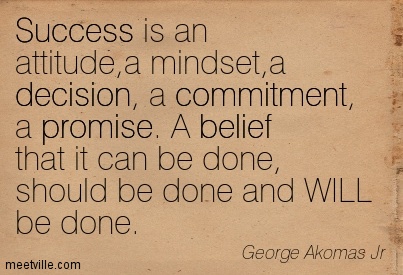
What if… we build this belief into great ambition, purpose and drive? Quotation-George-Akomas-Jr-decision-promise-belief-success-commitment-Meetville-Quotes-66977

“Whether you think that you can, or that you can’t, you are usually right.” (Henry Ford)


 Making movements stick. “Fire bullets then cannonballs” (Collins)

What if… we sought stickability of change and movements? Not only does change or movement need to be compelling, it also needs to stick around. Creating a movement or instigating change should consider if it will stick, a year, two years, three years… if not, don’t launch or invest energy and time, it is futile. The stickiness and sustainability of change is key; it needs to have legs! Education is a wasteland of terminated, washed-up initiatives. This is a real problem, because where organisation are initiative rich and these rarely take hold, the leadership reputation is eroded and damaged; further innovation becomes less likely to stick.

What if… we fired bullets first to test the water and then fully back those ideas that have the potential to be sticky, by firing cannonballs.

““the stickiness factor”, is a unique quality that compels a phenomenon to “stick” in the minds of people and influences their future behaviour.”

What if… we understood how to make ideas stick? and we considered the six principles of sticky ideas (“Made to Stick”, Chip and Dan Heath).

  1. Simple
  2. Unexpected
  3. Concrete
  4. Credible
  5. Emotional
  6. Stories

Maybe then…

  • we would understand the dynamics of how to start, propagate and sustain a movement (change) around the few things that matter; the few things that make the difference.
  • we would better understand that it is more about the followers than the lone nut leader. That moving from 16% to 80% is the measure of success as well as understanding that re-invigorating change is required to avoid plateauing and sustain a trajectory of improvement.
  • we would create the connection and conditions for movements to start, ensuring the checks and balances are in place so that we back those movements that are deliberate, effective and well targeted… avoiding a thousand flowers blooming and then wilting.
  • We would use story to emotionally connect and move people to action.
  • We would take bets on a few ideas and strategies that have a high chance of success. where success is measured in sustainability, adoption, impact and whether the change will become irreversible (or evolvable in the same direction) Will this be in place – consistently applied in 3 years time?
  • We understood the key components for making change stick; the stickability factor.
  • We would KISS and avoid complexity; because complexity kills movements.
  • We would get out of the cave and invite peers into our cave more to get perspective and better understand the movements we need to create; having that wider view.
  • we would align belief about what is possible .. about what the future could be .. and that this aligned to a deeply held moral purpose .. that recognise that everything is possible .. so long as we are willing to do whatever it takes.

“Great leadership is the ability to place bets on the few things that matter; that have impact – great leaders use a wide-view to create and propagate movements that reach tipping points, achieve irreversible change and lasting impact. This enables a metronomic and efficient turning of the flywheel.”

May 2015

Disadvantaged children | think low attainment not low ability

ATT00031

“What if… we view disadvantaged children as low attaining and not as low ability, instil a deep and widely held belief in what is possible and then set eye-watering targets that underline our ambition to overcome the inertia of context.”

It is probably true that… Primary and Secondary schools need to do more to close the gap in attainment between disadvantaged and advantaged children; perhaps seeing it more as low attainment and not low ability or delayed progress and not that there is a limit to a child’s potential. We know that gaps appear early (ages 0-4) and widen through a child’s education. All of which has a deep impact on the child’s life chance and success that ultimately leads to generational cycles of poverty and disadvantage.

Which begs the question… what does it take to close these gaps and disrupt the loop of unequal opportunity and outcomes?

believe-in-kids


What if… education reinforces early advantage and accumulated advantage for advantaged students and inadvertently creates conditions where early attainment gaps widen?… do we disadvantage the disadvantaged?

Malcolm Gladwell identifies in Outliers that we often perpetuate early advantage. He exemplifies through the Canadian Ice Hockey League where those children selected at 4 and 5 years old, are generally the oldest and largest children; having their birthdays in Jan, Feb and March. These children enter the hockey Academies, experience great coaching, many hours of practise (largely deliberate in nature) and of course they thrive, out-strip their slightly younger peers and go on to be professionals. Not because they are more gifted or talented than those children born later in the year, but because they were a quarter to fifth older and larger than their peers when selected…what happened next just served to prove the selectors and scouts right.

“Autumn born students showed higher attainment and made more academic progress over KS3.” (DfE, 2012)

What if… as educators and teachers we are complicit in the widening of gaps and perpetuating the early advantage of students from advantaged backgrounds?

“Within the complex landscape of differential attainment, socio- economic disadvantage appears to be the most consistent predictor of attainment, particularly for children and young people from white ethnic groups.” (Ofsted)

What if… we recognise that low attaining disadvantaged children on entry to Primary and Secondary school are actually low attaining and not low ability. What if we are actually see “delayed progress” and not fixed ability or limit our belief in what disadvantaged children can achieve.

What if… there is a wide-held and embedded belief in the ability of all disadvantaged to achieve and attain – life enhancing qualifications and skills that will break the generational cycle of poverty? What if… we did not assume that this belief exists? The type of belief that enables and levers success for disadvantaged students needs to be to depth and has to live and breath in the organisation – it has to be felt and ubiquitous in all that happens.

What if… we build in greater ambition for disadvantaged students? At the start of secondary why do we not set low attaining disadvantaged children a full level of progress each year?

What if… we understand that this higher ambition and action seeks to close early gaps in literacy and numeracy for example – because these gaps disenfranchise children from their education and maintain the loop of poor outcomes, with each generation.

What if… we understood that disadvantaged students are prone to “self de-selection”. They are more likely to see an opportunity, chance or activity as not for them and de-select themselves. What if we had a policy of “meeting them there” – to ensure that disadvantaged children attend extra-curricular events and attend trips etc. … and to deliberately plan lift the cultural capital for each child.

What if… we understand that disadvantaged students are more likely to have an external locus of control and more likely to assume that their experiences and opportunities in life are determined by others and that they are not in control of their own destiny (internal locus of control). All of which links to the self-esteem and self-confidence that is more prevalent in advantaged households, where there is an assumed progression and a greater internal locus that expects individuals to take control of their future; making things happen.

What if… we understood that not all disadvantaged students are disadvantaged and that there are many advantaged students who are disadvantaged? Do we use our own understanding and soft intelligence to identify our actual disadvantaged cohort?

What if… we sense-checked our pupil premium spending to ensure that the strategies we are using are not in fact enabling advantaged students to flourish further,(obviously no bad thing) but that they targeted at enabling disadvantaged to close the gap and achieve. This can only be born out of a deep understanding of what being disadvantaged really means.

What if… we realise that pupils premium spending should be proportionate to the numbers of disadvantaged and that only by measuring impact can we truly understand what and how we close the attainment gaps?

What if… we gained a deeper understanding of what it means to be disadvantaged – not because we intend to mis-understand the complexity of socio-economic disadvantage by creating unhelpful generalisations, but so we can find a language, approaches, strategies and teaching that unlocks and reverses the disadvantaged inertia that slows/delays progress.

Key factors can include: worklessness, low parental education, lower ambition, less well informed choices, poor home study routines, poor diet, overcrowding, alcoholism, violence, chaotic homes, lower access to books, tables, further resources, reduced cultural capital, visits, newspapers, discussion, debate… (obviously these are generalisations – there are many disadvantaged backgrounds that support and provide conditions for children to thrive and achieve beyond that achieved in advantaged households.)

“Students’ academic attainment and progress are strongly influenced by the education level of their parents. Influence of Fathers’ qualification levels only half as strong as mothers. Positive parenting experiences, especially the early years Home Learning Environment (HLE) helps to promote better longer term outcomes.” (DfE, 2012)

By understanding context we can inform the quality of provision that enables all children to exploit their one chance.

Slide08

What if… we understood that gaps in attainment happen early ages 0-4 and that these gaps typically widen through Primary and Secondary education. “Success is what sociologist would call accumulative advantage.” (Gladwell, 2008)

“Overall, attainment gaps are present from the early stages of education and progressively worsen during transition and through each phase.” (Ofsted)

What if… we understood that these gaps widen because of the Matthew Effect: “it is those who are successful, in other words, who are most likely to be given the kinds of special opportunities that lead to further success.” (Gladwell, 2008)

Differences in academic attainment and social-behavioural development related to background emerged early (at age 3) and remained fairly stable to age 14. (DfE, 2012)

What if…  the quality of Nursery education is a key determining factor. It is not uncommon for gaps to be significant at Reception and that this often directly relates to whether the child has attended Nursery and then whether this is of good quality.

What if… we understood that the summer holiday break (in this instance in the US) has a greater impact on disadvantaged children than advantaged children exemplify the home-advantage of advantaged children…

“The wealthiest kids come back in September and their reading scores have jumped more than 15 points. The poorest kids come back from their holidays and their reading scores have dropped almost four points. Poor kids may out-learn rich kids during the school year. But during the summer, they fall far behind.” … “Virtually all of the advantage that wealthy students have over poor students is the result of differences in the way that privileged kids learn while they are not in school.” (Gladwell, Outliers, 2008)

What if… we took seriously our collective system leadership responsibility for supporting families and by extension all children to make strong progress between 0 and 4. Fully exploiting the potential offered by all-through Academies. This connects the dots and works to remove/improve damaging transitions.

What if… all leaders and teachers are leaders of learning? And that this is never divorced from an on-going and deep dialogue about how we best-teach and support all children to close gaps. Indeed we have a moral obligation as leaders to close these gaps, because only then do we enhance life chances, break the generational cycle of poverty and leave a legacy that we can be proud of.

“Disrupt the loop of unequal outcomes.” (Ofsted)

What if… targets for disadvantaged students were set to close gaps (not to maintain them)? Too often we set targets that simply maintain the gap (for example 4 levels progress for all). And in this moment we limit what is possible and set our ambition for disadvantaged students – we are confirming previous disadvantage – we are seeing disadvantaged students attainment as their potential and limiting our ambition for them. Disadvantaged students need the opposite of this … to be offered a deep belief in them and their ability and that with the appropriate provision delayed progress can be reversed – not least because we should see low attainment not ability and that progress is delayed not a reflection on the child’s ability or potential.

What if… we understand that quality first teaching is what matters for exploiting potential and enabling accelerated progress of disadvantaged students? Indeed quality teaching has a disproportionate impact on disadvantaged children (and in contrast to summer holiday progress, above)…

Slide17

…underlining that disadvantaged students make greater progress than advantaged students when they receive quality teaching – perhaps highlighting the appetite of disadvantaged children to learn, again reflecting delayed progress not innate ability.

“The effects of high-quality teaching are especially significant for pupils from disadvantaged backgrounds: over a school year, such pupils gain 1.5 years’ worth of learning with very effective teachers, compared with 0.5 years with poorly performing teachers … For poor pupils the difference between a good teacher and a bad teacher can result in a deficit of a whole year’s learning.” (Ofsted)

What if… we realised that where Academies only go as far as identifying disadvantaged students on seating plans (or similar) that this could be limiting potential of disadvantaged students; as teachers make unhelpful assumptions about the child’s potential and become content that this child is keeping pace (or slightly behind the progress of advantaged children!)? Quite the opposite is required; disadvantaged children need to outstrip the progress of advantaged children – targets need to reflect greater gains in progress.

What if… we enabled a continuous discussion and strategy-sharing between teachers and pastoral staff to identify strategies and approaches that specifically support disadvantaged children – and that these are made explicit and employed to support students to make accelerated progress.

What if… we recognised that it is the quality of feedback (built-in, not after the event – that is particularly important for disadvantaged children) and what is done with it as well as the quality of differentiation that has the strongest opportunity to accelerate the progress of disadvantaged students.

“To build a better world we need to replace the patchwork of lucky breaks and arbitrary advantages today that determine success–the fortunate birth dates and the happy accidents of history–with a society that provides opportunities for all.” (Malcolm Gladwell)

What if… we considered the language that we use in lessons and across the Academy when talking about children with low attainment or delayed progress? How often do we talk about ability as if it is fixed or imply that there are limits and ceilings for some children. How far do we employ a growth mindset approach and a language of effort and opportunity?

What if… we remember that effort and opportunity are the greatest determinant on success in almost every area of life? Dweck, Coyle and Gladwell provide compelling evidence that learning and progress is achieved through effort, deliberate practice and the development of myelin within the brain. Disadvantaged students are not wired differently or born less clever…all of which demonstrates that (almost) all gaps can be closed and rates of progress increased. (Accepting that extreme neglect in early childhood can create physical changes in the brain).

Perhaps all of this will help to disrupt the loop of unequal opportunity that hold disadvantaged children back; reversing the cycle of poverty.

“Children experiencing poverty face multiple disadvantages that often continue throughout their lives and all too often continue on to the next generation.” (Child Poverty Strategy 2014-17)


Maybe then…

  • There would be a deep and wide-held belief in the possibility of closing all gaps. That there is eye-watering ambition for all students.
  • We would not equate low attainment as low ability. Such that our targets should reflect an acknowledgement that this is delayed progress.
  • We would develop  a greater understanding of what it means to be disadvantaged.
  • We understand that the educational system actually reinforces and perpetuates gaps, because cultural capital and early advantage enables advantaged students flourish.
  • We use system leadership and connections to equalise access to early advantage when children are 0-4 and through Primary into Secondary.
  • We no longer set targets for disadvantaged that simply maintain or worse open gaps wider for disadvantaged students.
  • We would realise that we often put into place strategies and approaches (perhaps through pupil premium funding) that simply enable advantaged students to continue their “accumulated advantage.”
  • We continue to invest in quality first teaching (particularly feedback and differentiation) so that disadvantaged children are freed and supported to make progress.
  • We remind and promote that ability is not fixed and that through effort and deliberate practise everything is possible.

“Education and organisations should be judged by how well it supports its most vulnerable and disadvantaged to achieve and feel success.”

May 2015

Failure is not an option… attitude matters…

“Leaders (and teachers) who know what they are doing will aim for the heart. They connect to the deepest values of their people and inspire them to greatness. They make the business case come alive with human experience; they engage the senses, create messages that are simple and imaginative, and call people to aspire.” John Kotter

It is probably true that attitude matters…possibly the most. It is also probably true that this determines our belief in what is possible, determines the questions we ask and the quests that we embark upon. Attitude is everywhere; it determines our limits and those that we expect of others…it is the underlying attitudes that determine the outcomes and progress of students in classrooms and schools/academies.  It is also probably true that urgency, purpose, emotional connection and ownership are key for developing, fostering and motivating positive and focused attitudes that are aligned to the ambitions of the individual, class or organisation.


…Urgency is often the key to aligning and propagating attitudes – attitudes that can transform and create unusually positive outcomes. The compelling urgency for the safe return of the Apollo 13 astronauts is a neat example of how attitude sets the challenge unwaveringly and achieves what appeared to be a miraculous return to Earth… taken from the script of Apollo 13 (edited)…(click picture for the video clip)… maxresdefault

GENE KRANTZ (FLIGHT DIRECTOR) – So you’re telling me you can only give our guys 45 hours. It brings them to about there… Gentlemen, that’s not an option.

(the use of the visual on the blackboard here is key – people need to see and feel a problem  – only then are they likely to be moved to action.) 

MOCR ENGINEER – Gene, Gene. We gotta talk about power here… 

CONTROL – Without it they don’t talk to us, they don’t correct their trajectory, they don’t turn the heatshield around… we gotta turn everything off. Now. They’re not gonna make it to re-entry…With everything on the LM draws 60 amps. At that rate in sixteen hours the batteries are dead, not 45. And so is the crew. We gotta get them down to 12 amps. 

MOCR ENGINEER – Whoa. 12 amps! – How many? – You can’t run a vacuum cleaner on 12 amps, John. 

GENE KRANTZ (FLIGHT DIRECTOR) – Well, we’re gonna have to figure it out. I want people in our simulators working re-entry scenarios. I want you guys to find every engineer who designed, every switch, every circuit, every transistor and every light bulb that’s up there. Then I want you to talk to the guy in the assembly line who had actually built the thing. Find out how to squeeze every amp out of both of these goddamn machines. I want this mark all the way back to Earth with time to spare. We never lost an American in space. We’re sure as hell not gonna lose one on my watch!. Failure is not an option!

(the attitude here compels action, it expects much and takes a “whatever it takes” approached to a well defined and clear, compellingly urgent problem. How far does this type of attitude permeate our classrooms and academies?)

…and from Star Wars… (the importance of certainty and purpose of moving to action –  committing to a key internal decision to do something..)

Luke: All right, I’ll give it a try. Yoda: No. Try not. Do… or do not. There is no try. 

Yoda-do

Luke: I don’t, I don’t believe it.  Yoda: That is why you fail.


All of which begs to question how do we recognise, use and provoke great attitudes, that make everything possible and does whatever it takes in our academies and classrooms?


What if we understood how our attitude and that of others around us interact to achieve our ambitions or hold us back? Consider your colleagues and students … are they drains (takers of energy) or radiators (givers of energy)? Street_Drain_w_Double_Yellas_by_BewildaBeast8radiator What if we also considered Adam Grant’s great book, “Give and Take,” which provides greater insight and highlights that there are three types of people: Givers, Matchers and Takers. Takers only seek to gain from others, these add little or hold organisations back. Matchers, match what they give with what they have received. However, he argues that the Givers are the most and least successful…

“This is what I find most magnetic about successful givers: they get to the top without cutting others down, finding ways of expanding the pie that benefit themselves and the people around them. Whereas success is zero-sum in a group of takers, in groups of givers, it may be true that the whole is greater than the sum of the parts.” ― (Adam Grant)

Question: how do we create the conditions in our organisations that reward and support Givers?

What if we realised that establishing the WHY (Sinek), the PURPOSE (Pink) and aiming for the heart (Kotter) is key to motivating and harnessing buy-in. This has a direct impact on attitude and on mobilising the inner drive to improve and succeed. It is interesting how these ideas line-up. Simon Sinek argues that people don’t buy what you do, they buy why you do it … Dan Pink identifies three things that are important for people to feel/achieve success – a motivating purpose and the autonomy to seek mastery. Allied to John Kotter’s thoughts around aiming for the heart, we have the recipe to secure and maintain individuals attitudes and for keeping these aligned to the organisational, class or individual ambitions.

Slide1

What if we realised that as teachers and leaders in addition to securing the why, we must also give autonomy and ownership of the how? This is important because to maintain a “whatever it takes attitude” there needs to be ownership and a freedom to determine the what and the search for mastery. This must also involve pushing the decision making closer to the action (David Marquet). What if we understood the motivating power there is in ensuring the attitudes and approaches value the near-win and the journey toward mastery? How do we reward the near win with our colleagues and students? As Sarah Lewis discusses, those seeking mastery have an attitude that drives them to strive and feel success in the near wins…

Mastery is in the reaching, not the arriving. It’s in constantly wanting to close that gap between where you are and where you want to be. …. We see it … in the life of the indomitable Arctic explorer Ben Saunders, who tells me that his triumphs are not merely the result of a grand achievement, but of the propulsion of a lineage of near wins.

We thrive when we stay at our own leading edge. It’s a wisdom understood by Duke Ellington, who said that his favorite song out of his repertoire was always the next one, always the one he had yet to compose. Part of the reason that the near win is inbuilt to mastery is because the greater our proficiency, the more clearly we might see that we don’t know all that we thought we did. It’s called the Dunning–Kruger effect… “You learn how little you know.” (Sarah Lewis)

4241335095e5e5026566315fbe8a827dc4e05353_1600x1200

Click picture to see Sarah Lewis: Embrace the near win

What if we realised that by keeping the moral purpose at the centre, investing time on the why, reaffirming the purpose and by appealing to the emotional drivers we maintain high urgency in the system – be it at individual or organisational level. It is this owned inner drive, the intrinsic motivation that will compel toward action and keep attitudes aligned with the ambition. Chip and Dan Heath highlight the key is to motivate the elephant as well as the rider…

  • Find the feeling (WHY/Purpose) – make people feel something
  • Shrink the change (How) – shrink change so that it does not spook the elephant
  • Grow your people – instil a growth mindset – attitude

howtomakeaswitch

(taken from Switch, Chip and Dan Heath)

What if attitude is about feelings and that stories are uniquely placed to motivate and develop attitudes that align with the ambition? As John Kotter highlights…(how often do we use stories … particularly those that tell of a preferred future?)

“Neurologists say that our brains are programmed much more for stories than for abstract ideas. Tales with a little drama are remembered far longer than any slide crammed with analytics.” (John Kotter)

What if we also understood that positive attitudes stem from a growth mindset? (Carol Dweck)

growth-mindset

What if we also understood that we need to develop attitudes in line with being deliberate? (Malcolm Gladwell) Leaders, teachers and students whose attitude drive them to…

1. …be motivated and exert effort to improve their performance.

2. …engage in tasks that take into account their pre-existing knowledge.

3. …seek and receive immediate informative feedback and knowledge of the results of their performance.

4. …repeatedly perform the same or similar tasks towards near wins…mastery.

“Success is a function of persistence and doggedness and the willingness to work hard for twenty-two minutes to make sense of something that most people would give up on after thirty seconds.” (Malcolm Gladwell)

What if attitude is dependent on ignition? and we should seek to increase students and colleagues opportunities to be ignited by an experience, thought, fact, opportunity etc…

“Beneath every big talent lies an ignition story – the famously potent moment when a young person falls helplessly in love with their future passion.” (Dan Coyle)

For Albert Einstein, that moment happened when his father brought him a compass.

“Einstein later recalled being so excited as he examined its mysterious powers that he trembled and grew cold…. [Einstein wrote] “I can still remember – or at least I believe I can remember—that this experience made a deep and lasting impression on me. Something deeply hidden had to be behind things.”

What if we recruited much more on attitude, understanding that skills and knowledge gaps are easier to close?  Particularly because getting the right people on the bus is the key to great organisations (Jim Collins).

What if we realise that asking challenging questions and setting expectations high can  instil desired attitudes? If we ask ridiculous questions we prompt different possibilities and perspectives. (Questions must be based on the brutal truth of the present reality.)

  • “If your life depended on it what would you do?”
  • “What would we do if the target was 100%?”
  • “What do we need to do now, such that everything else is either easier or no longer required?” (Keller)

It is often the second question that really makes the difference – having attitudes and approaches that dig deep to understand problems and to find solutions that aren’t immediately apparent. What if we also realised that this is about getting the right people in the room – those best placed to ask the right question and not so many to complicate the answer. Steve Jobs only met with 3-4 people – any additions were removed.


Maybe then we would pay much more attention to the attitude of leaders, teachers, staff and students …and seek to create the conditions that foster positive and aligned attitudes.

Maybe then we would also look to other examples like the Apollo 13 mission and learn that attitude rarely exists without purpose and urgency – it does not happen in a vacuum. We might work harder to engage the emotions to drive attitudes and approaches.

Maybe then we would work harder to create the conditions necessary to ensure healthy and positive attitudes.

Maybe then we would work harder to generate or communicate urgency and that this needs to be born out of a clear moral purpose and that this is best aimed at the heart.

Maybe then we would find more ways to reward attitudes that drive us toward success.

Maybe then we would be more attuned to understanding the importance of and the need to create conditions for ignition … to ignite a passion in a colleague or our students … that will propagate attitudes than align with our ambition.

Maybe then we would recognise the importance of attitude and stance when recruiting – getting the right people on the bus.

Maybe then we would understand that autonomy and ownership of the how and what are key to generating the motivation required to propagate great attitudes

Maybe then we would create organisations and classrooms where attitude is understood, fostered and grown – because attitude matters and failure is not an option.

“Try again. Fail again. Fail better.”  (Samuel Beckett)


April 2015

Seeing the wood for the trees: beware organisational blindness

blind-spot

Can’t see the wood for the trees: the whole situation is not clear, because you’re looking too closely at small details, or you’re too closely involved.

trees

It is probably true that the longer we lead, teach or support within an organisation the blinder, more conditioned we become to accepting how things are. Our organisational blindness restricts our ability to be shocked or provoked into action; our ability to see the ‘brutal truths’ (Collins) of our situation decreases with time (and surprisingly quickly). We are less able to see the reality of our present situation and less able to seek the required improvement.

“Organisational blindness inhibits individuals and teams from seeing the brutal truth of their reality; leading to missed opportunities, an inability to not see what really matters or be agile enough to strategically move to a brighter future.”


Which begs the question, how do we correct our organisational blindness; overcome our biases and conceptions that grow through time and be alive to the brutal truths so that we can focus on the things that matter; those things that will address the reality and not our perception of the reality? So how do we provoke fresh thinking and fresh perspectives?

g2g-confront-facts

“You absolutely cannot make a series of good decisions without first confronting the brutal facts.” (Collins)


What if we fully understood that we learn to live with and accept things over time. That over time we become organisationally blind to our reality. The story goes that if you place a frog in water and gradually boil the water, the frog sits happily until death, but throw a frog into boiling water and it will jump straight out…the difference between becoming conditioned and normalised to our organisation and seeing it through fresh eyes and from a new, wider perspective.

frog-in-pan

What if we understood that when we move organisations we have our sharpest understanding and insight during the first 6 weeks and after that we gradually become part of the system (Dr Patrick Dixon). What if we worked harder to find ways of re-creating this opportunity; to more often see through fresh eyes?

What if we realised that our institutional blindness is our greatest risk? As the future becomes increasingly uncertain and the educational landscape shifts often, an organisation that is sleepy and fog ridden with organisational blindness is very vulnerable to “wildcard” events as well as to normal rates of change. There are a number of island Academies who have required reinvention; a significant contributing factor being organisational blindness and a poor perspective on what matters now.

fog1

What if we recognise that decisions, strategies and approaches are often only appropriate and right for a point in time? Great organisations are able to be agile and evolve practices so that they stay on the leading edge. Our vulnerability increases where organisational blindness is deep and widely shared such that we are unable to see what is right for now.

What if we realised a key strength of being part of a collaborative network or Multi Academy Trust (MAT) is the ability to connect, compare, contrast and have the wider view that improves our organisational blindness, enabling a greater identification of the brutal truths. What if we accelerated our connectivity, because together Academies in firm and soft collaborations can raise standards and overcome the blindness and vulnerability caused through isolation?

What if the most dangerous institutional blindness is when it occurs at the top. If the Head/Principal is the most significant leader then blindness at this level can cripple an organisation. More than ever we need all leaders to be system leaders…

“All leaders, South West leaders.” (Sir David Carter, RSC)

What if the fragmented nature and isolation of some academies increases organisational blindness? Where island organisations exist and/or there is significant blindness there is significant danger that the organisation becomes less attuned to reality and less successful.

“We still have an education system that is fragmented and unstandardised (adapted from Lord Nash); one where there are too many island schools/academies whose viewpoint is unavoidably organisationally blind.”

What if we recognised that much of what we see and think is hugely vulnerable to selective perception: seeing only the things that fit with our own preconceptions or prior beliefs? Whilst we rely on internal scrutiny these perceptions will limit our notion of performance and this worsens over time.

“Selective perception is the tendency to not notice and more quickly forget stimuli that causes emotional discomfort and contradicts our prior beliefs.”

What if we accept that the people within organisations are least likely to be able to evaluate its quality? What if we fully exploited, embraced and sought external scrutiny, because as leaders we understand that this perspective will be truer, more balanced and less open to bias than our own?

What if we grew more system leaders to horizon scan and have a wide perspective that can correct blindness… to find coherence, to light the way, to reduce blindness so that the system as a whole saw more of the light; lifting our young people and communities up?

5886864693_d512f83368

What if system leaders connected the dots and collaborated; being strategically altruistic. Recognising that where we strategically give and collaborate we reduce our institutional blindness and contribute to correcting institutional blindness in others. By connecting the dots and by being a deliberately altruistic system leaders we reduce blindness in ourselves and others.

dots-and-circles-purple-24173866-2560-1600

What if we spent more time out of our organisation? What if we actively supported leaders and teachers to spend time in other Academies? So that we eased and removed organisational blindness, provided perspective and shifted the frame of reference such that we were better able to see the brutal truths and plot improvement. Fresh eyes provide a new perspective; in the land of the blind the one-eyed person is king…

Basic RGB

“Complacency in leadership limits our ability to notice the unacceptable and maintain high expectations. Leaders need to welcome and proactively seek challenge and peer review.”
(adapted from Steve Munby)
What if we recognise inhibiting hubris. Jim Collins in “How the Mighty Fall” identifies the dangers of hubris, the excessive pride that brings down a hero – following success, leaders often become arrogant about their success and almost view it as an entitlement.  As a result, they become complacent and lose sight of (become blind to) what caused/s their success.  Organisations that were perceived to be successful can be vulnerable to disruptive changes (occasionally dramatically)…

There is no danger that Titanic will sink. The boat is unsinkable and nothing but inconvenience will be suffered by the passengers.” -Phillip Franklin, White Star Line Vice-President

Der Untergang der Titanic

What if by recognising the problems caused by organisational blindness that we are better able to avoid catastrophes and to find an appropriately risk-aware approach based on the true realities of our performance and provision?

What if we protected ourselves from this false sense of security, the false notion of being able to control situations or understand present performance. It is this that compromises our ability to cope and evolve to meet the demands of the present and the future. Perhaps this is about remaining students of our work and seeking external opinion and thoughts; taking every opportunity to vacuum the brains of others for insight and perspective…

“Like inquisitive scientists, the best leaders remain students of their work, relentlessly asking questions–why, why, why?–and have an incurable compulsion to vacuum the brains of people they meet.” Jim Collins.
What if we sought peer review and scrutiny as the best way to avoid both complacency and organisational blindness? Even if this makes us feel uncomfortable and exposed to the truth… perhaps a humbling truth, but with this comes new understanding, insight and perspective to enable improvement.
 “What makes us vulnerable makes us beautiful.” (Brene Brown)
“What do we see when leaders are at their best. – a balance between confidence and humility.” (Steve Munby)
What if Ofsted valued system leadership more? Valued the system contributions made to other organisations and the wider community? After all Ofsted wields significant power to nudge the education system in the direction it chooses.
What if we also recognised that unless leaders, teachers and staff go beyond the organisation there is significant danger of Cabin Fever; becoming conditioned (negatively) to everyday experience, with little ability to measure quality or what is normal? It is healthy and desirable to offer and ensure that all staff gain wide perspectives – as organisational blindness can be damaging and provide a warped sense of performance or quality…(often selectively perceiving the organisation based on low amounts of evidence or restricted perspectives).
2009128-quiet_cabin

Maybe then we would recognise the prevalence and harm of organisational blindness…understanding that our ability to see with fresh eyes lasts around six weeks, after which, without corrective approaches, we become increasingly blind to the brutal truths of our reality, less able to identify improvement and actions that are right for now.

Maybe then we would have far less complacency within the system; the sort of complacency born out of hubris and organisational blindness.

Maybe then we would see the brutal truths in ourselves and our organisations. Enabling our organisation to avoid dangers and to be agile enough to cope and thrive despite the present pace of change.

Maybe then we would see the huge opportunity that presently exists for shifting our fragmented island system of Academies into local hubs and multi Academy Trusts to reduce blindness, create coherence and shift the quality of education for whole communities.

Maybe then we would connect and collaborate not just to see again, but so that we could treat blindness in others and be system leaders.

Maybe then we would welcome scrutiny and peer review as a way to reduce blindness, bring better perspective and focus and to therefore accelerate improvement.

Maybe then we would seek opportunities for staff and ourselves to “get out more often” to improve our blindness and that of others? … as well as reduce cabin fever and the dangers of selective perception.

Maybe then we would connect more and be strategically altruistic to improve the wider system; playing our part in removing organisational blindness. After all great organisations don’t settle and achieve greatness through conscious choice…

“Greatness is not a function of circumstance. Greatness, it turns out, is largely a matter of conscious choice.” (Collins)  (A choice that needs to be seen through the fog of organisational blindness)

Slide39


April 2015