A high-performing Trust, Inspiring lives  

Our Next Chapter 

It is time for the next chapter in the lives of our children to be written. Across our schools and Trust, we share the privilege and responsibility of shaping what that chapter becomes. Through the power, magic and hope of education we can create storylines, plots and characters that inspire the lives of all children with greater opportunity and choice. 

Yet our world is distracting, with lots of change that tempts us to chase what is not worth having. In a world of change, we should remind ourselves that what carries the greatest value is often that which is timeless and ‘forever true’. As the next chapters are written, we should ground ourselves in why we exist and what we are good at: protecting our attention on delivering the strongest and most enabling education for all children.

Inspiring every child to flourish through an inclusive, all-through education that nurtures opportunity, equity, and agency for  life

To meet our mission, we will prioritise higher performance, raising standards, strengthening our belief in what is possible, and shifting our underlying identity towards that of a high-performing Trust. By focusing on what children need and where our expertise lies, we will deliver an inspiring education that enables children’s personal development and delivers strong outcomes that forge keys to unlock the doors in their future.

As we approach a new academic year, the following sections set out the priorities and actions that will guide our next chapter. 


Performance-Oriented Trust  

We are a performance-oriented Trust: we seek to provide an excellent education and secure outcomes that give our children greater self-agency as they move into adulthood. Our focus on outcomes and the best possible attainment in every stage of education is a powerful lever for greater inclusion, and places every child as the hero in their story. 
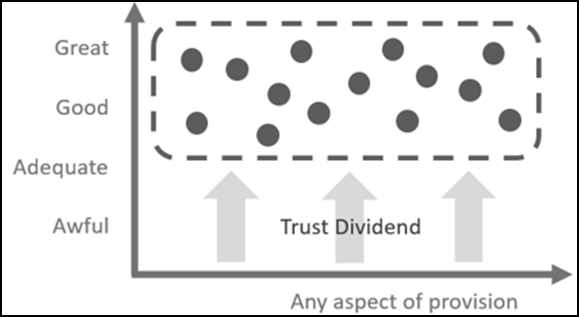
We have the capacity, expertise and high performance within our Trust to enable us to secure higher attainment in every year group and every school. We are relentless in helping those who fall behind to catch up and keep up, building greater self-belief and self-confidence. High attainment also supports strong progress, demonstrating the value and dividend that we add across the Trust. 

The Art of the Possible  

Our beliefs can limit what we see as possible. Too often, they protect us from the risks associated with striving for more.  We should engage ourselves and our teams in the art of the possible. We know that higher performance is achievable because it is already evident in several of our schools and teams. 
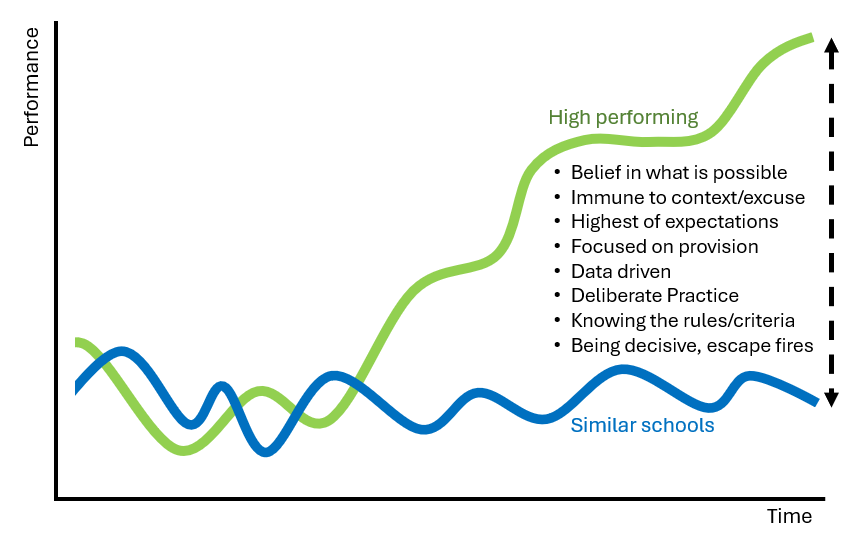
This year, we will continue to raise standards by believing that much more is possible, overcoming context and having the highest expectations of what all children can achieve. The strongest schools unswervingly secure high-quality provision, use assessment intelligently, invest in deliberate practice, know the rules and are brave enough to apply equity to close gaps. We do this because it is why we exist, where our expertise lies and what our children need. It is easier for us to write their next chapter than to rewrite their previous ones. 

Our investment in provision  

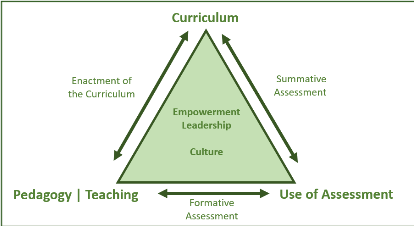
Our work across the Trust is guided by our school improvement triangle. Our significant investment in curriculum, assessment and pedagogy over time is central to our work, overseen by effective leadership and set within strong cultures. These are the main levers for high performance and the areas in which our investments have been made over time. It is the enactment of the curriculum and the use of formative assessment that unlock higher standards and raise attainment.
Performance-oriented Trusts, teams and schools understand when decisive action is required to change trajectories beyond those achieved through normal provision. Lighting escape fires and ‘doing different’ can achieve an alternative future and improve outcomes. 

We will also continue to assess the improvement journey of schools and teams against the forming, storming, norming and performing continuum. Most of our schools and teams across the Trust are norming or performing. The strongest schools continually evaluate their performance and refine the norms that sustain high performance and support further improvement. 

Performance-Oriented Inclusion  

We recognise that some children carry more than others, have had fewer opportunities and experiences in their early childhood and so need us more. They lack neither the ambition or ability, but they have less capacity, fewer resources and face barriers that tip the odds against them. In difficult times, education has the power to transform lives to gift the outcomes required to level up. The performance and development of these children are the most important measure of our worth. They should find their voice and become the central character in their story. 

Our strongest schools increase the life chances of under-resourced children by securing excellent provision with the highest expectations, applying equity to give children what they need and building a culture that closes gaps. Taken together, these approaches tip the odds in favour of disadvantaged children and become embedded in the school’s identityit is what they do. 


Trust Strategic Plan  

As we enter Year 2 of the Trust Strategic Plan, Building a High-Performing Trust, we recognise that it takes a whole organisation to create the platform (blue) that enables high performance (green). 
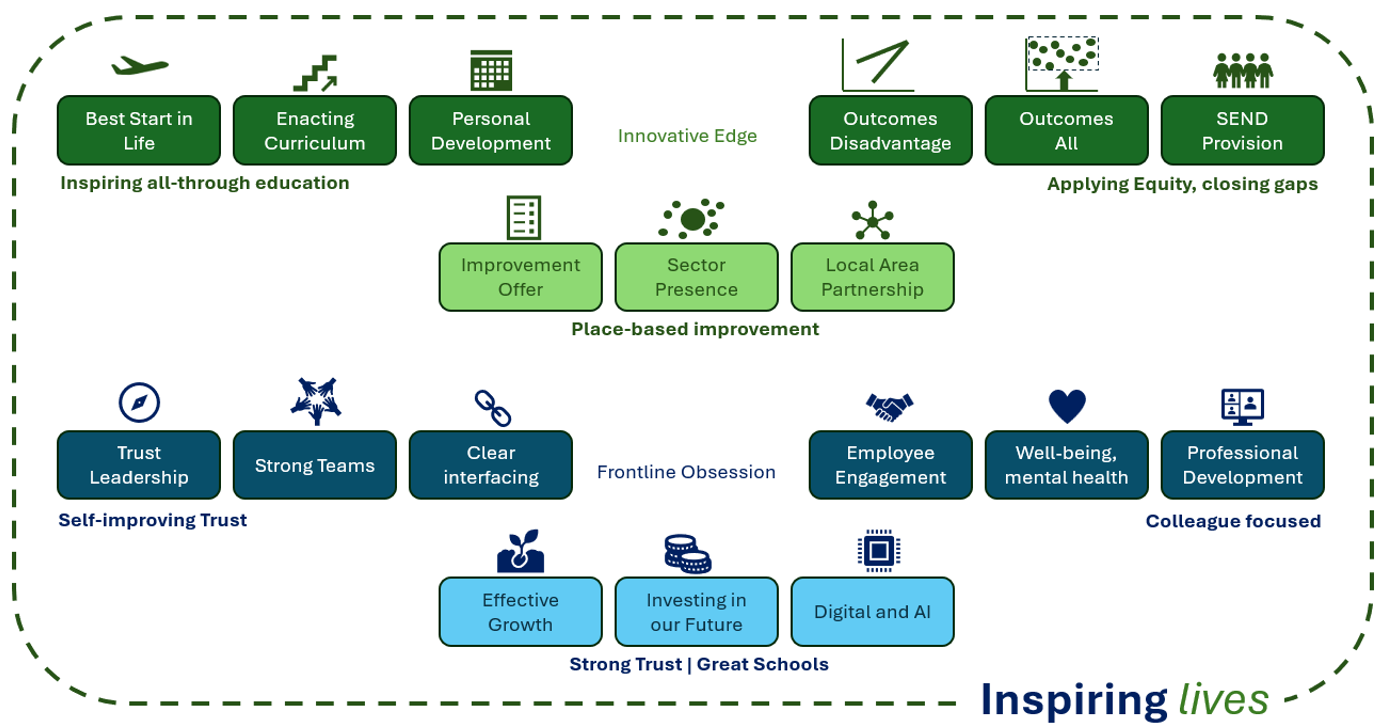
Inspiring All-Through Education | 570 Weeks 

We prioritise offering the best start in life for all children, focusing on the quality of provision in these early and formative years as a key lever in our disadvantage strategy. We seek to secure the best possible provision across the 570 weeks of education, enacting and teaching our shared curriculum and focusing on the effectiveness of our personal development curriculum for all children. 

Raising Standards | applying equity and closing gaps  
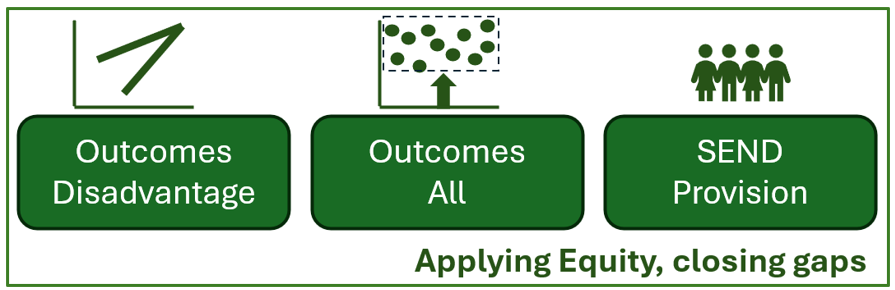
We raise attainment and secure progress in line with our ambition to be a performance-oriented Trust. We are passionate about outcomes for disadvantaged learners and need to continue to close gaps, gifting the keys to those who need us most. We exist to drive up attainment in each phase of education, seeking liberating outcomes for all children. In doing this, we will better meet the needs of all children with SEND.  

Standing Tall on our Platform  
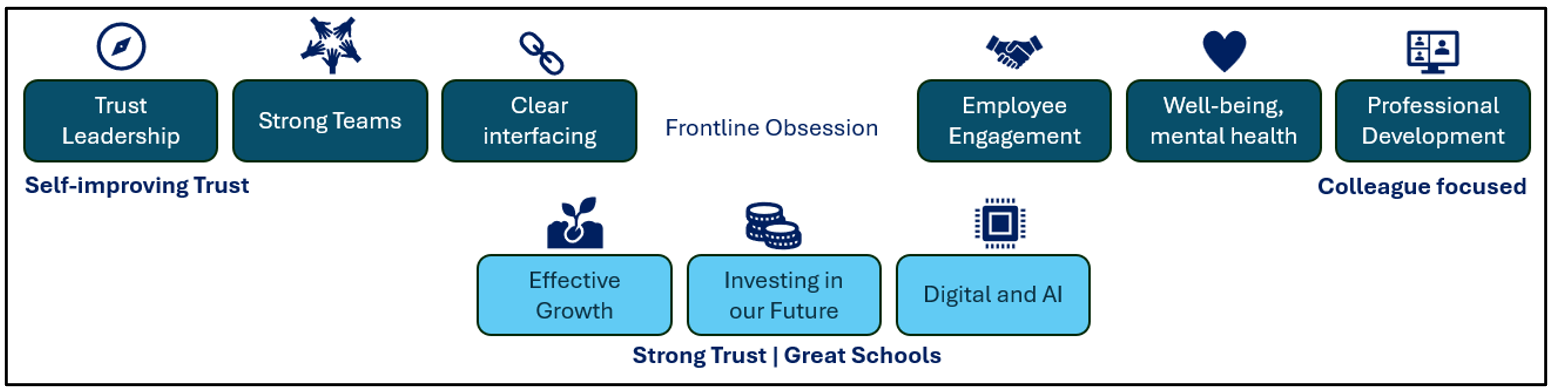
As a Trust, we continue to build the platform with the conditions, systems and support that colleagues and schools need to focus on the quality of education. We understand that our greatest asset is our colleagues and we will continue to invest in every colleague to ensure they are empowered and able to inspire lives. We maintain our focus on leadership and strong teams across the Trust as a key lever for improving performance and raising standards. We are committed to ensuring an efficient and effective platform, recognising the need to focus on the quality of communication and connection between key teams.  

We also focus on effective growth as the Trust grows to 40 schools and on using our strong financial position to invest in our future, including digital technology and responsible use of AI to improve the quality, efficiency and reach of our work. 


Writing the next chapter | pouring ourselves a cup of ambition 

As we venture into the second year of our plan, guided by our mission and values, we should proceed with confidence and greater self-belief, based on what has been achieved by the exceptional work of our colleagues. We will focus on being performance-oriented and raising standards by investing in our core purpose and provision, closing gaps and meeting the needs of those who need us most.

So go, inspire and create the next chapter for your colleagues and our children. Much of our work already advances our mission, yet there is still much to do. The next chapter must create great experiences and establish the conditions for every child to flourish. It is on us to secure the outcomes that will open more doors, build character and inspire children with greater opportunity and choice. 

You make the difference.  

Thank you.  


Dan Nicholls | September 2026 

Ethic of Excellence | CLF Conference

Slide1

The following supports the “ethic of excellence” workshop at the CLF Conference, 2 November 2015…


It is probably true that:

“Once a student sees that he or she is capable of excellence, that student is never quite the same. There is a new self-image, a new notion of possibility. There is an appetite for excellence.” (Ron Berger)

It is also probably true that where an ethic of excellence runs through teaching and learning a child’s progress is accelerated and they outperform their peers. This maybe the most important aspect for driving up standards, accelerating progress, securing unusually good outcomes and giving all children a new sense of possibility; enhancing their life chances for the long term.

The following reflects some of the best practices across the Federation and identifies the key aspects for securing an ethic of excellence in all classrooms…


Slide23

What if… an ethic of excellence is measurable and tangible? That it can be judged from a short triangulation of teaching, books and student voice…and that where teachers have a strong ethic of excellence this is likely to be reflective of strong habits and a personal commitment to excellence.

What if… the ethic of excellence is revealed in the attitude of children toward their learning – that low-level disruption is not a feature – it is, in fact, socially unacceptable to not engage and seek to make progress in lessons.

“What if I fail to be the prophecy?” (Peter Pan)

“What if you fail to try?” (Tiger Lily)

(from the film Pan, 2015)

What if… the ethic of excellence is sought through the way the teacher and others inspire and inject passion around content (subject or age related) and learning; using language and praise to reinforce the expectation of excellence. (praise is not cheap).

Slide3

What if… the ethic of excellence is supported by the challenge and stretch that is evident in lessons supports children to reach beyond what they can do now, expecting students to work in their top 10% excellence zone.

What if… the ethic of excellence is seen in the quality of work and books; showing an  an attention to detail in the…

  • care and precision of presentation
  • quality and depth of writing and working
  • continuity and progression in the work over time that reflects a layered curriculum

What if Ofsted are right and that some of the key evidence of an ethic of excellence is seen in books.

Slide2

What if… the ethic of excellence is shown in a focus on depth rather than breadth and in routinely re-doing and re-drafting; seeking excellence. That teaching uses deliberate practice to inform teaching, so that:

practice (is) intentional, aimed at improving performance, designed for (a student’s) current skill level, (aimed at excellence), combined with immediate feedback and repetitious.” (Malcolm Gladwell)
excellence

What if… children do not produce their best work often enough? It might be that although students are capable of excellence we rarely support students to produce their very best work and that much of the work produced falls in the bottom quartile of what is possible for that individual. It might be true then that the opportunity to enable students to see what is possible rarely happens as students simply tread water in the mediocre.

Slide1

What if… students skewed their work right toward excellence (and teaching prioritised and supported this) and not left where it probably sits at present?

skewed

What if… there is an ongoing and accessible record of a child’s best pieces of work so that there is an immediate benchmark to build from.

draft2

What if… the ethic of excellence is seen in the feedback that is built into tasks/lessons and is specifically targeted at securing concepts and unravelling mis-conceptions…expecting much and targeting specifically where chidden can improve?

feedback

What if… the ethic of excellence supported by assessment (all forms) that is a coherent element of teaching – formatively driving progress and improvement toward excellence? Using mastery to support all children to secure the foundations and core knowledge, skills and understanding that will allow them to be academically and personally successful in and beyond education.

What if… the ethic of excellence is supported where teachers are persistent, and unswerving in raising standards (pass marks etc.) and deliberate in lessons and over-time in catching-up and closing gaps for those students who fall behind?; making a discernible difference to those that fall behind. 

What if… the ethic of excellence is embedded through teacher passion, subject knowledge, pedagogical knowledge, exam or age-related understanding and an insightful understanding of concepts and mis-concepts that are the foundation for driving children toward excellence? This is also evident in the schemes of work – progression of lessons – and within the layered/spiralled/escalating curriculum. Avoiding the skimming of content and the shallow learning.

What if… the ethic of excellence is shown in questioning that immediately reveals the teachers desire to seek excellence, maintain a high bar and expect much from answers and discussion – expertly steering and intervening to maintain standards and encourage depth of pupil involvement? …the deliberate inclusion of explanation and modelling supports children in their quest for excellence.

What if… in seeking an ethic of excellence we borrowed much from Dan Coyle’s insights and establish the conditions for ignition, (moments that inspire an ignition of internal motivation) and provide the feedback of an expert coach from within tasks to breakdown tasks and specifically remove misconceptions and seek accelerated improvement.

“we are often taught that talent begins with genetic gifts – that the talented are effortlessly able to perform feats that the rest of us just dream of. This is false. Talent begins with brief powerful encounters that spark motivation (ignition) by linking your identity to a high performing person or group (or self image). This is called ignition, and it consists of a tiny, world shifting thought lighting up your unconscious mind: I could be them (or do that, or achieve that – in fact look at my best work… my near wins).” (Dan Coyle)

What if… the ethic of excellence was reinforced by teachers and others who have an  unswerving ambition for all children and expecting much from all children, every lesson.

What if… the ethic of excellence is reflected across the Academy in all that we do – in our day-to-day expectations? (from uniform to ‘finishing conversations’ to politeness).

What if… an ethic of excellence was allied to growth mindset that sets the conditions and ethos for a class, cohort or Academy to stretch for excellence? (Dweck)

“People with Growth Mindsets and who show GRIT achieve more when they engage in deliberative practice … it is this practice that achieve marginal gains (Steve Peters), inching toward excellence.”

What if… we focused more on the journey; on the “near win”?(Sarah Evans)

“The pursuit of mastery is an ever onward almost.” … “Grit is not just simple elbow-grease term for rugged persistence. It is an often invisible display of endurance that lets you stay in an uncomfortable place, work hard to improve upon a given interest, and do it again and again.”(Sarah Evans)

What if… the ethic of excellence is exemplified by the classroom environment that reflects learning, progress and supports excellence? Display is inspired, the walls are useful, all areas are tidy and reflective of excellence… boards (and IWB) reflect organised and logical presentation of information that is timely and focused on the key learning for the lesson?

What if… the ethic of excellence is seen in the routines that are shared and owned by all – they are systematic and reflects the desire to make progress and learn?


Maybe then…children would see that they are capable of excellence, that this would change them forever and raise their personal benchmark. They would have a new self-image, a new notion of possibility and an appetite for excellence. Maybe observation and education would value the outcome, the quality, the closeness to excellence and be less fixated on observed practice.

“If you’re going to do something, I believe, you should do it well. You should sweat over it and make sure it’s strong and accurate and beautiful and you should be proud of it” (Ron Berger)

Dan Nicholls

October 2015