Toward the future | inspiring lives

Our Mission

In the next phase we will strengthen our trust, deepen our connection and collaboration to add more value to each other and to all children. This is a venture in shared responsibility and joint endeavour to inspire lives with greater opportunity and choice. Succeeding in our mission:

Inspiring every child to flourish through an inclusive, all-through education that nurtures opportunity, equity, and agency for life.

A mission that ensures 11,000 children flourish and develop greater self-agency, becoming the masters of their fate. A worthy quest powered by 1,500 connected colleagues, empowered to do meaningful work.


For those that carry the most

We recognise that some children carry more than most, have had less opportunity and experiences in their early childhood and so need us more. They neither lack ambition or ability, but they have less capacity, fewer resources and face barriers that tip odds against them. In difficult times education has the power to transform lives, which is the business we are in. The performance and development of these children is the most important measure of our worth.

“We need equity in education, not equality. If someone can’t see straight because the world is falling in around them, we need to raise them up to clearer skies.” Poor, Katriona O’Sullivan


Anchored by our Values

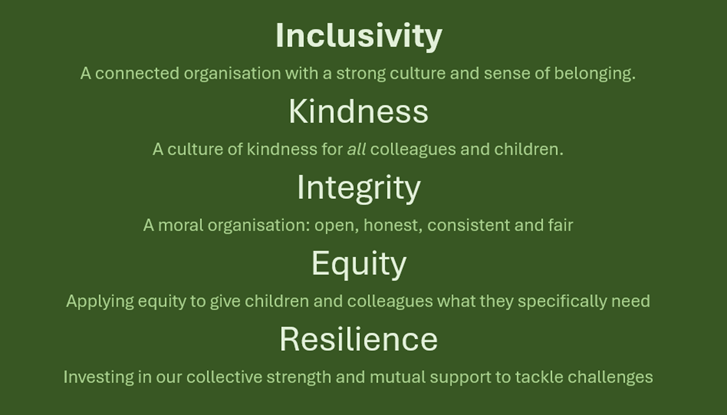
Everything we do is held by our shared values:

Our stable core enables our innovative edge

We continue to build a strong trust with great schools that focuses on getting every day right and building a stable core: consistently delivering high quality provision with effective systems and shared approaches, enables our frontline obsession.

We stand on our stable core and what we choose to do the same, so that we can innovate on the edge, expertly developing approaches to improve provision and inspire lives. This is a collective, connected and developmental endeavour through collaboration.


Towards 2030 | why we exist

To build a strong trust with great schools. Offering high quality education over 570-weeks that closes gaps for those that most need us. So that the trust exists in a higher performance space and exploits our collaborative advantage that yields a trust dividend.

Our focus on partnerships and places builds better communities for children to grow up in and flourish. Colleagues create greater opportunity through deliberate local and regional collaboration,seeking to improve other trusts and the sector.

The trust is deeply connected within itself. There is a strong collective desire and shared responsibility to add value for all children in every setting. This collaboration enables a level of innovation and shared approaches that add more value. As part of a human organisation colleagues are well connected, making a greater difference to others in and beyond our trust.

The consequence of our work over five years is that the trust becomes self-improving, the systems, shared approaches, trust improvement model, collaboration, horizontal leadership and empowerment is creating more value over time and is self-sustaining.

Colleagues enjoy more opportunity and are proud to do meaningful work that is enabling all children to flourish through an inclusive, all-through education that nurtures opportunity, equity, and agency for life


Higher performance space | in search of the trust dividend

There is an unswerving, shared responsibility and desire to raise standards. To build a strong trust and great schools that exist in a higher performance space that particularly enables disadvantaged learners to thrive and attain well.


So, where next… this year

In the next phase, to summer 2026 we will prioritise these six areas:
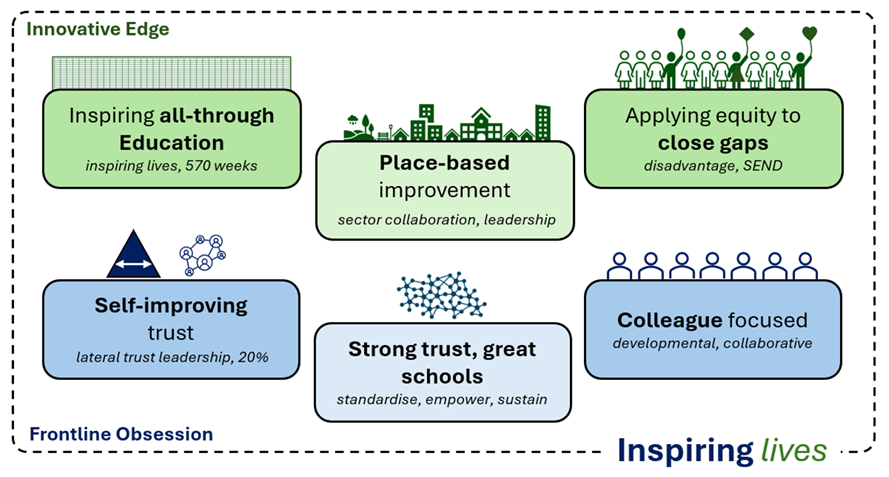
Innovative Edge | Inspiring lives

This year we will invest in our inclusive all-through education (570-weeks) and apply greater equity to close gaps for children that need us most. A focus on place-based improvement will build strong community partnerships and support improvement beyond our trust.

Stable Core | frontline obsession

We will continue to invest in our stable core, by building a strong trust that enables great schools. Our colleague focused strategy will invest in all colleagues and create the conditions for our frontline obsession. Aiming to create a self-improving trust, investing in lateral leadership, connection, collaboration and strong systems.


570 Weeks | inspiring all-through education

To build an inspiring, inclusive, all-through education: as an entitlement for all children. Enacting excellent provision for every child throughout their 570 weeks of education. Prioritising:

  • Trust Curriculum | curating and enacting a shared curriculum across all year groups. (SDP)
  • Attendance, inclusion and transitions | to secure stronger attendance, strong inclusion and high-quality transitions, disadvantage first. (SDP)
  • Best Start in life | investing in the strongest possible start for all children through nursery and early years, enabled through a set of core commitments. (SDP)
  • Outstanding Personal Development | outstanding personal development curriculum builds character and offers greater opportunity for all children in every setting.

Closing gaps | seeking social justice

To apply equity and unswervingly commit to meeting the needs of children experiencing disadvantage and SEND, securing attainment and attendance that closes gaps and builds agency for each child. Securing greater social justice by prioritising:

  • The trust-wide development of teaching | systematic focus on the development of teaching to enact our shared curriculum. Our strongest lever for closing gaps. (SDP)
  • Disadvantage first | unswerving focus on the performance of disadvantaged pupils, through targets, data and quality assurance, as the indicator of the quality of our provision. (SDP)
  • Catch-up, Keep-up | systematic tracking all learners and applying equity, doing different and more, so that all children are caught up and kept up. (SDP)
  • All leaders, leaders of SEND | developing our SEND provision, focusing on ‘all leaders as leaders of SEND’ – securing a systematic strategy to meet SEND needs.
The importance of place | community partnerships

To build partnerships with educational and community partners to secure stronger communities and 570-week educations for all children. Using expertise in the trust to reach out and secure improvement in schools, trusts and the sector. Growing our reputation and influence by prioritising:

  • Strong recruitment built on growing reputation | securing stronger recruitment of pupils into our schools to inspire more lives and better serve our communities.
  • Trust Growth | securing appropriate and strategic growth of the trust to secure financial opportunities and grow our reputation and influence.
  • Collaboration with local trusts, local authorities and partners | seeking strong collaboration to secure improvement beyond the trust – seeking to influence all 570-weeks
  • Sector reputation and influence | playing an active role beyond the trust, including with the DfE and other partners, to influence policy, improve other trusts and the sector.

Colleague focused | developmental and collaborative

Investing in all colleagues to be connected, to collaborate, develop and grow to lead and contribute toward the mission and feel empowered to do meaningful work. Prioritising:

  • Recruitment and Retention | building a strategy to recruit well and to attract and retain strong colleagues. Considering our approach to flexible working.
  • Professional Development | creating on-going opportunities for professional development, held in a curriculum. Developing, inspiring and creating more opportunities for colleagues.
  • Induction | investing in and building strong induction to support all colleagues to have the best possible start to their career in our trust.
  • Well-being and mental health strategy | securing approaches across the trust to support all colleagues with their well-being and mental health.

Strong Trust, Great Schools | standardise, empower, sustain

Ensuring that the trust improvement model offers the foundation for colleagues to lead great schools. Complicated systems well embedded across the trust to drive effectiveness and efficiency. Prioritising:

  • Deliberate enactment of the Trust Improvement Model (SIM) | developing our standardised approaches, enabling empowered areas and sustaining the model to secure improvement.
  • Financial stability and clarity | Ensuring the trust maintains the present financial security, secures wider responsibility and enables greater investment in the trust.
  • Professional Services | developing professional services, to strengthen platform, offer capacity, expertise and secure the environment to empower all colleagues to deliver the mission.
  • IT Strategy | ensuring colleagues and pupils have the tools they need to thrive now and in the future. Developing our digital vision and cloud-first approach. Exploring the opportunities of AI.

Towards a self-improving trust | lateral trust leadership

Creating the expectation and conditions for horizontal improvement across the trust. Connectivity and collaboration that are more effective and efficient at driving the School Improvement. Prioritising:

  • Trust Leadership Curriculum | investing in and enacting a trust leadership curriculum and to extend the sense of leadership curriculum through networks and the layers of the trust.
  • Networks and Subject Communities | connecting colleagues with purpose, formally and informally, to enable the development of strategies that raise standards.
  • Lateral leadership, 20% time | creating the expectation and the structure for colleagues to work beyond setting to support lateral leadership and secure a self-improving trust.
  • Succession Planning | investing in succession planning and talent management to ensure the future leadership security for our trust.

First Steps… into Term 1

And our first steps in Term 1 will see us deepen our connection and collaboration and prioritise:

  1. Understanding performance and setting the ambition and targets for 2026.
  2. High quality Induction and line management, starting out strong.
  3. Strong start and focus on Attendance, disadvantage first.
  4. Best Start in Life, embedding our core commitments.
  5. Enacting our shared curriculum.
  6. Focus on the development of teaching through Steplab.
  7. Embedding the new Planergy software in Finance.

We choose to venture on this journey to 2030 not because it is easy, but because it is hard, and because our ambition will serve to organise and measure the best of our energies and skills, because the challenge is one that we are willing to accept, one we are unwilling to postpone, and one which we intend to win (adapted, John F. Kennedy)

So, breathe, commit … and go inspire lives with greater opportunity and choice.

Thank you, you make a difference


Dan Nicholls | August 2025

This is not about you

You are not that important, but your influence on others and the future is.

The influence we have as leaders to trigger change in others is what matters. The proliferation of influence beyond ourselves, through a deliberate investment in other human beings, pays forward. It is through this investment that leaders influence greater numbers and further into the future. Ego-less, values-driven leadership that knows it is not about them, but about how they extend their reach and influence.

paying forward, through others, for the future

The strongest leaders invest disproportionately in relationships and interactions that very intentionally influences the leadership of others, far-sightedly. Quietly and deliberately seeking micro and macro investments in others, who are better able to make a greater difference over time. Whilst some acts of influence are seen and purposefully public, most are unseen, systematic and deliberately enacted. It is what they do: the hidden work of leadership.


 (very) Intentional acts of influence

Too often we are taken by bold, shout about acts of leadership that serve the individual. In contrast effective leaders deliberately invest over time, seeking greater value through others, to achieve a common good. This leadership is effortful, thoughtful and deliberate. It calculates expected value and acts to increase returns in the long term. The reverse is lazy, wasteful and short-termist; no friend to our ancestors.

be the ancestor that our future generations need

Leadership is the influence we have on others, those near and far, to make a difference now and next. Effective leaders seek to develop the mental models in others focused on how to lead and pay forward so that they deepen their influence. In creating these models in others we might create the quality of leadership that grows capacity and inspires more lives.


Relationships, ad infinitum

Leadership is relationships, ad infinitum. Our ability to connect, influence, enable, inspire and leave residual value in those we meet, in those we lead, permeates our influence in and through the lives of others. Leaders who give time, are present, give thought, experience, expertise and who purposefully invest through others, seed possibility beyond themselves.  As social beings we thrive on the belief others have in us.

“The relationships we build with each other provide the foundations of change. We are social beings who thrive on connections.” Sir Hamid Patel

Leaders are emotional catalysts, experts in motivation (and motivations). They energise, inspire, elevate and encourage commitment from others, unleashing our natural biases to belong and do meaningful work. This orchestration requires leaders to create the conditions, opportunities and choices for colleagues to lead with purpose and take responsibility, to make a difference.


Our sphere of influence | through who and how far?

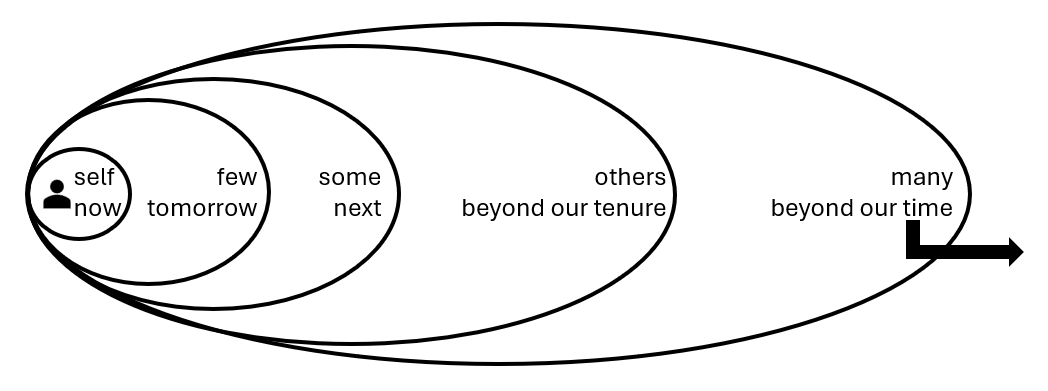
How far does your influence extend, to…

  • …self, a few, some, others, many?
    • …now, tomorrow, next, beyond your tenure, beyond your time?

    It is a choice. The emphasis of your priorities and how you use time, with who, will determine the impact and the reach of your leadership. It is both proximal and longitudinal. How far your leadership travels and how contagious it becomes determines legacy: in the trails you leave and open for others.

    We do not just leave trails we create new trails, tread lightly.

    Some leaders are fixated on now, today, tomorrow, getting through (and sometimes that is ok), others lift horizons and seek future returns, seeding the ground and deeply investing in others to change more and into the future. Your leadership is the sum of the actions taken by others, because of your leadership. Most of the impact of which will never be seen or known by you, paying forward.

    “Become the ancestor you’d like to thank.” Seth Godin


    Eco-systems and overstory I the theatre of leadership

    Effective leadership is hyper-aware of the peer and cultural codes that influence the motivation of humans within their ecosystem. Deliberate leadership is sensitive to these codes and acts to trigger ripple effects that take hold and add value.

    “…as tribal animals, we are bound to our peers, heroes, and ancestors … understanding ourselves as tribal helps us see the ripple effects of our actions.” Micheal Morris

    Effective leaders know that in this theatre their role is to enable the ecosystem to thrive, enhancing symbiotic relationships and connections that see beyond survival, toward something worthy. Knowing that their worth is measured in the health of all parts of the ecosystem and after their time.

    Each ecosystem has an overstory, a canopy that guides and shapes norms, decisions, actions, language that create or subtract value. People like us (here) do things like this. The stories we tell, the destinations we describe influences the ecosystem, and the effectiveness of leadership. Leaders…

    “…tend to forget about the overstory because we’re so focused on the life going on in front of and around us. But overstories turn out to be really, really powerful. The overstory is specific. It is tied to a place. It is powerful. It shapes behaviour. And it does not emerge out of nowhere. It happens for a reason…” Malcolm Gladwell.

    To pay forward, with intent, through others, requires leaders to calculate the expected value of their influence through others into the future. To do so requires an understanding of the ecosystem, motivation, peer codes, the overstory… a study of how social costs and cultural codes shape the decisions and actions of others overtime.


    Our landscape | Far-sighted leaders required

    “Our challenge is to ‘build’ the future society we (they) wish to see. This has implications for the curriculum, partnerships and school communities we develop.” Sir Hamid Patel

    The petri dish that is our sector is growing and maturing, the cultures are separate and largely in survival or winning mode. The future, however, is not about successful individuals or individual organisations. It is in the collective leadership and the networks we grow, that influences the sector, through others, that just might generate the capacity to reach all children.

    “…humankind gains enormous power by building large networks of co-operation, but the way these networks are built predisposes us to use the power unwisely. Our problem, then, is a network problem.” Yuval Noah Harari

    It is leadership that builds capacity through networks and deeper collaboration that will determine our stewardship of the future. The future starts with us, in our understanding of why we exist, how far we wish to lift and enable others, close to us, far from us, now and way into the future.

    What if the challenges we face as a sector are, in large part, a leadership challenge, and we are coming up short?


    Catch-up mode

    Our worth is seen in our influence on the lives of others. Our choices and priorities determine the difference that we make not just now, but next. We need to influence others in a way that will travel into the future, beyond our time. Leadership that propagates and adds value, ever-onward. Paying forward, through others, into the future.

    And yet our leadership is in catch-up mode, a feature reflected in the immaturity of our sector. There is much to do, but we have what we need and importantly the permission and obligation to lead more effectively. This weighty responsibility requires us to use our power well and to transfer and pass it through others to multiply and maximise our influence.

    In catch-up mode we must re-imagine what educational leadership is, their future depends on it. Our leadership must be more potent, generative and farsighted so that we do better than now, much better. Or else, we will not reach those children scrabbling for a foot hold on the fringes of education. Our present leadership paradigm does not generate enough capacity to do so.

    It is time to elevate the conversation, align our actions with our rhetoric and deliver far stronger leadership across the sector. We have far more influence than we are willing to admit. But there is hope, leadership that pays forward, through others, for the future just might generatively add the value, tip the balance for those who need us most, the ones we know and the ones we will not know.

    For the sun is shining on us now.

    …it is about your leadership


    Dan Nicholls | December 2024

    The world is getting darker | bringing light to those who need it most

    “Of course, poverty isn’t the only way in which people get overlooked by society; there are many ways that the world has of saying, “you don’t belong here.” …  I wanted to say, “yes, you DO belong. We all belong here.” (Tom Percival, 2022, from “The Invisible”)

    Our world is getting darker. In the enveloping gloom, individual children are becoming invisible, trapped by circumstance. We urgently need to wield our collective power and throw light on those who are fading. If we choose to work in education, and we do, then we also choose to make a difference to the lives of all children. And if it is about all children then we are compelled, through our shared duty of care, to tackle the eye-watering and widening inequality. Together we must secure far greater equity through education, giving individuals what they specifically need and seeking to close the growing chasm between those that have and those that have not.

    It is already too dark, for too many: the cost-of-living crisis, fuel, inflation, pandemic, political uncertainty, instability, conflict, the education system… has disenfranchised and exacerbated hopelessness. Everywhere you look in education the gap is widening. Whilst advantaged children and families have some (much) immunity, the world is forcing disadvantaged children and families to re-prioritise and step further back. This is cumulatively, and seemingly irreversibly, eroding status, belonging and undermining esteem.

    Over 4 million children, and rising, are growing up in poverty. Everywhere, families are struggling to meet their basic needs, forcing education and wider experiences to be inaccessible, unaffordable (in time and money). Securing the basic needs overwhelms, gradually removing the colour and slowly, intractably dissolving individuals who are ever more invisible in our world; hidden in plain sight.

    ”(Our) focus on (eye)sight means that we often are at a loss on how to deal with things that are invisible… and it works against us when it’s … invisible over time (like disadvantage). When there’s a conflict between what we know and what we see, we often default to the wrong one.” (Seth Godin)

    As educators, we are, for many children, the only second chance, but we are evidently not yet meeting that challenge. There is a heartbreakingly large number of individuals fading within our society and in our schools. But it is not hopeless, we should take heart, because we have what we need. We can create the conditions that offer hope, build status, esteem and agency; empowering children to become more visible. Ensuring that those experiencing disadvantage, are given the opportunities and experiences to be the masters of their fate and captains of their soul. (William Henley)

    Together we are obligated to tackle this invisibility and empower the marginalised, at a time when we are also distracted by these darkening times. Our collective endeavour, is to use education to illuminate and bring more colour, to more lives. It is through our leadership and in teams, that we can unswervingly focus on our best levers, teaching and culture to bring light to this darkness and to say, “yes, you do belong.”

    The following explores the key bets for securing greater equity through education for presently disadvantaged children. Whilst far from exhaustive, they seek to stop children from fading and becoming invisible.

    This builds on What if we are the hope? | Closing the gap curriculum as the lever  


    Disadvantage even over attendance first (culture)

    “One measure of poverty is how little you have. Another is how difficult you find it to take advantage of what others try to give you.” (Michael Lewis)

    One way to guarantee the invisibility is to accept poor attendance, everyday a disadvantaged learner is not in school the gap grows. It takes a whole school to improve attendance, because it is a team sport, with an individual focus. Seeking preventative strategies based on really knowing our individual children and families, as well as our responsive actions, reaches out and encourages/expects attendance. We must commit to persistently and insistently working to remove barriers to attendance. So that we, meet them there, apply equity, ensure that they are pushed and pulled to school, resisting the forces that encourage retreat.

    It is not good enough to just have good provision, we must support individuals to be present, visible and to take advantage. This is, of course, tightly linked to the quality of education, no one actively misses high quality provision, or the best party in town. Disadvantage attendance is the one measure that can be chased and improved every day; and every day counts when we tackle invisibility.

    Measure what we care about (Leadership)

    “You should measure things you care about. If you’re not measuring, you don’t care and you don’t know.” (Steve Howard)

    Not measuring what matters adds another layer of invisibility. Measuring what matters focuses our accountability systems and our attention towards enacting the level and depth of equity required to make a difference. Giving permission and incentivising colleagues to chase what is worth having; giving children what they specifically, individually need.

    “This is Vanity Fair a world where everyone is striving for what is not worth having.” (William Thackery)

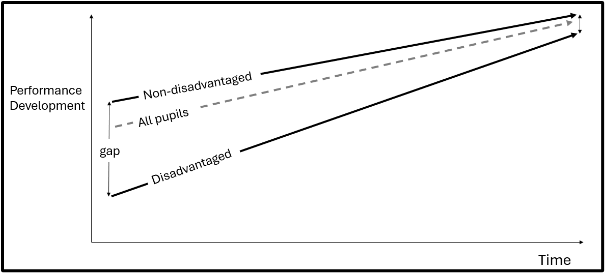
    The early advantage, linguistic privilege and supported opportunity that advantaged children enjoy, accumulates success, regardless and sometimes in spite of school. With less early advantage, disadvantaged learners need schools to be excellent, only then will provision reach and achieve the equity required to accumulate advantage. It is the attainment of disadvantaged learners, even over, that is the best measure of the effectiveness of provision. How far a school or Trust achieves attainment mobility and closes gaps to be in line with advantaged learners is the barometer of the quality of provision.

    “Making good use of school time is the single most egalitarian function the schools perform, because for disadvantaged children, school time is the only academic learning time, whereas advantaged students can learn a lot outside of school.” (Hirsch)


    Keeping the Main Thing the Main Thing (Teaching)

    “Teaching quality is important. It is arguably the greatest lever at our disposal for improving the life chances of the young people in our care, particularly for those from disadvantaged backgrounds.” (Peps McCrea, 2016)

    The quality of education, particularly teaching, and the culture of schools are the main things for securing equity and growing great humans, with the agency needed to exploit their future. This is the bet, consistently applied, over the 12,000 lessons and the 15,000 hours they are in school (age 4 to 16), that will reverse delayed attainment, linguistic under-privilege and accumulate advantage.

    Disadvantage learners disproportionately thrive when teaching is strong. When it is weak, advantaged learners still make sense of it, whilst disadvantage learners fall even further behind.  When teaching is purposeful, precise and where language and explanation includes and does not exclude learners, disadvantage learners make more progress. Where expectations remain high and where we scaffold to fill gaps in understanding, spiralling and bouncing back and forth in the curriculum we secure a narrative that has the footholds, ropes and ladders for disadvantaged learners. We need to avoid presumptions of language, background knowledge and self-efficacy (Marc Rowland). Of course, disadvantage learners really need us to follow learning to meet need, to explain clearly and well, model expertly and to engage in explanation; making learning explicit, coherent and accessible.

    Viewing teaching through the disadvantaged lens forces us to really explore, know and understand where learners are, find out what they know, what they don’t know and teach the next bit (Asubel). Whilst knowledge is power, it is understanding and application of knowledge that is king. The mind best understands facts when they are woven into a conceptual fabric, such as a narrative, mental map, or intuitive theory. Disconnected facts in the mind are like unlinked pages on the Web: they might as well not exist (Stephen Pinker). Teaching that deeply understands subject, the substantive concepts, its architecture, offers the best route map for disadvantage learners; it weaves nets.

    Weaving curriculum nets (Teaching)

    Decisions about what knowledge to teach is an exercise of power and therefore a weighty ethical responsibility. What we choose to teach confers or denies power (Christine Counsell). There is nothing more important for disadvantaged learners than a well sequenced, conceptually coherent curriculum that efficiently, and intentionally enacts the best of what has been thought and said. If the curriculum is overloaded, disconnected, full of arbitrary knowledge we will not be weaving conceptual nets and much will slip through as unresolved cognitive conflict. It is the progressive and precise sequence, coherence and clarity that disadvantaged learners really need.

    When we teach out of sequence, disadvantage learners assume that they do not understand, and this encourages further retreat and desk top truancy. Really, deeply thinking about why this, why now is so important – we often seek to cover too much, to move on too quickly and to be activity/task driven, instead of securing the conceptual spine that, once in place, will hold and accelerate future learning. Disadvantage learners need us to really know our subject and the progression, they neither have the time or the wider schema to make sense and find their way through the arbitrary or the ill-sequenced. Curriculum is arguably the most important lever that we have, it is further developed here: Closing the gap curriculum as the lever 

    Vocabulary | give the keys of language (Teaching)

    “Education is the process of preparing us for the big world and the big world has big words. The more big words I know, the better I will survive in it. Because there are hundreds of thousands of big words in English, I cannot learn them all. But this does not mean that I shouldn’t try to learn some.” (David Crystal)

    Big words, for a big world. Vocabulary gifts the keys of language, the basis for deeper understanding, but even more importantly gives access to culture, enfranchises and privileges learners. Being vocabulary-poor disenfranchises and excludes, it takes the colour away. Teaching (exploring, marvelling at) words in context, in subjects, connected to big ideas and concepts makes children feel clever, builds esteem and, most importantly, the words are stickier in schema.

    “The large amount of school time spent in direct word study is not being spent on systemically becoming familiar with new knowledge domains, where word learning occurs naturally, and up to four times faster, without effort.” (Hirsch, 2017)

    It is a feature of growing up in an advantaged home that words become jewels in conversations. And it is the etymology and structure of words that really intrigue and make individuals feel clever. Gifting a wealth of words to children, unlocks doors into the past, into interesting places and times, uncovering provenance, quirky connections and ; Joy filled learning.

    By paying attention to vocabulary growth at the micro level, we can better understand it, we can go to cultivating it and in so doing every child will be gifted a wealth of words.” (Alex Quigley, 2018)

    Oracy | valuing everyone’s voice (Teaching)

    “It may seem an obvious thing to say, but one of the best things we can do with young children is to have interesting and enjoyable conversations with them.” (Michael Rosen)

    Oracy exposes language, vocabulary, thought, cultural capital and understanding to all. Our sentences and words open the window to our understanding and how individuals navigate the world. Disadvantaged learners need full immersion in rich conversation, be given permission to listen, encouragement to be heard and the safety to articulate understanding out loud. In doing so they fire the connections, build word wealth and secure schema that grows confidence, cognition and enables musing and exploration. It is why we should be picky on full response, why we should provoke and encourage discussion and debate. It is also on this sea of talk that great writing happens. We need to articulate our ideas and thoughts, our opinions and cogitations to bring colour to learning, to revel in thinking and for individuals to find their voice.

    “If we are truly committed to empowering every young person regardless of their background, with the belief that their voice has value and the ability to articulate their thoughts so others will listen, then it is time to get talking in class.” (Beccy Earnshaw)

    Reading | opening eyes to multiple worlds (Teaching)

    “The more that you read, the more things you will know. The more that you learn, the more places you’ll go.” (Dr Seuss)

    Reading and the development of reading is fundamental for accumulating advantage. It is hard to over-state the importance of reading: it develops cultural capital, comprehension, vocabulary, thinking, empathy, inference, confidence, concentration, oracy, writing, esteem… all the ingredients required to achieve attainment mobility. Alex Quigley offers this helpful summary on developing reading:

    • Start with careful planning a broad and balanced curriculum that brings a world of knowledge alive.
    • Ensure pupils do lots and lots of reading of challenging texts.
    • Support pupils to develop, connect and cohere their knowledge.
    • Give pupils targeted, text sensitive support to deploy reading comprehension strategies, with a gradual release of responsibility.
    • Avoid over-practising comprehension assessments that can compromise curriculum time for read extended texts. (Alex Quigley, 2022)

    More than any other subject, English – and especially reading – gives pupils access to the rest of the curriculum and is fundamental to their educational success. (Ofsted, English Research Review, 2022)

    Hunt don’t fish (Teaching)

    “Fair doesn’t mean giving every child the same thing, it means giving every child what they need.” (Rick Lavoie)

    We are pre-programmed in education to seek equality, which in most areas of life is essential. But disadvantaged learners need more than equality, they need equity, they need what they need, not what everyone needs. This ensures that we privilege and prioritise the needs of disadvantage learners – to know exactly where they are and give them what they need – and to do that we need to hunt not fish. To fish is to cast the net and do the same for all (privileging advantaged) to hunt is to seek to meet the individual needs (privileging disadvantage).


    Advantaged childhood; one of high-demand and expectations (Culture)

    Sit up at the table, elbows, don’t talk with your mouth full, use the right tense, sit up, can you rephrase that, do you know where that word comes from, you know that links to this and what we saw there, finish all of that, put you knife and fork together, dry-up, put away, finish your homework, when is your tutoring, tidy your room, what time is training? have you got your violin out for tomorrow? do you need a new reading book? what time do I pick you up from rehearsal? we are going to the theatre on Saturday after hockey, have you applied for that part time job?….

    To grow up advantaged, is to experience the constant drip of expectation, self-fulfilling and accumulating advantage over time. The shaping, informing, correcting, pickiness, opportunity laden, supported experiences add up to add advantage that presents to adults as innate ability, even talent. Those experiencing disadvantage (only an economic label) have had fewer opportunities, less education and guided experiences, which slows progress, accumulates disadvantage and presents as less able (less talented) and once this sets-in, it holds on through life. This perpetuates the opposite of a virtuous circle, a vicious circle, where we consistently over time (perhaps subconsciously) expect less of those with delayed attainment and increase the gap. Disadvantage is a process (born out of circumstance(s)), it is not an event (Marc Rowland).

    Our job is not to collude with circumstance, but to maintain high expectations, understanding that if we let them off, we let them down. We must avoid deficit discourse, assumptions of innate talent and loose language that reinforces, often unintentionally, disadvantage. When we see delayed attainment, we acknowledge that nothing fundamental can stop attainment mobility or the closing of gaps, except, of course, if we fail to advantage those presently experiencing disadvantage.  

    Give Status (Culture)

    “It is difficult for us to realise how much information is socially transmitted, because the amount is staggering and the process is largely transparent.” (Pascal Boyer, 2018)

    As individuals, we have an un-ending well of status to give to colleagues and to children. The opportunity to give status is a fundamental human gift to others. To give status is to be interested in every child, who they are, what they are doing, smiling, acknowledging, encouraging, noticing, being present. It costs us nothing, is a measure of our shared values and plays out in every interaction.

    “…feeling deprived of status is a major source of anxiety and depression. When life is a game we’re losing, we hurt. …status is a resource as real as oxygen or water. When we lose it, we break.” (Will Storr, 2021)

    Given that we measure our status against those with whom we spend time, our classrooms are crucibles of comparative status. Our classroom cultures must level status upwards and not inadvertently reinforce disadvantage or status based on early advantage and current attainment.

    “We can’t help leaking expectations, through our gazes, our body language and our voices. My expectations about you define my attitude towards you.” (Rutger Bregman)

    Build belonging, distribute esteem (Culture)

    It may not appear obvious, but schools are the most trusted, resourced and the most able to tackle inequality and to combat the growing darkness in our communities. Our superpower is education and that is where we can shine the light and support children to find colour, to belong.

    “To feel a sense of belonging is to feel accepted, to feel seen and to feel included by a group of people… to not feel belonging is to experience the precarious and insecure sense of an outsider.” (Owen Eastwood, 2021)

    How then, do we create belonging in our language, values, artefacts, behaviours, routines in schools to say to all children that they belong. To what extent do we see the development of culture in schools as a curriculum to be taught and enacted, not left to social forces? This seeks to create an empowering and ordered culture to enable psychological safety, creating the climate to tackle disadvantage.

    The development of shared language and lexicon is a purposeful activity that understands that some words, phrases and attitudes reduce status and belonging (often unconsciously). We must select, develop and reinforce an empowering language to enable individuals to belong, feel safe and be able to prioritise learning.

    In this decade, with the inevitable challenges, our duty of care to the children we educate is to build their self-esteem, so that children have purpose, dignity and feel the glow of accomplishment. A marker of our success will be the extent to which we are able to distribute and redistribute esteem.

    “…we need a redistribution of esteem… to live lives of decency and dignity, winning social esteem. …we can travel the road to 2045 with purpose, dignity and accomplishment.” (Peter Hennessy, 2022)


    In the dark there is light (Team)

    “How a society treats its most vulnerable is always the measure of its humanity.” (Matthew Rycroft)

    Whilst it is darker and ever gloomier, we should remain optimistic and empowered. Those who are presently disadvantaged depend on us, we are their greatest hope, their best second chance. We do, however, need to actively choose to care, to privilege and to apply equity through education. To measure what matters, drive up attendance, focus on the main things, invest in curriculum, teaching, vocabulary, oracy, culture. To have high expectations, to give status, create belonging and systematically build esteem.

    This is our duty of care, it is what matters, it is why you are here. Go forth, build a coalition, a movement within your schools, across schools and across Trusts, for communities, within our regions. A movement that seeks to bring light to those who need it, to support children who are fading, to build the colour back in and to make sure every child has a fair chance, so we can say, “yes, you DO belong. We all belong here.”  

    “We are bound by a sense of shared belonging and collective responsibility; about strong local communities, active citizens and the devolution of responsibility. …ensuring that everyone has a fair chance to make the most of their capacities and their lives.” (Jonathan Sacks, 2020)


    Dan Nicholls | October 2022

    Thinking and content heavily influenced by colleagues within Cabot Learning Federation

    Outstanding Meetings | How groups drive improvement

    “Right at the heart of what makes humans unique is their social interaction and most importantly empathy… we are hardwired to connect social interaction with survival and that no connection can be more powerful; this is deep in our nature.” (Geoff Colvin, 2015)

    It is probably true.. that we spend a significant amount of time in meetings and yet they vary greatly in terms of their impact. The way groups interact, their culture, structure, quality of interaction, expectations and the groupthink dynamics mean that meetings can be prone to encouraging poor decisions, wasting precious time, limiting progress and not delivering the ambition of the people attending.

    and.. we are prone to accepting the norm and becoming conditioned to how meetings run  and teams interact in our organisation.

    Jobs-quote

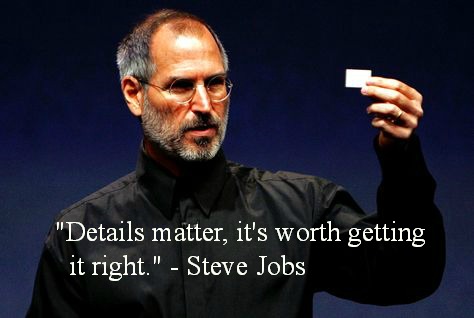
    It is also probably true.. that there are some excellent teams who squeeze the very best out of their precious meeting time, planning and executing team/group interaction to ensure high impact that secures improvement. It is also probably true.. that highly effective groups, teams and meetings do not happen by chance – they are highly engineered, developed over-time and are based on a set of key principles that need to be developed…because details matter, it’s worth getting it right.


    Which begs the question.. what are the key aspects of effective meetings/groups? How do we nudge and develop the quality of social interaction within groups/teams so that they deliver purposeful collaboration and drive improvement? In short, how do effective teams and groups collaborate to secure high performance and accelerate improvement?

    (How do your meetings rate against the checklist in the Maybe then… section?)


    What if.. we remembered why face-to-face meetings are so important to our culture and that they should be seen as an important vehicle for adding significant value over time and drive improvement? Seeking groups and working in teams is hard-wired into our brains – it taps deep into what makes us human and is far superior to electronic connection and phone conversations – are most important advances typically happen in person and in groups.

    “…the number one factor in making a groups effective is (the depth of) human interaction. Social skills are the most important factor in group effectiveness because they encourage … “ideas flow” …how good the group members are at harvesting ideas from all of the participants and eliciting reactions to each new one.” (Colvin, 2015)

    What if.. we understood that this is a workload issue. Efficient, effective, meaningful meetings reduce workload and use time efficiently to focus on the key priorities that will most benefit the team/organisation?

    What if.. it is all in the preparation. Given that meetings use high amounts of collective time and significant sums of money, the planning and preparation should seek to maximise the effectiveness and efficiency of meetings? What if..

    • The agenda is published at least 48 hours prior to the meeting (7 days perhaps)?
    • The agenda is timed so that each item is given a clearly defined slot?
    • It is really not ok to not read pre-released materials prior to a meeting?

    What if.. leaders take time to clarify each item and each person’s contribution to the meeting. Securing the key decisions to be made, considering the key questions and likely actions for each part of the agenda? What if.. leaders cancelled items where members have not prepared thoroughly or where the meeting will not add to the item or secure improvement in-line with the organisational aims?

    What if.. there is a strategic focus for meetings. So that the focus is on the Why and a bit of the How, but largely avoids the What, which is to be owned and developed outside of the meeting and closer to the action? (Sinek and Maquett) (Interestingly: Different voices are heard in meetings depending on whether the discussion is on the Why, the How or the What.)

    the-golden-circle

    What if.. the actions identified in the previous meeting are always reviewed with the expectation that these would have been addressed (what if.. leaders did not let people off the hook for their actions) – What if.. this secured a motivating level of accountability to the group?

    What if.. the leader/chair secured an appropriate level of urgency and drive to the meeting to reinforce its importance and reflect that time is precious. What if.. leaders took responsibility to reflect and improve the quality of meetings and team interactions?

    What if.. we were committed to and are tenacious in keeping to the the pre-agreed timings – limiting discussion where required? What if.. groups were made to stick to the agenda and not go off on tangents?

    What if.. we were aware of the dangers of groupthink? (taken from Sunstein and Hastie’s book Wiser (2015)) In particular..

    • Groups often amplify, rather than correct, individual errors in judgement.
    • Groups fall victim to cascade effects, as members follow what others say or do.
    • Groups become polarized, adopting more extreme positions than the ones they began with.
    • Groups can emphasise what everybody knows instead of focusing on critical information that only a few people know.

    “Most managers are exceedingly busy…it is tempting for them to prefer employees who offer upbeat projections and whose essential message is that there is no need to worry (Happy Talk). Employees…(can be) reluctant to provide their bosses with bad news. No one likes to be anxious or spread anxiety, especially to those who have power over them.(Cosy Club)” (Sunstein and Hastie, in Wiser, 2015)

    What if.. groups can be prone to “Happy Talk” – where it is easier for members to support the growing concensus and say things that will keep the leader/chair happy? … and feed the Cosy Club?

    What if.. we are vulnerable to being pursuaded more by how an idea is delivered as opposed to the merits of the idea. What if.. we are knowingly or un-knowingly bias towards other members of the group and to their ideas – what if we reinforce this bias by finding the good in what our favoured people say and ignore the weaker parts?

    What if.. meetings become hijacked by professional (and forceful) opinion givers and persuaders – more interested in serving their own ego than the overall good of the group?

    “Conversational turn taking also made a big difference; groups dominated by a few talkers were less effective than those in which members took more equal turns.” (Colvin , 2015)

    What if.. “social skills were the most important factor in group effectiveness because they encourage those patterns of “idea flow”. (Colvin, 2015) What if.. group performance depends upon how good the group members are at harvesting ideas from all participants and eliciting reactions to each new one.

    What if.. the meetings are dominated by one or a few individuals? What if.. decisions are normally aligned to the bossiest individual? What if.. any benefit of groupthinking is removed by a dominant participant; essentially limiting the quality of output to the quality of that person?

    What if.. Leaders strategically self-silenced themselves?

    “…leaders and high status members can do the group a big service by indicating their willingness and their desire to hear uniquely held information…Leaders can also refuse to state a firm view from the outset and in that way all space for more information to emerge.”(Sunstein and Hastie, 2015)

    What if.. all members of the meeting are obliged to provide a perspective (that self-silencing is actively discouraged)- so that the group can benefit from the widest viewpoint? This supports groups to benefit from insider-outsider viewpoints and reduces organisational blindness (Tett, 2015). What if.. the leaders actively brought individuals into discussions?

    “If the group encourages disclosure of information – even if information opposes the group’s inclination – the self-silencing will be reduced significantly.” (Sunstein and Hastie, 2015)

    What if.. it is not ok to be a bystander. What if.. “self-silencing” happens where the culture is not conducive to a range of ideas or is dominated by a few?

    What if.. success is a majority agreement not full concesus – to provide the safety and support for divergent and opposing viewpoints to exist? What if.. we openly welcomed and rewarded opposing views and ideas?

    What if.. silence was taken to mean that individuals agree with the item and that where they disagree or require further information that this is indicated at the time?

    What if.. Adam Grant is right the most successful groups use a “giver culture“…helping others, sharing knowledge, offering mentoring, and making connections without expecting anything in return.” And perhaps this is the basis for the high collegiate, low ego culture required in meetings and teams to drive-up group success and organisational improvement?

    What if.. group effectiveness depends on building up social capital of the team? (avoiding the dangers posed by Cosy Clubs) Colvin (2015) provides a good example of Steve Jobs who kept together the six top executives for 13 years until he stepped down as CEO of Apple in 2011.

    What if.. we championed and rewarded divergent thinking so that when appropriate groups generated a large number of ideas in short contributions from all members of the group – seeking and promoting individual viewpoints. What if.. we actively dispatched and brought in outsiders to provide an insider-outsider viewpoint (Tett, 2015)

    leaders are choice architects; determining the environment in which noticed and un-noticed features influence the decisions groups make. Leaders have the ability to influence behaviours and use “nudges” to influence individual and group behaviour. (influenced from, Thaler and Sunstein, 2008)

    What if… the art of leadership and leading change is in the ability to priortise what is important and to stay on track? What if… meetings and groups discussion sought to prioritise, asking…

    “…what’s the ONE Thing you can do such that by doing it everything else will be easier or unnecessary?” (Gary Keller)

    What if.. active listening is expected from all… and this meant eye-contact and small gestures to acknowledge the developing contributions. What if.. this meant all members were active note takers and (as reflected in research)…

    “…engage…in ‘deep interactions,’  with group members constantly alternating between advancing their own ideas and responding to contributions of others with “good”,”right”, “what?”and other super-short comments that signaled concensus on ideas value, good or bad.” (Colvin, 2015)

    What if.. we run scenarios of the future based on the decisions made by the group. What if.. these were considered in terms of possible and probable futures? What if.. we exercised high levels of empathy..changed perspective..and spent enough time thinking about how decision will be receieved by stakeholders and the likely level of adoption?

    What if… we use roles to draw all into discussion and debate. Devil’s advocate, Black Hat (Thinking Hats approach) or set-up red teams, who construct a case against the proposed idea, change to test the quality and sustainability of a strategy or change. What if.. we tested whether each proposed change is likely to be there and sustaining improvement in 3 years time?

    What if.. we realised the importance of execution and that we need to invest time in meetings ensuring that the execution of actions is fully timed, owned, evolved and reviewed?

    Slide2

    What if.. we ask “end of spectrum” questions to provoke debate, creativity and innovation?

    • If our lives depended on it what would we do?
    • If we were a new leadership team in this organisation what would we do?
    • If we had all the time and money we required what would we do?
    • If you had to argue against this course of action – what case would you build?
    • Are we answering the right question?

    What if.. we use data to inform decisions – hard and soft information that allows for Black Box Thinking (Syed, 2015) and brings a key reality to the decision making and to measuring impact.

    “Nothing seems to inject reality into a discussuin and banish wishful thinking and biased speculations as well as empirical evidence, especially in the form of data and numbers.” (Sunstein and Hastie, 2015)

    What if.. the power of questioning creates better meetings and better decisions? … As Barber highlights…

    “…our perception of what is possible is obstructed by historic assumptions about what is possible – they stop us considering game-changing innovations. Clever questioning has the ability to unlock possibilities previously not considered. Barber sets high targets to support ambition, urgency and to force a wide consideration of options. To drive change there needs to be a strict focus – “delivery never sleeps” (influenced by Michael Barber, 2015)


    ALSO What if…

    • … it is not ok to allow the agenda to fill the time available – finishing an effective and efficient meeting early is a good thing.
    • … the expectation is that everyone is 5 minutes early to every meeting…(what if members are not allowed to attend after the start?)
    • … the chair was decisive and assured in maintaining both quality, timing and the momentum of the meeting?
    • … Steve Jobs was right and that only the very key people should be in a meeting making key decisions – do we get the group/meeting attendance right?
    • phones and laptops are banned? – the meeting is either worth the full attention of the members or it is not.
    • … side-conversations were not tolerated and that no one spoke over anyone else, ensuring a shared bouncing of ideas across the group.
    • only ideas and not their owners were examined or pulled apart? What if.. it should never be about taking sides?
    • … post-mortems, conducted well, are a key way for groups and teams to learn?
    • … within 24 hours the actions of a meeting are clearly circulated to all members – highlighting and driving accountability.

    Maybe then.. we would use the following checklist to assess our meetings and the effectiveness of our groups and teams. Also Maybe then.. we would realise that this is hard to achieve and that it needs to be deliberately developed over-time to add real value to an organisation… the opportunity to improve our groups, teams and meetings is too important to ignore.

    1. Meticulusly plan each meeting – it occupies too much time and cost too much money not to be fully planned. Understanding and evaluating the intention of each item.
    2. Keep meetings tight – effective and efficient. Start on time, consider who really should be attending, no mobiles/laptops, keep to time, read pre-released information, keep to the agenda, no side conversations, seek clear actions, keep concise minutes and seek high accountability for agreed actions (always follow-up actions – avoid letting people of the hook) – finish on time.
    3. Delivery never sleeps – meetings should prioritise the most leveraging items for discussion and agreement. There sould be a level of urgency and drive delivered through the leader/chair – this is precious time.
    4. Beware of and share the dangers of group think (empowering groups to identify these dangers in meetings):
      1. Amplifying errors through a lack of critical discussion.
      2. Cascading initial or most forcfully delivered ideas
      3. becoming polarized based on allegance instead of the ideas
      4. Having a narrow view and limited development of ideas as the group only shares knowledge known by all  (or that of the most vocal) – lacking wider viewpoints and insider-outsider views.
    5. Find ways to support broad brainstorming, explore wide perspectives and encouage Divergent Thinking to solve problems, generate ideas and develop strategy. Effective groups seek and support “idea flow” from all participants.
    6. Avoid a culture that is dominated by “Happy Talk” within a “Cosy Club”. Seek majority agreement, by tolerating and exploring opposing positions – decisions to be supported by all outside of the meeting.
    7. Use data to inform decisions – hard and soft information that allows for Black Box Thinking and brings a key reality to decision making and to measuring impact. People need to feel something to change their views (Kotter).
    8. Beware the Bystander and the tendency for individuals to be self-silencing – create structures and an ethos that expect participation. Reward opposing viewpoints and critical comment – make it a safe environment to share critical views. Ensure silence is taken as agreement. Develop a “Givers culture” (Grant, 2015)
    9. Leaders and chairs need to take to opportunity to be self-silencing to avoid over-influencing decisions and draw a wider range of opinions out.
    10. Beware the Hijacker – generate cultures that champion group as opposed to individual success – counter act dominant individuals – make it about the groups/teams success not individual success.
    11. Provoke wider views and perspective through end-of-spectrum questions and scenario creation to test the impact and likely success of strategies.
    12. Use roles to draw all into discussion and debate. Devil’s advocate or Black Hat etc. or red teaming – set-up a team who construct a case against the proposed idea, strategy or change.
    13. Promote an ethos and culture of active listening and deep buy-in – enhance where meetings or team interaction are meaningful, effective and efficient.
    14. Execute all actions agreed in meetings – ensuring enough time is spent thinking-through delivery and execution over-time. Always return to the actions to secure accountability and the on-going effectiveness of he meeting.
    15. Why?, What if?, Have we thought?, What is the consequence of? – our meetings and group interactions need to be rich in clever and searching questions? Clever questioning has the ability to unlock possibilities previously not considered.

    “…participating in co-operative group behaviour  – working for the success of the group without regard to potential personal rewards – makes us high.” (Colvin, 2015)

    What if.. I took some of this advice?

    Dan Nicholls

    April 2016

    Delivering discernible difference

    “If something is discernible, you can discern it – you can see it, smell it, taste it, or otherwise tell what it is.” (www.vocabulary.com)

    It is probably true… that effective leaders and exceptional teachers have the ability to deliver discernible difference (improvement). It is this ability and awareness to focus in, move to action and deliver a discernible difference that stands these people out as great leaders and teachers. They have the ability to rationalise, prioritise, simplify, see the important, dismiss the clutter and move effortlessly and quickly to…

    …secure meaningful improvement in areas that will leverage the most impact and improvement… triggering and delivering change that is both discernible and sticky…maybe even irreversible.

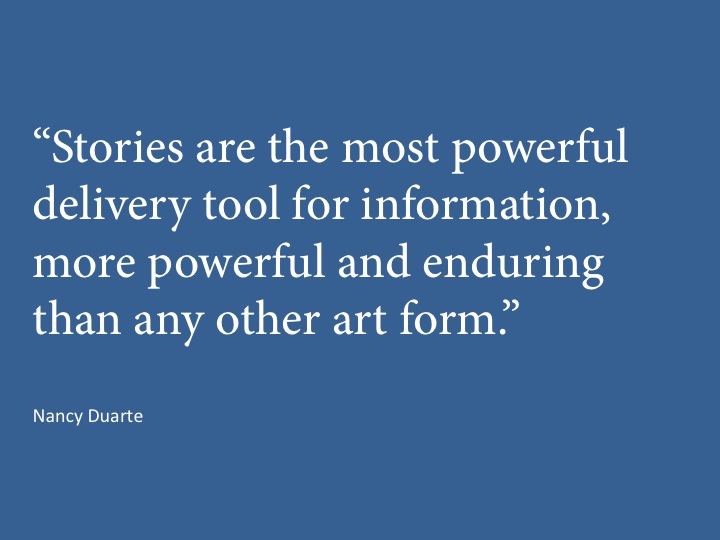
    Perhaps… we should seek to tell stories and build narratives of improvement in identified areas or on trails where we deliberately place bets to transform practice and deliver discernible difference.

    make_a_difference_sign


    Which begs the question… what does it take to deliver discernible difference? How can we be more deliberate and focused on singling out the key levers of improvement; executing these changes, building a story and telling a narrative of improvement around the few things that matter?


    What if… achieving discernible difference requires prioritisation of what matters? and that this takes thinking time and a careful consideration of what will leverage the greatest improvement? What if… we considered the following phrase when identifying where to play and achieve the discernible difference that we seek…

    “What’s the ONE Thing you can do such that by doing it everything else will be easier or unnecessary?” (Gary Keller)

    What if… great leaders and teachers understood that what you do not do, what you de-prioitise (the omissions) are as important as what is actioned? …that ability to place bets only on what counts and the mindset that reduces  crippling complexity and workload?

    What if… we realised that trails and areas requiring improvement are often obvious and rarely require deep evaluation to be understood?; seek the trails that matter…

    Slide4

    What if… we spend too much time evaluating and applying QA to the whole population or provision instead of moving more quickly to action on the areas that require improvement; seeking discernible difference?

    What if… we also realised that in any population there are outliers, bright spots and positive deviants who have that answer or exhibit behaviours that have the ability transform? …achieving discernible difference and improvement will often be within the population… seek the wisdom and grow it…

    Slide3

    What if…we were more aware of the fact that we can get over-excited or be prone to complacency when we measure and weigh stuff? That feeling we get when we complete the SEF, a round of observations, work scrutiny, achievement meeting, re-writing our to-do-list etc. – often confuses us into thinking we have achieved impact or improvement?

    What if…we are prone to believing that things will just improve, or that if we apply a strategy more, or if we weigh stuff more, that we will achieve a different end point?

    Insanity is doing the same thing over and over and expecting a different result.” Albert Einstein

    What if… we only focused on the key trails and moved to action. What if… we are not quick enough to move to action (to start stories) and as a consequence rarely achieve the change that we desire and others need…

    d3a6b2aafb7946d0ec5aacd42d4860e2

    What if… we do not continue to commit to action during the implementation dip or when it is easier to go off and measure something else or when we can duck the difficult conversation or action?

    seth-godin-the-dip

    What if… we were in the habit of telling stories; and building a narrative of improvement? … around those areas that we have prioritised, that will have the greatest impact and deliver discernible difference?

    Slide2

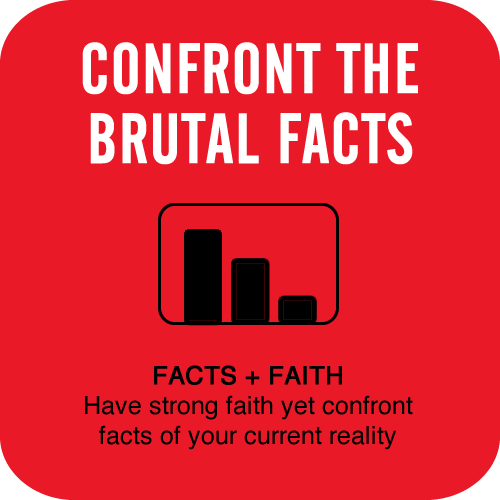
    What if… a self-improving education system or academy or teacher has the ability to understand the brutal truths of the situation and embark on a set of deliberate actions that together tell a story and provide a narrative of improvement?

    g2g-confront-facts

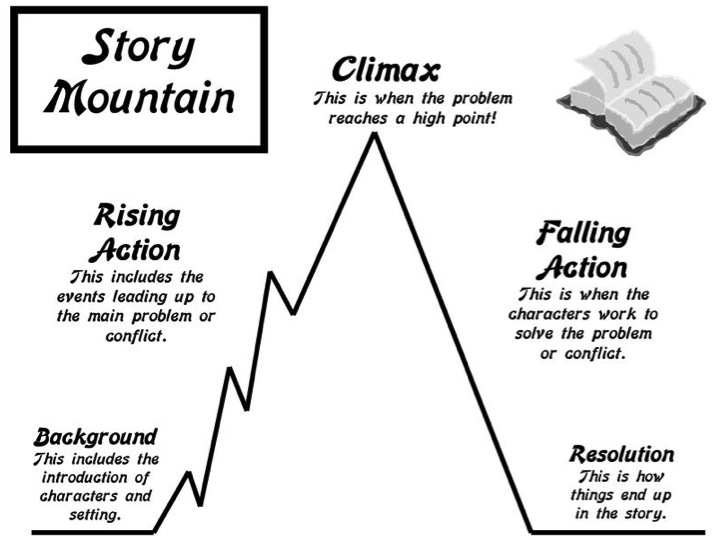
    What if… these stories always have a start, a middle and an end…

    Slide1

    blogs.scholastic.com

    What if… we are good at opening up stories, but much weaker at building plot and poor at writing great endings (happy or tragic)? What if… we do not stick around long enough on a story or move to action quick enough to realise the twist or truths or barriers to improvement that exist?

    …stories motivate people to achieve more. They show what is possible and trigger other unintended improvement.

    What if… milestones are a key aspect of delivering discernible difference? That these chart progress, point to the desired destination and importantly provide ongoing motivation to overcome implementation dips and secure discernible difference … perhaps even irreversibility (Barber).


    gorsel-km-taslari

    What if…this ability to place bets on the stuff that matters is born out of an acute awareness and a lack of organisational blindness achieved from beyond our present context (Academy, classroom, MAT, region…)

    What if… delivering discernible difference has everything to do with execution, execution, execution… only this delivers transformation… and possibly irreversibility…

    Slide2

    What if… we…

    …ensure that the choice architecture, nudges and culture provokes and rewards individuals and teams to chase their own narratives of improvement, growing the ability to tell stories of discernible difference.


    Maybe then… leaders would have pride in telling their narrative of improvement – their motivating stories of the difference that they have made. Maybe then… leaders and teachers can point to examples of  discernible difference as evidence of impact on others and students.

    Maybe then… leaders and teachers would move to action more quickly on the few things that matter – placing bets on the one thing(s) that make a discernible difference. Maybe this… level of focused action has the ability to add far greater value than blunt, catch-all, self-evalution.

    What are your trails? where is your discernible difference? what stories of improvement can you tell – where have you achieved irreversibility? Has this become the lens through which you seek future improvement?

    After all… the measure of our own impact should be judged through the stories of discernible difference that we can tell.

    Dan Nicholls @DrDanNicholls

    November 2015

    Stretch and Challenge | CLF Conference

    Slide1

    It is probably true… that consistently, deliberately and purposefully pitching learning just beyond a child’s present ability, that point between confusion and boredom, is perhaps the hardest part of teaching. This requires a depth of awareness of where each child is and specifically what each individual needs to do next to learn and make progress.

    It is also probably true… that good lessons have the ability to stretch and challenge 80+% of children, whereas a great set of lessons stretches and challenges a different 80% each lesson. This requires teachers to become expert coaches who have a depth of subject and age-related knowledge, formatively assesses and use effective feedback to know where each child is with their learning, has the ability to use this to plan for progress, has an in-built ethic of excellence and the in-lesson awareness to intervene with effective questioning, explanation and modelling. Effective coaching happens when there is a consistent application of these elements over time, so that…

    “…success is not a random act. It arises out of a predictable and powerful set of circumstances and opportunities (provided by teachers and others).” (Malcolm Gladwell)

    The following reflects some of the best practices across the Federation and identifies the key aspects for securing stretch and challenge in all classrooms…


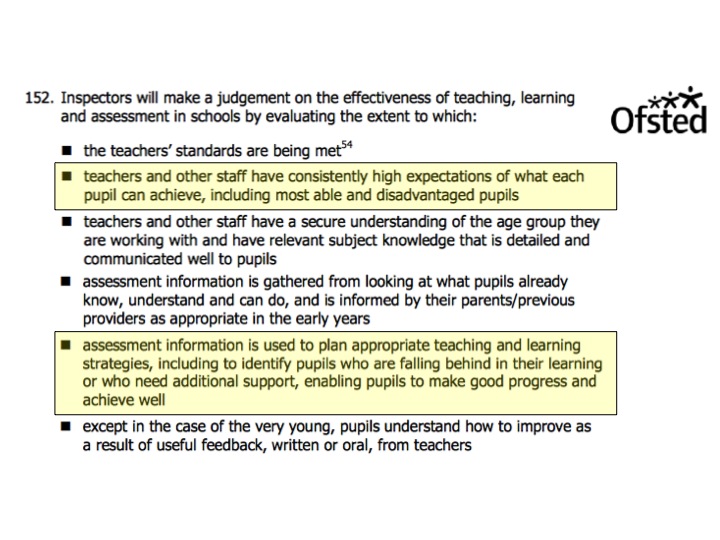
    What if… Ofsted are right? that the stretch and challenge of all children should be based on having consistently high standards of what each pupil can achieve, including the most able and disadvantaged…and assessment that informs planning for pupils who are falling behind in their learning or who need additional support enabling pupils to make good progress and achieve well?

    Slide1

    …and that when looking at books… there is the level of challenge and evidence that pupils have to grapple appropriately with content, not necessarily “getting it right” first time the work is not too easy?

    Slide2

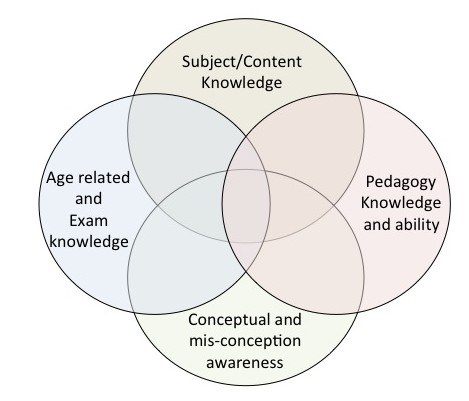
    What if… the ability to plan for and to challenge and stretch children is impossible without a depth of knowledge that encompasses…

    • subject/age-related understanding of standards and expectations – that enables appropriate pitch as well as igniting an interest and passion around specific and well-ordered content?
    • a deep understanding of the key concepts and importantly the key mis-conceptions that are built into the progression of a subject or area of learning?
    • knowledge of exam and age-related expectations to provide precise planning, task setting that ensure that children are stretched and challenged around the appropriate content?
    • Knowledge of pedagogy – how to plan to pitch learning, plan lessons, activities and other elements of pedagogy to secure progress.

    What if.. one of the key levers in stretching and challenging children is the subject passion from teachers who inspire young people to achieve more. Teachers have huge influence – and with that opportunity comes great responsibility:

    717296dd52443f5d014228877381418e

    What if… this passion is particularly portrayed through the language we use? It is language that motivates and perhaps more importantly inspires interests that enhance young peoples lives. What if… we analysed our own use of language and identified phrases and approaches that automatically set limits (often unknowingly) on what children can achieve or indicate limits to what we believe is possible?

    What if… planning to stretch and challenge requires:

    • lesson objectives that genuinely stretch children based on where they are in their learning.
    • feedback and previous progress is the basis for the planning of each lesson – teachers show the flexibility required to respond and pitch lessons by child.
    • flexibility within lessons enable learning, tasks, questioning to be altered to maintain challenge and pitch.
    • peer-to-peer learning is used to support and accelerate progress.
    • different tasks are required to stretch children who are at different points in their progression.
    • lessons and content need to increase in depth rather than breadth to support increased challenge and stretch.
    • absolute clarity around what the age-related or exam-expectations are to direct learning appropriately and stretch in the right areas.
    • have high expectations of what is possible and what children can achieve.
    • Build resilience in pupils who develop GRIT and a growth mindset to spend more time outside of their comfort zone.

    comfort-zone-4

    What if… children do not produce their best work often enough and tread water in the mediocre? It might be that we rarely stretch and challenge students to produce their very best work and that much of the work produced falls in the bottom quartile of what what they are capable of?

    Slide1

    What if… children were stretched and challenged to produce work that is skewed to the right, toward excellence and not left where it probably sits at present?

    skewed

    What if… there is an ongoing and accessible record of a child’s best pieces of work so that there is an immediate benchmark to build from (perhaps at the front of each book).

    draft2

    What if… children can fly if they truly believe they can? 

    cc1ae1a0333adcd0ad428bd2046efa5d

    The moment you doubt whether you can fly, you cease for ever to be able to do it.” (from, Peter Pan)

    What if… teachers always started from the position that all children can achieve their potential? and What if… this was portrayed in the manner, language, optimism and challenge that teachers have for their classes/children?

    What if… we understood that a child’s beliefs can limit what they believe to be possible and worse still that as teachers and educators our beliefs can also limit what others believe that can achieve?

    “Tread carefully on the dreams of children; they are fragile”

    “…and release them to achieve their podium position…”

    podium

    What if… to stretch and challenge individuals practise needs to be …intentional, aimed at improving performance, designed for (their) current skill level, combined with immediate feedback and repetitious.”  (Malcolm Gladwell) … enabling children to  over-perform.

    What if… creating these conditions and the opportunity to stretch and challenge children requires teachers to be expert coaches who…

    1. Opportunity – creating the opportunity for children to learn and work just beyond their present ability.
    2. Competition from like-minded individuals – create a ethos and atmosphere of sharing and feedback that balances competition and co-operation.
    3. develop GRIT – supporting children to focus on long term goals, ignoring short-term distractions. Often re-doing and re-drafting for example.
    4. seek Deliberative practise – based on precise feedback support children to practise and apply understanding.

    bell curve

    What if… this seeks to…

    “replace the patchwork of lucky breaks, context and arbitrary advantages that determine success…with a system (learning) that provides opportunities and the conditions for all to feel success.” (Malcolm Gladwell, adapted)

    What if… planning, tasks and activities are informed by Blooms and SOLO taxonomy? That these frameworks support children to be appropriately stretched and challenged.

    blooms_taxonomysolo-taxonomy-with-verbs

    What if… we sought more often to escalate lessons and tasks from closed to open and (more often) to challenge children to apply, analyse, synthesis and evaluate their developing understanding. What if… too often children spend time doing what they can already do?

    What if… we pitch lessons in the proximal zone? and that the real challenge is to plan learning so that as many children are kept in their proximal zone for as long as possible, just beyond what the child is capable of, supported by a peer) … or in a state of FLOW (that area between boredom and anxiety)?

    What if… good lessons stretch and challenge 80% of students, but that in great lessons this is a different 80% each lesson? seeking to pitch and stretch all children over time… an ability that should not be under-estimated.

    pz

    figure1

    What if… stretch and challenge also came from teaching to depth and seeking mastery around the key ideas and concepts.

    More generally, in top performing education systems the curriculum is not mile-wide and inch-deep, but tends to be rigorous, with a few things taught well and in great depth.

    stock-footage-deep-end-deep-end-of-the-pool-a-good-visual-metaphor-to-show-madness-forstock-footage-shallow-end-of-the-pool

    What if… we stretched and challenged children based on a development of a growth mindset (Dweck) – where an anything is possible. What if… it was the absolute expectation that children had to meet the standards. …ensuring, of course, that we do not set the bar too low.

    What if… we are prone to underestimating what children are capable of and that this can be highlighted through modest lesson objectives. What if… by setting the bar high and seeking marginal gains we can expect more from children.

    “People with Growth Mindsets and who show GRIT achieve more when they engage in deliberative practice … it is this practice that achieve marginal gains (Steve Peters), inching toward excellence.”

    marginal-gains

    What if… teaching focused more on the journey; on stretching and challenging children to seek “near wins” (Sarah Evans)

    “The pursuit of mastery is an ever onward almost.” … “Grit is not just simple elbow-grease term for rugged persistence. It is an often invisible display of endurance that lets you stay in an uncomfortable place, work hard to improve upon a given interest, and do it again and again.”(Sarah Evans)


    Maybe then…  children will spend more time in their proximal zone thanks to the expertise and pedagogical understanding of the teacher. A teacher who consistently, deliberately and purposefully pitches learning just beyond a child’s present ability, that point between confusion and boredom, so that children are kept in flow more often. Teachers, as expert coaches, use assessment and formative feedback, strong subject and conceptual knowledge to use elements of pedagogy that stretch and challenge all children over time.

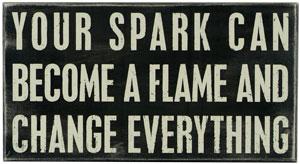
    …and maybe then, as teachers, we can be the spark of numerous ignition stories that are born out of an unswerving desire to stretch and challenge pupils; increasing the chances of individuals to be inspired and fall helplessly in love with a future passion…

    “Beneath every big talent lies an ignition story – the famously potent moment when a young person falls helplessly in love with their future passion.” Dan Coyle

    Dan Nicholls

    October 2015

    Middle Leadership | CLF Conference

    It is probably true that Middle Leadership is the key role in an Academy for driving improvement. At its best it inspires children and staff to bring new light to what might be, improves quality of teaching, champions an enabling curriculum, drives up outcomes to deliver improved life chances for all (including the team members).

    Slide04

    It is also probably true that Middle Leadership is most effective when those concerned can be considered to be true experts in their field, when they lead by example with an ethic of excellence, and when they act in concert with their senior colleagues, supporting whole school improvement through highly effective day to day management…owning their curriculum, championing knowledge and learning, actively improving teaching and being clinical about improving outcomes.


    Which begs the question: what are the key elements of middle leadership that makes the difference? The following What ifs… are inspired by the strong middle leadership that exist across the Federation.


    What if middle leaders consistently created a culture within their team where risks could be taken and individual talents recognised, without losing the ability to challenge, to support, to direct and to critique? …a culture that creates the conditions where team members inspire and are inspired by their colleagues.

    IMG_2084

    What if middle leaders were respected and trusted in equal measure, so that their team members knew beyond all doubt that they would be receiving the best possible coaching and support to achieve outstanding outcomes through effective lessons? …where middle leaders are the champion of their team and subject/area.

    Slide13

    What if middle leaders were the first people in the organisation to offer feedback to their staff members, and the first to offer coaching to ensure the craft of teaching was honed and nurtured for each individual in their team? They are the agents of change who shift the quality of teaching.

    What if middle leaders fully understood the crucial nature of their role in an Ofsted inspection, where the question on the Inspector’s lips might be ‘how is teaching more effective because of what this leader knows about achievement in this school?’

    What if middle leaders championed the one chance that children have. Understanding the deep moral purpose that exists and generating urgency so that all children fulfil and reach their potential…taking seriously the need to reverse accumulated disadvantage for our disadvantaged children.

    Slide08

    What if Middle Leaders understood that the key strategy for accelerating a child’s progress and enhancing life chances was the consistent delivery of quality first teaching every lesson, every day.

    Slide14Slide17

    What if middle leaders secured delivery of key elements of the signature pedagogy; where a depth of knowledge, an ethos of excellence, along with teaching that stretches and challenges, that questions to unlock understanding and delivers effective feedback, accelerates learning?

    Slide1

    What if Middle Leaders were champions of their curriculum; understanding the need to develop a layered/spiralled curriculum that explores and revisits areas to depth and assesses knowledge, skills and understanding against age related expectations?

    What if Middle Leaders were champions of their subject and pedagogy? Understanding the need to ensure a depth of knowledge inspires, understands the key concepts and mis-concepts and how pedagogy can be applied to accelerate knowledge, skills and understanding?

    Slide4Slide3

    What if middle leaders knew about the performance of different student groups not only over the course of the year, but building on previous years in the same school, charting their progress and matching it to departmental interventions and foci over time? …targeting those children that fall behind and accelerating progress to close gaps in attainment.

    Slide25
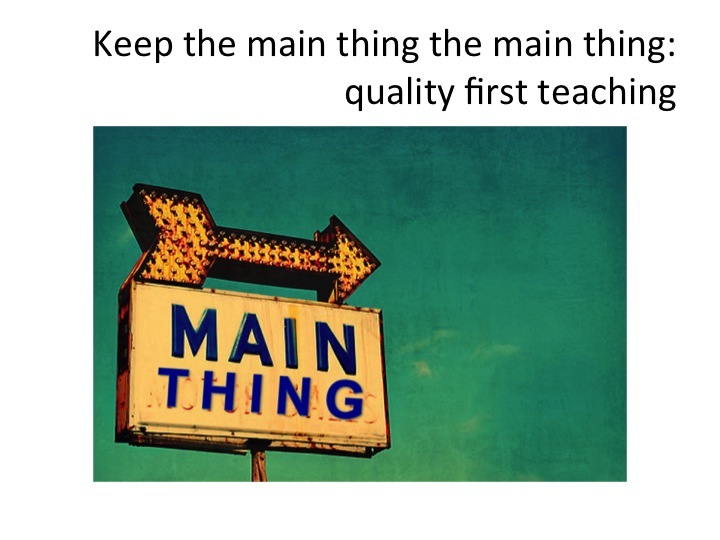
    What if middle leaders walked the line between the ‘statesman-like’ approach of the senior leader and that of a supportive family member to those in their team? …supporting and challenging improvements in performance overtime, both deliberately and compassionately.

    fit-to-lead

    What if middle leaders prepared each meeting as they might a lesson, taking into account the learning experience for their colleagues, their diverse needs, the best way to structure the experience, to have seamless transitions, and a judicious mix of action, discussion, reflection, and imparting of information?

    What if middle leaders had the confidence and competence to highlight areas of strength and weakness within the course of a school year or term, without waiting for external validation but seeking to collaborate with others to improve at an accelerated rate?

    g2g-confront-facts

    What if middle leaders sought to achieve a discernible difference in areas that they identify for improvement?

    What if middle leaders were at once confident enough to deal with emerging issues, and humble enough to ask for perspective, support, even validation from their senior colleagues?

    What if middle leaders understood that they start to become organisationally blind after six weeks? What if because of this understanding middle leaders connected and collaborated deeply within and beyond their own Academy?

    blind-spot

    What if middle leaders were able to ask for feedback not only from their line managers but from their own team and from their peers, knowing that feedback enables growth?


    Maybe then individual subjects would develop at a fast pace, with outcomes for all students exceeding national expectations, and reducing achievement gaps between groups.

    Maybe then teaching, our core business, would be consistently outstanding within each department and across each school. Set within an owned and inspiring curriculum.

    Maybe then a generation of leaders would emerge that would have impact and influence well beyond their role.

    …and Maybe then we would have the deepest job satisfaction, knowing we have performed unusually well and that our students are the real winners.

    Slide08

    Sally Apps and Dan Nicholls

    October 2015

    Ethic of Excellence | CLF Conference

    Slide1

    The following supports the “ethic of excellence” workshop at the CLF Conference, 2 November 2015…


    It is probably true that:

    “Once a student sees that he or she is capable of excellence, that student is never quite the same. There is a new self-image, a new notion of possibility. There is an appetite for excellence.” (Ron Berger)

    It is also probably true that where an ethic of excellence runs through teaching and learning a child’s progress is accelerated and they outperform their peers. This maybe the most important aspect for driving up standards, accelerating progress, securing unusually good outcomes and giving all children a new sense of possibility; enhancing their life chances for the long term.

    The following reflects some of the best practices across the Federation and identifies the key aspects for securing an ethic of excellence in all classrooms…


    Slide23

    What if… an ethic of excellence is measurable and tangible? That it can be judged from a short triangulation of teaching, books and student voice…and that where teachers have a strong ethic of excellence this is likely to be reflective of strong habits and a personal commitment to excellence.

    What if… the ethic of excellence is revealed in the attitude of children toward their learning – that low-level disruption is not a feature – it is, in fact, socially unacceptable to not engage and seek to make progress in lessons.

    “What if I fail to be the prophecy?” (Peter Pan)

    “What if you fail to try?” (Tiger Lily)

    (from the film Pan, 2015)

    What if… the ethic of excellence is sought through the way the teacher and others inspire and inject passion around content (subject or age related) and learning; using language and praise to reinforce the expectation of excellence. (praise is not cheap).

    Slide3

    What if… the ethic of excellence is supported by the challenge and stretch that is evident in lessons supports children to reach beyond what they can do now, expecting students to work in their top 10% excellence zone.

    What if… the ethic of excellence is seen in the quality of work and books; showing an  an attention to detail in the…

    • care and precision of presentation
    • quality and depth of writing and working
    • continuity and progression in the work over time that reflects a layered curriculum

    What if Ofsted are right and that some of the key evidence of an ethic of excellence is seen in books.

    Slide2

    What if… the ethic of excellence is shown in a focus on depth rather than breadth and in routinely re-doing and re-drafting; seeking excellence. That teaching uses deliberate practice to inform teaching, so that:

    practice (is) intentional, aimed at improving performance, designed for (a student’s) current skill level, (aimed at excellence), combined with immediate feedback and repetitious.” (Malcolm Gladwell)
    excellence

    What if… children do not produce their best work often enough? It might be that although students are capable of excellence we rarely support students to produce their very best work and that much of the work produced falls in the bottom quartile of what is possible for that individual. It might be true then that the opportunity to enable students to see what is possible rarely happens as students simply tread water in the mediocre.

    Slide1

    What if… students skewed their work right toward excellence (and teaching prioritised and supported this) and not left where it probably sits at present?

    skewed

    What if… there is an ongoing and accessible record of a child’s best pieces of work so that there is an immediate benchmark to build from.

    draft2

    What if… the ethic of excellence is seen in the feedback that is built into tasks/lessons and is specifically targeted at securing concepts and unravelling mis-conceptions…expecting much and targeting specifically where chidden can improve?

    feedback

    What if… the ethic of excellence supported by assessment (all forms) that is a coherent element of teaching – formatively driving progress and improvement toward excellence? Using mastery to support all children to secure the foundations and core knowledge, skills and understanding that will allow them to be academically and personally successful in and beyond education.

    What if… the ethic of excellence is supported where teachers are persistent, and unswerving in raising standards (pass marks etc.) and deliberate in lessons and over-time in catching-up and closing gaps for those students who fall behind?; making a discernible difference to those that fall behind. 

    What if… the ethic of excellence is embedded through teacher passion, subject knowledge, pedagogical knowledge, exam or age-related understanding and an insightful understanding of concepts and mis-concepts that are the foundation for driving children toward excellence? This is also evident in the schemes of work – progression of lessons – and within the layered/spiralled/escalating curriculum. Avoiding the skimming of content and the shallow learning.

    What if… the ethic of excellence is shown in questioning that immediately reveals the teachers desire to seek excellence, maintain a high bar and expect much from answers and discussion – expertly steering and intervening to maintain standards and encourage depth of pupil involvement? …the deliberate inclusion of explanation and modelling supports children in their quest for excellence.

    What if… in seeking an ethic of excellence we borrowed much from Dan Coyle’s insights and establish the conditions for ignition, (moments that inspire an ignition of internal motivation) and provide the feedback of an expert coach from within tasks to breakdown tasks and specifically remove misconceptions and seek accelerated improvement.

    “we are often taught that talent begins with genetic gifts – that the talented are effortlessly able to perform feats that the rest of us just dream of. This is false. Talent begins with brief powerful encounters that spark motivation (ignition) by linking your identity to a high performing person or group (or self image). This is called ignition, and it consists of a tiny, world shifting thought lighting up your unconscious mind: I could be them (or do that, or achieve that – in fact look at my best work… my near wins).” (Dan Coyle)

    What if… the ethic of excellence was reinforced by teachers and others who have an  unswerving ambition for all children and expecting much from all children, every lesson.

    What if… the ethic of excellence is reflected across the Academy in all that we do – in our day-to-day expectations? (from uniform to ‘finishing conversations’ to politeness).

    What if… an ethic of excellence was allied to growth mindset that sets the conditions and ethos for a class, cohort or Academy to stretch for excellence? (Dweck)

    “People with Growth Mindsets and who show GRIT achieve more when they engage in deliberative practice … it is this practice that achieve marginal gains (Steve Peters), inching toward excellence.”

    What if… we focused more on the journey; on the “near win”?(Sarah Evans)

    “The pursuit of mastery is an ever onward almost.” … “Grit is not just simple elbow-grease term for rugged persistence. It is an often invisible display of endurance that lets you stay in an uncomfortable place, work hard to improve upon a given interest, and do it again and again.”(Sarah Evans)

    What if… the ethic of excellence is exemplified by the classroom environment that reflects learning, progress and supports excellence? Display is inspired, the walls are useful, all areas are tidy and reflective of excellence… boards (and IWB) reflect organised and logical presentation of information that is timely and focused on the key learning for the lesson?

    What if… the ethic of excellence is seen in the routines that are shared and owned by all – they are systematic and reflects the desire to make progress and learn?


    Maybe then…children would see that they are capable of excellence, that this would change them forever and raise their personal benchmark. They would have a new self-image, a new notion of possibility and an appetite for excellence. Maybe observation and education would value the outcome, the quality, the closeness to excellence and be less fixated on observed practice.

    “If you’re going to do something, I believe, you should do it well. You should sweat over it and make sure it’s strong and accurate and beautiful and you should be proud of it” (Ron Berger)

    Dan Nicholls

    October 2015

    Thunks | simple questions that prompt a new view

    Thunks… beguiling questions about everyday things that stop you in your tracks and suggest new ways to look at the world… earthrise

    Earthrise: “The vast loneliness is awe-inspiring and it makes you realise just what you have back there on Earth.” (Jim Lovell)

    Thunks have the ability to change our view, our thinking, our behaviours, our habits and the way we lead and teach; just like seeing earth from space changes perspective and forces us to reflect. The following is a herd of thunks designed to add ideas and viewpoints that stop and force reflection…prompting improvement in our leadership and teaching…

    All teaching and leadership blogs are here


    Thunk #3 | What if… motivation needs to be ignited?

    i-4e84ae6655ead4d2602ed030e890aa1f-ShuttleLiftOff

    “Beneath every big talent lies an ignition story – the famously potent moment when a young person falls helplessly in love with their future passion.” Dan Coyle

    We all have them; the moments in our past that have shaped the present and will influence the future. It may be a teacher, a sportsperson, a hero, a film, a piece of work, art, riding a bike, running, a poem, essay, a realisation, a chance encounter. It can be like a lightning bolt that ignites something deep inside that motivates a lifetime of passion for something; it causes the heart to flutter and captures the imagination.

    “Success is not a random act. It arises out of a predictable and powerful set of circumstances and opportunities.” (Malcolm Gladwell)

    It is probably true that there are moments in our lives that create core memories that have disproportionate influence on who we are, what we do and who we become. The Disney Pixar film Inside Out is a great tale that revolves around those forming experiences that shape each of us.

    screen-shot-2015-06-22-at-7-00-43-pm

    In the film each memory that Riley has is diligently stored in the short and long term memory, occasionally forgotten and removed (hoovered in the movie). There are however key core memories – it is these that shape Riley’s personality islands…those few things that define who  she is, what is important to her and what she is passionate about. The mind replays the key igniting memories that reinforce this passion and drives the intrinsic motivation for deep practice.

    inside-out-personality-islands

    “Talent begins with brief powerful encounters that spark motivation (ignition) by linking your identity to a high performing person or group (or self image). This is called ignition, and it consists of a tiny, world shifting thought lighting up your unconscious mind: I could be them (or do that, or achieve that)” Dan Coyle

    The emerging thunk is that these moments are a lot like falling in love — we can’t force it, but we can increase the odds slightly by doing a few basic things. As teachers and leaders how do we create the conditions and the opportunities that are more likely to provoke these lightning bolt moments for children and our peers?

    These moments are: (from Dan Coyle)

    1. Serendipitous. Happen by chance, and thus contain an inherent sense of noticing and discovery.
    2. They are joyful. Crazily, obsessively, privately joyful. As if a new, secret world is being opened.
    3. The discovery is followed directly by action. Not to just admire, but to act, do and practise.

    One key lever in education is subject knowledge or rather subject passion from teachers who inspire. Teachers have huge influence – and with that opportunity comes great responsibility:

    717296dd52443f5d014228877381418e

    The language we use is also extremely powerful. It is language that can create ignition points and perhaps more importantly can confirm and propagate these sparks into passions that drive the motivation to shape and enhance young peoples lives…

    Screen Shot 2015-03-10 at 9.18.46 AM

    “Tread carefully on the dreams of children; they are fragile”

    So, create moments of joy, inspiring facts, details and experiences that ignite a passion, perhaps not seen or witnessed early but for ever changing the individual. After all…

    “Once a student sees that he or she is capable of excellence, that student is never quite the same. There is a new self-image, a new notion of possibility. There is an appetite for excellence.” (Ron Berger)

    It just might be that supporting children to achieve the best work they have ever done ignites the sort of motivation that creates a personality island and the deep passion to engage in the practice that enriches a lifetime.

    How do we create core memories, lightning bolts, ignition moments or at least the conditions for them to happen more often?

    How do we use language to support children’s dreams and passions?

    We may not create olympic medalists, chess grandmasters or a world-class composers, but the fun is in the journey, in having a passion, an interest and generating the kind of joy that sparks an interest – Teachers have no idea the influence they have on others.

    Go create ignition opportunities and sparks that will enrich and empower young people to be passionately interested about stuff… and reinforce these passions with your language.

    you have the privilege of sparking remarkable futures.

    soulnote_heartflutter_grande

    August 2015


    Thunk #2 | What if… Mission + Campaigning = Momentum?

    Untitled

    Michael Hayman and Nick Giles identify: Mission: “A driving desire to change things, a higher purpose that drives (improvement).” (best expressed in 5 words) Campaigning: “Turning the mission into a powerful reality, the activist mentality.” Momentum: “The measure of success moving and growing faster than the competition.” Are you a campaigner, an activist, a disruptor? …on a mission to secure the momentum you require to change the piece of the world that you want to improve? This is a refreshing view of change (particularly the link to activism) and what it takes to move to action and secure the level of change that will make the difference. But what does it take to be an activist/campaigner? Hayman and Giles identify:

    1. Drive (or refusal to give in): Do you have the drive to keep going when it is easier to stop or when people tell you it will not work? Remember that there is a default movement against change and an inherent fear of new/different. Set your mission with care – it needs to be simply expressed and the focus of your drive.
    2. Self improvement: Do you build in enough time to reflect and learn? Treat experience and opportunity as stepping stones forward as part of the ups and downs of a campaign.
    3. Communication: Without communication there is no campaign. Reinforce the mission and the purpose often – drive the mission daily…this is the flywheel. If it is not simple and compelling there will be no followers.
    4. Disruption: To achieve change you need to disrupt the current status quo: If your mission is to address dissatisfaction or a need for change and this is multiplied by a Vision (Mission) and First Steps (Campaign) and this is greater than the Resistance you will achieve Momentum. (based on Gleicher formula)change-graphicOvercoming the Resistance of status quo requires a disruptive drive to succeed in achieving non-reversable change.

    5. Persuasion: You will not achieve your mission alone – persuasion is the key to securing followers – it is followers that transforms a lone nut into a leader. You need a tipping point to secure change – persuade through the strength of purpose, mission and ambition – people follow those with a deep and unshakable belief about what they seek to change. Unwavering commitment to change.
    6. Connection: Connect and network widely to secure support, seek feedback and make things happen.
    7. Optimism: To overcome the status quo activists and campaigners need to be optimistic. The vast majority of people will give up before they realise the change they seek. Develop the ability to bounce.

    “Go big or go home. Because it’s true. What do you have to lose?” (Eliza Dushku)

    Maybe then: As educators and leaders we should assume the role of activist and trigger campaigns to achieve missions. This language underlines the inertia of the status quo and that if we really want to trigger change and make a big difference – irreversible change – then activism and campaigning is more appropriate representation of the energy and commitment required to overcome the inherent resistance and secure the improvement we seek.

    Go forth and disrupt, commit to a mission that you love, use ridiculous amounts of drive, communicate for buy-in, create a movement through persuasion and connect with others to achieve a level of momentum that makes the change stick and irreversible.

    Go big or go home

    Further Reading: (“Mission” by Michael Hayman and Nick Giles is excellent and very applicable to educational leadership)

    and this blog: Great Leaders create movements that stick | Amazing is what spreads 

    August 2015


    Thunk #1 | What if… leading change and improvement is all about the nudge? Nudge “Nudges are ways of influencing choice” (Hausman & Welch 2010) …a fundamental aspect in education. The behavioural insights team, led by David Halpern, commonly known as the “nudge unit” was set up by David Cameron to “help people make better choices for themselves… (by gentle prompting or nudging).” The art of leadership, teaching and sparking change is often in the ability of “nudging” new ways of acting, learning and thinking in others. Nudges are similar in nature to other powerful change agents: butterflies (Brighouse), bright spots (Heaths) or positive deviants (Sternin)… those outliers present in any population that, when amplified, have the power to leverage change and improvement. Thaler et al. highlight that there are influential strategies (nudges) that leaders can use as choice architects to influence choice and behaviour. So leaders are choice architects; determining the environment in which noticed and un-noticed features influence the decisions that staff and students make. Leaders have the ability to influence behaviours, create social epidemics and use “nudges” to influence individual and group behaviour. We are surrounded by nudges; good leaders see them, look for them and use them (often automatically), great leaders have an increased awareness of nudges and use them to spark change; clever, cheap and effective ways that change behaviours intrinsically – without forcing choices. Perhaps some obvious nudges are:

    • What is placed onto observation forms and is therefore rewarded.
    • Telling students how many marks they are away from the next grade and not their actual grade.
    • Shifting Satisfactory to Requires Improvement.
    • Removing levels.
    • Any new performance measure  – nudging by shifting the goal to where you want it and not wasting time supporting the how it can improve.
    • Any new category that classifies performance of Academies or MATs – nudges improvement toward set criteria.
    • Asking (not telling) others what they will contribute.
    • Warning bell moved earlier to nudge punctuality.
    • Accepting that change is the norm and not saying things like, “we just need stability”
    • Never talking negatively as a leader – nudging that positive ethos that is desired.
    • Being in every classroom everyday.
    • Providing enough seating at lunchtime.
    • Finding and promoting teaching bright spots.
    • Removing all graffiti immediately.
    • Using “we” and not “I” or “you” when collaborating.
    • Investing in signage/branding that describes the accepted behaviour.
    • Leading with Why and telling emotive stories of a compelling future.
    • Not talking about behaviour and only about learning.
    • Praising the good habits, only highlighting that which is desirable.

    …you will have other nudges. As the choice architect of your organisation, team, classroom… 

    • do you recognise the nudges around you? …the nudges that influence you as well as the nudges that you use to influence others?
    • how do you use nudges? Do we think and plan long enough to seek softer ways (nudges) to achieve the changes we wish to see?
    • how can you nudge improvement?

    (a Future Thunk: Do we understand and recognise the constraints that we have around us; constraints that control what we do, how we think and how we behave?)

     August 2015

    Disadvantaged children | think low attainment not low ability

    ATT00031

    “What if… we view disadvantaged children as low attaining and not as low ability, instil a deep and widely held belief in what is possible and then set eye-watering targets that underline our ambition to overcome the inertia of context.”

    It is probably true that… Primary and Secondary schools need to do more to close the gap in attainment between disadvantaged and advantaged children; perhaps seeing it more as low attainment and not low ability or delayed progress and not that there is a limit to a child’s potential. We know that gaps appear early (ages 0-4) and widen through a child’s education. All of which has a deep impact on the child’s life chance and success that ultimately leads to generational cycles of poverty and disadvantage.

    Which begs the question… what does it take to close these gaps and disrupt the loop of unequal opportunity and outcomes?

    believe-in-kids


    What if… education reinforces early advantage and accumulated advantage for advantaged students and inadvertently creates conditions where early attainment gaps widen?… do we disadvantage the disadvantaged?

    Malcolm Gladwell identifies in Outliers that we often perpetuate early advantage. He exemplifies through the Canadian Ice Hockey League where those children selected at 4 and 5 years old, are generally the oldest and largest children; having their birthdays in Jan, Feb and March. These children enter the hockey Academies, experience great coaching, many hours of practise (largely deliberate in nature) and of course they thrive, out-strip their slightly younger peers and go on to be professionals. Not because they are more gifted or talented than those children born later in the year, but because they were a quarter to fifth older and larger than their peers when selected…what happened next just served to prove the selectors and scouts right.

    “Autumn born students showed higher attainment and made more academic progress over KS3.” (DfE, 2012)

    What if… as educators and teachers we are complicit in the widening of gaps and perpetuating the early advantage of students from advantaged backgrounds?

    “Within the complex landscape of differential attainment, socio- economic disadvantage appears to be the most consistent predictor of attainment, particularly for children and young people from white ethnic groups.” (Ofsted)

    What if… we recognise that low attaining disadvantaged children on entry to Primary and Secondary school are actually low attaining and not low ability. What if we are actually see “delayed progress” and not fixed ability or limit our belief in what disadvantaged children can achieve.

    What if… there is a wide-held and embedded belief in the ability of all disadvantaged to achieve and attain – life enhancing qualifications and skills that will break the generational cycle of poverty? What if… we did not assume that this belief exists? The type of belief that enables and levers success for disadvantaged students needs to be to depth and has to live and breath in the organisation – it has to be felt and ubiquitous in all that happens.

    What if… we build in greater ambition for disadvantaged students? At the start of secondary why do we not set low attaining disadvantaged children a full level of progress each year?

    What if… we understand that this higher ambition and action seeks to close early gaps in literacy and numeracy for example – because these gaps disenfranchise children from their education and maintain the loop of poor outcomes, with each generation.

    What if… we understood that disadvantaged students are prone to “self de-selection”. They are more likely to see an opportunity, chance or activity as not for them and de-select themselves. What if we had a policy of “meeting them there” – to ensure that disadvantaged children attend extra-curricular events and attend trips etc. … and to deliberately plan lift the cultural capital for each child.

    What if… we understand that disadvantaged students are more likely to have an external locus of control and more likely to assume that their experiences and opportunities in life are determined by others and that they are not in control of their own destiny (internal locus of control). All of which links to the self-esteem and self-confidence that is more prevalent in advantaged households, where there is an assumed progression and a greater internal locus that expects individuals to take control of their future; making things happen.

    What if… we understood that not all disadvantaged students are disadvantaged and that there are many advantaged students who are disadvantaged? Do we use our own understanding and soft intelligence to identify our actual disadvantaged cohort?

    What if… we sense-checked our pupil premium spending to ensure that the strategies we are using are not in fact enabling advantaged students to flourish further,(obviously no bad thing) but that they targeted at enabling disadvantaged to close the gap and achieve. This can only be born out of a deep understanding of what being disadvantaged really means.

    What if… we realise that pupils premium spending should be proportionate to the numbers of disadvantaged and that only by measuring impact can we truly understand what and how we close the attainment gaps?

    What if… we gained a deeper understanding of what it means to be disadvantaged – not because we intend to mis-understand the complexity of socio-economic disadvantage by creating unhelpful generalisations, but so we can find a language, approaches, strategies and teaching that unlocks and reverses the disadvantaged inertia that slows/delays progress.

    Key factors can include: worklessness, low parental education, lower ambition, less well informed choices, poor home study routines, poor diet, overcrowding, alcoholism, violence, chaotic homes, lower access to books, tables, further resources, reduced cultural capital, visits, newspapers, discussion, debate… (obviously these are generalisations – there are many disadvantaged backgrounds that support and provide conditions for children to thrive and achieve beyond that achieved in advantaged households.)

    “Students’ academic attainment and progress are strongly influenced by the education level of their parents. Influence of Fathers’ qualification levels only half as strong as mothers. Positive parenting experiences, especially the early years Home Learning Environment (HLE) helps to promote better longer term outcomes.” (DfE, 2012)

    By understanding context we can inform the quality of provision that enables all children to exploit their one chance.

    Slide08

    What if… we understood that gaps in attainment happen early ages 0-4 and that these gaps typically widen through Primary and Secondary education. “Success is what sociologist would call accumulative advantage.” (Gladwell, 2008)

    “Overall, attainment gaps are present from the early stages of education and progressively worsen during transition and through each phase.” (Ofsted)

    What if… we understood that these gaps widen because of the Matthew Effect: “it is those who are successful, in other words, who are most likely to be given the kinds of special opportunities that lead to further success.” (Gladwell, 2008)

    Differences in academic attainment and social-behavioural development related to background emerged early (at age 3) and remained fairly stable to age 14. (DfE, 2012)

    What if…  the quality of Nursery education is a key determining factor. It is not uncommon for gaps to be significant at Reception and that this often directly relates to whether the child has attended Nursery and then whether this is of good quality.

    What if… we understood that the summer holiday break (in this instance in the US) has a greater impact on disadvantaged children than advantaged children exemplify the home-advantage of advantaged children…

    “The wealthiest kids come back in September and their reading scores have jumped more than 15 points. The poorest kids come back from their holidays and their reading scores have dropped almost four points. Poor kids may out-learn rich kids during the school year. But during the summer, they fall far behind.” … “Virtually all of the advantage that wealthy students have over poor students is the result of differences in the way that privileged kids learn while they are not in school.” (Gladwell, Outliers, 2008)

    What if… we took seriously our collective system leadership responsibility for supporting families and by extension all children to make strong progress between 0 and 4. Fully exploiting the potential offered by all-through Academies. This connects the dots and works to remove/improve damaging transitions.

    What if… all leaders and teachers are leaders of learning? And that this is never divorced from an on-going and deep dialogue about how we best-teach and support all children to close gaps. Indeed we have a moral obligation as leaders to close these gaps, because only then do we enhance life chances, break the generational cycle of poverty and leave a legacy that we can be proud of.

    “Disrupt the loop of unequal outcomes.” (Ofsted)

    What if… targets for disadvantaged students were set to close gaps (not to maintain them)? Too often we set targets that simply maintain the gap (for example 4 levels progress for all). And in this moment we limit what is possible and set our ambition for disadvantaged students – we are confirming previous disadvantage – we are seeing disadvantaged students attainment as their potential and limiting our ambition for them. Disadvantaged students need the opposite of this … to be offered a deep belief in them and their ability and that with the appropriate provision delayed progress can be reversed – not least because we should see low attainment not ability and that progress is delayed not a reflection on the child’s ability or potential.

    What if… we understand that quality first teaching is what matters for exploiting potential and enabling accelerated progress of disadvantaged students? Indeed quality teaching has a disproportionate impact on disadvantaged children (and in contrast to summer holiday progress, above)…

    Slide17

    …underlining that disadvantaged students make greater progress than advantaged students when they receive quality teaching – perhaps highlighting the appetite of disadvantaged children to learn, again reflecting delayed progress not innate ability.

    “The effects of high-quality teaching are especially significant for pupils from disadvantaged backgrounds: over a school year, such pupils gain 1.5 years’ worth of learning with very effective teachers, compared with 0.5 years with poorly performing teachers … For poor pupils the difference between a good teacher and a bad teacher can result in a deficit of a whole year’s learning.” (Ofsted)

    What if… we realised that where Academies only go as far as identifying disadvantaged students on seating plans (or similar) that this could be limiting potential of disadvantaged students; as teachers make unhelpful assumptions about the child’s potential and become content that this child is keeping pace (or slightly behind the progress of advantaged children!)? Quite the opposite is required; disadvantaged children need to outstrip the progress of advantaged children – targets need to reflect greater gains in progress.

    What if… we enabled a continuous discussion and strategy-sharing between teachers and pastoral staff to identify strategies and approaches that specifically support disadvantaged children – and that these are made explicit and employed to support students to make accelerated progress.

    What if… we recognised that it is the quality of feedback (built-in, not after the event – that is particularly important for disadvantaged children) and what is done with it as well as the quality of differentiation that has the strongest opportunity to accelerate the progress of disadvantaged students.

    “To build a better world we need to replace the patchwork of lucky breaks and arbitrary advantages today that determine success–the fortunate birth dates and the happy accidents of history–with a society that provides opportunities for all.” (Malcolm Gladwell)

    What if… we considered the language that we use in lessons and across the Academy when talking about children with low attainment or delayed progress? How often do we talk about ability as if it is fixed or imply that there are limits and ceilings for some children. How far do we employ a growth mindset approach and a language of effort and opportunity?

    What if… we remember that effort and opportunity are the greatest determinant on success in almost every area of life? Dweck, Coyle and Gladwell provide compelling evidence that learning and progress is achieved through effort, deliberate practice and the development of myelin within the brain. Disadvantaged students are not wired differently or born less clever…all of which demonstrates that (almost) all gaps can be closed and rates of progress increased. (Accepting that extreme neglect in early childhood can create physical changes in the brain).

    Perhaps all of this will help to disrupt the loop of unequal opportunity that hold disadvantaged children back; reversing the cycle of poverty.

    “Children experiencing poverty face multiple disadvantages that often continue throughout their lives and all too often continue on to the next generation.” (Child Poverty Strategy 2014-17)


    Maybe then…

    • There would be a deep and wide-held belief in the possibility of closing all gaps. That there is eye-watering ambition for all students.
    • We would not equate low attainment as low ability. Such that our targets should reflect an acknowledgement that this is delayed progress.
    • We would develop  a greater understanding of what it means to be disadvantaged.
    • We understand that the educational system actually reinforces and perpetuates gaps, because cultural capital and early advantage enables advantaged students flourish.
    • We use system leadership and connections to equalise access to early advantage when children are 0-4 and through Primary into Secondary.
    • We no longer set targets for disadvantaged that simply maintain or worse open gaps wider for disadvantaged students.
    • We would realise that we often put into place strategies and approaches (perhaps through pupil premium funding) that simply enable advantaged students to continue their “accumulated advantage.”
    • We continue to invest in quality first teaching (particularly feedback and differentiation) so that disadvantaged children are freed and supported to make progress.
    • We remind and promote that ability is not fixed and that through effort and deliberate practise everything is possible.

    “Education and organisations should be judged by how well it supports its most vulnerable and disadvantaged to achieve and feel success.”

    May 2015