Our self-identity forms over time, shaped by our experiences and interactions, particularly in our formative years. It is not a uniform development of self, but rather one that is punctuated disproportionately by high impact moments. These sit in our backstories, having ignited our identity and shaped who we have become.
These moments are often subtle, quiet experiences of awe and wonder: a sudden realisation, both unsettling and exciting, that the world and our role in it is not what we thought. In these moments of alchemy, brief serendipitous collisions create a hiatus between our old and new self-image.
“…in moments of alchemy, brief and serendipitous collisions, the beautiful texture of interwoven lives. There are many seeds of genius in the world, we must nurture as many as we can.” Helen Lewis
Circumstance and happenstance
The development of self is determined by our context, upbringing and by the influential adults and peers that we look to through childhood: an on-going influence of circumstance through our formative years.
But much, arguably, is happenstance, serendipitous moments that build our self-image. Brief events, often remarkably small, that disproportionately shape our lives. Rather awkwardly, they are often surprisingly quiet, private moments of self-realisation that are invisible to the provider.
“The smallest act in the most limited circumstances bears the seed of boundlessness, because one deed, and sometimes one word, suffices to change every constellation.” Hannah Arendt
Yet for some children the vagaries of life’s happenstances are less frequent, less influential or much less accessible. It also depends on a child’s circumstance and their pre-disposition to act on these moments. Whilst our childhood sets the conditions and the circumstances that influence our predispositions, the brief moments,the happenstances, disproportionately explain who we become.
Predispositions
Will, Should, Might, Could, Won’t, Can’t
Our context and circumstance, whether consciously or unconsciously, determine our predispositions and the strength of our self-agency. For any given aspect of life we align to one of the following dispositions:
•I Will …. I fully expect to do this, unswerving, predestined, locked in, self-fulfilling.
•I Should … Highly likely, people like me do things like this (reinforced by peer status).
•I Might … Entirely possible and within my gift, requires a step forward, focus and resourced adults.
•I Could … It is possible, but could be difficult to achieve – requires ignition, support and must be followed by resource.
•I Won’t … People like me don’t do this, locked out, keys hard to find, and not sought, no capacity or resource, unable to see the future or be part in it.
•I Can’t … Not possible, nobody like me does things like this, psychologically and materially forbidden.
If you are under-resourced and have experienced much less privilege, then too often your agency is limited to the bottom few dispositions. This offers a form of immunity to moments of ignition and even if ignited a lack of resource to follow your triggered passion. In a world of privilege, however, you occupy the top few dispositions: emboldened to accessible experiences and open to life-changing moments. And yet, ‘ambition’ is equally distributed, but enhanced or stifled from birth and perhaps before birth.
“If you are lucky enough to be born in a world made in your image, you probably think of a failure as an obstacle on the path to eventual success. If you are a marginalised person in any way you internalise that failure more closely.” Elizabeth Day
Moments of wow… igniting identity
Regardless of who we are there are moments we witness that change our passions, our identity and motivation for what we wish to become…
“But the moment that changed everything came on 29 July 1992 … the Barcelona Olympics. Chris Boardman was about to go in the final of the men’s individual pursuit. I sat in front of the TV and watched him … Four and a bit minutes later, Chris had overtaken his German counterpart and become Britain’s first Olympic cycling gold medallist in 72 years. I was 12 and knew straightaway I wanted to emulate his feat. Another 12 years later I did just that.” Bradley Wiggins
…or influential adults who we are desperate to emulate…
“When I’m 13, my mum gives me a load of photos that she’s found. There he is, in his cycling kit, racing. It’s a definite “Wow!” moment, like he’s been brought to life in my hands. Those photos become my greatest treasure. The closest connection I could have with my father was by following in his footsteps” Bradley Wiggins
…or experiences that ignite our identity…
“My love for cinema began at a very early age, as early as I can remember… I was just a little kid in a darkened theatre, and I remember that beam of light just cut across the room and I remember looking up, and it seemed to just explode on the screen. … and suddenly, the world was so much larger than the one that I knew … it opened my eyes. It opened my imagination to the possibility that life could expand far beyond the boundaries that I then perceived in my own life.” Tom Cruise
“Making films is not what I do, it is who I am.” Tom Cruise
Owning the future
How far are children able to focus on the future? If you exist in an under-resourced world where you seek to survive the day, the week, your effective horizon is limited, perhaps irrelevant to you: there is no bandwidth to contemplate your future. This fundamentally forces you toward the weaker predispositions, I Won’t and Can’t, and breaks the connection between recognising that the efforts of now are an investment in next. The future will act on me.
Resourced children are able to make the investments now, fill their lockers and are typically compelled to do so, supported to strong dispositions, I Will and Should.I create my future.
To be or not to be
To be or not to be, that is the question that children wrestle with as they navigate the world. We know, though, that some children have much less capacity to be, forced into a not to be mindset. Growing in a world that tips the odds against you, denies a starting disposition, or ladder to, ‘Will, Should, Could’ and restricts the under-resourced to ‘Can’t and Won’t’. Only the application of equity can offer a ladder and break the cycle.
Lockers filled with belief
In every aspect of a child’s life, a child holds a locker of self-belief. Advantaged children have bursting lockers, filled by circumstance and opportunity, narrated by resourced adults, affirmed through experience. The lockers of under resourced children are sparse, short on belief, encouragement or affirming experiences. When they look to their lockers for self-confidence and self-belief they are encouraged, perhaps compelled, to step back, to not take risks and internalise the failure. We must be better at filling the lockers of under-resourced children.
“When you are born into wealth and privilege, you inherit a plan that outlines the paths ahead, indicating the shortcuts and byways available to reach your destination … If you enter the world without such a map, you are bereft of proper guidance. You lose your way more easily.” Elif Shafak
Chasing status
What you become depends largely on who you find yourself with. We measure status on those around us, typically the 5 peers that we spend time with that we look to and derive our own sense of status. Our belief in what is possible is shaped by our peers, and our schools are the crucible for these interactions.
Our verbal quota
“…we speak about 16,000 words a day, that is a lot of chances to tease, complain and criticise, but also to encourage, inspire and comfort. I know I can do a lot more good with my verbal quota.” Matt Woodcock
In every interaction, exchange and conversation our words are a powerful force for good (or ill). We never know for certain the weight of our words on a child, but we do know that children are adult-watchers, seeking to decode the world around them. Awkwardly or helpfully, in every interaction our words always carry weight and have influence, intended or otherwise. Often just 13 words deliver a self-belief that becomes unshakable and propels a dopamine-soaked desire to follow a passion:
“…I was introduced to a club coach, Stan Knight. Immediately he took hold of my wrist. “I’ve never felt a pulse like it,” he said. He looked me in the eye – “You’re going to be the best cyclist this country has ever produced.” … I liked the fact he had belief in me… Stan didn’t tell me I was special because of who my dad was. He told me I was special. Me.” Bradley Wiggins
Inspiring lives
“I began to realise how important it was to be an enthusiast in life. If you are interested in something, no matter what it is, go at it full speed, Embrace it with both arms, hug it, love it and above all else become passionate about it. Lukewarm is no good.” Roald Dahl
As educators we chose to inspire lives – and yet we spend little time understanding how children exist in the world or how their lives unfold through their circumstance and happenstance. How do we ensure that curiosity, hope and ambition is a feature of all childhoods not just those that are privileged?
Perhaps we should maintain a greater sense of awe and wonder, of possibility and back it with the application of equity and protect the flickering flames of hope, so that more children can embrace an interest with both arms. If we are to ignite a child’s self-identity, so that they have agency into their adulthood, we must create greater opportunityand apply the equity that will give all children the choiceto follow their dreams.
...inspire lives with greater opportunity and choice.
We are in the business of growing human beans, and beans have dreams.
Some have dreams that are delicate, wispy-misty bubbles, but, more frightsome, some beans believe dreams are for others and not for them. So, whilst all kiddle beans have dreams, some are lost before they grow to be whunking. For the world has a habit of bursting the bubbles of beans.
“Dreams,” he said, “is very mysterious things. They is floating around in the air like little wispy-misty bubbles. And all the time they is searching for sleeping people.” Roald Dahl
Tread softly | zozimus is fragile
We grow beans and all beans spread their dreams under our feet.
But I, being poor, have only my dreams; I have spread my dreams under your feet; Tread softly because you tread on my dreams W.B. Yeats
So, tread softly, but do deliberately step and set the stage for dreams to appear, exist and grow. Dreams require our guardianship, for the moment a child ceases to believe, they step back and separate themselves from those whose dreams are well preserved and soundly protected. For the dreamless beans we are their only second chance: exunckly why we choose to be here, doing what we do.
“The moment you doubt whether you can fly, you cease for ever to be able to do it.” Peter Pan
Leaders of Dreams | dealers in dreams
“Leadership iscommunicating to (human beans) their worth and potential so clearly that they are inspired to see it in themselves.” Stephen Covey
We must curate the conditions that convince beans of their worth and potential so clearly that they are inspired to see it in themselves. Leadership that deals in dreams and has the courage to apply equity, might just create the opportunities that change lives of human beans, because childhoods last a lifetime.
“Dreams is full of mystery and magic… Do not try to understand them.” Roald Dahl
The land of less | surviving childhood
All human beans depend on supported opportunity to thrive. Opportunity, however, is largely a feature in the land of advantage. A place where beans go on quests, fueled by belief and held to high expectations. In their land, they stride sure-footedly, supported, resource laden, time enabled, in the direction of their dreams, with eyes affixed on the horizon.
Contrariwise, the land of disadvantage has less. Whilst, all beans are seeking to survive childhood, beans and often their grown-ups, in this land have less time, fewer resources and fleeting opportunity. Whilst ability and ambition are distributed equally in beans, dreams evaporate quicker in this land, quests revert to quiescence as under-resourced beans seek to survive, focused on the foreground, suspichy of their future.
Of course, the odd thing about the land of the less is that it is expensive to exist, to get by; there is a scarcity of money, and of resource and of time. But, we know this, and as educators we do have the resource and the expertise to offer the specific, targeted support that can lift horizons, to short cut and create cheat codes that close gaps and grow opportunity in the land of less. We are not yet brave or courageous enough to hack the system, one diddly and different bean at a time.
“Every human bean is diddly and different.” Roald Dahl
Igniting dreams | shifting self-image
Human beans are the sum of their experiences. Some of which are potent enough to ignite something deep inside making beans fall helplessly in love with their future passion. We are not yet experts in ignition; we pay too little attention to these life-changing moments and yet we are all shaped by them.
“Beneath every big talent lies an ignition story – the famously potent moment when a young person falls helplessly in love with their future passion.” Dan Coyle
All children are social beans, deeply sensitive to the words and actions of all adults. In every action, interaction and intonation we choose to construct or de-construct, to convey status, or not. Our role is to ignite and guard dreams, secure excellent provision and apply equity to gift beans a new notion of what is possible, daring them to dream, guiding them to look up and beyond.
“Once a student sees that he or she is capable of excellence, that student is never quite the same. There is a new self-image, a new notion of possibility.” Ron Berger
Fields of dreams | seeding serendipity
Only the application of equity in the right conditions can overcome the insidious influence and impact of having less. We must seed greater opportunity, deliberately to both specifically target and to increase the probability that unmoored beans will grow, flourish and accumulate advantage over time. For success is not a random act, it arises out of a predictable set of circumstances, more readily and typically evident in the advantaged realm.
“…success is not a random act. It arises out of a predictable and powerful set of circumstances and opportunities …replace the patchwork of lucky breaks, context and arbitrary advantages that determine success…with a system that provides opportunities and the conditions for all to feel success.” Malcolm Gladwell
To accumulate advantage for those with less, we should recreate the conditions of the land of more, being braver to give what is specifically needed so that beans do not feel unremarkable and separated from their world.
Full of Beans | inspiring lives with opportunity and choice
“Somewhere inside all of us is the power to change the world.” Matilda
We are full of beans, they are everywhere, and so are their dreams. Together, we have a responsibility, to grow both beans and dreams. To find that little bit of magic asleep inside each and everyone. In doing so we might just influence the lives of those who exist in the land of less, who carry more, who need, indeed rely upon, our expertise and our belief in them. As enthusiasts in life we can inspire the lives of those with less with greater opportunity and choice. But we should choose to close gaps at full speed, to embrace it with both arms, to become passionate about it, because lukewarm is no good.
“I began to realise how important it was to be an enthusiast in life. If you are interested in something, no matter what it is, go at it full speed, Embrace it with both arms, hug it, love it and above all else become passionate about it. Lukewarm is no good.” Roald Dahl
You are not that important, but your influence on others and the future is.
The influence we have as leaders to trigger change in others is what matters. The proliferation of influence beyond ourselves, through a deliberate investment in other human beings, pays forward. It is through this investment that leaders influence greater numbers and further into the future. Ego-less, values-driven leadership that knows it is not about them, but about how they extend their reach and influence.
paying forward, through others, for the future
The strongest leaders invest disproportionately in relationships and interactions that very intentionally influences the leadership of others, far-sightedly. Quietly and deliberately seeking micro and macro investments in others, who are better able to make a greater difference over time. Whilst some acts of influence are seen and purposefully public, most are unseen, systematic and deliberately enacted. It is what they do: the hidden work of leadership.
(very) Intentional acts of influence
Too often we are taken by bold, shout about acts of leadership that serve the individual. In contrast effective leaders deliberately invest over time, seeking greater value through others, to achieve a common good. This leadership is effortful, thoughtful and deliberate. It calculates expected value and acts to increase returns in the long term. The reverse is lazy, wasteful and short-termist; no friend to our ancestors.
be the ancestor that our future generations need
Leadership is the influence we have on others, those near and far, to make a difference now and next. Effective leaders seek to develop the mental models in others focused on how to lead and pay forward so that they deepen their influence. In creating these models in others we might create the quality of leadership that grows capacity and inspires more lives.
Relationships, ad infinitum
Leadership is relationships, ad infinitum. Our ability to connect, influence, enable, inspire and leave residual value in those we meet, in those we lead, permeates our influence in and through the lives of others. Leaders who give time, are present, give thought, experience, expertise and who purposefully invest through others, seed possibility beyond themselves. As social beings we thrive on the belief others have in us.
“The relationships we build with each other provide the foundations of change. We are social beings who thrive on connections.” Sir Hamid Patel
Leaders are emotional catalysts, experts in motivation (and motivations). They energise, inspire, elevate and encourage commitment from others, unleashing our natural biases to belong and do meaningful work. This orchestration requires leaders to create the conditions, opportunities and choices for colleagues to lead with purpose and take responsibility, to make a difference.
Our sphere of influence | through who and how far?
How far does your influence extend, to…
…self, a few, some, others, many?
…now, tomorrow, next, beyond your tenure, beyond your time?
It is a choice. The emphasis of your priorities and how you use time, with who, will determine the impact and the reach of your leadership. It is both proximal and longitudinal. How far your leadership travels and how contagious it becomes determines legacy: in the trails you leave and open for others.
We do not just leave trails we create new trails, tread lightly.
Some leaders are fixated on now, today, tomorrow, getting through (and sometimes that is ok), others lift horizons and seek future returns, seeding the ground and deeply investing in others to change more and into the future. Your leadership is the sum of the actions taken by others, because of your leadership. Most of the impact of which will never be seen or known by you, paying forward.
“Become the ancestor you’d like to thank.” Seth Godin
Eco-systems and overstory I the theatre of leadership
Effective leadership is hyper-aware of the peer and cultural codes that influence the motivation of humans within their ecosystem. Deliberate leadership is sensitive to these codes and acts to trigger ripple effects that take hold and add value.
“…as tribal animals, we are bound to our peers, heroes, and ancestors … understanding ourselves as tribal helps us see the ripple effects of our actions.” Micheal Morris
Effective leaders know that in this theatre their role is to enable the ecosystem to thrive, enhancing symbiotic relationships and connections that see beyond survival, toward something worthy. Knowing that their worth is measured in the health of all parts of the ecosystem and after their time.
Each ecosystem has an overstory, a canopy that guides and shapes norms, decisions, actions, language that create or subtract value. People like us (here) do things like this. The stories we tell, the destinations we describe influences the ecosystem, and the effectiveness of leadership. Leaders…
“…tend to forget about the overstory because we’re so focused on the life going on in front of and around us. But overstories turn out to be really, really powerful. The overstory is specific. It is tied to a place. It is powerful. It shapes behaviour. And it does not emerge out of nowhere. It happens for a reason…” Malcolm Gladwell.
To pay forward, with intent, through others, requires leaders to calculate the expected value of their influence through others into the future. To do so requires an understanding of the ecosystem, motivation, peer codes, the overstory… a study of how social costs and cultural codes shape the decisions and actions of others overtime.
Our landscape | Far-sighted leaders required
“Our challenge is to ‘build’ the future society we (they) wish to see. This has implications for the curriculum, partnerships and school communities we develop.” Sir Hamid Patel
The petri dish that is our sector is growing and maturing, the cultures are separate and largely in survival or winning mode. The future, however, is not about successful individuals or individual organisations. It is in the collective leadership and the networks we grow, that influences the sector, through others, that just might generate the capacity to reach all children.
“…humankind gains enormous power by building large networks of co-operation, but the way these networks are built predisposes us to use the power unwisely. Our problem, then, is a network problem.” Yuval Noah Harari
It is leadership that builds capacity through networks and deeper collaboration that will determine our stewardship of the future. The future starts with us, in our understanding of why we exist, how far we wish to lift and enable others, close to us, far from us, now and way into the future.
What if the challenges we face as a sector are, in large part, a leadership challenge, and we are coming up short?
Catch-up mode
Our worth is seen in our influence on the lives of others. Our choices and priorities determine the difference that we make not just now, but next. We need to influence others in a way that will travel into the future, beyond our time. Leadership that propagates and adds value, ever-onward. Paying forward, through others, into the future.
And yet our leadership is in catch-up mode, a feature reflected in the immaturity of our sector. There is much to do, but we have what we need and importantly the permission and obligation to lead more effectively. This weighty responsibility requires us to use our power well and to transfer and pass it through others to multiply and maximise our influence.
In catch-up mode we must re-imagine what educational leadership is, their future depends on it. Our leadership must be more potent, generative and farsighted so that we do better than now, much better. Or else, we will not reach those children scrabbling for a foot hold on the fringes of education. Our present leadership paradigm does not generate enough capacity to do so.
It is time to elevate the conversation, align our actions with our rhetoric and deliver far stronger leadership across the sector. We have far more influence than we are willing to admit. But there is hope, leadership that pays forward, through others, for the future just might generatively add the value, tip the balance for those who need us most, the ones we know and the ones we will not know.
Pause. Before we launch into the new term, we should check we are prioritising what matters… serving those who need us most.
Childhoods that are constrained by poverty are shaped by steep challenges, limited resources, and few opportunities. Children surviving under the weight of hardship, cope with more, with less help, are more vigilant, anxious, and mistrusting of the world they navigate. Childhoods that are shaped by poverty lead to adulthoods that never quite escape the impact of growing up poor, because childhoods last a lifetime (Floella Benjamin).
“Even as an adult the ripples of that (poverty) still affect me.” (Katriona O’Sullivan)
As educators we must do more to understand what it is to grow up poor, to grasp some understanding of the lived experience and the visceral truth. We should cut through our own jargon, our own perceptions and assumptions to understand the barriers, the struggle and the occupying weight of what some children are forced to carry.
“‘Poor’ cuts through a lot of jargon – words like ‘disadvantaged’, ‘underprivileged’, ‘deprived’, ‘under-class’, ‘under-resourced’. Words that have their place but don’t capture the visceral truth of what it is to grow up the way I did. The way thousands of children are growing up right now.” (Katriona O’Sullivan)
We need equity | inspiring lives with greater opportunity and choice
“We need equity in education, not equality. If someone can’t see straight because the world is falling in around them, we need to raise them up to clearer skies.” (Katriona O’Sullivan)
In these times, as schools return, we must apply the equity required to enable all children to flourish, to clear their skies, and to not feel marginalised in their world. “We cannot keep pretending it’s an equal opportunities education system. It is not.” (Katriona O’Sullivan) Applying equity is giving what is needed, offering the opportunities for more children to thrive, to have greater choice in their lives, to open doors that let in the future.
“There is always one moment in childhood when the door opens and lets the future in.” (Graham Greene)
This is not about planning and plotting an escape for a few but creating the conditions for all children to feel success in their school and their community. Applying equity to create the opportunities and experiences that inspirelives and unlock doors.
Tipping the odds | valuing what matters
As educators, we need to choose to better use our power, to be braver, to tip the odds and create the conditions that enable more children to flourish in their lives, where they are. To do so requires us to value and measure what matters, high attainment and attendance for the most vulnerable. This reveals the quality of provision and the closing of gaps is the evidence of success. We can and should do better.
“I was lucky, the timing for me was right – I managed but so many others don’t. The world is less because of that. The education system can and should do better. We all should do better.” (Katriona O’Sullivan)
Children living in poverty are not problems to be solved, the system is mis-aligned, lop-sided and intransigent. An uneven playing field that starts from birth and is exacerbated though childhood. Our system creates adverse conditions, fails to value diversity and has narrow success measures that perpetuate the present order and condemns those with the least. Poor assumptions and preconceived views of ability and ambition fail to unleash the potential and contribution of too many children. We need to re-engineer and reconfigure our system, avoiding the traps of meritocracy.
Our deficit discourse, language and vocabulary, both intended and unintended is deafening and maintaining the status quo, ensuring that a child’s poverty extends into all aspects of their lives. Only the deliberate application of equity addresses the a-symmetry of childhoods. Equity, tips the odds.
The deeper implications of poverty | levelling up
“Most of the time being poor felt like a sodden blanket was lying heavy across my shoulders, dragging me down into dark waters.” (Katriona O’Sullivan)
Whilst poverty is fundamentally about having less money, the impact of poverty extends far beyond, eroding self-confidence and a sense of worth:
“… ‘poor’ for me was also feeling like I had no worth. It was poverty of mind, poverty of stimulation, poverty of safety and poverty of relationships. Being poor controls how you see yourself, how you trust and speak, how you see the world and how you dream.” (Katriona O’Sullivan)
If we are to influence how children see the world, how they dream and how they build their future, we need to be bolder, to call out our unhelpful narratives, excuses, and assumptions that fixate on escape and tales of rags to riches. We must enrich their world, create more opportunity, more experiences, offer greater belief in individual children so that they feel more success and have stronger self-belief. You’ve got this.
“… opportunity, money and support. The middle classes are born with those three things in spades; the poor are born with none of them. And the truth is, we are losing some brilliant minds in the trenches of poverty.” (Katriona O’Sullivan).
Beyond the brilliant minds, there is considerable benefit to society when we create conditions that include, that value diversity and broaden access to success. Conditions that privilege all children disproportionately levels-up those who are traversing a world that is loaded against them.
“Sometimes, even these days, I feel like an interloper. I need reassurance sometimes that I am okay. Deserving. Worthwhile.” (Katriona O’Sullivan)
The smallest act | surfing on the ripples of others
Our influence on those closest to us and those that depend on us is more significant than we believe. How we are, what we say, do, behave, deeply affect those around us; children particularly so, who seek clues and are vigilant of snakes…
“Are there snakes here? …you become hyperaware. Mistrust becomes a tool of survival. Whenever I met anyone in authority, I was instantly suspicious, instantly mistrustful… it is actually a safety meter.” (Katriona O’Sullivan)
We have an opportunity as educators, as schools and trusts to shape and inspire lives, to remove snakes, hold ladders, create the conditions for children to feel secure, to belong, to have status, to feel less anxious, less wired, more trusting and to grow in an environment that values the uniqueness of each child. And one of our greatest gifts is to give children their voice, the oracy to confidently contribute, to step forward, and stop their lives being narrated by others.
“My life was narrated for me by others. Their voices were forceful, emphatic, absolute. It had never occurred to me that my voice might be as strong as theirs.” (Tara Westover)
Sadly, not our present system, which is perfectly designed to create the reverse, to exclude children from and within schools. Schools need to be riddled with details, interactions, and sparks that pivot young lives.
“Every development in life pivots on small, contingent details, ad infinitum. We’d like to pretend it isn’t true, but reality doesn’t care what we think. We forever surf on the ripples of others.” (Brian Klass)
But, here is the thing, whilst our influence on others carries significant responsibility, humans are beautifully contagious; And, amazingly, importantly, thankfully, even the simplest acts, set of words, an acknowledgement, a moment of belief in another, changes every constellation, shapes a life and creates ripples for others to surf.
“The smallest act in the most limited circumstances bears the seed of boundlessness, because one deed, and sometimes one word, suffices to change every constellation.” (Hannah Arendt)
So, at the start of term, we should pause, and plan to create the conditions for more to flourish, to apply equity and build schools that privilege all children and disproportionately support those who need us most. Prioritising what matters…
…to seek excellent educational provision: the strongest curriculum, enacted well, inspiring thought and stalking awe, where assessment follows learning to meet need.
…to never lower our expectations of what a child can achieve, because if we let them off, we let them down. Focused on high attainment and attendance, to build belonging and gift agency so that all children possess the keys to thrive through childhood, into adulthood. Because there is no lack of ambition, and a significant desire for self-agency …
“We don’t need to waste time raising people’s ambitions. Idleness and low aspiration have never explained the lack of mobility. Presented with greater opportunity, most people grasped them …(seeking) the control over their lives and (the) choices that offered.” (Selina Todd)
…to apply equity, the permission to give what is specifically needed, to meet need, remove barriers, do different for those that need us most and give strong, timely, specific feedback, the golden thread of an advantaged upbringing. To need want to do different, to create the pathways and encouragement for children to ‘play on’ (Jemima Montag).
“I am giving you this feedback because I believe in you.” (Jo Boaler)
…to create incentives, currency, performance indicators that place value and reward the closing of gaps and gap-closers, so that no child is left behind, written off or able to be discounted. The attainment and attendance of disadvantage, reveals the true quality of provision.
…to build culture that privileges disadvantage and those in poverty, unswervingly never giving up on a child, because it is who we are and what we do. A commitment etched into our identity.
Perhaps then…
…we can create the conditions for colleagues to wittingly and unwittingly inspirelives with more opportunity so that we create the conditions for those living in poverty to prosper in their world, in these times. It is why we are here … to be the Myles for others.
“If not for Myles, I wouldn’t have been on that train. As distant as he was, his impact on my life was still tangible – only wishing I had the chance to thank Myles for the path he unwittingly set me on.” (Ashley John-Baptiste)
so, breathe, commit … and go inspirelives
Much of this piece is inspired by Katriona O’Sullivan, whose book “Poor” is an extraordinary exploration of what it is to grow up in poverty. Read it.
Dr Dan Nicholls | The White Horse Federation | August 2024
Securing provision that privileges disadvantaged children requires a deliberate balance of Excellence, Equity and Culture. A system in 3 dimensions. An excellent education made accessible by the application of equity held within a culture of high expectation closes gaps into adulthood for under-resourced children. Shifting the identity of schools and organisations to systemically privilege those that need us most, because it is who they are and what they do.
Privileging disadvantage and closing gaps is futile without excellent provision. Effective enactment of a progressive, sequenced curriculum, every lesson, every day, as a universal entitlement, offers far greater opportunity for all. Whilst our strongest lever is an excellent education, this alone, is not enough. Schools also need to apply far greater equity, to be braver and fiercer to do different for under-resourced children, so that they are empowered and able to exploit the excellent education. An alchemy of excellence and equity.
“One measure of poverty is how little you have. Another is how difficult you find it to take advantage of what others try to give you.” (Michael Lewis)
When schools secure an excellent education, allied with the deliberate application of equity, children are enabled to, supported to, and expected to take the opportunity. This creates the conditions that disproportionately advantage disadvantaged learners. A potent mix of excellence and opportunity.
“…schools remain one of the few remaining trusted institutions equipped to help create a fairer society. -explicitly thinking about how teaching can be genuinely inclusive to benefit all pupils, while relentlessly identifying, understanding and overcoming barriers to learning outside (and inside) school – are the interlocking foundations of equity-based education.” (Lee Elliot Major)
Privileging disadvantage in three dimensions.
Sustaining this potent combination of excellence and equity requires a strong culture, where colleagues take responsibility for enacting the very best provision and to unlock it for all children (psychologically and structurally). Cultures of high expectation, never give up on individuals, let them down or off, they meet them there, step (push) them forward, in an ‘advantaged-like’ environment, upheld by all. Creating a culture that changes the life chances of those that have had the least, because childhoods last a lifetime, and we may be their only second chance.
“4.3 million children, 30% are growing up in poverty in the UK.” (Department of Work and Pensions)
Closing gaps and privileging disadvantage requires Excellence, Equity and Culture:
Excellence | Securing an excellent education for all learners – our strongest lever.
An excellent curriculum, sequenced, progressive and enacted to secure powerful knowledge and understanding, with eye-wateringly high expectations of all children, is our strongest lever. It requires our full attention to be uncompromising in pursuing social justice, confer power and an entitlement to the strongest possible provision.
“Curriculum is all about power. Decisions about what knowledge to teach are an exercise of power and therefore a weighty ethical responsibility. What we choose to teach confers or denies power.” (Christine Counsell)
To disproportionately support disadvantage learners, we need all teachers and leaders to really understand the architecture of each subject, the most fundamental substantive core concepts, the most powerful knowledge and the key disciplinary concepts. We need to not stray far from thisspine of the curriculum so that we weave baskets and schema that fundamentally support children to make links and learn more in the future. Arbitrary subject wanderings is kryptonite for disadvantage learners, confirming it is not for them and too abstract to connect and engage with.
Seeking to bounce up and down through a spiral curriculum, often, reinforces the spine, increases the proximity of the presently known to new knowledge and reinforces over time what is the most important and fundamental for learning. Do seek to inspire, expect much, and be geeky about the subject spine.
Excellent teaching must invest in strong explanation and direct instruction that assumes less about previous knowledge and experiences, tethered closely to the spine of the curriculum. Don’t hide explanation in slides or complicated context. Exposition is teaching and learning. Prioritise human explanation, modelling and analogy, enacted in real time, in plain sight, in simple language, visually accumulates advantage. High quality teaching triggers attainment mobility and realises potential.
Enabling disadvantaged learners to find their voice requires an effective school-wide systematic development oforacy. When there is strong oracy we privilege disadvantaged learners, because…
“… it is utterly transformative. It changes the way we feel about ourselves. It changes the way in which other people see us. It changes the way in which we relate to friends and family members. It changes our ideas about what we might go on to do in the future.” (James Mannion)
Seek to prioritise the building of vocabulary, particularly tier 2 vocabulary. This is key for joining thoughts and ideas together, deepens oracy and enables deeper thinking. Also actively lift the quality of all conversations, in all interactions, all the time, in the school. All colleagues have influence and skin in this game.
Reading and the development of reading is fundamental for accumulating advantage. It is hard to over-state the importance of reading: it develops cultural capital, comprehension, vocabulary, thinking, empathy, inference, confidence, concentration, oracy, writing, esteem, unlocks the world, quality of life, belonging…
“I didn’t know words could hold so much.” (Kya Clark)
Nudging, narrating, and coaching is a feature of an advantaged upbringing. From formative years advantaged children receive constant feedback and commentary that supports growth and is the driver for accumulating advantage. Formative assessment needs to be an intentional and deliberate part of an excellent education, it is a strong expression of care. I am giving you this feedback because I believe in you. The strongest teaching seeks to hunt, not fish, being precise about where individual children are and offering specific feedback. Follow learning to meet need.
Creating a strong culture of professional learning, with colleagues engaged in incremental coaching, often and specifically on aspects of teaching creates classrooms of opportunity for disadvantaged learners.
Children taught by the most effective teacher in that group of 50 teachers, learn in six months what those taught by the average teacher learn in a year. (Hanushek & Rivkin)
Equity | to enable all children to take advantage of an outstanding education.
“Fair doesn’t mean giving every child the same thing, it means giving every child what they need.” (Rick Lavoie)
We tend to under-use equity, in favour of equality, which often stops us giving what individual children really need. Applying equity, fiercely, bravely and deliberately, enables children to access and take advantage of excellent provision, but it requires us to understanding children as individuals. To do so requires us to genuinely walk in their shoes and see the world through their eyes and then to remove barriers and create an optimal environment. Applying the disadvantaged lens.
“90% of my time is spent thinking about and watching people … (to) genuinely get inside their shoes and see the world through their eyes … (to) create an optimal environment where a human being is going to have the best chance of being the best they could possibly be.” (David Brailsford)
To grow up advantaged is to exist in a world of opportunity and high expectation, it is demanding. We need to have the highest of expectations for disadvantaged learners, if we let them off, we will let them down. Each time we lower the bar we are complicit in widening the gap. Disadvantaged learners are not less able, it is an economic label only… and labels are dangerous.
To grow up advantaged is to be held to high expectations and encouraged to participate in supported opportunities over time. A childhood that encourages risk taking, a low safety bar (with safety net), offers commentary of the journey through life and reaffirms a child’s internal locus of control. We need a system where all children have someone who believes in them, someone (maybe many) to meet them there.
“The biggest benefit in being the child of a scientist? Low safety bar. As soon as Mad could walk, Elizabeth (Zott) encourages her to touch, taste, toss, bounce, burn, rip, spill, shake, mix, splatter, sniff, and lick nearly everything she encountered… Nevertheless, she lived.” (Bonnie Garmus)
Focus on Attendance first, compelling and engaging all colleagues to drive up attendance of disadvantaged children, as the priority. If children aren’t in, our influence is zero, they need us to reach out and pull them in.
Mentoring and tutoring, in addition, is an overt expression of equity and a typical feature of an advantaged upbringing. Schools must focus on careers and future planning, so that disadvantaged learners see and know what is possible, because disadvantaged children are not less ambitious.
We need to apply equity to every transition point, to step in, hold disadvantaged learners and build a secure sense of psychological safety. It is within transitions that advantaged parents step in, navigate, and support children over the multiple transitions of childhood. It is not just between schools, or years, or terms, or days, it is all the time; our lives are punctuated by transitions. We need to be the bridge, to be the ladder.
Beware of being complicit in creating schools within schools. Too often schools inadvertently create pathways, perfectly designed to widen gaps and exacerbate disadvantage. Alternate realities do not exist in schools that privilege disadvantage. We measure ourselves and our status against those we spend time with. We should seek to create conditions for attainment mobility and wide social connection.
Culture | Privileging into the long term is about culture change, seeking irreversibility.
“Your goal is your desired outcome. Your system is the collection of daily habits that will get you there… you do not rise to the level of your goals. You fall to the level of your systems.” (James Clear)
In schools where under-resourced children thrive the strength of culture and shared responsibility is evident and tangible, you feel it. These schools have systems that entirely privilege all children, subconsciously carved into the expected norms, habits, routines, language and behaviour as an irreversible commitment to educate and apply equity to all children. Disadvantage even over
Schools that privilege disadvantage have exothermic systems that generate their own energy and subconsciously (but by design) close gaps, rather than endothermic systems that require external energy, conscious focus, initiative, strategy and tables on websites. The first is a permanent shift in identity and values, the latter is ill-equipped to close gaps. Schools becoming what they repeatedly do.
Our interactions, language, and the attention we give to others defines our attitude towards themand influences the way children see themselves. Language really matters, it warrants deep consideration and development over time, it is the artefact of any culture.You belong here. Systems that privilege disadvantage call out behaviours, attitudes, actions, language and intent that widen gaps.
Schools that close gaps measure what matters, because and what we measure, we care about. The true measure of the effectiveness of an education is revealed in the attainment, progress, and attendance of disadvantaged learners. The best schools prime the conditions, reward gap closers and gap closing as part of the values, even over other metrics.
Closing gaps in 3D | In brief
Step one: Seek to secure an excellent education, where great teaching of a well sequenced, progressive, conceptually driven curriculum, disproportionately supports learning of disadvantaged children, every lesson, every day to close gaps.
Step two: Really understand all children, remove barriers, maintain very high expectations, and apply equity to secure full access for all children to an excellent education (over privileging and applying equity as necessary).
Step three: Build a culture that ensures the excellent education is accessible and unavoidable for all children by applying equity. Shift the identity, to one that privileges disadvantage in everything.
Then:stop talking about disadvantage, disadvantage strategies, PP Plans and initiatives, instead talk about high quality provision, accessed by all, because it is who we are and it is what we do for all.
If we do so, we just might create the conditions that disproportionately support disadvantaged learners to accumulate advantage and close the gaps that we currently perpetuate. An education, where all children belong and feel success because it privileges disadvantage.
Seek Excellence, Equity, Culture | close gaps in 3D.
As educators, we choose to educate children, all children, and to make a difference to the lives of others; it is what brought us here. We do this surrounded by good people seeking to use the power of education, in darkening times, against the backcloth of a fracturing social contract and weak social justice, to do good. It is a noble quest, but for those that need us most, at this time, it is a quest that we are not winning, at least not collectively winning. We need to show greater courage, to be braver, to do more to close the gaps that tarnish our system; heroes needed.
Being Braver
Educators definitely do care, really care, about closing the disadvantage gap, we deeply do, and yet this care is not enough, because gaps are growing and our system is not working for too many children; far too many are becoming invisible. We are all involved, we all have skin in this game and we are all implicated in our inability to close the gap.
We could choose the comfort of an external locus of control, and say too big, too ingrained, too difficult and seek comfort in our personal insignificance, against the magnitude of the prevailing system; a resigned acceptance of how life is. Or we could choose to become braver, recognising that small (and big), deliberate strategies, the application of equity, advocacy and action, challenging norms, attitudes and behaviours can tip the system. Adjoined effort of collective strength to change and transform provision that privileges all children. To call out, build provision and influence a system so that it disproportionately advantages disadvantaged children; levelling the playing field, viewing our world through the disadvantage lens.
Whilst the forces that perpetuate the gaps, are insidious and part of the accepted fabric of schools and society, we have the power and agency to challenge our cultural norms, accepted truths, and attitudes that prevail in our system. We must be braver and bolder to build schools, provision and a system (including our accountability system) that addresses the chasm between those that have and those that have not; it will need to look and be quite different.
Being more Ferocious | An active not passive process.
We need to be more ferocious, more tenacious in creating the conditions that enable our disadvantaged learners to flourish. This requires educators to be more honest, to ask uncomfortable questions and fiercely educate those that need us the most. To fiercely educate is to replicate the stage-managed, high expectation and sharpened elbows of an advantaged childhood. Being fierce means guarding a child’s education, expecting much, staying alongside, pushing from behind, consistently and persistently championing individual children.A shared endeavour to lift lives, one by one. Creating the conditions for a movement to lift-up a generation; a deeper, more ferocious, expression of care.
We are being braver and more ferocious in some schools that deliberately act to build cultures and approaches that successfully privilege disadvantage, that exercise equity and create the conditions that close gaps. Cultures that privilege all children and not just those who benefit from an education system “…which has been constructed and is maintained primarily in the interests of those who find learning easy*.” (Ben Newmark)
*an easiness born out of supported opportunity and experiences over time that present as more able (even talented).
Apply Equity | to give what an individual actually needs.
We must be braver and more courageous to apply equity, so that many more children get the care, focus, provision, resources, supported opportunities and experiences they, specifically, need. Adults willing to be braver, to question how things presently work to apply greater equity. This will require us to do different and feel happy to do differently; gaps are widening under the present conditions; equality achieved through equity, hunt don’t fish.
“Fair doesn’t mean giving every child the same thing, it means giving every child what they need.” (Rick Lavoie)
Privileging disadvantage | see through the lens, always.
We need to try harder to really understand what it is to be disadvantaged (in each setting and individual circumstance). Understanding the impact of the system, of attitudes, norms and beliefs that accumulate disadvantage. To privilege disadvantage everywhere and in everything requires us to prioritise disadvantaged learners in all decision making, in provision, in opportunity, a culture of ambition for all children, going beyond just caring. A system that firmly privileges disadvantage in all that it does, such that it becomes the norm; a system perfectly designed to close gaps. How we do anything has an impact, positive or negative, on disadvantaged learners. It is written deep in the ‘cultural fabric‘ of any organisation.
How we do anything, is how we do everything.
Measure what matters | attainment mobility.
“You should measure things you care about. If you’re not measuring, you don’t care and you don’t know.” (Steve Howard)
How far do we evaluate our provision and performance based on the attendance, attainment, and progress of disadvantaged learners; even over? This is the true test of the quality of provision, as advantaged children bring much of what they need to school, whereas disadvantaged learners rely on schools to close the gaps.
“…the evidence suggests that national education policy needs to be rebalanced to recognise the job many schools do in countering stark inequalities outside the school gates, while maintaining high expectations for under-resourced students.” (Lee Elliott Major)
We need systems and the system to motivate, give greater permission and reward provision that chases disadvantage attainment (and attendance); attainment mobility as the truest measure of the quality of provision. Attainment Mobility is the reversing of delayed attainment, linguistic under-privilege andlack of early opportunity,so that children self-select (not self-de-select) and accumulate advantage (not disadvantage) through life.
Attendance first | every day missed, widens the gap
“One measure of poverty is how little you have. Another is how difficult you find it totake advantage of what others try to give you.” (Michael Lewis)
One way to guarantee the gap widening, is to accept poor attendance, everyday a disadvantaged learner is not in school the gap grows, they cannot take advantage of what is offered to them. It takes a whole school to improve attendance, because it is a team sport, with an individual focus. Seeking preventative strategies based on reallyknowing our individual children and families, as well as our responsive actions, reaching out and building relationships that encourages/expects attendance. We must commit to persistently and insistently working to remove barriers to attendance. So that we, meet them there, apply equity, ensure that they are pushed and pulled to school, resisting the forces that encourage retreat.
Give Status | it is free.
Disadvantaged learners are more likely to have an external locus of control, to step back and to opt out of learning. Our sense of status determines how far webelong, connect, and ultimately whether we feel part of the game. If you do not see yourself as part of the game, you will opt out and protect yourself from further status harm by playing a different game or cutting losses to avoid playing and failing.
As individuals, we have an un-ending well of status and to give status is a fundamental human gift. To give status is to be interested in every child, who they are, what they are doing, smiling, acknowledging, encouraging, noticing, being present. It costs us nothing, is a measure of our shared valuesand plays out in every interaction. How far are schools places of status how far are all colleagues truly on the side of children?
I believe in you | An invitation to dance (always)
Every child needs to have at least one adult who believes in them. Magic happens when all colleagues believe in all children.
To grow up advantaged is to have adults who deeply believe in you, hold you to high expectations, encouraging (demanding) participation in supported opportunities over time. A childhood that encourages risk taking, whilst holding a safety net and offering commentary, narrating the journey through life, reaffirming and strengthening a child’s internal locus of control incrementally, day by day.
And in this we see what must be done, to re-design the system to enable disadvantaged to participate, to have supported opportunity and wider social connectivity, with a back stop of someone who believes in them, who creates a safety net and supports them as they interpret life. Get up, go again, you have agency, you are always invited to dance.
Lost in Transition | mind the gap
Children navigate many transitions as they move through their education. Advantaged children leap confidently across these transitions, whilst disadvantaged gingerly and uncertainly step across; this is not for me. Whether it is the summer break (any break), moving schools, moving years, options or pathway choices, advantaged families step forward, stage manage, resource and guide readiness and decision making. At the same time disadvantaged learners get lost in transitions and lose connection, disconnected from seizing opportunities. In these transitions they are reminded that this is a world that happens to them, they step back, not forward and the gap widens, on repeat. We need to be braver and apply equity to stage manage and connect children so they find (not lose) themselves in transition.
Curriculum is the key lever | Quality of teaching the determining factor
The curriculum, and particularly what we choose to value, how we structure it and how we enact it, is the key lever and our best bet for disadvantaged learners.This long-term investment seeks to secure the key substantive and disciplinary concepts and powerful knowledge required to achieveattainment mobilityfor all children; placing our chips on curriculum, the golden ticket. Securing the spine of the curriculum (and tight to the spine), the core concepts and powerful knowledge that weaves the warp and weft of children’s schema to accumulate more, later. Really understanding where children are and teaching the next bit, assuming less and adapting teaching to meet need. Measuring and targetting the attainment of disadvantaged learners (and progress) as the true (only) measure of teaching quality.
Being braver
Children need us to be braver, to be more ferocious, to use our power and agency to apply equity, to give status, to measure what matters, to build culture and curriculum that closes gaps; attendance first. And if we do so, we just might create the conditions that disproportionately support disadvantaged learners to accumulate advantage and close the gaps that we currently perpetuate.
Are we brave enough to re-think, to be unswerving in building provision (schools and our system) to apply the equity and give the resource required to those children who are under-resourced, who need us to be braver?
A sense of belonging: is one of humanity’s most basic needs; feeling an affinity with a group, that accepts you.
Enabling colleagues to feel a sense of belonging is an exercise in leadership. Leadership that creates the conditions for colleagues to feel psychologically safe and able to engage in meaningful work. It is under these conditions and when the climate is right, that colleagues feel a sense of belonging, that they have status and are empowered to use their agency to add value. When colleagues are encouraged and empowered they feel the protected and secure sense of being an insider.
“To feel a sense of belonging is to feel accepted, to feel seen and to feel included by a group of people… to not feel belonging is to experience the precarious and insecure sense of an outsider.”(Owen Eastwood, 2021)
Organisations that seek to be as amazing as the colleagues within, actively create the conditions for belonging. Under these conditions colleagues feel an affinity to the group and to the mission, they feel the security and acceptance that gives them the mandate to bring themselves to others and to their work. Where leaders create these conditions there is an alchemy of purposeful engagement that is self-sustaining and creates momentum; the momentum of the many on a mission.
Enhancing belonging requires nuanced leadership that understands the complexity of humans and human motivation to empower and align collective effort; freeing capability and capacity. It is this nuanced leadership that deliberately leads, makes decisions, upholds values, sets parameters and direction to a compelling future that empowers colleagues. Under these conditions colleagues feel the security of deliberate leadership that both holds and frees colleagues to make good decisions, more often and aligned in the pursuit of meaningful work.
“…an organisation is not a machine – it is a collection of individual human beings. …built on normal, everyday human relationships, and it will work so much better for us if we approach its design from a human-level perspective …understanding the “cultural magic” that makes an organisation feel truly human and creates a sense of connection and belonging.” (Tracey Camilleri, et al., 2023)
The following identifies the conditions required for connection and belonging.
Relationships, relationships, relationships
“It is difficult for us to realise how much information is socially transmitted, because the amount is staggering and the process is largely transparent.” (Pascal Boyer)
Treat people well. If belonging is an exercise in leadership, then leadership is an exercise in relationships. Leaders who engage with, listen to, seek to understand, learn, connect colleagues and at the same time make decisions, bring clarity, lead and set direction, create the climate for belonging. Be a host, not a guest.
Strong leaders use time to listen, learn and build relationships. This is about ensuring colleagues are known as individuals, individuals with a unique story, a story that is heard. Understanding an individual’s story allows colleagues to weave collective stories into the future; creating insiders, who feel and believe that they each belong.
“Isn’t it odd. We can only see our outsides, but nearly everything happens on the inside.” (Charlie Mackesy)
Taking time to build relationships and understanding what is on the inside is not just about securing belonging, it is also a matter of status and esteem.
Belonging that is alive in the DNA
Creating the conditions for belonging is not accidental, it is a deliberate attempt to influence the climate in which colleagues thrive. The organisation’s values, explicit and implicit, are the antecedent conditions for creating the climate for belonging. Values are never achieved just in words. Values need to be lived, to be meant, to be evident in artefacts, actions, behaviours, routines and language; our words matter, a lot, they are the window into the soul.
“…your culture is… (the) assumptions your colleagues use to resolve the problems they face every day …how they behave when no one is looking. If you do not methodically set your culture, then two thirds of it will end up being accidental, and the rest will be a mistake.” (Ben Horowitz)
Values that are just written, cliché ridden or tokenistic will erode, not build, belonging. Colleagues want to feel part of something bigger than themselves, something tangible and meaningful. Building culture is the result of all interactions and actions, over time, secured in years not months. Strong organisations invest deeply in values, they map values through the organisation, challenge anti-value behaviours and seek to nudge and reinforce values over time; it is what we do, it is what we are, it is how we come to be.
“Integrity is doing the right thingeven when no one is watching.” (C.S. Lewis)
Connect peers with purpose | describe a compelling future
Life is too short not to do something that matters. Connecting peers with purpose, encourages joint enterprise and individuals to have skin in the game, in the shared pursuit of something bigger, triggering a greater sense of belonging. Strong leaders paint pictures of what could be; building loyalty to the joint mission, rather than the leader.
Communication from set pieces to seemingly inconsequential comments, constantly set tone, reinforce culture and create the lived experience of what it is to be a member of this group. The art of leadership is revealed in meaningful communication, which connects colleagues to a shared purpose; knowing why we exist, gives us identity and something to belong to.
Belonging evaporates in a vacuum. Colleagues are cast adrift and feel a reduced sense of belonging where leaders fail to make decisions, set rules and implement well. Colleagues are not well held in an environment of constant initiative and u-turn or one that lacks direction or purpose. Place a few bets well; bets that all colleagues have a stake in, long term investments.
…and connect peers with each other. Build collaborative structures, give permission, provide mandates and expect colleagues to collaborate in a shared quest that adds value. This is at the heart of a learning organisation, one that frees colleagues to explore together, to learn together, to support each other and to make a difference.
“To be successful beyond the very short run, all organisations must incorporate moral purpose, respect, build, and draw on human relationships; and foster purposeful collaboration inside and outside the organisation.” (Michael Fullan)
Give away the ending, step away from the plot and the characters.
Leaders should give away the ending of the story/quest/mission in technicolour detail. They should also begin the story with the truth of the present situation, setting the scene, the baseline for the quest to follow. With the start and the end in place, leaders need to empower others to develop the plot, the twists, the character development that create the story; empowering others to find the way.
“…people rise to the occasion when they are helped by leaders who develop others to do something that is individually and collectively worthwhile. Such leaders tap into fundamental virtues of humans – and when they do, improvement happens quickly.” (Michael Fullan)
Leadership is not a passive activity, it is deliberate, seeking to empower colleagues, giving permission to exercise agency within the bounds of the shared values, headed toward our compelling, shared future. Colleagues thrive when they have purpose and the autonomy to seek mastery (Dan Pink).
Clarity is kindness. Colleagues need to understand the rules of the game and to understand what constitutes success in this team; how they belong. Without clarity, there is an uncertainty in action and a risk in expressing agency. Humans like rules, it is this clarity that creates safety.
Resist the temptation to simplify the complex.
Leave room for colleagues to express their agency. The dance between leading/directing and empowering drives the dividend, the value an organisation adds. The sweet spot between directing and empowering, enables more to contribute to the mission. Over directing, stifles contributions and agency, it denies professionalism and local decision making.
“When we build a culture of people who eagerly seek out and take responsibility, we build a culture that enables a special kind of resilient freedom.” (Seth Godin)
Feel the tension, leaders need to live and be happy with cognitive dissonance. Holding ideas in tension and resisting simplifications, or the urge to codify too far into the professional space. Whilst being clear about how we do things here is important (for the complicated), where provision is complex, leaders must invest in professional learning and the professional judgement of those closest to the action. We tend to be compelled to simplify, when many areas in education are in tension and require nuance; strong leaders live with and exploit this tension.
As a general rule people do not simply do what they are told to do (or at least not well or over time). Creating the conditions for colleagues to bring art to their work creates the climate for ownership, experimentation to get excited about the work.
Creating places of belonging is an exercise in nuanced leadership that invests deeply in human relationships. Leadership that influences the daily weather to create the long term climate that builds organisations as great as the colleagues within.
“In the end, all that matters is how we feel about the places we spend most of our time in. It is the sense of belonging that defines our experiences.” (Rob Carpenter)
When the weather conditions in our sector seem to be decreasing belonging, it is reassuring that belonging is typically situational, built, grown and strengthened locally with leaders building havens that we need to deliberately nurture more widely for our sector; a sector worth belonging to and where more feel that they belong.
Please hold while we try to connect you, your life is important to us
dis: the lack of, not…
We live in a time when increasing numbers of children are becoming disconnected from their world. Too often, circumstances and events act to disconnect disadvantaged learners, who become increasingly disillusioned and disenfranchised from society and school; pushed to the fringes. As children become disconnected their status, sense of belonging and self-esteem diminishes, encouraging retreat.
We live in a time of increased disconnection and social inequality, that is tipping life and opportunity away from increasing numbers of children who are presently disadvantaged. Disconnection is an ever-present thread, a process, through life, accentuated by key events that chip away at a child’s belief in what is possible. This is an on-going and sometimes catastrophic erosion of agency over time that encourages children to step back and not forward into opportunity.
“Disconnection is a fearsome state for a social animal to find itself in. It is a warning that its life is failing and its world has become hostile: where there’s no connection, there is no protection.” (Will Storr)
Looking through the lens of disadvantage we can see the circumstances and experiences that create disconnection and accentuate disadvantage. Almost none of it is purposeful, but we are inconveniently complicit through our actions and collude with practices that disconnect. The failure of a child to connect positively time after time, increases the likelihood of disconnection that drains the joy, the ambition and colour from life, profoundly harming well-being. Once disconnection leads to disillusionment, children find themselves on the outside, where return is possible, but rare. The powers of education are weak at this distance, too often any existing connection irretrievably snaps.
“…loneliness can quite literally make us sick? Human beings crave togetherness and interaction. Our spirits yearn for connection just as our bodies hunger for food.” (Rutger Bregman)
We can counteract and remove these “forces of disconnection” and create better climates and cultures that enable children to grow, to belong and to have more agency. Only then will children feel like the hero in their story through life. Heroes that need equity for their quest, to be privileged, to not be let off and to be held by high expectations worthy of hero-status. We do, however, need to meet them there and up the bandwidth of connection to reach out and say you belong here.
The pandemic is the greatest “disconnection event” of our time and it has entrenched and exposed a world that is already riddled with disconnection. A world where connection systematically weakens over time for increasing numbers and gaps become chasms between those that have and those that have not. The following explores just a few examples of disconnection.
Alternate realities | schools hidden within schools
Alternate reality: a self-contained separate world, coexisting within the real world.
Schools are navigated entirely differently by each child. We may like to generalise provision, but children are the only real experts of their experience. The reality for too many is that they attend a school within a school, disconnected and parallel to the best provision. These alternate realities hinge on a range of factors: levels of attainment, timetable, staffing, setting, banding, reputation, pathways, peers, groupings, pre-conceived ideas, expectations. Typically, high attaining children experience a privileged route, whilst lower attaining children endure a less privileged route; different reality, same school.
“The last thing a fish would ever notice would be water.”(Ralph Linton)
The decisions we make about how we organise provision, have consequences for learners, that create or deny connection, systematically over time. We have come to accept the alternate realities, where those presently disadvantaged are disproportionately represented in the less connected, lower performing, under ambitious, alternate reality. They do not often feel the privilege of the high attaining reality.
“What provokes our outrage depends on what surrounds us – on what we consider normal.” (Cass Sunstein)
Lost in Transition | mind the gap
Children navigate many transitions as they move through their education. Advantaged children leap confidently across these transitions, whilst disadvantaged gingerly and uncertainly step across; this is not for me. Whether it is the summer break (any break), moving schools, moving years, options or pathway choices, advantaged families step forward, stage manage, resource and guide readiness and decision making. At the same time disadvantaged learners get lost in transitions and lose connection, disconnected from seizing opportunities. In these transitions they are reminded that this is a world that happens to them, they step back, not forward and the gap widens, on repeat. We need to stage manage and connect children so they find (not lose) themselves in transition.
We assume too much | pedagogy and teacher that connects children to what is possible
Classrooms should build connection, not just between peers or with adults, but also with the joy of learning and the richness of subject. A connection that enables children to feel clever, to build knowledge and understanding that opens their eyes and inspires them to feel enfranchised and empowered; connecting and giving them access to the world.
Too often we make assumptions that erode connectivity and deny access, particularly for disadvantaged learners. Each time we assume knowledge, cultural capital, language, vocabulary, ability to attend to verbal and written instruction, resilience, persistence in seeking to understand… we limit accessibility and the ability to connect. Assuming too much over time, disenfranchises learners; there is a limit to how often a child will go back and try to connect.
“Making good use of school time is the single most egalitarian function that schools perform, because for disadvantaged children, school time is the only academic learning time, whereas advantaged students can learn a lot outside of school.” (Hirsch)
Enhancing connection in classrooms:
Invest deliberately in a Reading Strategy; perhaps the most important enabler for learning, connecting to the best that has been written. Literally connecting a child, forever, to learning and the world around them; fundamentally enhancing quality of life.
Invest in vocabulary, the keys to language, to comprehension, discussion, building fluency and falling in love with words.
Invest in oracy; supporting children to find their voice to articulate, apply and explore their understanding out loud, connect to others and have a voice that is heard.
Tell stories that bounce up and down through the curriculum, reducing assumptions, inspiring, connecting knowledge and understanding in rich retrieval spaces.
Weave schema nets: really understand the architecture and structure of subject. It is this spine, these key organising concepts that create the net or holding baskets for future learning.
Keep the curriculum tight, spiralling and bouncing not far from the core spine of the subject. Too much unconnected breadth or arbitrary content disconnects disadvantaged learners; who are much more likely to blame themselves than the quality of teaching.
“The curriculum should whisper to our children, you belong. You did not come from nowhere. All this came before you, and one day you too might add to it.” (Ben Newmark)
Connection lost | attendance first
Looking for the disconnected? they aren’t in. Everyday too many children are physically disconnected from school. If we do not consider attendance first and reach out to reconnect we reinforce disconnection. In our endemic world the forces disconnecting children from their education are strong. There is a growing sense of wider disconnection that is shifting attitudes and weakening the contract held between families and schools. Children need to feel like they belong, that they can succeed, that it is worth attending and that we deeply care if they are in. Belonging is rarely achieved through compulsion or penalty.
Small moments of prestige | interactions can have serious repercussions for the future
“Anything you do could have serious repercussions on future events. Do you understand?” (Doc Brown, BTTF)
Tread carefully, you know not where your influence will lead. Each interaction or experience can trigger a child to connect or disconnect to a new self-image a new sense of whether this is for them; whether they step forward and persist or step back and dissociate. Each positive connection fills a child’s “confidence locker” stacking evidence that they can do.
“An ignition story … when a young person falls helplessly in love with their future passion … a tiny, world shifting thought lighting up your unconscious mind: I could be them” (Dan Coyle)
Small moments of prestige, give status. We all need to feel clever, to achieve something, to be acknowledged, to be truly listened to, to be invested in, to see yourself in the learning, to build belonging and status over time. Every interaction, word, comment, response, expectation, experience builds or breaks a child’s sense of what is possible (often stickily into adulthood). It is too easy for individuals to grow disconnected and to feel the insecure sense of being an outsider.
“To feel a sense of belonging is to feel accepted, to feel seen, to feel included.. to not feel belonging is to experience the precarious and insecure sense of an outsider“(Owen Eastwood)
Our language and expectations are an expression of our attitudes towards others. Deficit language erodes connection, we need to invest in specific language, in high standards and expectations; if we let you off we let you down. High expectations are an expression care, that connect and include individuals. To grow up advantaged is to be shaped by high expectations.
“My expectations about you define my attitude towards you.” (Rutger Bregman)
“some of us may need to start with bubbles of safety.. when we belong and where we are encouraged or at least allowed to make a contribution, the magic happens.” (Jon Alexander)
Building a sequenced, coherent, cumulatively sufficient and spiraled curriculum from 3 to 19 is perhaps the most important bet we can place for disadvantaged learners
The world is an increasingly challenging place to be a child; the compounding combination of the pandemic, economic hardship and political uncertainty has exposed and entrenched disadvantage in society; threatening to define and harm a generation. Without stronger leadership and greater action, our legacy may reflect that we did not do enough for those who needed us most.
This think piece explores our best bets for closing the disadvantage gap. Whilst far from exhaustive, it highlights the central and critical role that curriculum (and the enactment of curriculum) needs to play as the key lever; a bet that accumulates advantage year-on-year and is best placed to privilege those who are presently or previously experiencing disadvantage. (and all children)
How … do we privilege those presently and previously experiencing disadvantage … (and) apply a lens (to) ask searching questions about what we should value and how we must act. Now is the time to use the expertise and experience across our region to make a discernible difference? from: what if we are the hope and we fail
Placing the curriculum under the disadvantage lens allows much greater specificity in response to this challenge. Identifying the connected best bets that will secure the circumstances and opportunities for children to accumulate advantage in our schools; disproportionately supporting disadvantage learners so that we (upwardly) close the disadvantage gap…
“Success is not a random act. It arises out of a predictable and powerful set of circumstances and opportunities…” (Malcolm Gladwell)
Successful people are not gifted; they just work hard, then succeed on purpose.” (G.K. Nielson)
The curriculum, and particularly what we choose to value, how we structure it and how we enact it, is the key lever and our best bet for disadvantaged learners.This long term investment seeks to secure the irreversible conditions required to achieve attainment mobility for all children and prepare disadvantage to thrive in an uncertain world; placing our chips on curriculum.
The impact of disadvantage on learning is not static. It is a long-term process, not a moment or an event. (Marc Rowland)
Give the golden ticket: As educators what we choose to include and how we sequence and curate the curriculum confers or denies power for our disadvantaged learners. Designing the curriculum as the golden ticket to the world for all children is a weighty ethical responsibility. We must think hard about what is in and what is out; what of all that has been thought, written and said gives the very best chance for disadvantaged children to thrive and have self agency throughout their lives. Not everything is of equal importance; we need to seek deep subject domain expertise to consider, identify and curate the key substantive concepts, disciplinary knowledge and powerful necessary knowledge wrapped together in a well-conceived curriculum; as an ever-onward investment.
Curriculum is all about power. Decisions about what knowledge to teach are an exercise of power and therefore a weighty ethical responsibility. What we choose to teach confers or denies power. (Christine Counsell)
The potential of a progressive, sequenced, cumulatively sequenced Curriculum is our best bet for securing greater…
Social justice: Theequal access to wealth, opportunities, and privileges within a society.
Social mobility: The ability of individuals, families or groups to move up or down the social ladder in a society. Social mobility is often used to describe changes in wealth, but it can also be used to describe general social standing or access to education.
Equity: Ensuring that everyone receives what they need to be successful. In short, equality is not enough to combat disadvantage. “While the world in which we live distributes talent equally, it does not equally distribute opportunity,”
…as well as systemically and upwardly closing the disadvantage gap year-on-year.
Think hard about the Conceptual Backbone of the curriculum. Prioritise, as our most important bet, a progressive, cumulatively sufficient curriculum that has a well-conceived conceptual backbone; the key substantive and disciplinary concepts that provide the conceptual fabric and holding baskets (Mary Myatt) for future learning. Weaving vertical threads through subject ropes.
Cognitive psychology has shown that the mind best understands facts when they are woven into a conceptual fabric, such as a narrative, mental map, or intuitive theory. Disconnected facts in the mind are like unlinked pages on the Web: They might as well not exist. (Stephen Pinker)
We know that the mind best understands facts when they are woven into a conceptual fabric of the subject. Thinking hard about the conceptual backbone and how this identifies the Big Ideas/Substantive Concepts to be considered through a disciplinary approach, imprints and builds the cognitive architecture. Onto this backbone substantive concepts are thrown into sharp relief and brought to life by judiciously selected necessary, powerful (subject) knowledge, seeding the ground, weaving the nets, creating the Velcro for future learningand for remembering more.Schema sticks knowledge.
It is precisely this schema development, this access to the organising concepts, that is the nurtured gift that advantaged learners bring to our schools as the consequence of experience and supported opportunity over time. It is why the year-on-year progression and securing of the substantive concepts, as threads through the curriculum, is so essential for disadvantaged learners to connect and create conceptual holding baskets for powerful knowledge that self-perpetuates in the future… creating precisely the Mathew Effect that has given an advantage to advantaged learners from birth (and before).
It is this conceptual architecture, schema and backbone that secures the big ideas, makes sense of and holds necessary, powerful knowledge that develops disciplinary understanding to build historians, authors, mathematicians, geographers, artists… who develop their states of being over time (…and with it their identity, self-esteem, sense of place, agency and belonging).
Concepts are sitting in every part of the curriculum and they cannot be left to chance, because they are acting as holding baskets for a lot of information. (Mary Myatt)
See the Curriculum as the progression model; it raises the tide. It is the year-on-year progression through a cumulatively sufficient curriculum that is the biggest opportunity and the best bet for disadvantaged learners to close the gap.
Learning should not only take us somewhere; it should allow us later to go further more easily. (Bruner, 1960)
Constructing and curating the curriculum and the enactment of it is a long term bet that requires a long term investment – it is precisely the coherence and sequence built progressively over time that lifts and raises the tide for all and particularly disadvantaged learners. As educationalists we need to give the capacity, space and time for subject experts to carefully craft, curate and develop curriculum. Children get one chance, one opportunity to experience a coherent, progressive curriculum; incoherence and arbitrary knowledge is leaving the guesswork to chance and children.
The curriculum requires an infinite mindset; one that requires educators to plant trees for the future. The development of curriculum through a child’s lens lasts at least from age 3 (although we also know the first 1001 days from conception is a significant determinant) to age 19 and beyond; approaching two decades. A daunting, yet helpful perspective. If the power of curriculum is its cumulative coherence and sufficiency over time – regular revolution and change of curriculum is detrimental for learners; and particularly disadvantaged learners. (how often has curriculum changed in the last 15 years? how has this lack of continuity and coherence impacted on the progress of disadvantaged learners?)
The curriculum should not be half baked. Random curriculum (or poorly conceived curriculum), can present the prospect of multi-serendipitous findings for advantaged learners to make sense of within their well-connected schema, an opportunity to meander and make meaning. For disadvantaged learners it feels more like a trek into an abstract unknown, poorly structured and sequenced, day on day struggle to work out how this bit fits. This cognitive conflict and dissonance gradually erodes confidence and shifts the blame onto themselves, reaffirming that they do not belong. (Discontinuity and incoherence is damaging for disadvantaged learners; hence the presently widening gap as the impact is not felt evenly).
Stay close to the backbone– its strength isrealised over time; it holds, supports and directs the curriculum, but it is an investment that should be viewed in years… decades (resist mission creep into a world of arbitrary knowledge, topics, lists, whims… ). Too much curriculum and teaching steers too far from both the substantive concepts and disciplinary approach to deliver arbitrary knowledge not held by the conceptual/big ideas of the subject or supported through the development of disciplinary knowledge and states of being.
Staying close to the backbone requires teachers to consider less content and to deepen teaching that hangs around on the big ideas, concepts and the judiciously selected necessary knowledge that catalyses and provides the stickier holding baskets for future learning; covering what matters most, better.
Beware the noisy, content heavy, multi-topic curriculumthat is bursting with arbitrary knowledge – chasing that which is not worth having (or that which will not stick in the absence of a conceptual backbone or secure holding baskets, or because ultimately much detail is forgotten in the long term).
Arbitrary: based on random choice or personal whim, rather than any reason or system ‘an arbitrary decision’
Instead judiciously select necessary knowledge that exposes, simplifies and exemplifies the organising concepts and big ideas of our curriculum; think networks of knowledge held by concepts and less about facts and lists. Understanding that it is the substantive concepts and the disciplinary understanding that is the goal of the curriculum, which is brought to life through judiciously selected knowledge; gifting the thrill of insight and knowing more to disadvantaged learners.
Arbitrary knowledge, content and topics selected randomly or as a personal (or historic) whim is kryptonite for disadvantaged learners. Understanding the organising concepts gives the thrill of insight and the ‘feeling of being clever’ that super-charges curiosity; as disadvantaged become advantaged and see the world differently and are then in turn increasingly motivated to test new experiences and information against their new view of the world. Gifting how subjects are organised and the concepts that define it not only tackles disadvantage in the present, but also into the futurewithin and beyond the subject – setting the type of schema and conceptual awareness that many advantaged learners bring to school.
Subject is King. Curriculum is enacted through the lens of subject. These domains organise and structure our curriculum into distinct realms. Only deep investment over time on how subjects are constructed will provide the insight that teachers need to teach (not present) the substantive concepts, build disciplinary understanding and secure the pertinent and president knowledge that allows pupils to know more, remember more and do more. (understanding that much will be forgotten, but that the organising concepts will live on to allow learners to know what to do when they do not know what to do, throughout their lives). Pushing wide open a door for colleagues to think deeply and celebrate widely the unique aspects of their subject; to get their subject geek on(but not in the undisciplined pursuit of content, but in the underlying structure that is so important to learning).
There is significant‘polymathic’ demand on primary teachers and schools. To realise the intention of the new framework and to invest deeply in curriculum and subject requires significant subject domain expertise… unlikely to exist within a single primary. Educators from across 3-19 must work together altruistically across our sector to think hard about and curate accessible and understood subject curricular for teachers (and pupils). Groups of school creating the collaborative structures and subject knowledge expertise to curate curriculum that will disproportionately support those presently experiencing disadvantage.
There is a reverse problem in secondary, where the degree-level expertise tends to lean towards content-heavy curricula that are prone to ‘arbitrary’ knowledge, whims and a breadth of curriculum that is too noisy and not efficient enough to secure and deepen understanding of the conceptual framework; placing responsibility for drawing connections across subjects with students. For some learners, this autonomy leads to meaning making and mastery and for others the incoherence leads to dislocation and disconnection. We need much greater debate and discussion on what it means to be a teacher of…
Sequence matters; really matters within learning episodes. Learning happens when we think hard and where we can connect new ideas securely into our existing schema. When disadvantaged learners meet new learning in our classrooms they really need it to be enacted in a sequence that is coherent and cumulative. Whilst advantaged learners have cultural capital and developed schema that is more resistant to poorly sequenced learning, disadvantaged learners are much less able to make sense of poor sequence; the curriculum literally becomes out-of-order (and out of reach) for disadvantaged learners if it is enacted out of order.
Disadvantaged learners are likely to have less well developed schema, which makes them far more sensitive to learning that is out of sequence. Given that disadvantaged learners often need to structure and re-structure schema as opposed to accrete or tune schema it really matters the order in which areas are taught. Learners with limited or less stable schema are more likely to reject (fail to resolve cognitive conflict) new learning that is not well sequenced and sensitive to previous knowledge and existing schema.
Sequencing that achieve an hours-worth of learning for an hours-worth of input will close the gap for disadvantaged learners. Typically, disadvantaged learners are far more likely to assume that they alone do not understand when learning/teaching is out of sequence; “that does not make sense, it must be me,” compared to advantaged learners who are self-confident enough to recognise poor sequence, “this is a bit odd, but I am confident with what I already know, I’ll tolerate the learning and assimilate as I go.”
Give Status; Small Moments of Prestige, that say you belong. Disadvantaged learners are more likely to have an external locus of control, to step back and to opt out of learning. Our perceived status drives are sense of belonging, our connectedness, our value and ultimately whether we are part of the game (and entitled to be…). The Pandemic has driven far greater disenfranchisement in education; if you do not see yourself as part of the game, you will opt out and protect yourself from further status harm by playing a different game or cutting losses to avoid playing and failing.
It is easy to forget we have status to give, that it costs nothing and it never runs out. …Allowing others to feel statusful makes it more likely they’ll accept our influence. (Will Storr, 2021)
It’s probably not a surprise to discover that feeling deprived of status is a major source of anxiety and depression. When life is a game we’re losing, we hurt. …To our brains, status is a resource as real as oxygen or water. When we lose it, we break. (Will Storr, 2021)
As humans we seek status, typically measuring against those that we are closest to. Classrooms are on-going status games, one that reflects a key aspect of being human.
…our curriculum should whisper to our children, “You belong. You did not come from nowhere. All this came before you, and one day you too might add to it.” (Ben Newmark)
Create learning spaces where all children belong. Without psychological safety we cannot attend to what is to be learnt. Within these spaces how do we gift Small Moments of Prestige and build every learners status, how do we have greater awareness of how we give status and build a fully inclusive space for all and particularly those learners experiencing disadvantage.
To feel a sense of belonging is to feel accepted, to feel seen and to feel included by a group of people… to not feel belonging is to experience the precarious and insecure sense of an outsider. (Owen Eastwood, 2021)
Build schema by weaving (conceptual) nets. Do not presume previous knowledge, weave conceptual nets, stop throwing fish at broken nets. We are the sum of our memories (and opportunities and experiences) over time. This means that each individual is unique; be wary of working to the average. This uniqueness is to be celebrated and yet it provides the wickedest of problems for teaching. Each of us bring a range of schema to our learning; some advanced and deep, others beginning and shallow.
People are not born with fixed reserves of potential; instead potential is an expandable vessel, shaped by the various things we do throughout our lives. Learning isn’t a way of reaching one’s potential but rather a way of developing it. We can create our own potential.” (Anders Ericsson)
Our understanding of the world and our place in it is built over time through the development of schema.
“…our brains do something vastly more impressive, forming neural nets from billions of cells, each connected to thousands of others. And these networks are organized into larger structures, … and so on, in a complex hierarchical scheme..” (Leonard Mlodinow, 2018)
When we meet new information (and when we are primed to attend to it) we typically do one of four things:
Accretion: Add it into existing schema with little cognitive conflict, like inserting a new puzzle pieceinto existing puzzle.
Tuning: Tweak and reshape what is already known or understood in light of new insight. The puzzle picture shifts to reveal a new truth or connection.
Restructure or structuring: New information is acquired by thinking hard about it and securing a few connections together that can hold fast. New puzzle under construction (without repeating or see in other contexts, learning likely to be insecure).
Rejection: New information is beyond proximal zone, cannot resolve the cognitive conflict. No puzzle to add too, starting a new puzzle is too abstract or teaching not made the leap to existing puzzles.
Deepening the wicked problem; the importance of the proximal zone a space that is typically narrower for disadvantaged learners. Understanding where children are in their learning and the scope of previous knowledge is particularly important for disadvantaged learners who have much less scope to wrestle with learning that is beyond schema.
Disadvantaged learners typically have less developed schema supported by cultural capital and opportunities and experiences over time. This is not linked to innate ability. Whilst advantaged learners typically spend time in the accreting and tuning space, and within their proximal zone much more often, disadvantaged learners typically spend more time structuring or restructuring, wrestling often beyond the proximal zone to build understanding and retain exemplifying knowledge. Careful structuring of learning episodes to systematically build in the fundamental and foundational concepts and the introduction of ‘necessary knowledge’ gives a greater chance for cognitive dissonance to be resolved.
“The sweet spot: that productive, uncomfortable terrain located just beyond our current abilities, where our reach exceeds our grasp. Deep practice is not simply about struggling; it’s about seeking a particular struggle, which involves a cycle of distinct actions.” (Dan Coyle, 2009)
In this way we can build conceptual nets that allow more knowledge and understanding to be caught by disadvantaged learners; levelling-up the playing field towards advantaged learners who drag thickly woven nets (conceptual fabric of the subject) that are steeped in cultural capital and understanding that collect much of what is available in classrooms (even where it is poorly taught). It is why advantaged still make progress with poor teaching and why poor teaching has a disproportionately negative impact on the progress of disadvantaged… (Helpfully the reverse is true, highly effective teaching secures greater progress for disadvantaged compared to advantaged).
Consistent, insightful formative assessment, that allows teachers to build conceptual understanding and to teach the next bit, disproportionately advantages disadvantaged learners. We need to consider particularly the pre-work and the structure of sequences of learning to address previous conceptual and knowledge gaps and at the same time consistently build learning with one eye on future learning.
Seek subject domain experts to inform, curate, collaborate and evolve the conceptual backbone of the curriculum (as an ever-onward); those who will know and understand the threads that weave vertically through the subject. Subject Communities and Subject Groups who together curate an efficient curriculum that enables all learners to secure the substantive concepts, disciplinary knowledge, meaning and understanding through the judicious selection of powerful knowledge. Where subject is celebrated and seen as an academic pursuit, where the discussion and talk is deep, expert and about how subjects are uniquely structured and organised, revealing the conceptual backbone essential for holding and accelerating learning over time…
“Communities of practice are groups of people who share a passion for something they do and want to learn how to do it better by interacting regularly.” (Etienne Wenger)
Double down on and build deep understanding of the conceptual backbone with teachers and other colleagues. Teachers and colleagues often engaging in deep professional subject specific discussion and debate on the nuances and peculiarities of concept development over time. So that against this backcloth and architecture we can identify and judiciously select the necessary powerful knowledge, Tier 3 vocabulary, and secure understanding and meaning to allow all learners to know more, remember more and do more. We must create the conditions for collective endeavour, the pursuit of subject and collaboration; creating Communities of Practice in each subject/department, where teachers deliberately plan, sequence and play with pedagogy that will best enact the shared curriculum. A powerful alchemy is created when colleagues discuss practice on aligned curriculum across schools and evaluate often.
Teachers ensure that pupils embed key concepts in their long term memory and apply them fluently (Ofsted Framework)
Create much more space for teachers to debate, discuss, test and evaluate the pedagogy and teaching that is most efficacious in every way for the delivery of the specific subject necessary knowledge and conceptual framework; this can only be done in the consideration and shared planning of specific sequences of learning that fit the curriculum backbone and are an exploration of curriculum, assessment and pedagogy. We should deeply invest in Communities of Practice; the result of these curriculum conversations are our disadvantaged learners best chance of experiencing teaching that is efficient, effective and focused on what matters most.
Deeply consider and discuss Pedagogy. Teachers teach, presenters present. The careful selection of pedagogy in planning sequence and in response to following learning to meet need within learning episodes is the determining factor on the quality of the curriculum. Where the teacher habits, skills, strategies and approaches are highly aligned to the subject content and disciplinary nature of the subject we will accelerate learning, year-on-year. Whilst it is important to build habits and skills of teachers, particularly those that maximise learning time, secure routines and create climates that maximise attention and attending to learning, these are just the starting point of establishing the climate for learning. Those habits and skills that are deeply linked to the specific subject knowledge acquisition and for developing subject conceptual understanding and the disciplinary aspects of the subject will secure greater learning now and in the future. Matching the pedagogical choices to the particular curriculum item, subject nuance and specific desired learning over time.
Don’t build Knowledge in a vacuum; curriculum is not a list it is a network. We learn and remember knowledge and build understanding in relation to what is already known and understood. We compare and contrast and attempt to resolve/assimilate what is new with what we already know.
“The importance of knowledge is not in question, but knowledge alone is not enough.” (Mick Waters)
Stacking knowledge in isolation of context and concept slows learning. Acquiring knowledge and building understanding in context accelerates learning.
The large amount of school time spent in direct word study is not being spent on systemically becoming familiar with new knowledge domains, where word learning occurs naturally, and up to four times faster, without effort. (Hirsch, 2017)
…we should be wary of assuming stacking vocabulary in a list for some quick quizzing offers anything like the deep understanding and rich connections pupils need to make between words, phrases, concepts and big ideas. (Alex Quigley)
We also need to balancing another wicked problem: how do we judiciously introduce new knowledge and new understanding in and within context, without increasing noise and surplus information far beyond the conceptual scope of some disadvantaged learners?
We need to offer insight and examples to embed learning so that learners wrestle with co-occurrences, varied examples and contexts to secure connections and deepen understanding. Using analogy, explaining and modelling expertly so that we explore the multi-faceted richness experienced when growing up advantaged.
By paying attention to vocabulary growth at the micro level, we can better understand it, we can go to cultivating it and in so doing every child will be gifted a wealth of words.” (Alex Quigley, 2018, Closing the Vocabulary Gap))
Seek rich retrieval. Retrieval practices should seek rich context based retrieval in preference to memory tests; teaching should seek to be memorable more than a test of memory. Engaging, rehearsing, exploring, discussing, explaining, defending… are far richer for memory than fact checks and quizzing.
It is inefficient to learn facts, vocab, knowledge in the absence of the conceptual fabric of the curriculum. Tier 3 vocabulary for example requires anchoring in learner’s schema. Where necessary knowledge is built within context and where it is judiciously selected to reinforce the conceptual fabric of the curriculum backbone the new information is stickier and retained up to four time faster. Where this is linked to a strong narrative and mental model we have an opportunity to disproportionately enable disadvantaged learners to close gaps efficiently and more precisely.
Investing deeply in debate, discussion and oracy. We have an opportunity to accelerate the learning of those experiencing the most disadvantage through effective oracy practice. As we support our learners to discover and use their voice as part of their learning and as a result of their learning, we enable them to develop more deeply their own sense of belonging and sense of self, with significant impact on mental health and well-being – not as a tokenistic sidebar, but as an embedded pedagogy upon which the curriculum rides. The very thinking needed as children journey through our curriculum can in many cases most effectively be done as part of dialogic learning, using subject as the ‘grammar’ and talk as the vehicle to develop critical thought. (Neil Phillipson, Dialogic Education: Mastering Core Concepts). Understanding that the development of individual and collective oracy as curriculum is essential for accelerating advantage for disadvantaged learners.
Tell Stories to tap into what makes us human. Dan Willingham highlights that, “our brain privileges story.” Fortunately, stories exist across the whole curriculum and yet our enactment of the curriculum can often revert to something far colder and transactional.
“…stories perform a fundamental cognitive function… when we encounter a complex issue and try to understand it, what we look for is not consistent and reliable facts, but a consistent and comprehensible story.” (from Out of the Wreckage, George Monbiot, 2017)
There are many things that attract and hold the attention of brains. Storytellers engage a number of neural processes that evolved for a variety of reasons and are waiting to be played like instruments in an orchestra: moral outrage, unexpected change, status play, specificity, curiosity and so on. By understanding them, we can more easily create stories (curriculum and sequences) that are gripping, profound, emotional and original. (Will Storr, 2019)
Tell stories about words. Etymology offers the opportunity to discover the roots of words that build stories around each word that makes them stickier (connection-wise) in the brain and offers further capacity for future learning. Mary Myatt insightfully highlights that this taps the curiosity of children (something innate in humans) and makes them feel clever. This disproportionately benefits disadvantage who go deeper into the learning and secure the necessary knowledge that will close the disadvantaged gap as well as giving status to learners, empowering them and give them the ticket to culture.
Seek to support learners to use Tier 3 vocabulary with the ease, confidence and fluency that more befits Tier 2 vocabulary. A significant passport not just to the world but also to conceptual understanding that creates the holding baskets for future learning.
Provoke, even anger learners, make them care about learning. Curriculum that provokes, that challenges is one that is much more likely to persuade the brain that this is important enough to encode, that this is important enough to release chemicals to secure connections and wrap myelin, that this is important to me and my life and my future. Curriculum that has provoking questions/hypotheses/conjectures, demands a response and tap emotions. Emotionally linked experiences, both positive and negative, are encoded much more quickly and secured in the longer term; if learning through the curriculum feels more like a quest or a mission it is more likely to be both coherent, memorable and remembered.
Make it irresistibly important, give a sense of urgency. We learn what we care about. Cognitive science has highlighted the chemical changes that happen when we code new learning. If the content of what is to be learnt is not deemed important enough, if it is not compelling enough to think hard about, it does not trigger the emotional/chemical response to connect and encode it.
Inside the brain, this relevance is expressed through widely reaching systems that release chemicals called neuromodulators… releasing with high specificity (to) allow change occur (in the brain) only at specific places and times. … The presence of acetylcholine… tells it to change… they increase plasticity in the target areas. When they’re inactive, there’s little or no plasticity (learning). (David Eagleman, 2020)
So when we attend to something, whether by free will, a burst of emotion, under coercion or by finding meaning in it, we hugely increase our chances of remembering it. (Alex Beard, 2018)
Clearly teaching is not about performance, but it is about moving learners to care enough to trigger chemical and attention cues so that new information is encoded and wrestled with. To this end making learning irresistible, provocative and conflicting is vital.
We learn what we attend to, what we think hard about. Unless the classroom climate enables such focus, particularly for disadvantaged learners who may become distracted in class (because if you bring less into the classroom, or you have other things on the mind, it is harder), and by events out of class (because we need both psychological safety as well as being able to park ‘the multi-distractions of life’ at the door), then learning is slowed and the gap widens. We learn when we attend to the information at hand, when we enhance it into focus, released neurotransmitters to encode, create connections, wrap connections and stick long enough at it to secure connections.
It is my fear there are a great many struggling children who believe they are colluding in a game in which their role is to be physically present in a classroom and to make a pretence they are learning in it, but that nobody really believes anything meaningful is ever accomplished and this doesn’t really matter. (Ben Newmark)
Make learning compelling and irresistibly important. We are competing for attention and convincing other humans (disadvantaged learners) that this is too important to be ignored. Allied with the award of status across the class and judicious issuing of small moments of prestige; learners feel valued, empowered to learn more and to take risks.
You couldn’t learn something you didn’t pay attention to. Yet the process of paying attention to something was complex, and not always under our control. It could be enhanced… in a few ways: things that created an emotional reaction were much more likely to be remembered; repetition helped a little; wanting to remember didn’t help much; reflecting on meaning had a positive effect, such as knowing where something fitted in a story or schema, whether personal or general.” (Alex Beard, 2018)
What if learning and our understanding of the world is more catastrophic than we think? Our view of what we are capable of, of how we understand the world, a subject, a concept often progresses catastrophically and not in a linear way. Once we have seen what we are capable of (or see the world differently) we are never the same. Teachers and the curriculum should create fertile grounds for this insight, born out of the curriculum, opportunity, feedback, modeling, explaining etc.
Great teaching create serendipity fields for all learners, but particularly disadvantaged learners who need to have experiences and supported opportunities that grow and intertwine understanding that is the structure for powerful knowledge that needs to accelerate learning if we are to close the gap.
Whilst the world is an increasingly challenging place to be a child, we have an opportunity as educators to address the embarrassing inequality that exists and work together to close the disadvantage gap. Our collective capacity and shared expertise applied to the development and enactment of curriculum is our best bet, or set of linked bets, to advantage disadvantaged learners. This is the key lever that accumulates advantage year-on-year and is best placed to privilege those who are presently or previously experiencing disadvantage.
Our best hope is to adopt a laser like focus on disadvantage. We can then shine a light on those left behind at school and find ways to ignite their minds. (Lee Elliott Major, 2022)
Dan Nicholls | February 2022
This is significantly influenced by the insight and expertise of colleagues from across the Cabot Learning Federation.
Pre-reading for the South West Disadvantage Network | 18th February 2022
“We have.. come to believe that an individual’s rank on narrow metrics of attainment can be used to judge their talent ..and ability.. and potential.” (adapted from Rose, 2106, “The end of Average”)
“Typing and ranking (against the average) have come to seem so elementary, natural, and right that we are no longer conscious of the fact that every such judgement always erases the individuality of the person being judged.” (Rose, 2016)
It is probably true that the removal of levels and Ofsted’s “no prescribed or preferred method” presents an enormous opportunity for teachers and leaders at KS3 (likely to refer to Year 7 and 8 for most – with the preference for three year KS4) to own the curriculum, develop assessment, improve pedagogy and inspire students to learn and progress into rounded, successful individuals (who also achieve well at GCSE and A-level).
This opportunity is likely to be enhanced in Multi Academy Trusts where scale provides a unique chance to drive-up standards and create world-class, shared, moderated approaches to curriculum, assessment, reporting and teaching in an area of the curriculum without external benchmarks. A chance to define specifically and focus on what students need to know, understand and do as the foundation for being and feeling successful.
It is also probably true that it is hard to avoid recreating a levelled system or to simply drop GCSE grades (or numbers) down through Key Stage 3.
“There are no ladders (progress is not linear), instead, each one of us has our own web of development, where each step we take opens up a whole range of new possibilities that unfold according to our own individuality.” (Fischer quoted in Rose, 2016)
It is also true.. that to move from levels at KS3 requires a shift in what is valued; a letting go of reassuring and convenient level descriptors, ladders of progress and grades. There is also an inherent danger that we will drift into a time of mediocrity and low expectation as schools and academies introduce non-standardised approaches across KS3 – an area that is presently riddled with underachievement, dips in progress and firmly in the shadow of performance measures at KS4. And.. there is additional danger that where KS3 is inept this will have a disproportionate impact on disadvantaged learners and those on the margins; widening gaps already open on entry to KS3.
And it is importantly true.. that primary colleagues have already moved to an age related / mastery approach. The 2016 results show 53% of students achieving the Age Related Expectations (AREs) in Reading, Maths and Writing (with the percentage achieving ARE in Reading (66%), Maths (70%), Writing (72% (TA)) and SPAG (72%)). Children entering secondary in September understand their attainment and to a lesser extent their progress against Age Related Expectations.
It is also true.. that the time for stalling on a life after levels approach at KS3 is over; not least because of the extraordinary opportunity that it provides. Almost half of all schools have dropped GCSE grades (or numbers) down through to Year 7 and 8 from GCSE (some dropping Progress 8 measures through the five years). Whilst this is both reassuring and convenient it offers no continuity with Primary approaches and essentially replaces levels with grades – particularly where these are fine graded and flipped to the new number grades… (replacing 4c with 4c, but less useful than the previous level because it relates to an equivalent performance projected to a distant summative exam, inherently narrowing the curriculum and experience of children)
However.. in a world without levels there is still a need to measure both the relative attainment and progress of students against a clearly defined age-related standards or expectations to measure the efficacy of the curriculum, teaching and to identify groups and individuals who fall behind, as well as ensuring that all students who need to deepen are stretched and challenged. And.. as Ofsted rightly identify there is a need to secure progress across all Years, in all subjects and across all groups and that where students fall behind they are caught up.
“When we are able to appreciate the jaggedness of other peoples talents – the jagged profile of our children – we are more likely to recognise their untapped potential, to show them how to use their strengths, and to identify and help them improve their weaknesses.” (Rose, 2016)
Which begs the question, what should an approach to life after levels seek to achieve at KS3?
What if.. we developed an approach that used well defined and rigorous Age Related Expectations across each subject and an assessment approach that measured both progress and attainment of children against these AREs and an approach to teaching and learning that inspired, deepened learning and brought the curriculum alive? What if.. was all enhanced through collaboration within a Multi Academy Trust?
What could that look like?..
What if.. this approach to KS3 had a fundamental influence on:
The curriculum – so that it becomes absolutely transparent what every child should know, understand and be able to do. As well as affording the space and time to support teaching that deepens and stretches all children within Age Related Expectations. Building a curriculum that inspires children to enjoy and find life long passions across a broad and balanced curriculum – that answers, “what do we want young people to become, how can we give them wings and purpose in life?” as opposed to, “how can we prepare children to achieve an A grade (or 9) in 5 years time on a narrow summative exam testing areas that do not translate well to success in life?”
Assessment –common summative assessments that test students against Age Related Expectations (requiring teachers and leaders to develop, create and moderate assessments, enhanced within a MAT or a Collaborative). Using formative assessment to close gaps, accelerate progress as well as catching-up those short of or falling behind the Age Related Expectations. Broadening our use of formative and summative assessment to include teacher assessment, coursework, book scrutiny, oral presentations, group working – to assess and support children to work at and deepen within ARE.
Teaching and learning: Secure learning and progress of all children against the age Related Expectations of knowledge, understanding and skills. But, and here is the real opportunity, inspire and stretch children so that they deepen within the Age Related Expectations within a flexible, broad and balanced curriculum. Built in Formative feedback that has a strong influence on lesson planning and closing gaps to and beyond the Age Related Expectations.
What if.. we no longer equate speed of learning with ability? (Rose, 2016) What if.. we stopped labelling children as less able or more able; recognising that the key thing is that all have potential to attain well, regardless of their present level of attainment? The present level of attainment of a child is much more likely the result of background, chance, opportunity, linguistic privilege, context etc. than innate talent or ability. What if.. Age Related Expectations made explicitly clear how to close attainment gaps? And that.. the assessment and feedback woven into (and not bolted onto) the curriculum celebrates the jaggedness of children’s abilities and talents?
What if.. this new approach championed all subjects; Art, Music, Drama, PE, writing, poetry, sculpture, design, craft, reading, languages … because when students are enthused in their learning and they value increasing parts of it, they will also progress in literacy and numeracy as the vehicles for them to pursue their passions?
“Good Schools get on and do things: dance, drama, music, art, using the outdoors, speaking in other languages, finding out about the past and other places, growing things, cooking, going places, using ICT and paint brushes, making things, experimenting, learning about their own bodies, working out how to get on with others in the real world. Above all, they use all these experiences as vehicles to do amazing English and Mathematics to support the structured literacy and numeracy programmes at the same time bring purpose to learning for pupils.” (Mick Waters, 2013)
What if.. this extended to extra-curricular opportunities, not least because this does can unpick disadvantage and has been shown to have a significant impact on grades and progress. As Angela Duckworth describes extra curricular activities are, the playing fields of Grit. (When we talk of curriculum at KS3 we should retain “curriculum” in its broadest sense).
“When kids are playing sports or music or rehearsing for the school play, they’re both challenged and having fun.” … “There are countless research studies showing that kids who are more involved in extracurriculars fare better on just about every conceivable metric – they earn better grades, have higher self esteem, are less likely to get in to trouble and so forth. … more participation in activities predicts better outcomes.” (Angel Duckworth, in Grit,2016)
“Talent begins with brief powerful encounters that spark motivation (ignition) by linking your identity to a high performing person or group (or self image). This is called ignition, and it consists of a tiny, world shifting thought lighting up your unconscious mind: I could be them (or do that, or achieve that)” (Dan Coyle)
What if.. the present Year 7 and 8 Curriculum is so opaque, directionless and random that it actually works to enhance accumulated disadvantage? What if.. there was real clarity and consistency for all about the Age Related Expectations so that.. only motivation is the limiting factor for a child’s attainment. What if.. this disrupted the loop of unequal opportunity for students at the margins?
What if.. all of this had the ability to tackle workload through:
The sharing of resources, SOW and curriculum planning.
We did not seek breadth and focused on quality and depth of learning; reducing the burden on teachers; freeing them from the need to skim and teach at pace. Reassuringly clear clear about the key concepts and misconceptions, as well as the required Knowledge, Understanding and Skills.
Centralised assessments and reporting to generate real clarity of expectation.
Curriculum groups and CPD to have clear direction around, for example, the key Year 7 concepts and misconceptions. This will bring shared purpose to departments across Academies.
Establishing shared exemplars for the Age Related knowledge, understanding and skills in Year 7 and 8 to support modelling and acquisition of AREs.
What if.. the very first question that we ask is, “what should students at the end of Year 7 (and 8) know, understand and be able to do?” ..in each subject? (and across the full curriculum?)
“Our task is to educate their whole being so they can face the future. We may not see the future, but they will and our job is to help them make something of it.” (Ken Robinson)
What if.. it is much more about developing successful individuals, historians, geographers, musicians, artist, sportspeople, scientist, writers, innovators, dreamers, mothers, fathers, positive citizens.. and that KS3 is about this grounding across all of these areas within a broad, balanced, inspiring, motivating curriculum … Then the question is what do we, as professional teachers, subject specialist and leaders, want our Year 7 (8, 9) children to know, understand and do? Ensuring that we set our expectations high enough.. (and on from Expectations at KS2)..
“The greater danger for most of us lies not in setting our aim too high and falling short; but in setting our aim too low, and achieving our mark.” (Michelangelo)
What if.. we also realised that there should be only one set of expectations – the Year 7 Age-related standard – And we avoided describing any sort of level on the way to this standard or beyond. We became comfortable that the Age Related Expectation is just that. And in a similar way to Ofsted who provide no descriptors for Requiring Improvement (it is not yet good) .. students are “working towards age related expectations” (Of course it may well be helpful to use departing levels, KS2 Age Related Expectations and even GCSE descriptors to inform and support shared construction of the Year 7 Age Related Expectations and the Year 8 AREs … BUT we should resist on-going comparisons and remove levels and grades from assessment – there is no life after levels if levels or grades or a proxy still exist – AREs are single statements of what is expected by age, no ladder through them just distance from ARE and deepening within ARE)
What if.. it is also unhelpful to try to align the Age Related Expectations to GCSE grades or numbers. Whilst you would expect a child working at Age Related Expectations to go on and achieve at least a “good pass” (at least a 5 (1-9)) and that through deepening and pursuing excellence will access 6-9 at GCSE, we should resist placing age related expectations on a graduated scale or flight path across 7-11. Not least because KS3 should be about progress and preparation for life across a broad and balanced curriculum, that learning should spiral and interleave and that assigning a child as an F, G, H in Year 7 is a non-sensical descriptor of their attainment that ignores progression in learning. We should tread carefully if we try to force-fit summative GCSE grading down through to Year 7, even if there is a level of convenience in drawing on GCSE descriptors, questions, mark schemes etc. What if.. a better fit is to base all types of assessment to percentages or standardised scores of 100 and then determine percentage of performance that relates to working at Age Related Expectations? – (banding that can to planned into tests or derived through moderation post-assessment).
What if.. Knowledge is Power and that this should be a key focus for a Age Related Curriculum? What if.. the acquisition of knowledge allows the proximal zone of development to widen so that progress accelerates as students are more able to assimilate new information/understanding/skill with their existing ability. What if.. this is more important from disadvantaged students who age 3 have half the words of children from professional families? (553 words v 1100 words) What if.. therefore, our KS3 curriculum and Age Related Expectations emphasised the required knowledge and this was made accessible, transparent and secured through quality first teaching .. so that effort (motivation) was the only barrier to acquiring the required age related knowledge?
What if..instead of levels or grades we were only interested in children working towards Age Related Expectations at KS3 (following the primary model), achieving the AREs and importantly being given the freedom to deepen their knowledge, understanding and skills within these Age Related Expectations? We might describe a child as..
Deepening (D): child has reached the year group expectation and is now taking this deeper into more abstract work – following their passion within a broad curriculum that inspires the full range of talent and interest.
On track (O) / Working At current age related expectation. Child is working at the age related expectation for the Year group.
Yet to be on track (Y): the child shows some working at age related expectations but is not on track to achieve them.
At an earlier stage (A) in their learning journey. The child is short of the age related expectation.
(…and we resisted trying to describe any stages before or beyond age related expectations, which would recreate levels)
What if.. these tracked onto the national criteria at KS2?..
What if.. we tracked both attainment and progress against age related expectations (ARE) using the following?.. for whole cohort (Year group or MAT Year group), groups, subjects, classes etc. … enabling inter and intra Academy and subject and group comparisons.
What if.. this shows where students enter year 7.. using the KS2 scaled score. (where >100 reflects “Working at Expected Standard” on the x-axis? That in-line with Progress 8 this is the average of Reading and Maths. (53% of students achieved >100 (scaled score) in Reading, Writing and Maths. (SPAG being the fourth area measured at the end of KS2.
What if.. we used blue to identify non-PP, orange to identify PP children, triangles for female and circles for male and that an SEND child is shown by a black border?..AND what if.. as you rolled over each symbol the name and class of the child popped up?
What if.. we used the y-axis as a 100-scale – most likely to be linked to a summative assessment (percentage) that identified children’s present attainment against Age Related Expectations.. What if.. the measure of a child’s attainment against Age Related Expectations could be given through teacher assessment, practical scores, oral presentation against set criteria?
What if.. the child’s vertical position identified their present attainment or distance from, on or beyond Age Related Expectation? AND that vertical movement up or down is a reflection of progress toward or away from the Age Related Expectation..
What if.. we could plot over 1000 students against these Age Related Expectations (a benefit afforded by being part of a Multi Academy Trust)? What if.. this created a unique opportunity to moderate and standardise performance against a significant sample of children in each year (n.>1000), in each subject across all classes and groups? What if.. this was a significant nudge that raised standards at KS3?
What if.. we presented this data for each subject? ..or group? ..or class? So that..
We were able to track cohort percentages of the attainment of students – e.g. 63% at or above ARE
We were able to track the progress of students – e.g. of those starting at ARE and above at the start of Year 7, 40% are gaining ground against ARE, 52% are falling behind
We can visually and directly see who is falling behind … and intervene.
We can compare the attainment and progress of groups, particularly focused on groups.
We can measure the progress of students by class – a class that is moderated across a number of schools – in a student cohort of >1000, across 8 Academies.
What if.. we described progress over time against Age Related Expectations as:
Accelerating progress against Age Related Expectations
Gaining ground against Age Related Expectations
Maintaining progress against Age Related Expectations
Falling behind against Age Related Expectations
Falling further behind against Age Related Expectations
And.. these could be used with the attainment against Age Related Expectations: Deepening ARE, At ARE, Yet to be at ARE or At an Earlier stage (as above).
What if.. this allowed very clear identification of the children who are falling behind from where they were against the clearly defined Age Related Expectations?.. what if.. this told us about PP or SEND or gender or academy or department or individual? what if.. we did a work scrutiny and student voice for those students falling behind, and actively caught them up?
AND.. those that are gaining ground from where they were against the clearly defined Age Related Expectations.. so that we can grow bright spots, celebrate and share practice that accelerates the acquisition of knowledge, understanding and skills..
What if.. our job as educators just became very straight forward … all children regardless of present attainment need to be supported to reach the Age Related Expectations and for those who are secure to deepen and further bring alive and broaden the curriculum. So that the standard deviation shrinks and attainment rises (or deepens!)… seeking this…
OR more simply.. to get all up to the standard and to deepen within the curriculum to inspire the next generation of mathematicians, writers, readers, sculptors, actors, artists, play writes, composers, biologists, astronauts, comedians and so on? against deepened AREs … and without levels and/or grades.
AND What if.. this just required:
a set of rigorous and well crafted Age Related Expectations – cleverly described and accessible…(to students, teachers, leaders and parents) Expectations that develop over time (through moderation and the professional dialogue of subject specialists) to articulate ever more clearly the expected knowledge, understanding and skills?
a set of common assessments that are 2/3 times a year sat across all Academies., as well as a suite of other summative and formative assessment techniques?
BUT we need to.. remember that we can also measure whether children are working at age related expectation through teacher assessment, through the quality of books, practicals, presentations, group working etc. After all this should really focus on the quality of formative feedback and importantly how this informs and shapes teacher’s planning.
What if.. the real benefit is that children, teachers, leaders, parents etc. will know much more precisely what they know, what they do not know, understand or can do … and importantly how they can close gaps in their learning. This may help to replace the patchwork of lucky breaks…
“(KS3 needs to…) replace the patchwork of lucky breaks, context and arbitrary advantages that determine success…with a system (curriculum and teaching) that provides opportunities and the conditions for all to feel success.” (Malcolm Gladwell, adapted)
What if..ALL OF THIS is compromised if we do not invest time in establishing outstanding Age Related Expectations. AND what if.. even with this we need to support the development of teaching to secure deepening of ARE, the quality go feedback for planning lessons, feedback for children and the ability to broaden the curriculum to inspire and secure a passion for deeper learning.
What if.. we need to become excellent at setting ARE summative Assessments? as well as teacher assessment, coursework, practical assessments etc. to judge children against Age Related Expectations. Where Multi Academy Trusts have scale they become their own Exam Board for KS3 with paper setting, expectation setting, moderation, reporting and feedback. The moderation, CPD, sampling, ARE reporting, ARE data will grow our understanding of ARE over time; clarifying and improving the Age Related Expectations and the quality of Assessment (and feedback).
What if.. the age related expectations are clearly communicated on single sheets that show the specific gaps in what children know, understand and can do? – not dissimilar to PiXL Covey tables or PLC grids…a DTT approach. What if.. deliberate practice approach is then used in lessons, at parents evenings, in reports and through intervention to close gaps.
What if.. this allowed reporting and parents evenings to have the structure of…
Your child is gaining ground (or falling behind) in their learning towards age related expectations. (progress)
She is presently short of Age Related Expectations (Attainment)
What she specifically needs to do to secure Age Related Expectations is … and this … and that … (Targets)
And here is the specific Age Related Expectations that I have colour coded to show you where there are gaps and these link to specifically how you (and we) can support your child to go beyond ARE and deepen in these areas…
For every subject at KS3.
What if.. this enabled us to plan, teach and intervene to: catch-up those who fall behind, ensuring all achieve ARE, deepen children’s knowledge, understanding and skills within the Age Related Expectations and stretch and challenge all to release their passion for learning within a deep and challenging curriculum – inspiring excellence
What if.. all of this required great teaching … perhaps most importantly emphasising..
Feedback that inform planning of lessons against ARE and specifically what students can and cannot yet do. (More reading/marking for planning over marking to the individual)
Questioning that secures and deepens key concepts and challenges mis-concepts by age. Focusing on the acquisition of knowledge, understanding and application.
Deepening and challenging lessons that bring the curriculum to life and to depth to challenge all learners to ARE and to deepen beyond.
What if we then further embed ideas around Blooms and SOLO taxonomy? That “by age” we were very clear about what is expected (what competences children need to have or be able to do?)…and that this provides the framework for depth, teaching, questioning etc. as it already does in many classrooms.
What if we taught to depth around these age related expectations because the necessity to cover lots of content is removed. What if there was a real stickiness around redrafting and re-doing, such that children were challenged to do their best work and this enabled students to spend more time working at Age Related Expectations?
“More generally, in top performing education systems the curriculum is not mile-wide and inch-deep, but tends to be rigorous, with a few things taught well and in great depth.”
What if all of this also sought the ethic of excellence, because…
“Once a student sees that he or she is capable of excellence, that student is never quite the same. There is a new self-image, a new notion of possibility. There is an appetite for excellence.” (Ron Berger)
What if.. this seeking excellence required an unswerving expectation that all teachers were purposeful, deliberate and precise around formative feedback and that this was within tasks and lessons and not bolted on. What if.. we judged the quality of feedback much more on the quality of what students produce and less on ticks or comments or forced dialogue in books.
What if.. the curriculum was interleaved so that the Age Related Expectations are re-visited to embed and secure new knowledge and understanding? What if.. we developed a spiral nature to the curriculum?
Maybe then we would have an approach to life after levels that..
was focused on developing successful individuals, historians, geographers, musicians, artist, sportspeople, scientist, writers, innovators, dreamers, mothers, fathers, positive citizens.. as identified by subject specialists in our Academies.
took control of the curriculum, assessment and teaching against a clear set of Age Related Expectations that importantly allow teaching to deepen and inspire within the expectations.
built on the Primary experience of Ager Related Expectations and Mastery and provided a strong foundation across a broad curriculum – including
was able to measure attainment and progress to identify those that fall behind.
was clear about the precise Age Related Expectations for Year 7 and 8 – so that children understood the knowledge, understanding and skills that they can and cannot do and importantly the gaps in their learning and importantly how to close them.
did not recreate levels in a new format or simply use GCSE grades or numbers down through to Year 7. It did not seek to provide any other descriptors other than one set at Year 7 and one at Year 8 – the child is either at an earlier stage, yet to be at ARE, working at ARE, deepening within ARE.
took full advantage of Multi Academy Trusts and Collaboratives to own and develop standardised approaches that sought to raise the bar. That charged subject specialists with developing AREs and Common assessments (summative and other) that brought real ownership of what and how knowledge, understanding and skills are secured in our young people.
had a sophisticated way of visually showing the attainment and progress of all children, by year, group, class … Academy, department etc. So that progress of a child is identified as accelerating progress, gaining ground, maintaining progress, falling behind or falling further behind.
never forgot that it is still the quality of teaching in each lesson every day that is the transformative engine of education regardless of the curriculum.
had at its heart a drive to close gaps for the disadvantaged and children on the margins. In fact catching-up all those who are and fall behind.
“An individual is a high-dimensional system evolving over place and time.” (Molenaar, in Rose 2016) “…if we demand that social institutions value individuality over the average, then not only will we have greater individual opportunity, we will change the way we think about success – not on terms of our deviation from average, but on the terms we set for ourselves.” (Rose, 2016)
What if.. it was precisely this opportunity to take control of the curriculum, assessment and teaching that inspired us all to enter Education and seek to make a difference?
Dan Nicholls | August 2016
Thoughts and ideas largely my own and do not necessarily reflect that of the Cabot Learning Federation.






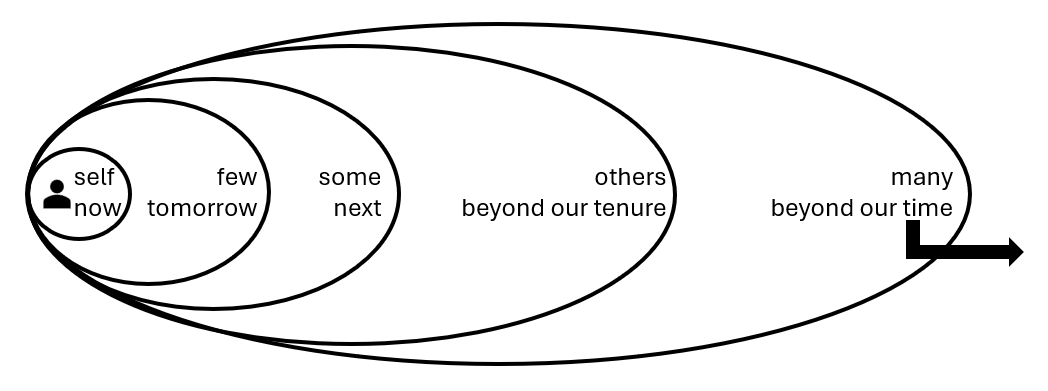








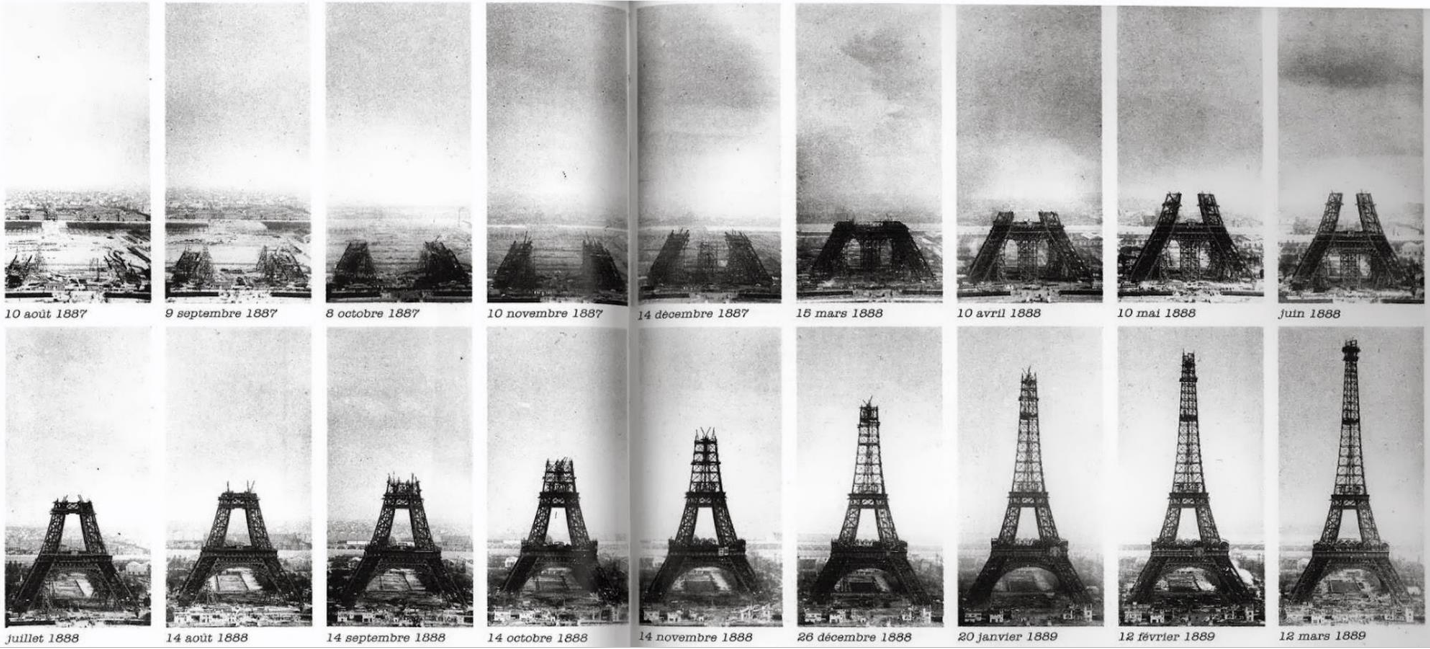





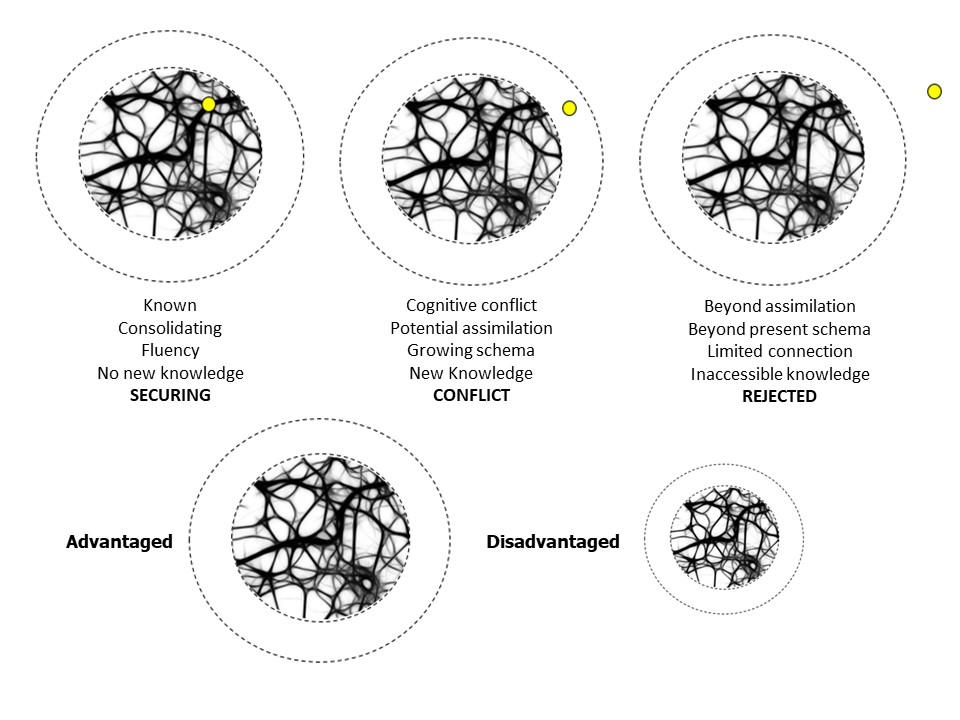


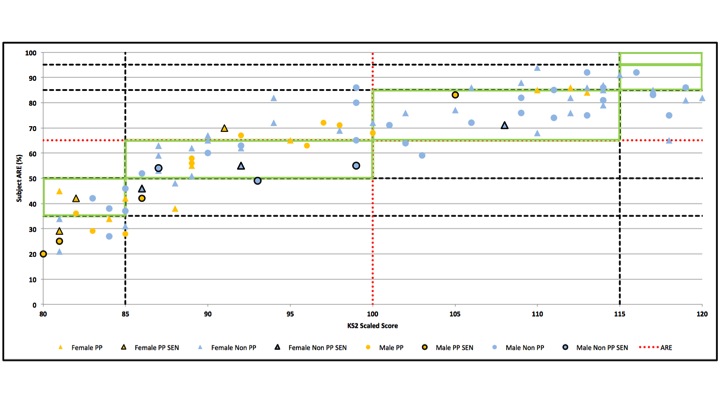

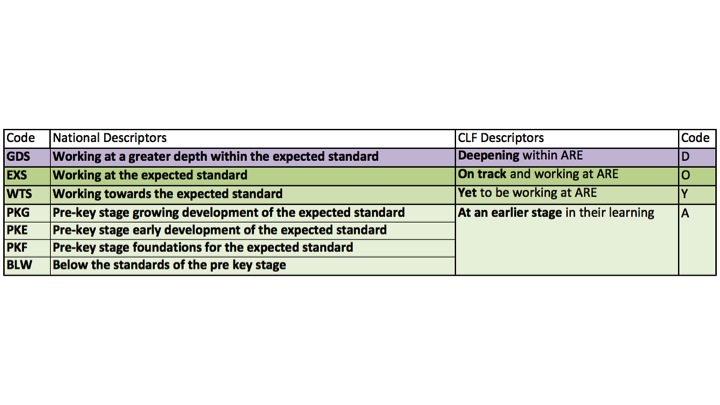
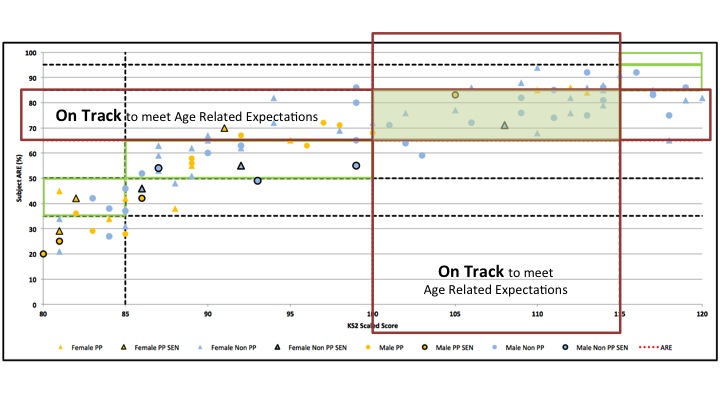
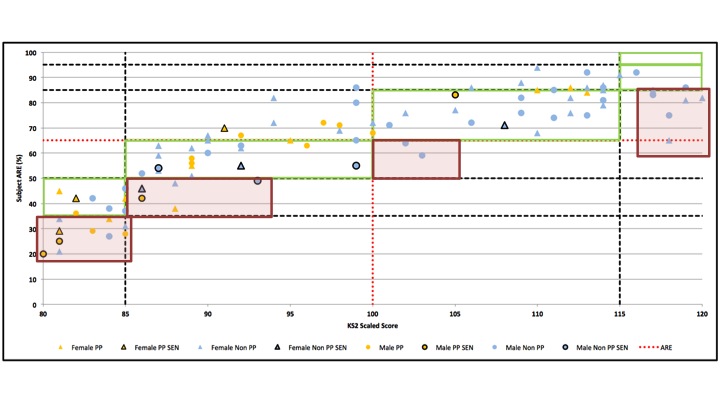
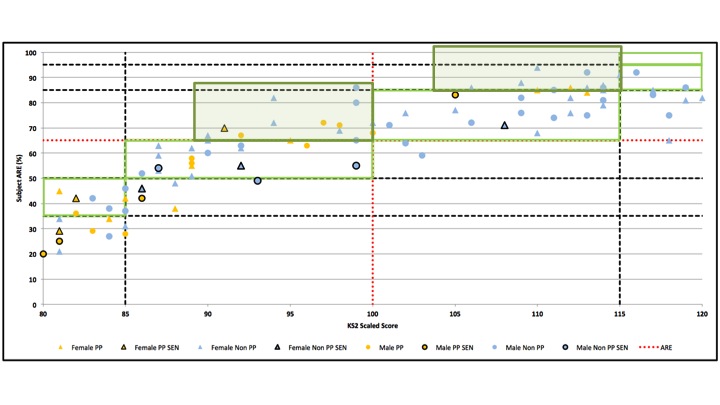
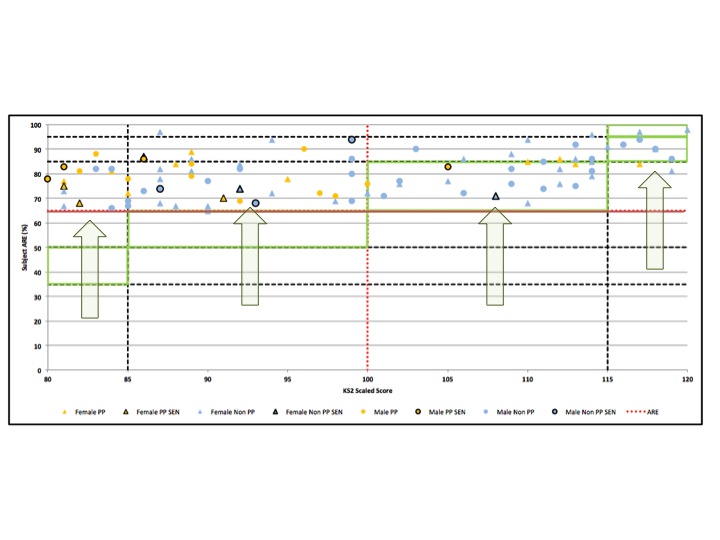


 Dan Nicholls