A high-performing Trust, Inspiring lives  

Our Next Chapter 

It is time for the next chapter in the lives of our children to be written. Across our schools and Trust, we share the privilege and responsibility of shaping what that chapter becomes. Through the power, magic and hope of education we can create storylines, plots and characters that inspire the lives of all children with greater opportunity and choice. 

Yet our world is distracting, with lots of change that tempts us to chase what is not worth having. In a world of change, we should remind ourselves that what carries the greatest value is often that which is timeless and ‘forever true’. As the next chapters are written, we should ground ourselves in why we exist and what we are good at: protecting our attention on delivering the strongest and most enabling education for all children.

Inspiring every child to flourish through an inclusive, all-through education that nurtures opportunity, equity, and agency for  life

To meet our mission, we will prioritise higher performance, raising standards, strengthening our belief in what is possible, and shifting our underlying identity towards that of a high-performing Trust. By focusing on what children need and where our expertise lies, we will deliver an inspiring education that enables children’s personal development and delivers strong outcomes that forge keys to unlock the doors in their future.

As we approach a new academic year, the following sections set out the priorities and actions that will guide our next chapter. 


Performance-Oriented Trust  

We are a performance-oriented Trust: we seek to provide an excellent education and secure outcomes that give our children greater self-agency as they move into adulthood. Our focus on outcomes and the best possible attainment in every stage of education is a powerful lever for greater inclusion, and places every child as the hero in their story. 
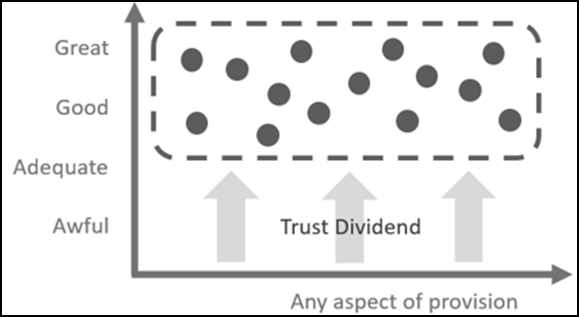
We have the capacity, expertise and high performance within our Trust to enable us to secure higher attainment in every year group and every school. We are relentless in helping those who fall behind to catch up and keep up, building greater self-belief and self-confidence. High attainment also supports strong progress, demonstrating the value and dividend that we add across the Trust. 

The Art of the Possible  

Our beliefs can limit what we see as possible. Too often, they protect us from the risks associated with striving for more.  We should engage ourselves and our teams in the art of the possible. We know that higher performance is achievable because it is already evident in several of our schools and teams. 
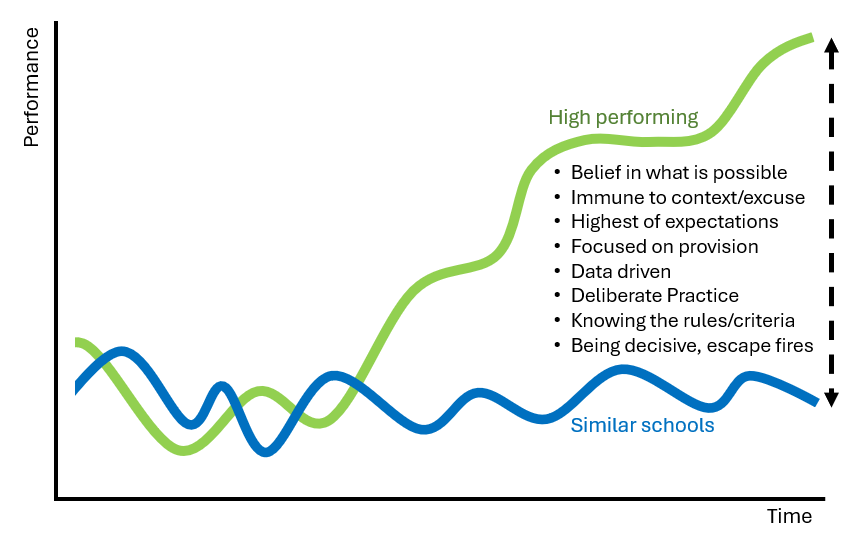
This year, we will continue to raise standards by believing that much more is possible, overcoming context and having the highest expectations of what all children can achieve. The strongest schools unswervingly secure high-quality provision, use assessment intelligently, invest in deliberate practice, know the rules and are brave enough to apply equity to close gaps. We do this because it is why we exist, where our expertise lies and what our children need. It is easier for us to write their next chapter than to rewrite their previous ones. 

Our investment in provision  

Our work across the Trust is guided by our school improvement triangle. Our significant investment in curriculum, assessment and pedagogy over time is central to our work, overseen by effective leadership and set within strong cultures. These are the main levers for high performance and the areas in which our investments have been made over time. It is the enactment of the curriculum and the use of formative assessment that unlock higher standards and raise attainment.
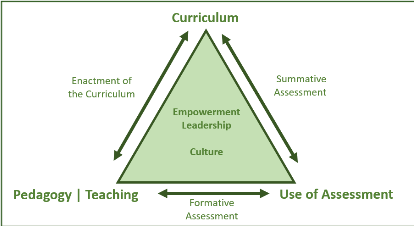
Performance-oriented Trusts, teams and schools understand when decisive action is required to change trajectories beyond those achieved through normal provision. Lighting escape fires and ‘doing different’ can achieve an alternative future and improve outcomes. 

We will also continue to assess the improvement journey of schools and teams against the forming, storming, norming and performing continuum. Most of our schools and teams across the Trust are norming or performing. The strongest schools continually evaluate their performance and refine the norms that sustain high performance and support further improvement. 

Performance-Oriented Inclusion  

We recognise that some children carry more than others, have had fewer opportunities and experiences in their early childhood and so need us more. They lack neither the ambition or ability, but they have less capacity, fewer resources and face barriers that tip the odds against them. In difficult times, education has the power to transform lives to gift the outcomes required to level up. The performance and development of these children are the most important measure of our worth. They should find their voice and become the central character in their story. 

Our strongest schools increase the life chances of under-resourced children by securing excellent provision with the highest expectations, applying equity to give children what they need and building a culture that closes gaps. Taken together, these approaches tip the odds in favour of disadvantaged children and become embedded in the school’s identityit is what they do. 


Trust Strategic Plan  

As we enter Year 2 of the Trust Strategic Plan, Building a High-Performing Trust, we recognise that it takes a whole organisation to create the platform (blue) that enables high performance (green). 
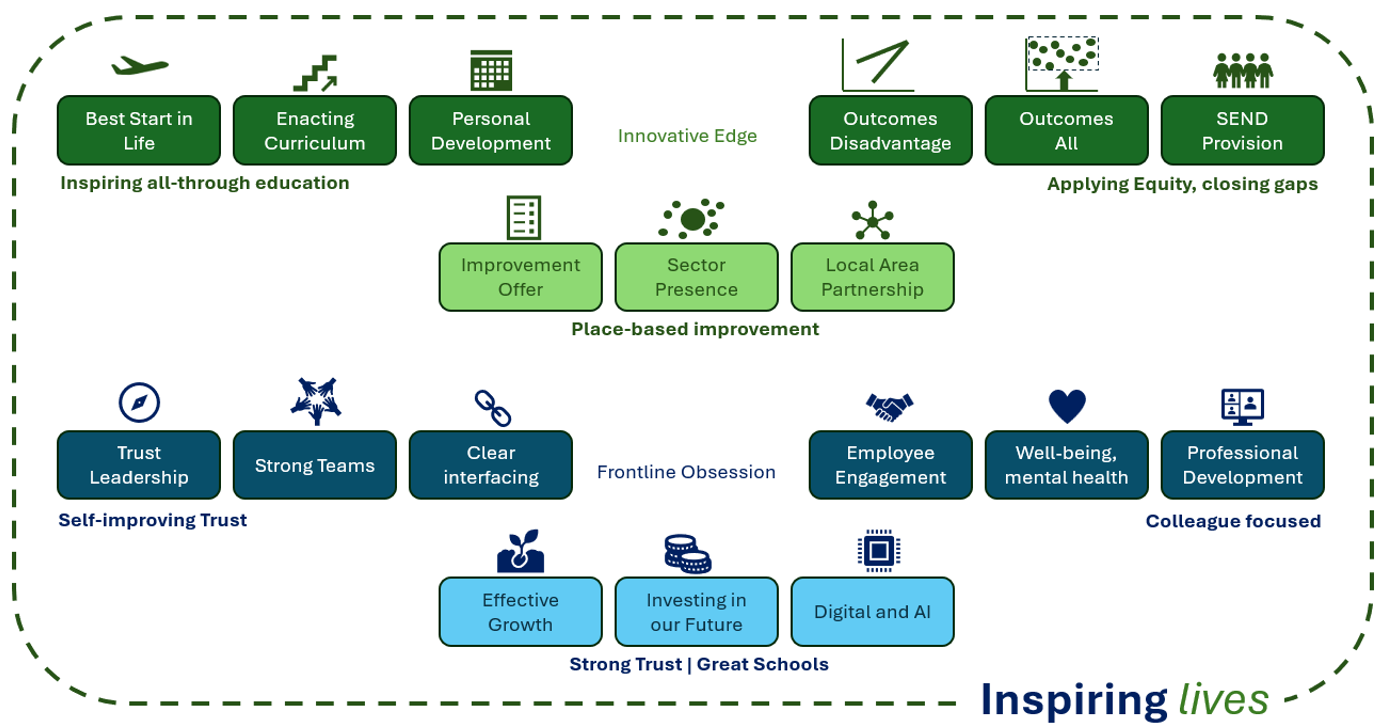
Inspiring All-Through Education | 570 Weeks 
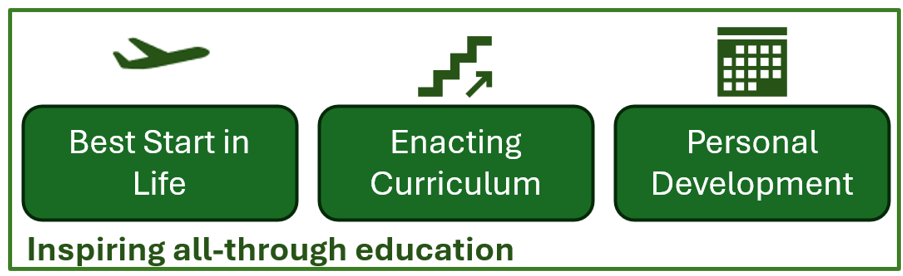
We prioritise offering the best start in life for all children, focusing on the quality of provision in these early and formative years as a key lever in our disadvantage strategy. We seek to secure the best possible provision across the 570 weeks of education, enacting and teaching our shared curriculum and focusing on the effectiveness of our personal development curriculum for all children. 

Raising Standards | applying equity and closing gaps  
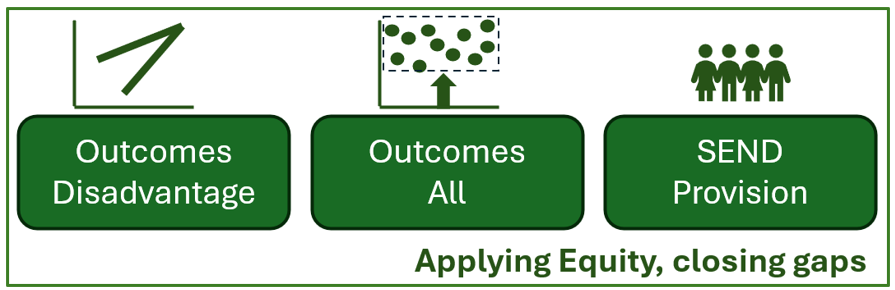
We raise attainment and secure progress in line with our ambition to be a performance-oriented Trust. We are passionate about outcomes for disadvantaged learners and need to continue to close gaps, gifting the keys to those who need us most. We exist to drive up attainment in each phase of education, seeking liberating outcomes for all children. In doing this, we will better meet the needs of all children with SEND.  

Standing Tall on our Platform  
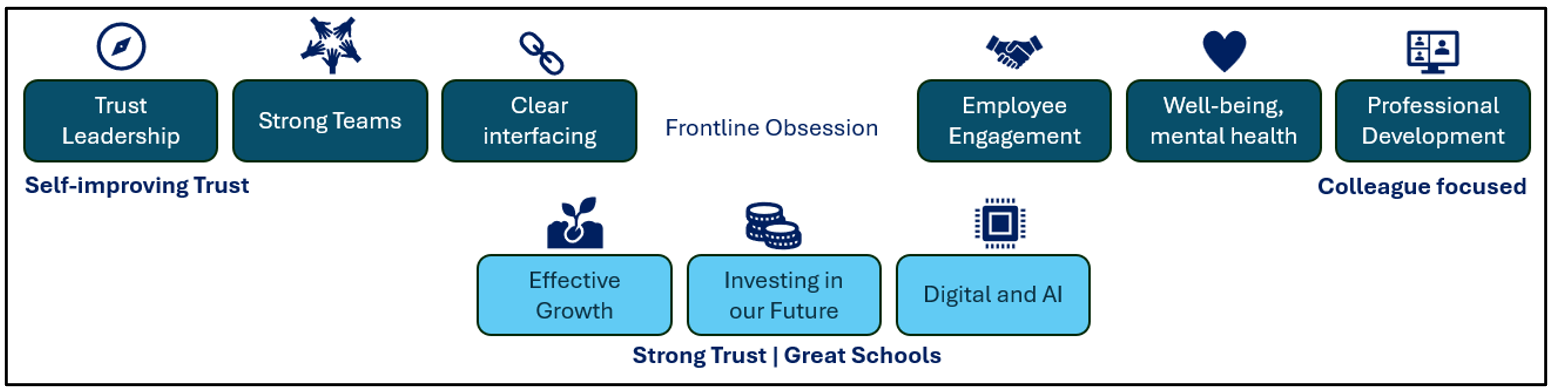
As a Trust, we continue to build the platform with the conditions, systems and support that colleagues and schools need to focus on the quality of education. We understand that our greatest asset is our colleagues and we will continue to invest in every colleague to ensure they are empowered and able to inspire lives. We maintain our focus on leadership and strong teams across the Trust as a key lever for improving performance and raising standards. We are committed to ensuring an efficient and effective platform, recognising the need to focus on the quality of communication and connection between key teams.  

We also focus on effective growth as the Trust grows to 40 schools and on using our strong financial position to invest in our future, including digital technology and responsible use of AI to improve the quality, efficiency and reach of our work. 


Writing the next chapter | pouring ourselves a cup of ambition 

As we venture into the second year of our plan, guided by our mission and values, we should proceed with confidence and greater self-belief, based on what has been achieved by the exceptional work of our colleagues. We will focus on being performance-oriented and raising standards by investing in our core purpose and provision, closing gaps and meeting the needs of those who need us most.

So go, inspire and create the next chapter for your colleagues and our children. Much of our work already advances our mission, yet there is still much to do. The next chapter must create great experiences and establish the conditions for every child to flourish. It is on us to secure the outcomes that will open more doors, build character and inspire children with greater opportunity and choice. 

You make the difference.  

Thank you.  


Dan Nicholls | September 2026 

Poor | inspiring childhoods shaped by poverty

Pause. Before we launch into the new term, we should check we are prioritising what matters… serving those who need us most.


Childhoods that are constrained by poverty are shaped by steep challenges, limited resources, and few opportunities. Children surviving under the weight of hardship, cope with more, with less help, are more vigilant, anxious, and mistrusting of the world they navigate. Childhoods that are shaped by poverty lead to adulthoods that never quite escape the impact of growing up poor, because childhoods last a lifetime (Floella Benjamin).

“Even as an adult the ripples of that (poverty) still affect me.” (Katriona O’Sullivan)

As educators we must do more to understand what it is to grow up poor, to grasp some understanding of the lived experience and the visceral truth. We should cut through our own jargon, our own perceptions and assumptions to understand the barriers, the struggle and the occupying weight of what some children are forced to carry.

“‘Poor’ cuts through a lot of jargon – words like ‘disadvantaged’, ‘underprivileged’, ‘deprived’, ‘under-class’, ‘under-resourced’. Words that have their place but don’t capture the visceral truth of what it is to grow up the way I did. The way thousands of children are growing up right now.” (Katriona O’Sullivan)


We need equity | inspiring lives with greater opportunity and choice

“We need equity in education, not equality. If someone can’t see straight because the world is falling in around them, we need to raise them up to clearer skies.” (Katriona O’Sullivan)

In these times, as schools return, we must apply the equity required to enable all children to flourish, to clear their skies, and to not feel marginalised in their world. “We cannot keep pretending it’s an equal opportunities education system. It is not.” (Katriona O’Sullivan) Applying equity is giving what is needed, offering the opportunities for more children to thrive, to have greater choice in their lives, to open doors that let in the future.

“There is always one moment in childhood when the door opens and lets the future in.” (Graham Greene)

This is not about planning and plotting an escape for a few but creating the conditions for all children to feel success in their school and their community. Applying equity to create the opportunities and experiences that inspire lives and unlock doors.


Tipping the odds | valuing what matters

As educators, we need to choose to better use our power, to be braver, to tip the odds and create the conditions that enable more children to flourish in their lives, where they are. To do so requires us to value and measure what matters, high attainment and attendance for the most vulnerable. This reveals the quality of provision and the closing of gaps is the evidence of success. We can and should do better.

“I was lucky, the timing for me was right – I managed but so many others don’t. The world is less because of that. The education system can and should do better. We all should do better.” (Katriona O’Sullivan)

Children living in poverty are not problems to be solved, the system is mis-aligned, lop-sided and intransigent. An uneven playing field that starts from birth and is exacerbated though childhood. Our system creates adverse conditions, fails to value diversity and has narrow success measures that perpetuate the present order and condemns those with the least. Poor assumptions and preconceived views of ability and ambition fail to unleash the potential and contribution of too many children. We need to re-engineer and reconfigure our system, avoiding the traps of meritocracy.

Our deficit discourse, language and vocabulary, both intended and unintended is deafening and maintaining the status quo, ensuring that a child’s poverty extends into all aspects of their lives. Only the deliberate application of equity addresses the a-symmetry of childhoods. Equity, tips the odds.


The deeper implications of poverty | levelling up

“Most of the time being poor felt like a sodden blanket was lying heavy across my shoulders, dragging me down into dark waters.” (Katriona O’Sullivan)

Whilst poverty is fundamentally about having less money, the impact of poverty extends far beyond, eroding self-confidence and a sense of worth:

“… ‘poor’ for me was also feeling like I had no worth. It was poverty of mind, poverty of stimulation, poverty of safety and poverty of relationships. Being poor controls how you see yourself, how you trust and speak, how you see the world and how you dream.” (Katriona O’Sullivan)

If we are to influence how children see the world, how they dream and how they build their future, we need to be bolder, to call out our unhelpful narratives, excuses, and assumptions that fixate on escape and tales of rags to riches. We must enrich their world, create more opportunity, more experiences, offer greater belief in individual children so that they feel more success and have stronger self-belief. You’ve got this.

“… opportunity, money and support. The middle classes are born with those three things in spades; the poor are born with none of them. And the truth is, we are losing some brilliant minds in the trenches of poverty.” (Katriona O’Sullivan).

Beyond the brilliant minds, there is considerable benefit to society when we create conditions that include, that value diversity and broaden access to success. Conditions that privilege all children disproportionately levels-up those who are traversing a world that is loaded against them.

“Sometimes, even these days, I feel like an interloper. I need reassurance sometimes that I am okay. Deserving. Worthwhile.” (Katriona O’Sullivan)


The smallest act | surfing on the ripples of others

Our influence on those closest to us and those that depend on us is more significant than we believe. How we are, what we say, do, behave, deeply affect those around us; children particularly so, who seek clues and are vigilant of snakes…

Are there snakes here? …you become hyperaware. Mistrust becomes a tool of survival. Whenever I met anyone in authority, I was instantly suspicious, instantly mistrustful… it is actually a safety meter.” (Katriona O’Sullivan)

We have an opportunity as educators, as schools and trusts to shape and inspire lives, to remove snakes, hold ladders, create the conditions for children to feel secure, to belong, to have status, to feel less anxious, less wired, more trusting and to grow in an environment that values the uniqueness of each child. And one of our greatest gifts is to give children their voice, the oracy to confidently contribute, to step forward, and stop their lives being narrated by others.

“My life was narrated for me by others. Their voices were forceful, emphatic, absolute. It had never occurred to me that my voice might be as strong as theirs.” (Tara Westover)

Sadly, not our present system, which is perfectly designed to create the reverse, to exclude children from and within schools. Schools need to be riddled with details, interactions, and sparks that pivot young lives.

“Every development in life pivots on small, contingent details, ad infinitum. We’d like to pretend it isn’t true, but reality doesn’t care what we think. We forever surf on the ripples of others.” (Brian Klass)

But, here is the thing, whilst our influence on others carries significant responsibility, humans are beautifully contagious; And, amazingly, importantly, thankfully, even the simplest acts, set of words, an acknowledgement, a moment of belief in another, changes every constellation, shapes a life and creates ripples for others to surf.

“The smallest act in the most limited circumstances bears the seed of boundlessness, because one deed, and sometimes one word, suffices to change every constellation.” (Hannah Arendt)


Excellence | Expectation | Equity | Currency | Culture | …our identity

So, at the start of term, we should pause, and plan to create the conditions for more to flourish, to apply equity and build schools that privilege all children and disproportionately support those who need us most. Prioritising what matters…

…to seek excellent educational provision: the strongest curriculum, enacted well, inspiring thought and stalking awe, where assessment follows learning to meet need.

…to never lower our expectations of what a child can achieve, because if we let them off, we let them down. Focused on high attainment and attendance, to build belonging and gift agency so that all children possess the keys to thrive through childhood, into adulthood. Because there is no lack of ambition, and a significant desire for self-agency

“We don’t need to waste time raising people’s ambitions. Idleness and low aspiration have never explained the lack of mobility. Presented with greater opportunity, most people grasped them …(seeking) the control over their lives and (the) choices that offered.” (Selina Todd)

…to apply equity, the permission to give what is specifically needed, to meet need, remove barriers, do different for those that need us most and give strong, timely, specific feedback, the golden thread of an advantaged upbringing. To need want to do different, to create the pathways and encouragement for children to ‘play on’ (Jemima Montag).

“I am giving you this feedback because I believe in you.” (Jo Boaler)

…to create incentives, currency, performance indicators that place value and reward the closing of gaps and gap-closers, so that no child is left behind, written off or able to be discounted. The attainment and attendance of disadvantage, reveals the true quality of provision.

…to build culture that privileges disadvantage and those in poverty, unswervingly never giving up on a child, because it is who we are and what we do. A commitment etched into our identity.


Perhaps then…

…we can create the conditions for colleagues to wittingly and unwittingly inspire lives with more opportunity so that we create the conditions for those living in poverty to prosper in their world, in these times. It is why we are here … to be the Myles for others.

“If not for Myles, I wouldn’t have been on that train. As distant as he was, his impact on my life was still tangible – only wishing I had the chance to thank Myles for the path he unwittingly set me on.” (Ashley John-Baptiste)

so, breathe, commit … and go inspire lives


Much of this piece is inspired by Katriona O’Sullivan, whose book “Poor” is an extraordinary exploration of what it is to grow up in poverty. Read it.  

Dr Dan Nicholls | The White Horse Federation | August 2024

Privileging disadvantage | Excellence, Equity, Culture

Securing provision that privileges disadvantaged children requires a deliberate balance of Excellence, Equity and Culture. A system in 3 dimensions. An excellent education made accessible by the application of equity held within a culture of high expectation closes gaps into adulthood for under-resourced children.  Shifting the identity of schools and organisations to systemically privilege those that need us most, because it is who they are and what they do.

Privileging disadvantage and closing gaps is futile without excellent provision. Effective enactment of a progressive, sequenced curriculum, every lesson, every day, as a universal entitlement, offers far greater opportunity for all. Whilst our strongest lever is an excellent education, this alone, is not enough. Schools also need to apply far greater equity, to be braver and fiercer to do different for under-resourced children, so that they are empowered and able to exploit the excellent education. An alchemy of excellence and equity.

“One measure of poverty is how little you have. Another is how difficult you find it to take advantage of what others try to give you.” (Michael Lewis)

When schools secure an excellent education, allied with the deliberate application of equity, children are enabled to, supported to, and expected to take the opportunity. This creates the conditions that disproportionately advantage disadvantaged learners. A potent mix of excellence and opportunity.

“…schools remain one of the few remaining trusted institutions equipped to help create a fairer society. -explicitly thinking about how teaching can be genuinely inclusive to benefit all pupils, while relentlessly identifying, understanding and overcoming barriers to learning outside (and inside) school – are the interlocking foundations of equity-based education.” (Lee Elliot Major)

Privileging disadvantage in three dimensions.

Sustaining this potent combination of excellence and equity requires a strong culture, where colleagues take responsibility for enacting the very best provision and to unlock it for all children (psychologically and structurally). Cultures of high expectation, never give up on individuals, let them down or off, they meet them there, step (push) them forward, in an ‘advantaged-like’ environment, upheld by all. Creating a culture that changes the life chances of those that have had the least, because childhoods last a lifetime, and we may be their only second chance.

“4.3 million children, 30% are growing up in poverty in the UK.” (Department of Work and Pensions)

Closing gaps and privileging disadvantage requires Excellence, Equity and Culture:


Excellence | Securing an excellent education for all learners – our strongest lever.

An excellent curriculum, sequenced, progressive and enacted to secure powerful knowledge and understanding, with eye-wateringly high expectations of all children, is our strongest lever. It requires our full attention to be uncompromising in pursuing social justice, confer power and an entitlement to the strongest possible provision. 

“Curriculum is all about power. Decisions about what knowledge to teach are an exercise of power and therefore a weighty ethical responsibility. What we choose to teach confers or denies power.” (Christine Counsell)

To disproportionately support disadvantage learners, we need all teachers and leaders to really understand the architecture of each subject, the most fundamental substantive core concepts, the most powerful knowledge and the key disciplinary concepts. We need to not stray far from this spine of the curriculum so that we weave baskets and schema that fundamentally support children to make links and learn more in the future. Arbitrary subject wanderings is kryptonite for disadvantage learners, confirming it is not for them and too abstract to connect and engage with.

Seeking to bounce up and down through a spiral curriculum, often, reinforces the spine, increases the proximity of the presently known to new knowledge and reinforces over time what is the most important and fundamental for learning. Do seek to inspire, expect much, and be geeky about the subject spine.

Excellent teaching must invest in strong explanation and direct instruction that assumes less about previous knowledge and experiences, tethered closely to the spine of the curriculum. Don’t hide explanation in slides or complicated context. Exposition is teaching and learning. Prioritise human explanation, modelling and analogy, enacted in real time, in plain sight, in simple language, visually accumulates advantage. High quality teaching triggers attainment mobility and realises potential.

Enabling disadvantaged learners to find their voice requires an effective school-wide systematic development of oracy. When there is strong oracy we privilege disadvantaged learners, because…

“… it is utterly transformative. It changes the way we feel about ourselves. It changes the way in which other people see us. It changes the way in which we relate to friends and family members. It changes our ideas about what we might go on to do in the future.” (James Mannion)

Seek to prioritise the building of vocabulary, particularly tier 2 vocabulary. This is key for joining thoughts and ideas together, deepens oracy and enables deeper thinking. Also actively lift the quality of all conversations, in all interactions, all the time, in the school. All colleagues have influence and skin in this game.

Reading and the development of reading is fundamental for accumulating advantageIt is hard to over-state the importance of reading: it develops cultural capital, comprehension, vocabulary, thinking, empathy, inference, confidence, concentration, oracy, writing, esteem, unlocks the world, quality of life, belonging…

“I didn’t know words could hold so much.” (Kya Clark)

Nudging, narrating, and coaching is a feature of an advantaged upbringing. From formative years advantaged children receive constant feedback and commentary that supports growth and is the driver for accumulating advantage. Formative assessment needs to be an intentional and deliberate part of an excellent education, it is a strong expression of care. I am giving you this feedback because I believe in you. The strongest teaching seeks to hunt, not fish, being precise about where individual children are and offering specific feedback. Follow learning to meet need.

Creating a strong culture of professional learning, with colleagues engaged in incremental coaching, often and specifically on aspects of teaching creates classrooms of opportunity for disadvantaged learners.

Children taught by the most effective teacher in that group of 50 teachers, learn in six months what those taught by the average teacher learn in a year. (Hanushek & Rivkin)


Equity | to enable all children to take advantage of an outstanding education.

“Fair doesn’t mean giving every child the same thing, it means giving every child what they need.” (Rick Lavoie)

We tend to under-use equity, in favour of equality, which often stops us giving what individual children really need. Applying equity, fiercely, bravely and deliberately, enables children to access and take advantage of excellent provision, but it requires us to understanding children as individuals. To do so requires us to genuinely walk in their shoes and see the world through their eyes and then to remove barriers and create an optimal environment. Applying the disadvantaged lens.

“90% of my time is spent thinking about and watching people … (to) genuinely get inside their shoes and see the world through their eyes … (to) create an optimal environment where a human being is going to have the best chance of being the best they could possibly be.” (David Brailsford)

To grow up advantaged is to exist in a world of opportunity and high expectation, it is demanding. We need to have the highest of expectations for disadvantaged learners, if we let them off, we will let them down. Each time we lower the bar we are complicit in widening the gap. Disadvantaged learners are not less able, it is an economic label only… and labels are dangerous.

To grow up advantaged is to be held to high expectations and encouraged to participate in supported opportunities over time. A childhood that encourages risk taking, a low safety bar (with safety net), offers commentary of the journey through life and reaffirms a child’s internal locus of control. We need a system where all children have someone who believes in them, someone (maybe many) to meet them there.

“The biggest benefit in being the child of a scientist? Low safety bar. As soon as Mad could walk, Elizabeth (Zott) encourages her to touch, taste, toss, bounce, burn, rip, spill, shake, mix, splatter, sniff, and lick nearly everything she encountered… Nevertheless, she lived.” (Bonnie Garmus)

Focus on Attendance first, compelling and engaging all colleagues to drive up attendance of disadvantaged children, as the priority. If children aren’t in, our influence is zero, they need us to reach out and pull them in.

Mentoring and tutoring, in addition, is an overt expression of equity and a typical feature of an advantaged upbringing.  Schools must focus on careers and future planning, so that disadvantaged learners see and know what is possible, because disadvantaged children are not less ambitious.

We need to apply equity to every transition point, to step in, hold disadvantaged learners and build a secure sense of psychological safety. It is within transitions that advantaged parents step in, navigate, and support children over the multiple transitions of childhood. It is not just between schools, or years, or terms, or days, it is all the time; our lives are punctuated by transitions. We need to be the bridge, to be the ladder.

Beware of being complicit in creating schools within schools. Too often schools inadvertently create pathways, perfectly designed to widen gaps and exacerbate disadvantage. Alternate realities do not exist in schools that privilege disadvantage. We measure ourselves and our status against those we spend time with. We should seek to create conditions for attainment mobility and wide social connection.


Culture | Privileging into the long term is about culture change, seeking irreversibility.

“Your goal is your desired outcome. Your system is the collection of daily habits that will get you there… you do not rise to the level of your goals. You fall to the level of your systems.” (James Clear)

In schools where under-resourced children thrive the strength of culture and shared responsibility is evident and tangible, you feel it. These schools have systems that entirely privilege all children, subconsciously carved into the expected norms, habits, routines, language and behaviour as an irreversible commitment to educate and apply equity to all children. Disadvantage even over

Schools that privilege disadvantage have exothermic systems that generate their own energy and subconsciously (but by design) close gaps, rather than endothermic systems that require external energy, conscious focus, initiative, strategy and tables on websites. The first is a permanent shift in identity and values, the latter is ill-equipped to close gaps. Schools becoming what they repeatedly do.

Our interactions, language, and the attention we give to others defines our attitude towards themand influences the way children see themselves. Language really matters, it warrants deep consideration and development over time, it is the artefact of any culture.You belong here. Systems that privilege disadvantage call out behaviours, attitudes, actions, language and intent that widen gaps.

Schools that close gaps measure what matters, because and what we measure, we care about. The true measure of the effectiveness of an education is revealed in the attainment, progress, and attendance of disadvantaged learners. The best schools prime the conditions, reward gap closers and gap closing as part of the values, even over other metrics.


Closing gaps in 3D | In brief

Step one: Seek to secure an excellent education, where great teaching of a well sequenced, progressive, conceptually driven curriculum, disproportionately supports learning of disadvantaged children, every lesson, every day to close gaps.

Step two: Really understand all children, remove barriers, maintain very high expectations, and apply equity to secure full access for all children to an excellent education (over privileging and applying equity as necessary).

Step three: Build a culture that ensures the excellent education is accessible and unavoidable for all children by applying equity. Shift the identity, to one that privileges disadvantage in everything.

Then: stop talking about disadvantage, disadvantage strategies, PP Plans and initiatives, instead talk about high quality provision, accessed by all, because it is who we are and it is what we do for all.

If we do so, we just might create the conditions that disproportionately support disadvantaged learners to accumulate advantage and close the gaps that we currently perpetuate. An education, where all children belong and feel success because it privileges disadvantage.

Seek Excellence, Equity, Culture | close gaps in 3D.


Dan Nicholls | May 2024