Questioning (explanation and modelling) | CLF Conference

Slide1

It is probably true… that questioning is an incredibly powerful way to drive learning and accelerate progress – particularly those questions or explanations that unlock light bulb moments of personal discovery. When questioning is used in concert with quality explanation and modelling children get a new view of the world, increased access to knowledge, greater opportunity to understand and develop skills. It is perhaps these aspects of pedagogy that have the greatest ability to intervene, inject and steer greater gains in learning.

bulb

It is also probably true… that questioning is often the period in a learning episode where the true talent, ability and awareness of the teacher is shown. It reveals much about:

  • the on-going depth of planning to secure and intervene along the learning journey…an expert element of pedagogy – deliberately delivered, precise and targeted within a lesson and across a series of lessons.
  • the level of formative assessment based on effective feedback so that teaching is based on an the awareness of where children are, what they can do and precisely what is required to secure the next steps, the key concept or breakdown a misconception.
  • the depth of subject/age-related knowledge and passion they bring to the discussion.
  • the ability to intervene or change direction with impact to secure key concepts or tackle misconceptions.
  • the ability to build knowledge and understanding in a logical, spiralled and progressive way that support all children to make progress (or a different 80% each time)
  • the ability to differentiate through language, conscription and questioning, including the ability to judge and time, a question, an explanation or use modelling to close gaps.
  • the ability to stand back enough and facilitate to draw the knowledge and understanding that already exists in the room…provoking good discussion, debate and argument.

When it is at its best it is an awesome thing to witness and be a part of – a crafts-person tweaking, tinkering, picking, choosing, being precise and super-aware of student progress … using questioning, explanation and modelling expertly to enable children to feel the exhilaration of learning and the motivating feeling of progress.

fit-to-lead

This begs the question… what are the key aspects to developing great questioning and discussion as well as explanation and modelling to allow children to thrive, engage and make connections in learning and trigger sustained progress? How is this blended into an effective pedagogical approach?

The following reflects some of the best practices across the Federation and identifies the key aspects for securing questioning (explanation and modelling) in all classrooms…


What if… questioning, explanation and modelling can only have impact on learners and learning when it is based on a strong foundation of knowledge? Knowledge that encompasses…

  • subject/age-related understanding of standards and expectations – that enables appropriate pitch as well as igniting an interest and passion around specific and well-ordered content?
  • a deep understanding of the key concepts and importantly the key mis-conceptions that are built into the progression of a subject or area of learning?
  • Knowledge of exam and age-related expectations to provide precise questioning, explanation and modelling – with the end in mind?
  • Knowledge of pedagogy – how to blend questioning, explanation and modelling within and across lessons.

What if… we see passages of questioning/discussion and explanation as key aspects to stick around on as opposed to a part of the lesson to move through – it drives the learning as opposed to marking points in lessons or being purely a transition. These…

  • drive passion and intrigue for the subject or area of learning. Passion that can be contagious and demands interest to accelerate learning.
  • unlock mis-conceptions, particularly where children can hear others wrestle with cognitive conflict. Consolidates learning and enables key concepts to be grasped.
  • Seek to create and resolve (over time) cognitive conflict.
  • build learning deliberately and precisely and move to application and synthesis.
  • model discussion and the elements of enquiry.

stock-footage-deep-end-deep-end-of-the-pool-a-good-visual-metaphor-to-show-madness-for

What if… these are the key areas of questioning…

  • Wait time: so that we allow children the time to think and consider answers
  • Not to allow children an opt-out of thinking – carefully conscripting and demanding wide response – no-opt out policy.
  • What if we go to pairs sometimes to support more interaction and thinking about questions.
  • Build on answers – basketball questioning or asking children to build on or from what has just been offered. agree and build | disagree and explain | offer new idea. or pose | poise | ponce | bounce.
  • Encourage debate – step-back to allow genuine argument and debate. Using provocative questioning where appropriate.
  • Take time to dwell to depth on topics and ideas.
  • Be flight of foot – shifting discussion to address misconceptions.

Slide2

What if… we too often stifle, control and close down genuine debate and discussion? Just at the moment when children get inspired, passionate and even angry in debate we choose to close discussion down – concerned that there is a lack of control.

What if… we need to be more explicit about what children are aiming for; using modelling to de-mystify the purpose or aim of the learning? Too often children are spending too long discovering knowledge and not enough on application.

What if… we sat children in mixed gender pairs? So that girls who typically describe and explain are closer to risk taking and boys who typically describe and take risks are closer to greater explanation. Perhaps this would encourage more balanced discussion and learner-driven explanations (to class or pair).

What if… this is tightly woven into an Ethic of Excellence? the purpose, precision, rigour and timing of questioning immediately reveals the teachers desire to seek excellence, maintains a high bar and expects much from answers and discussion – expertly steering and intervening to maintain standards and encourage depth of pupil involvement? …the deliberate inclusion of explanation and modelling supports children in their quest for and understanding of excellence.

What if… questioning, explaining, modelling and planning was informed by Blooms and SOLO taxonomy? That these frameworks supported questioning that systematically supported children to understand more …and that this provides the framework for explanation, modelling and questioning etc.

blooms_taxonomysolo-taxonomy-with-verbs

What if… we sought more often to ask questions that moved from closed to open, but that also moved children (more often) to apply, analyse, synthesis and evaluate their developing understanding.

What if… questioning and explanation (and modelling) needs to be in the proximal zone? and that the real challenge is to pitch discussion and explanation so that as many children are kept in their proximal zone for as long as possible (discussing, explaining and applying knowledge just beyond what the child is capable of, supported by a peer) … or in a state of FLOW (that area between boredom and anxiety)?

What if… good lessons used questioning and explanation that is pitched and challenging for 80% of students, but that in great lessons this is a different 80% each lesson? Great teachers use effective formative feedback to build on prior learning and pitch questions and explanations in the proximal zone, whilst modelling the desired end point (or next near win)... an ability that should not be under-estimated.

pz

figure1

What if… great questioning replicates the connections in the brain? understanding that learning is a physical process – that the development of myelin in the brain (layers in picture below) enables neurons to fire and for things to be remembered or skills to be hard-wired … such that questioning, explanation and modelling engages children in deliberate practise and repetition to physically create connections in the brain that allow them to remember and master…developed, consolidated and practised (hardwired) through questioning (explanation and  modelling).

Myelin1

What if…questioning and explanation reflected the curve of forgetting? so that it returned and repeated episodes to consolidate understanding within an interleaved, layered, escalating spiral curriculum where children repeat and return to build on learning.

curve_0-500x231

What if… we understood that practise has to be deliberate to be effective and that this is accelerated where children are in the presence of an expert coach who exploits, questions, explanation and modelling; so that the teacher…

  • maximises reachfulness in the presence of an expert.
  • supports children to embrace the struggle – “You will become clever through your mistakes.”
  • and encourages theft – using questioning and discussion to support peer assisted performance.

What if… this is tightly woven into Effective Feedback and the need to Stretch and Challenge each child?

What if… questioning, explanation and modeling was “… intentional, aimed at improving performance, designed for (a student’s) current skill level, (aimed at excellence), combined with immediate feedback and repetitious.” (Malcolm Gladwell)

What if… explanation is best delivered in different ways to support all children to access the new knowledge, understanding and skills. Using VAK, but more importantly a variety of angles and approaches…as well as using other children in the class to explain new gains in learning – not only consolidating learning for the explainer, but offering a different explanation in peer-friendly language to the receiving child.


Maybe then… questioning (explanation and modelling) will trigger greater depth of learning, allow new ways of seeing and drive progress. The precision and deliberate delivery of these aspects of pedagogy will be based on strong formative assessment and feedback that enables appropriate pitch, stretch and challenge of children. An ethic of excellence will expect much of children their thinking, response, discussion and quality of answer … that happens in their proximal zone.

Maybe then… this aspect of pedagogy will provide the engine room of learning – where teachers tweak, tinker, pick, choose, are precise and super-aware of student progress … using questioning, explanation and modelling expertly to intervene and provoke response that enables children to feel the exhilaration of learning and the motivating feeling of progress.

Dan Nicholls

October 2015

Ethic of Excellence | CLF Conference

Slide1

The following supports the “ethic of excellence” workshop at the CLF Conference, 2 November 2015…


It is probably true that:

“Once a student sees that he or she is capable of excellence, that student is never quite the same. There is a new self-image, a new notion of possibility. There is an appetite for excellence.” (Ron Berger)

It is also probably true that where an ethic of excellence runs through teaching and learning a child’s progress is accelerated and they outperform their peers. This maybe the most important aspect for driving up standards, accelerating progress, securing unusually good outcomes and giving all children a new sense of possibility; enhancing their life chances for the long term.

The following reflects some of the best practices across the Federation and identifies the key aspects for securing an ethic of excellence in all classrooms…


Slide23

What if… an ethic of excellence is measurable and tangible? That it can be judged from a short triangulation of teaching, books and student voice…and that where teachers have a strong ethic of excellence this is likely to be reflective of strong habits and a personal commitment to excellence.

What if… the ethic of excellence is revealed in the attitude of children toward their learning – that low-level disruption is not a feature – it is, in fact, socially unacceptable to not engage and seek to make progress in lessons.

“What if I fail to be the prophecy?” (Peter Pan)

“What if you fail to try?” (Tiger Lily)

(from the film Pan, 2015)

What if… the ethic of excellence is sought through the way the teacher and others inspire and inject passion around content (subject or age related) and learning; using language and praise to reinforce the expectation of excellence. (praise is not cheap).

Slide3

What if… the ethic of excellence is supported by the challenge and stretch that is evident in lessons supports children to reach beyond what they can do now, expecting students to work in their top 10% excellence zone.

What if… the ethic of excellence is seen in the quality of work and books; showing an  an attention to detail in the…

  • care and precision of presentation
  • quality and depth of writing and working
  • continuity and progression in the work over time that reflects a layered curriculum

What if Ofsted are right and that some of the key evidence of an ethic of excellence is seen in books.

Slide2

What if… the ethic of excellence is shown in a focus on depth rather than breadth and in routinely re-doing and re-drafting; seeking excellence. That teaching uses deliberate practice to inform teaching, so that:

practice (is) intentional, aimed at improving performance, designed for (a student’s) current skill level, (aimed at excellence), combined with immediate feedback and repetitious.” (Malcolm Gladwell)
excellence

What if… children do not produce their best work often enough? It might be that although students are capable of excellence we rarely support students to produce their very best work and that much of the work produced falls in the bottom quartile of what is possible for that individual. It might be true then that the opportunity to enable students to see what is possible rarely happens as students simply tread water in the mediocre.

Slide1

What if… students skewed their work right toward excellence (and teaching prioritised and supported this) and not left where it probably sits at present?

skewed

What if… there is an ongoing and accessible record of a child’s best pieces of work so that there is an immediate benchmark to build from.

draft2

What if… the ethic of excellence is seen in the feedback that is built into tasks/lessons and is specifically targeted at securing concepts and unravelling mis-conceptions…expecting much and targeting specifically where chidden can improve?

feedback

What if… the ethic of excellence supported by assessment (all forms) that is a coherent element of teaching – formatively driving progress and improvement toward excellence? Using mastery to support all children to secure the foundations and core knowledge, skills and understanding that will allow them to be academically and personally successful in and beyond education.

What if… the ethic of excellence is supported where teachers are persistent, and unswerving in raising standards (pass marks etc.) and deliberate in lessons and over-time in catching-up and closing gaps for those students who fall behind?; making a discernible difference to those that fall behind. 

What if… the ethic of excellence is embedded through teacher passion, subject knowledge, pedagogical knowledge, exam or age-related understanding and an insightful understanding of concepts and mis-concepts that are the foundation for driving children toward excellence? This is also evident in the schemes of work – progression of lessons – and within the layered/spiralled/escalating curriculum. Avoiding the skimming of content and the shallow learning.

What if… the ethic of excellence is shown in questioning that immediately reveals the teachers desire to seek excellence, maintain a high bar and expect much from answers and discussion – expertly steering and intervening to maintain standards and encourage depth of pupil involvement? …the deliberate inclusion of explanation and modelling supports children in their quest for excellence.

What if… in seeking an ethic of excellence we borrowed much from Dan Coyle’s insights and establish the conditions for ignition, (moments that inspire an ignition of internal motivation) and provide the feedback of an expert coach from within tasks to breakdown tasks and specifically remove misconceptions and seek accelerated improvement.

“we are often taught that talent begins with genetic gifts – that the talented are effortlessly able to perform feats that the rest of us just dream of. This is false. Talent begins with brief powerful encounters that spark motivation (ignition) by linking your identity to a high performing person or group (or self image). This is called ignition, and it consists of a tiny, world shifting thought lighting up your unconscious mind: I could be them (or do that, or achieve that – in fact look at my best work… my near wins).” (Dan Coyle)

What if… the ethic of excellence was reinforced by teachers and others who have an  unswerving ambition for all children and expecting much from all children, every lesson.

What if… the ethic of excellence is reflected across the Academy in all that we do – in our day-to-day expectations? (from uniform to ‘finishing conversations’ to politeness).

What if… an ethic of excellence was allied to growth mindset that sets the conditions and ethos for a class, cohort or Academy to stretch for excellence? (Dweck)

“People with Growth Mindsets and who show GRIT achieve more when they engage in deliberative practice … it is this practice that achieve marginal gains (Steve Peters), inching toward excellence.”

What if… we focused more on the journey; on the “near win”?(Sarah Evans)

“The pursuit of mastery is an ever onward almost.” … “Grit is not just simple elbow-grease term for rugged persistence. It is an often invisible display of endurance that lets you stay in an uncomfortable place, work hard to improve upon a given interest, and do it again and again.”(Sarah Evans)

What if… the ethic of excellence is exemplified by the classroom environment that reflects learning, progress and supports excellence? Display is inspired, the walls are useful, all areas are tidy and reflective of excellence… boards (and IWB) reflect organised and logical presentation of information that is timely and focused on the key learning for the lesson?

What if… the ethic of excellence is seen in the routines that are shared and owned by all – they are systematic and reflects the desire to make progress and learn?


Maybe then…children would see that they are capable of excellence, that this would change them forever and raise their personal benchmark. They would have a new self-image, a new notion of possibility and an appetite for excellence. Maybe observation and education would value the outcome, the quality, the closeness to excellence and be less fixated on observed practice.

“If you’re going to do something, I believe, you should do it well. You should sweat over it and make sure it’s strong and accurate and beautiful and you should be proud of it” (Ron Berger)

Dan Nicholls

October 2015

Failure is not an option… attitude matters…

“Leaders (and teachers) who know what they are doing will aim for the heart. They connect to the deepest values of their people and inspire them to greatness. They make the business case come alive with human experience; they engage the senses, create messages that are simple and imaginative, and call people to aspire.” John Kotter

It is probably true that attitude matters…possibly the most. It is also probably true that this determines our belief in what is possible, determines the questions we ask and the quests that we embark upon. Attitude is everywhere; it determines our limits and those that we expect of others…it is the underlying attitudes that determine the outcomes and progress of students in classrooms and schools/academies.  It is also probably true that urgency, purpose, emotional connection and ownership are key for developing, fostering and motivating positive and focused attitudes that are aligned to the ambitions of the individual, class or organisation.


…Urgency is often the key to aligning and propagating attitudes – attitudes that can transform and create unusually positive outcomes. The compelling urgency for the safe return of the Apollo 13 astronauts is a neat example of how attitude sets the challenge unwaveringly and achieves what appeared to be a miraculous return to Earth… taken from the script of Apollo 13 (edited)…(click picture for the video clip)… maxresdefault

GENE KRANTZ (FLIGHT DIRECTOR) – So you’re telling me you can only give our guys 45 hours. It brings them to about there… Gentlemen, that’s not an option.

(the use of the visual on the blackboard here is key – people need to see and feel a problem  – only then are they likely to be moved to action.) 

MOCR ENGINEER – Gene, Gene. We gotta talk about power here… 

CONTROL – Without it they don’t talk to us, they don’t correct their trajectory, they don’t turn the heatshield around… we gotta turn everything off. Now. They’re not gonna make it to re-entry…With everything on the LM draws 60 amps. At that rate in sixteen hours the batteries are dead, not 45. And so is the crew. We gotta get them down to 12 amps. 

MOCR ENGINEER – Whoa. 12 amps! – How many? – You can’t run a vacuum cleaner on 12 amps, John. 

GENE KRANTZ (FLIGHT DIRECTOR) – Well, we’re gonna have to figure it out. I want people in our simulators working re-entry scenarios. I want you guys to find every engineer who designed, every switch, every circuit, every transistor and every light bulb that’s up there. Then I want you to talk to the guy in the assembly line who had actually built the thing. Find out how to squeeze every amp out of both of these goddamn machines. I want this mark all the way back to Earth with time to spare. We never lost an American in space. We’re sure as hell not gonna lose one on my watch!. Failure is not an option!

(the attitude here compels action, it expects much and takes a “whatever it takes” approached to a well defined and clear, compellingly urgent problem. How far does this type of attitude permeate our classrooms and academies?)

…and from Star Wars… (the importance of certainty and purpose of moving to action –  committing to a key internal decision to do something..)

Luke: All right, I’ll give it a try. Yoda: No. Try not. Do… or do not. There is no try. 

Yoda-do

Luke: I don’t, I don’t believe it.  Yoda: That is why you fail.


All of which begs to question how do we recognise, use and provoke great attitudes, that make everything possible and does whatever it takes in our academies and classrooms?


What if we understood how our attitude and that of others around us interact to achieve our ambitions or hold us back? Consider your colleagues and students … are they drains (takers of energy) or radiators (givers of energy)? Street_Drain_w_Double_Yellas_by_BewildaBeast8radiator What if we also considered Adam Grant’s great book, “Give and Take,” which provides greater insight and highlights that there are three types of people: Givers, Matchers and Takers. Takers only seek to gain from others, these add little or hold organisations back. Matchers, match what they give with what they have received. However, he argues that the Givers are the most and least successful…

“This is what I find most magnetic about successful givers: they get to the top without cutting others down, finding ways of expanding the pie that benefit themselves and the people around them. Whereas success is zero-sum in a group of takers, in groups of givers, it may be true that the whole is greater than the sum of the parts.” ― (Adam Grant)

Question: how do we create the conditions in our organisations that reward and support Givers?

What if we realised that establishing the WHY (Sinek), the PURPOSE (Pink) and aiming for the heart (Kotter) is key to motivating and harnessing buy-in. This has a direct impact on attitude and on mobilising the inner drive to improve and succeed. It is interesting how these ideas line-up. Simon Sinek argues that people don’t buy what you do, they buy why you do it … Dan Pink identifies three things that are important for people to feel/achieve success – a motivating purpose and the autonomy to seek mastery. Allied to John Kotter’s thoughts around aiming for the heart, we have the recipe to secure and maintain individuals attitudes and for keeping these aligned to the organisational, class or individual ambitions.

Slide1

What if we realised that as teachers and leaders in addition to securing the why, we must also give autonomy and ownership of the how? This is important because to maintain a “whatever it takes attitude” there needs to be ownership and a freedom to determine the what and the search for mastery. This must also involve pushing the decision making closer to the action (David Marquet). What if we understood the motivating power there is in ensuring the attitudes and approaches value the near-win and the journey toward mastery? How do we reward the near win with our colleagues and students? As Sarah Lewis discusses, those seeking mastery have an attitude that drives them to strive and feel success in the near wins…

Mastery is in the reaching, not the arriving. It’s in constantly wanting to close that gap between where you are and where you want to be. …. We see it … in the life of the indomitable Arctic explorer Ben Saunders, who tells me that his triumphs are not merely the result of a grand achievement, but of the propulsion of a lineage of near wins.

We thrive when we stay at our own leading edge. It’s a wisdom understood by Duke Ellington, who said that his favorite song out of his repertoire was always the next one, always the one he had yet to compose. Part of the reason that the near win is inbuilt to mastery is because the greater our proficiency, the more clearly we might see that we don’t know all that we thought we did. It’s called the Dunning–Kruger effect… “You learn how little you know.” (Sarah Lewis)

4241335095e5e5026566315fbe8a827dc4e05353_1600x1200

Click picture to see Sarah Lewis: Embrace the near win

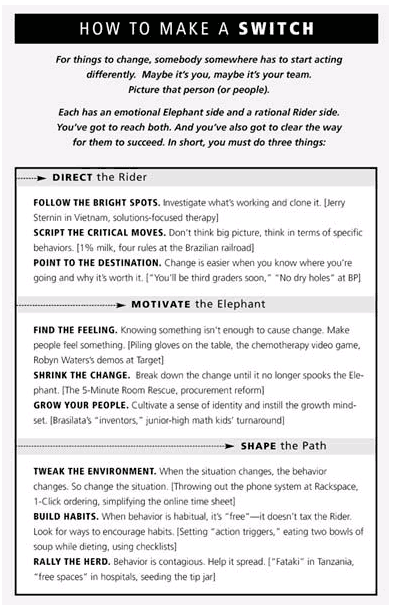
What if we realised that by keeping the moral purpose at the centre, investing time on the why, reaffirming the purpose and by appealing to the emotional drivers we maintain high urgency in the system – be it at individual or organisational level. It is this owned inner drive, the intrinsic motivation that will compel toward action and keep attitudes aligned with the ambition. Chip and Dan Heath highlight the key is to motivate the elephant as well as the rider…

  • Find the feeling (WHY/Purpose) – make people feel something
  • Shrink the change (How) – shrink change so that it does not spook the elephant
  • Grow your people – instil a growth mindset – attitude

howtomakeaswitch

(taken from Switch, Chip and Dan Heath)

What if attitude is about feelings and that stories are uniquely placed to motivate and develop attitudes that align with the ambition? As John Kotter highlights…(how often do we use stories … particularly those that tell of a preferred future?)

“Neurologists say that our brains are programmed much more for stories than for abstract ideas. Tales with a little drama are remembered far longer than any slide crammed with analytics.” (John Kotter)

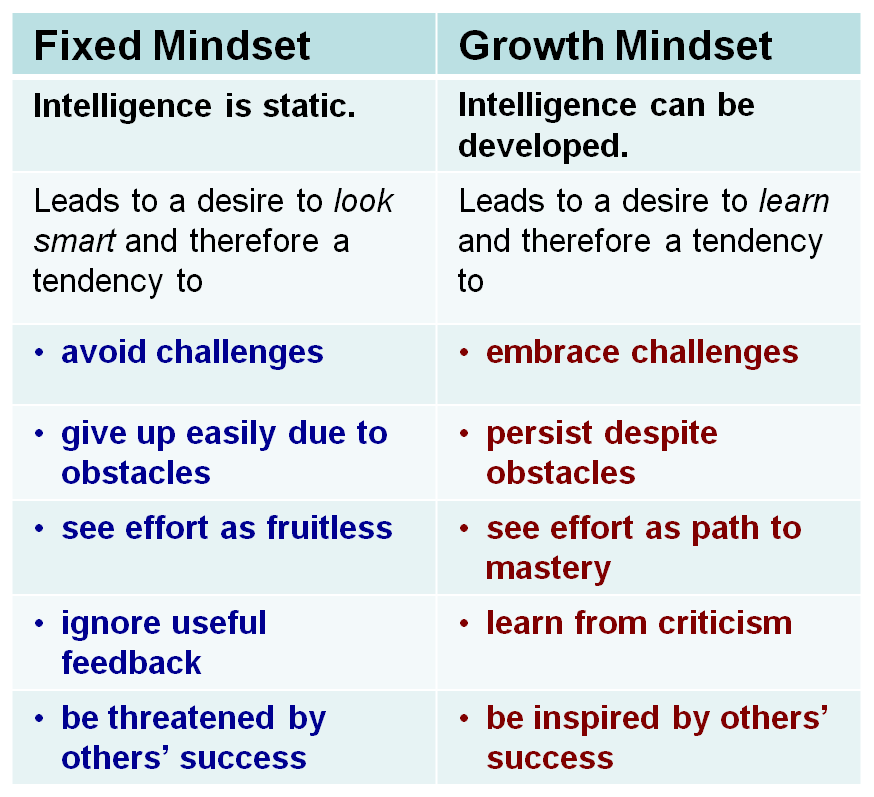
What if we also understood that positive attitudes stem from a growth mindset? (Carol Dweck)

growth-mindset

What if we also understood that we need to develop attitudes in line with being deliberate? (Malcolm Gladwell) Leaders, teachers and students whose attitude drive them to…

1. …be motivated and exert effort to improve their performance.

2. …engage in tasks that take into account their pre-existing knowledge.

3. …seek and receive immediate informative feedback and knowledge of the results of their performance.

4. …repeatedly perform the same or similar tasks towards near wins…mastery.

“Success is a function of persistence and doggedness and the willingness to work hard for twenty-two minutes to make sense of something that most people would give up on after thirty seconds.” (Malcolm Gladwell)

What if attitude is dependent on ignition? and we should seek to increase students and colleagues opportunities to be ignited by an experience, thought, fact, opportunity etc…

“Beneath every big talent lies an ignition story – the famously potent moment when a young person falls helplessly in love with their future passion.” (Dan Coyle)

For Albert Einstein, that moment happened when his father brought him a compass.

“Einstein later recalled being so excited as he examined its mysterious powers that he trembled and grew cold…. [Einstein wrote] “I can still remember – or at least I believe I can remember—that this experience made a deep and lasting impression on me. Something deeply hidden had to be behind things.”

What if we recruited much more on attitude, understanding that skills and knowledge gaps are easier to close?  Particularly because getting the right people on the bus is the key to great organisations (Jim Collins).

What if we realise that asking challenging questions and setting expectations high can  instil desired attitudes? If we ask ridiculous questions we prompt different possibilities and perspectives. (Questions must be based on the brutal truth of the present reality.)

  • “If your life depended on it what would you do?”
  • “What would we do if the target was 100%?”
  • “What do we need to do now, such that everything else is either easier or no longer required?” (Keller)

It is often the second question that really makes the difference – having attitudes and approaches that dig deep to understand problems and to find solutions that aren’t immediately apparent. What if we also realised that this is about getting the right people in the room – those best placed to ask the right question and not so many to complicate the answer. Steve Jobs only met with 3-4 people – any additions were removed.


Maybe then we would pay much more attention to the attitude of leaders, teachers, staff and students …and seek to create the conditions that foster positive and aligned attitudes.

Maybe then we would also look to other examples like the Apollo 13 mission and learn that attitude rarely exists without purpose and urgency – it does not happen in a vacuum. We might work harder to engage the emotions to drive attitudes and approaches.

Maybe then we would work harder to create the conditions necessary to ensure healthy and positive attitudes.

Maybe then we would work harder to generate or communicate urgency and that this needs to be born out of a clear moral purpose and that this is best aimed at the heart.

Maybe then we would find more ways to reward attitudes that drive us toward success.

Maybe then we would be more attuned to understanding the importance of and the need to create conditions for ignition … to ignite a passion in a colleague or our students … that will propagate attitudes than align with our ambition.

Maybe then we would recognise the importance of attitude and stance when recruiting – getting the right people on the bus.

Maybe then we would understand that autonomy and ownership of the how and what are key to generating the motivation required to propagate great attitudes

Maybe then we would create organisations and classrooms where attitude is understood, fostered and grown – because attitude matters and failure is not an option.

“Try again. Fail again. Fail better.”  (Samuel Beckett)


April 2015

To grade or not to grade… is probably not the question?

obs in time

“Whether we grade observations or not, we need to ensure teaching is increasingly progress-orientated and outcome-orientated – concentrating the strategies that provoke progress and secure outcomes for students.”

It is probably true that we should not determine the quality of teaching based on short lesson observations, but use a triangulation of evidence that identifies the typical quality of teaching; evaluating the effectiveness of teaching for securing progress-over-time and its success in securing strong outcomes for students. (outcomes in a broad sense as well as”attainment”) 

It is also true that we need to ensure and support teachers to find their way to great progress/outcome-orientated teaching that has a deep impact on students life chances. It is this autonomy that secures the motivation and ownership to reflect and stretch toward mastery.


We should, however, explore the assumption that grading teaching denies formative development; understanding that it perhaps provides the framework for improvement. Without a descriptive continuum of effective practices there is a danger of mediocrity. Particularly as…

“Not all approaches aimed at securing progress over time are equally effective or equally well delivered”

So this begs the question how do we develop a deep understanding of what secures progress, how do we measure the quality of teaching and how do we ensure that feedback to teachers is precise, owned and liberating, such that it sparks deliberate improvement, debate and improvement? It is difficult to see how we do this without a  descriptive continuum of what matters. We can rename the continuum, but when we consider progress-over-time and outcome-orientated teaching not everything is equal…or equally well delivered. Slide1


What if we fully understood how we move from this…Slide8To this… (where teaching is progress and outcome-orientated?… and that it is this that is rewarded and developed?)

Slide16

What if we understood that measuring quality of teaching through observation alone only measures a teacher’s ability to perform a lesson by tumbling and jumping between different teaching and learning strategies to tick enough of the criteria to get them over the Good line? What if we understand the limited sample that a lesson observation provides?…(shown as the vertical line below)

jumpy progress What if we firmly framed any episode of learning or scrutiny in the context of student progress, in the past and into to the future as the measure of the typicality of teaching?… such that it becomes a measure of how:

  1. Progress-orientated the teaching has been, such that students have made good progress over time.
  2. Outcome-orientated the teaching is, such that students achieve in the future.

What if we viewed the window of observation as an opportunity to measure progress over time and future progress?… obs in time


What if we examine, reward and measure the conditions, teaching habits and approaches in lessons that give us evidence that students are making progress over time and are aimed at achieving worthwhile outcomes?

What if this involved us recognising and identifying poor proxies for learning and being smarter at evaluating what we see? (from Robert Coe)… Slide21

“every child a powerful learner” (Steve Mundy, 2015)

So given that not all approaches/strategies are equally able to leverage progress over time and that some proxies are compelling, even blinding, what should be valued to ensure that every child is a powerful learner? What if progress-orientated and outcome-orientated teaching was revealed in…

  • The quality of teacher subject knowledge, concept (and misconception) understanding as well as pedagogy understanding.
  • and that this was revealed in the quality of direct instruction and the ability to impart knowledge and to understand how students learn and make progress in their subject
  • and that this was expertly revealed in the quality of questioning that accelerates learning and unlocks understanding (perhaps the most efficacious part of the learning for progress?)
  • and that this has had the impact of increasing the quality of students answers and oracy that is beyond age-related expectation and directly improving writing.
  • and that through embedded formative assessment (within not after) – teaching plans, differentiates and intervenes to enable all abilities to make progress.
  • and that there is real clarity on the end point – students are well set to perform unusually well in assessment or exams as a result of outcome-orientated teaching.
  • and that teaching shows ambition, warmth and drive to secure progress for all; setting ambitious expectations for all students.
  • and that this is also revealed in the quality of work in books.
  • and that these highlight an appropriate amount and depth of learning as a consequence of time spent in lessons focused on writing and demonstrating learning.
  • and that teaching dwells and goes to depth at the expense of skimming content.
  • and that is informed by on-going feedback that is within and not bolt-on in lessons. And that time is committed in lessons to respond to feedback and make progress. What if we rewarded and looked for actual improvement in books from the front to back as evidence of ongoing feedback … and much less impressed by regularity of feedback sheet or dialogue that does little to improve the work?

Slide2

  • and that there is clear evidence of an ethic of excellence where students re-do and redraft work, so that they produce their very best work that they have ever done more often – something that diminishes as they progress from 3-19. Primary children often produce their best ever piece of work.

B3NFRJOCEAAQsMO.jpg-large

  • and that leads to students attitudes and approaches that demonstrate a thirst for knowledge, enquiring and knowledgeable questions.
  • …and because teaching has imparted inspiring knowledge and achieved progress over time – learning takes on its own momentum.

What if we also realised that the greatest teachers have these as habits…consistent approaches and abilities to teach with purpose, precision and consistency.

20130201-191828

What if the importance of progress over time and having the end in mind was rewarded and that observation is seen as just one part of evaluating whether the conditions are present to secure progress? What if we triangulated with data, outcomes, planning, student voice, books and other evidence? Perhaps then we would measure the quality of teaching in this way…(apologies for the grading – but not everything is equal or equally well delivered)

Slide2 …by ignoring observed performance, we reward teaching habits and approaches that have created and secured the conditions for progress and outcomes. if there is no evidence of progress over time, historic good outcomes and/or evidence of outcome-orientated teaching then teaching cannot be typically good.

What if this meant that evidence over time led to a view of the typicality of teaching and that this is stickier than when judgements are based on one-off observations? Any observed episode then simply adds to what is already known about the typical quality of teaching to secure progress and outcomes.


What if we ensured that ownership for improvement was located with individual teachers – understanding that there is also an element of earned autonomy to this freedom… Not least because you…

“Prescribe adequacy, (but) unleash greatness…”

What if this empowered teachers who then have greater freedom to explore progress-orientated and outcome-orientated approaches to teaching…

  • Purpose (secure student progress to give them a better chance in life)
  • Autonomy (you decide how you secure student progress)
  • Mastery (it is a craft not a science, be creative and innovative – seek mastery in teaching to drive progress and secure outcomes) (Dan Pink)
“We know we are in a good school when the four following things happen: Teachers talk about teaching and learning; Teachers observe each other’s practice; Teachers plan, organise, deliver, monitor and evaluate their work together; Teachers teach each other” Judith Warren, Little The Power of Organisational Setting (1981)
What if we applied our understanding of deliberate practice to support teachers to improve…deliberate practice occurs when teachers…

1. …are motivated and exert effort to improve their performance.

2. …engage in tasks that take into account their pre-existing knowledge.

3. …receive immediate informative feedback and knowledge of the results of their performance.

4. …repeatedly perform the same or similar tasks.

So that…

practice (is) intentional, aimed at improving performance, designed for (a student’s) current skill level, (aimed at excellence), combined with immediate feedback and repetitious.” (Malcolm Gladwell)

What if observers engaged with teachers in real time, so that observers support improvement, reflection and learning during lessons?


Maybe then we would…

  • …ensure that teaching is progress-orientated and outcome-orientated.
  • ….not use short observations alone to assess quality of teaching and instead triangulate observation that evaluates progress over time and the effectiveness of the teaching to deliver outcomes.
  • …tread carefully when considering removing grades as this may reduce our ability to understand what makes the difference and to show direction of travel for teaching improvement…even without grading a descriptive continuum is required – probably divided four ways… (beginning, embedding, effective, transferrable)(or 4,3,2,1)
  • …understand that not all strategies and approaches are equal or equally well delivered.
  • …understand that the efficiency and efficacy of teaching for progress and outcomes is what matters.
  • ..release teachers to own their improvement and to consider what we know about deliberate practice as a framework/continuum to enable teachers to receive immediate feedback that informs focused, repetitious improvement.
  • …realise that what maybe considered as traditional teaching is often the most effective at securing progress over time.

March, 2015