Towards Social Justice

Featured

Every system is perfectly designed to get the results it gets.”

Our education system is perfectly designed to secure and maintain the conditions that accumulate disadvantage over time. A system so ingrained and accepted that we unwittingly perpetuate it and see the results as inevitable. Against the backdrop of the fracturing social contract, the aftermath of the pandemic and in darkening times, the cogs of the system continue unabated, galvanised and renewed to further widen gaps and disenfranchise an ever-larger number of children.

To not feel belonging is to experience the precarious and insecure sense of an outsider.” (Owen Eastwood, 2021)

The system is strengthening, forging greater division in society precisely at a time when individual agency and mobility is decreasing. A system that has powerful ways of telling children that they do not belong, playing out asymmetrically to make life precarious and insecure for far too many. A national crisis rages, children are becoming more invisible, opting out of education and they are being pushed to the edges. Those who most need school are not there, absent and missing from the very place that could offer social justice and opportunity.

We need to create a system that is for all children, a system of opportunity that is on their side, a place to belong, where equity gives them what they need. A system where we go beyond just caring about closing gaps. Recognising that the system and our accepted norms often exclude children whose experience of multi micro-exclusions, accumulate disadvantage and erode self-agency.


Using our architecture to tilt the system towards social justice

What if we have more power in this system than we think, than we have come to accept? What if we were to use the architecture of our system, the maturation of groups of schools connected within Trusts to tilt the system, to re-align and re-engineer the system? Taking braver, more courageous decisions that unswervingly seek social justice and challenge the status quo. We choose to do this not because it is easy, but because it is hard; a loonshot.

Never tell me the odds.” (Han Solo)

What if Trusts, engage in deep(er) connection and collaboration, offering the security and permission to go after something that really matters? Trusts working together for all children transforming and re-aligning the system to secure greater social justice for disadvantaged learners.


It is not that we don’t care, it is that we do not care enough

… because if we did we would seek to influence, adapt, re-orientate the very system that we are part of, that we are responsible for; understanding the we are the system. What we presently do as educationalists is not working, gaps are growing, we are getting no closer to social justice.

Ubuntu – a quality that includes the essential human virtues; compassion and humanity: I am what I am because of who we all are

We need greater expressions of compassion and humanity to overcome the forces in our society and schools that insidiously widen gaps. We need to be more ferocious, more tenacious in creating the conditions that enable our disadvantaged learners to flourish. This requires educators to be more honest, to ask uncomfortable questions and make braver decisions to enact greater equity: a deeper expression of care.


Social justice as the aim, social mobility as an outcome.

Social mobility” is about escaping disadvantage, whereas social justice is about eradicating that disadvantage in the first place. Education as a tool for social justice ought to be the goal of any civic-minded (society) university, and indeed our collective goal as a sector for our widening participation efforts to be capable of actually producing meaningful change.” (Claire Sosienski Smith)

Seeking social justice and how our system increases participation, connection, opportunity and experience is better placed than initiatives focused on mobility, which seek to enable relatively few individuals to escape the system, to defy the odds. We need a bottom-up investment in all individuals; we need to change the rules of the game with social justice as the goal and social mobility as an outcome.

Social justice: Access, Equity, Diversity, Participation, Human Rights

Seeking social justice requires us to work in the system at an individual-level to integrate and engineer connection between all attainment bands and groups, and through this deliberate act of inclusion, create supported opportunity, participation and experiences that close gaps.  Reaching in and applying equity to lift lives; counterintuitively, one by one. A redistribution of esteem to increase the number of those that see they are able to live lives of decency and dignity.

“…we need a redistribution of esteem… to live lives of decency and dignity, winning social esteem. …(to) travel the road to 2045 with purpose, dignity and accomplishment.” (Peter Hennessy)

We need educators and leaders to act within the system, as agents of change, tilting our system to achieve greater social justice. Leadership from the inside to enact the equity required to create paths that have heart and secure social justice; heroes wanted.

“Look at every path closely. Then ask yourself, and yourself alone, the question: does this path have a HEART?” (Carlos Castenada)


Equity over Equality | giving what individuals actually need

We are baffled and compelled by equality, but equality is a brilliant way to maintain our perfect system. Equity in contrast is not offering the same to all, but securing what individuals actually need. This means that we need to be more comfortable with doing different, doing more and meeting the ‘actual’ needs of individuals so we give ourselves a chance at closing gaps and match fixing the system. Turning, where we can the system on itself.

The system is so ingrained, accepted and normalised that we are often blind to the influence of the system, and complicit in it. We do have a choice and the agency to actively disrupt the system, to apply equity and redirect the power of the system to level the playing field.


The multiplying effect of small acts | the power of the crowd

“Never doubt that a small group of thoughtful, committed citizens can change the world; indeed, it’s the only thing that ever has.” (Margret Mead)

The power of the crowds and the accumulation of small acts, of heroes who are alive to the system, call it out and tilt it with small and large actions towards those that need it most. Seeking to privilege disadvantaged learners in all that we do, redesigning our system for social justice.

“It is a matter of shared purpose and sustained application.”(Peter Hennessy)


Every child needs at least one person who believes in them | advantaging the disadvantaged

We need a system where all children have someone who believes in them. To grow up advantaged is to have adults who deeply believe in you, hold you to high expectations, encouraging (demanding) participation in supported opportunities over time. A childhood that encourages risk taking, whilst holding a safety net and offering commentary, narrating the journey through life, reaffirming and strengthening a child’s internal locus of control incrementally, day by day.

And in this we see what must be done, to re-design the system to enable disadvantaged to participate, to have supported opportunity and wider social connectivity, with a back stop of someone who believes in them, who creates a safety net and support them as they interpret life. Get up, go again, you have agency, you are always invited to dance.


Help me, Obi Wan, you’re my only hope

Educationalists need to work together to propagate a movement that re-engineers and re-aligns our system, increasing our impact on the everyday experience of every child, bottom up; great schools in strong Trusts, meeting need. So that together we realise and enhance a collective Trust Dividend that offers hope and achieves greater social justice for all children and particularly those presently or previously experiencing disadvantage.

“To be hopeful in bad times is not just foolishly romantic.” (Howard Zinn)

We need to seek greater collective endeavour that goes upstream in search of social justice for the many, demonstrating through our actions our deeply held desire to do more than just care, to be braver and to join in a quest that accumulates advantage. A quest that enacts equity through education to lift up disadvantaged children and make a difference, one life at a time, knowing that this collective sector wide effort might just tilt the system to something that befits our personal values and the collective desires for our sector.

What if we decided to seek greater social justice and re-engineer our system to…  

  • Privilege disadvantage everywhere and in everything? Prioritising disadvantage learners in all decision making, in provision, in opportunity, a culture of ambition for all children, going beyond just caring. A system, Trusts and schools that firmly privilege disadvantage in all that they do, such that it becomes the norm; a system perfectly designed to close gaps.
  • Measure what we really care about, what really matters? Securing the attainment and attendance of disadvantaged learners. Measure it, target it, expect it, publish it, reward it, make it the accepted and expected currency of our sector. Securing high attainment because grades really matter and attendance because there is no point in any other actions if they are not there; disadvantage even over, attendance first.
  • Apply Equity through education? Shaking the shackles of equality to give children what they specifically need. Doing differently by individuals, securing this as the normal; using the advantaged upbringing as a measure for the amount of equity required to tilt the system.
  • Seek deep and sustained participation for all children? Measure it, prioritise it, demand it and invest in it. Using the sharp elbows that create the supported opportunity for advantaged children and over-match for disadvantaged learners. Beyond enrichment, this is about entitlement for those who presently feel the opposite of entitled.
  • Mix all attainment bands and create a strong system of inclusion for all children? Actively addressing the school within a school phenomenon, that creates alternate realities and routes. Individuals measure status and standards against those that we are closest to. We must create the connections and influences that close gaps.
  • Deeply understand individual lives?  Working to understand each child so that they connect, belong, participate, feel success, thrive. Every child needs to have at least one adult who believes in them. Magic happens when all colleagues believe in all children.
  • Seek bottom-up mobilisation, a movement? Focus at the level of individual and mobilise the many in this shared endeavour to lift lives, one by one. Creating the conditions for a movement to lift up a generation. A counterintuitive focus on individuals and schools, in Trusts, to re-engineer our system toward social justice, seeking irreversible change in our society.

To do so is to be a bit more pirate and seek good trouble, rather than conform to the system and remain in the Navy. If not now, when, if not you, who?

“I’d rather be a pirate than join the Navy.” (Steve Jobs)


Dan Nicholls | October 2023

Failure is not an option… attitude matters…

“Leaders (and teachers) who know what they are doing will aim for the heart. They connect to the deepest values of their people and inspire them to greatness. They make the business case come alive with human experience; they engage the senses, create messages that are simple and imaginative, and call people to aspire.” John Kotter

It is probably true that attitude matters…possibly the most. It is also probably true that this determines our belief in what is possible, determines the questions we ask and the quests that we embark upon. Attitude is everywhere; it determines our limits and those that we expect of others…it is the underlying attitudes that determine the outcomes and progress of students in classrooms and schools/academies.  It is also probably true that urgency, purpose, emotional connection and ownership are key for developing, fostering and motivating positive and focused attitudes that are aligned to the ambitions of the individual, class or organisation.


…Urgency is often the key to aligning and propagating attitudes – attitudes that can transform and create unusually positive outcomes. The compelling urgency for the safe return of the Apollo 13 astronauts is a neat example of how attitude sets the challenge unwaveringly and achieves what appeared to be a miraculous return to Earth… taken from the script of Apollo 13 (edited)…(click picture for the video clip)… maxresdefault

GENE KRANTZ (FLIGHT DIRECTOR) – So you’re telling me you can only give our guys 45 hours. It brings them to about there… Gentlemen, that’s not an option.

(the use of the visual on the blackboard here is key – people need to see and feel a problem  – only then are they likely to be moved to action.) 

MOCR ENGINEER – Gene, Gene. We gotta talk about power here… 

CONTROL – Without it they don’t talk to us, they don’t correct their trajectory, they don’t turn the heatshield around… we gotta turn everything off. Now. They’re not gonna make it to re-entry…With everything on the LM draws 60 amps. At that rate in sixteen hours the batteries are dead, not 45. And so is the crew. We gotta get them down to 12 amps. 

MOCR ENGINEER – Whoa. 12 amps! – How many? – You can’t run a vacuum cleaner on 12 amps, John. 

GENE KRANTZ (FLIGHT DIRECTOR) – Well, we’re gonna have to figure it out. I want people in our simulators working re-entry scenarios. I want you guys to find every engineer who designed, every switch, every circuit, every transistor and every light bulb that’s up there. Then I want you to talk to the guy in the assembly line who had actually built the thing. Find out how to squeeze every amp out of both of these goddamn machines. I want this mark all the way back to Earth with time to spare. We never lost an American in space. We’re sure as hell not gonna lose one on my watch!. Failure is not an option!

(the attitude here compels action, it expects much and takes a “whatever it takes” approached to a well defined and clear, compellingly urgent problem. How far does this type of attitude permeate our classrooms and academies?)

…and from Star Wars… (the importance of certainty and purpose of moving to action –  committing to a key internal decision to do something..)

Luke: All right, I’ll give it a try. Yoda: No. Try not. Do… or do not. There is no try. 

Yoda-do

Luke: I don’t, I don’t believe it.  Yoda: That is why you fail.


All of which begs to question how do we recognise, use and provoke great attitudes, that make everything possible and does whatever it takes in our academies and classrooms?


What if we understood how our attitude and that of others around us interact to achieve our ambitions or hold us back? Consider your colleagues and students … are they drains (takers of energy) or radiators (givers of energy)? Street_Drain_w_Double_Yellas_by_BewildaBeast8radiator What if we also considered Adam Grant’s great book, “Give and Take,” which provides greater insight and highlights that there are three types of people: Givers, Matchers and Takers. Takers only seek to gain from others, these add little or hold organisations back. Matchers, match what they give with what they have received. However, he argues that the Givers are the most and least successful…

“This is what I find most magnetic about successful givers: they get to the top without cutting others down, finding ways of expanding the pie that benefit themselves and the people around them. Whereas success is zero-sum in a group of takers, in groups of givers, it may be true that the whole is greater than the sum of the parts.” ― (Adam Grant)

Question: how do we create the conditions in our organisations that reward and support Givers?

What if we realised that establishing the WHY (Sinek), the PURPOSE (Pink) and aiming for the heart (Kotter) is key to motivating and harnessing buy-in. This has a direct impact on attitude and on mobilising the inner drive to improve and succeed. It is interesting how these ideas line-up. Simon Sinek argues that people don’t buy what you do, they buy why you do it … Dan Pink identifies three things that are important for people to feel/achieve success – a motivating purpose and the autonomy to seek mastery. Allied to John Kotter’s thoughts around aiming for the heart, we have the recipe to secure and maintain individuals attitudes and for keeping these aligned to the organisational, class or individual ambitions.

Slide1

What if we realised that as teachers and leaders in addition to securing the why, we must also give autonomy and ownership of the how? This is important because to maintain a “whatever it takes attitude” there needs to be ownership and a freedom to determine the what and the search for mastery. This must also involve pushing the decision making closer to the action (David Marquet). What if we understood the motivating power there is in ensuring the attitudes and approaches value the near-win and the journey toward mastery? How do we reward the near win with our colleagues and students? As Sarah Lewis discusses, those seeking mastery have an attitude that drives them to strive and feel success in the near wins…

Mastery is in the reaching, not the arriving. It’s in constantly wanting to close that gap between where you are and where you want to be. …. We see it … in the life of the indomitable Arctic explorer Ben Saunders, who tells me that his triumphs are not merely the result of a grand achievement, but of the propulsion of a lineage of near wins.

We thrive when we stay at our own leading edge. It’s a wisdom understood by Duke Ellington, who said that his favorite song out of his repertoire was always the next one, always the one he had yet to compose. Part of the reason that the near win is inbuilt to mastery is because the greater our proficiency, the more clearly we might see that we don’t know all that we thought we did. It’s called the Dunning–Kruger effect… “You learn how little you know.” (Sarah Lewis)

4241335095e5e5026566315fbe8a827dc4e05353_1600x1200

Click picture to see Sarah Lewis: Embrace the near win

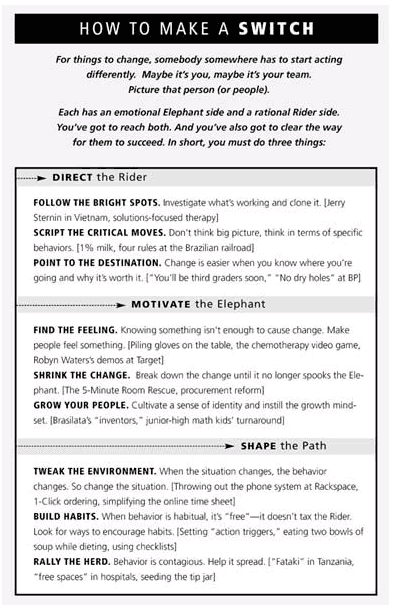
What if we realised that by keeping the moral purpose at the centre, investing time on the why, reaffirming the purpose and by appealing to the emotional drivers we maintain high urgency in the system – be it at individual or organisational level. It is this owned inner drive, the intrinsic motivation that will compel toward action and keep attitudes aligned with the ambition. Chip and Dan Heath highlight the key is to motivate the elephant as well as the rider…

  • Find the feeling (WHY/Purpose) – make people feel something
  • Shrink the change (How) – shrink change so that it does not spook the elephant
  • Grow your people – instil a growth mindset – attitude

howtomakeaswitch

(taken from Switch, Chip and Dan Heath)

What if attitude is about feelings and that stories are uniquely placed to motivate and develop attitudes that align with the ambition? As John Kotter highlights…(how often do we use stories … particularly those that tell of a preferred future?)

“Neurologists say that our brains are programmed much more for stories than for abstract ideas. Tales with a little drama are remembered far longer than any slide crammed with analytics.” (John Kotter)

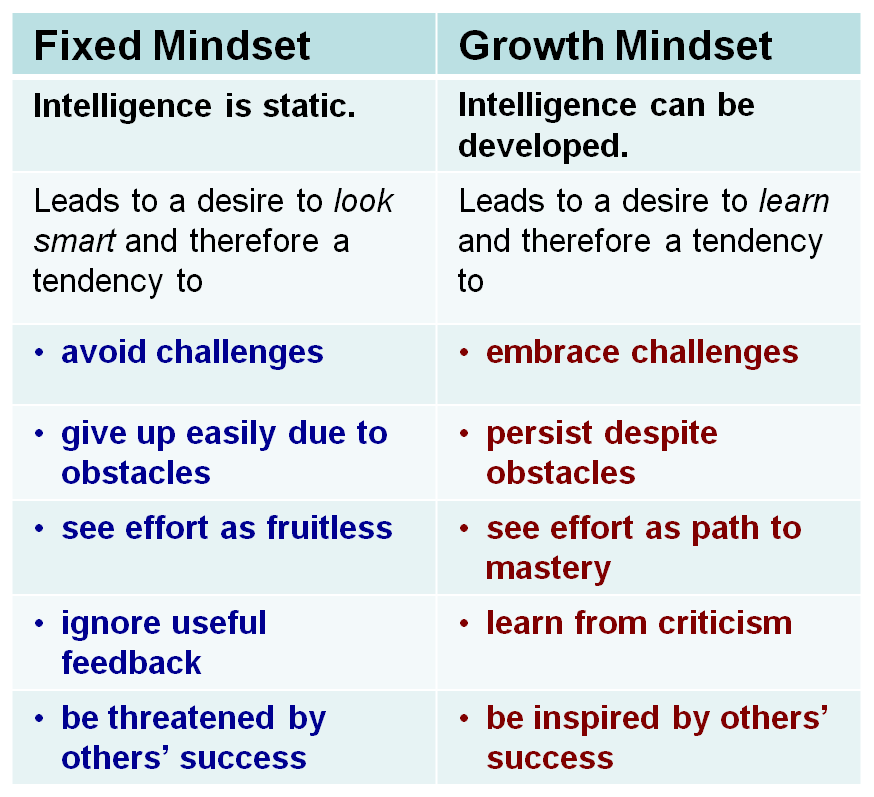
What if we also understood that positive attitudes stem from a growth mindset? (Carol Dweck)

growth-mindset

What if we also understood that we need to develop attitudes in line with being deliberate? (Malcolm Gladwell) Leaders, teachers and students whose attitude drive them to…

1. …be motivated and exert effort to improve their performance.

2. …engage in tasks that take into account their pre-existing knowledge.

3. …seek and receive immediate informative feedback and knowledge of the results of their performance.

4. …repeatedly perform the same or similar tasks towards near wins…mastery.

“Success is a function of persistence and doggedness and the willingness to work hard for twenty-two minutes to make sense of something that most people would give up on after thirty seconds.” (Malcolm Gladwell)

What if attitude is dependent on ignition? and we should seek to increase students and colleagues opportunities to be ignited by an experience, thought, fact, opportunity etc…

“Beneath every big talent lies an ignition story – the famously potent moment when a young person falls helplessly in love with their future passion.” (Dan Coyle)

For Albert Einstein, that moment happened when his father brought him a compass.

“Einstein later recalled being so excited as he examined its mysterious powers that he trembled and grew cold…. [Einstein wrote] “I can still remember – or at least I believe I can remember—that this experience made a deep and lasting impression on me. Something deeply hidden had to be behind things.”

What if we recruited much more on attitude, understanding that skills and knowledge gaps are easier to close?  Particularly because getting the right people on the bus is the key to great organisations (Jim Collins).

What if we realise that asking challenging questions and setting expectations high can  instil desired attitudes? If we ask ridiculous questions we prompt different possibilities and perspectives. (Questions must be based on the brutal truth of the present reality.)

  • “If your life depended on it what would you do?”
  • “What would we do if the target was 100%?”
  • “What do we need to do now, such that everything else is either easier or no longer required?” (Keller)

It is often the second question that really makes the difference – having attitudes and approaches that dig deep to understand problems and to find solutions that aren’t immediately apparent. What if we also realised that this is about getting the right people in the room – those best placed to ask the right question and not so many to complicate the answer. Steve Jobs only met with 3-4 people – any additions were removed.


Maybe then we would pay much more attention to the attitude of leaders, teachers, staff and students …and seek to create the conditions that foster positive and aligned attitudes.

Maybe then we would also look to other examples like the Apollo 13 mission and learn that attitude rarely exists without purpose and urgency – it does not happen in a vacuum. We might work harder to engage the emotions to drive attitudes and approaches.

Maybe then we would work harder to create the conditions necessary to ensure healthy and positive attitudes.

Maybe then we would work harder to generate or communicate urgency and that this needs to be born out of a clear moral purpose and that this is best aimed at the heart.

Maybe then we would find more ways to reward attitudes that drive us toward success.

Maybe then we would be more attuned to understanding the importance of and the need to create conditions for ignition … to ignite a passion in a colleague or our students … that will propagate attitudes than align with our ambition.

Maybe then we would recognise the importance of attitude and stance when recruiting – getting the right people on the bus.

Maybe then we would understand that autonomy and ownership of the how and what are key to generating the motivation required to propagate great attitudes

Maybe then we would create organisations and classrooms where attitude is understood, fostered and grown – because attitude matters and failure is not an option.

“Try again. Fail again. Fail better.”  (Samuel Beckett)


April 2015