Our Future | building culture

The next stage of our Trust will seek to connect and empower all colleagues as one organisation. Colleagues trusted to transform lives, so that children thrive and flourish now and into adulthood. We will use the power of education to unlock and inspire young lives, particularly for those children who carry more than others, in these difficult times.

“There is no trust more sacred than the one the world holds with children.” (Kofi Annan)

Building on strong foundations

Your expertise and commitment have built the platform on which our Trust now stands. Because of this work, over time, you have developed provision and approaches that are making a difference to the lives of children and is the foundation for our next stage. On this maturity we will seek greater influence on the lives of colleagues and children, strategically plotting and shaping our path, together.

In the next stage there are key approaches and principles that will establish a cultural model that will inform our relationships, interactions and underpin the strategy. This will build the conditions, culture, and climate for colleagues to do meaningful work. We will prioritise psychological safety for colleagues, so that they feel greater belonging and to be given permission to do work that transforms lives. Offering the opportunities for more children to flourish, to have a sense of wonder and be wonder-smitten: I am here, that I may wonder.

“To live wonder-smitten with reality is the gladdest way to live.” (Maria Popova)

One organisation

We are one organisation, serving children, aged 2 to 19, responsible for all children, with every school and colleague woven into a collective cultural fabric: school is trust, trust is school. A collection of great schools, meeting need, held in a strong trust.

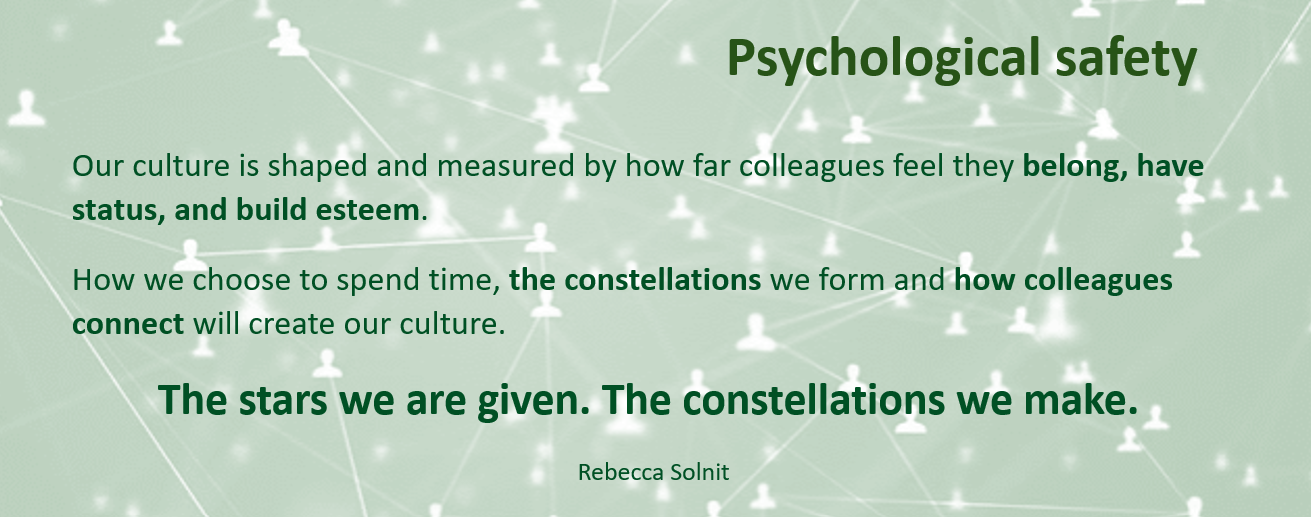
Our culture matters to us. It is built and shaped, in every interaction, everywhere, all the time and ever onward. Our cultural landscape is carved over time towards our shared purpose and is guided by deeply held lived values and shared rituals and routines. It is shaped and measured by how far colleagues feel they belong, have status, and build esteem. How we choose to spend time, the constellations we form and how colleagues connect will create our culture.

“The stars we are given. The constellations we make.” (Rebecca Solnit)
Making good decisions together

We make good decisions together. We seek and value expertise across our schools and the Trust as a whole. We are open and transparent as an organisation, making the best decisions we can, with the information we have, whilst seeking to do the right thing. We act without fear or favour.

First say yes. If a colleague feels the need to ask for support or resource, we should say yes, first, and work out how, later. Paying forward as an exercise in collective endeavour and shared responsibility.

The second mistake. It is rarely the case that the first mistake matters, it is often the second or third that turns mistake into problem. Because we make good decisions together, are open and transparent we share and resolve challenges at the first opportunity. Almost everything becomes easier when things are shared, it builds trust, and importantly avoids the second and third mistake.

A Human organisation, valuing relationships

We make time to listen, learn and build relationships. Being present. This is about ensuring colleagues are known as individuals, individuals with a unique story, a story that is heard. Understanding an individual’s story allows us to weave collective stories into the future; generating a greater sense of belonging. How we treat anyone, is how we treat everyone.

Humans are beautifully contagious

Use time well, seek simplicity

We will seek to use time well. Deliberately prioritising time towards the Main Thing(s). Logically sequencing our routines and networks and creating simple approaches that focus on making the greatest difference. We will work to reduce unnecessary burdens on individuals, to be as agile and nimble as is appropriate to our scale. As simple as possible, but not more so.

We will seek clarity because it is kind. Humans like rules, it is clarity that creates safety. We will share all data and information transparently to understand performance and drive improvement, part of our joint endeavour and collective responsibility for all children.

Primacy of Headteachers, the drivers of change

We understand the importance and primacy of Headteachers. The strongest Heads are great with people, understand provision and lead with purpose, prioritising and implementing key strategies and approaches, over time, to enable colleagues to change lives. They are open and able to utilise the capacity of the Trust, and to add into the strength of the Trust; a mutually beneficial symbiosis that adds value.

We are the sum of our decisions

Our effectiveness could be simplified as the sum of all decisions, by all colleagues, all the time, everywhere across our Trust that either accumulates value, or not. Our role as Trust Leaders is to influence, nudge, direct, enable better decisions to be made more often, to deliver a dividend. We will continue to dance between what we decide to do together and where we choose to empower colleagues to act.

Deliberately choosing where to standardise and where to empower colleagues

We will continue to standardise aspects of provision, to become more than the sum of our parts. Standardising, building things together, has tremendous power to liberate, support and give permission (and opportunity) for colleagues to focus on the Main Thing(s); creating a platform for colleagues. Our shared, common curriculum exemplifies the power of this collective endeavour.

Leadership is the art of giving people a platform for spreading ideas that work. (Seth Godin)

We will standardise and empower deliberately and strategically. Holding ideas in tension, informed by context, because context matters; it is not a compromise. Whilst recognising the importance of standardisation and of empowering colleagues on platforms, we will not seek to over dictate the complex areas of provision where experts and professionals make decisions, informed in the moment, in context, for their community.

“…under the conditions of true complexity – where unpredictability reigns – efforts to dictate every step from the centre will fail. People … require a seemingly contradictory mix of freedom and expectation.” (Atul Gawande)

We understand the influence we have on others

Back to the Future. Whilst Marty McFly travelled back in time and understood the future consequences of his actions, we are much less conscious of our influence on the future. Whilst we cannot foresee the future we can, together, create the conditions, sow the seeds, prepare the ground for humans to flourish and for more good than bad to happen. We, collectively create a crucible of serendipity where colleagues shape what is possible. Lives are shaped by opportunity. Our collective capacity can and will transform lives, evidenced in the smallest acts, every day.

“The smallest act in the most limited circumstances bears the seed of boundlessness, because one deed, and sometimes one word, suffices to change every constellation.” (Hannah Arendt)

We are collaborative by nature

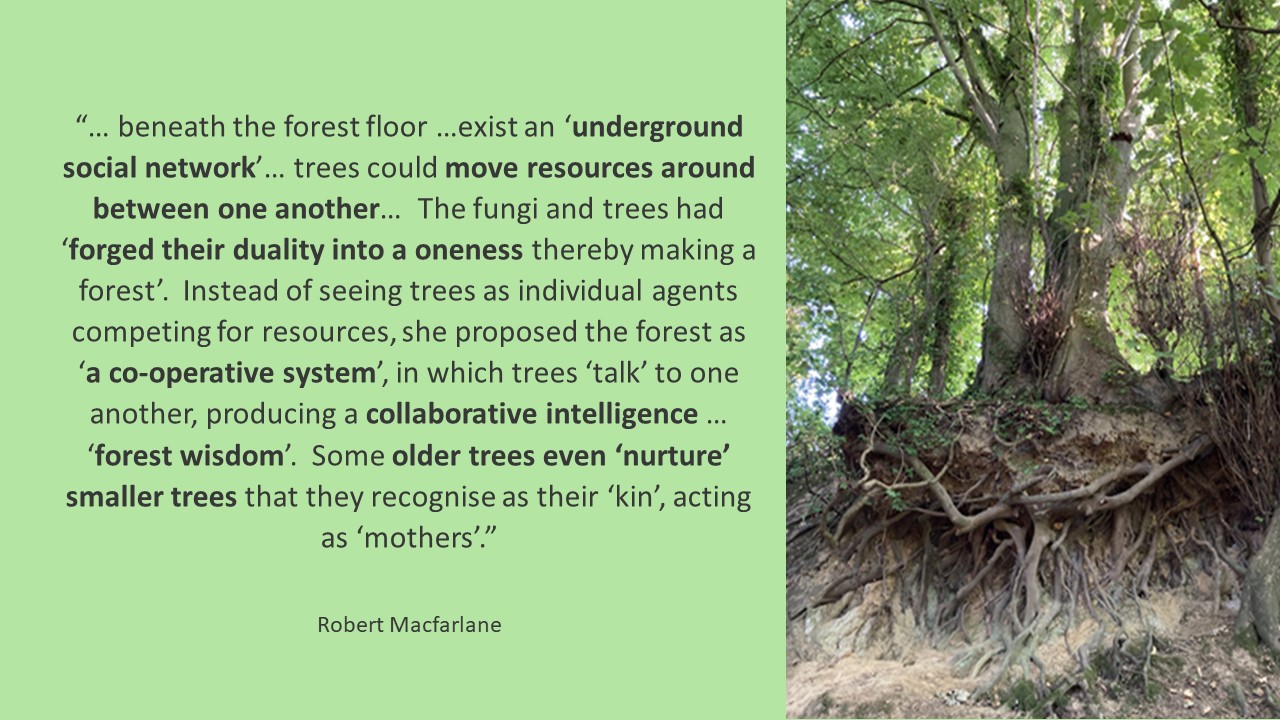
We will build on our existing collaborative architecture, our co-operative system, to connect colleagues with purpose and to each other, seeking collaborative advantage. Connecting colleagues within professional networks and subject/year communities, where hard and soft-wired collaboration secures collaborative intelligence and wisdom that becomes self-improving and irreversible. The biggest influence on colleagues is colleagues.
Getting today right and building for the future

Two speed. As we forge forward, we will build our future, based on where we have been, where we are, and toward what we seek. We will seek to get today right and the future right. We will seek change and improvement in months and years, concurrently.

What do we seek? We decide, next, together.


Into our future

So, based on the platform that you have built, we will work with humanity, humility and openness, to shape the future, together. So, at this time, as I join you as CEO, my optimism, hope and determination for what we will achieve is galvanised by the brilliant people in our Trust.

“When we build a culture of people who eagerly seek out and take responsibility, we build a culture that enables a special kind of resilient freedom.” (Seth Godin)

We have an opportunity to enable all colleagues across our Trust to collaborate, connect and feel empowered to make a difference. To work as one organisation, sharing responsibility, engaged in collective endeavour to secure greater social justice, particularly for our most vulnerable children, those that carry the most through life, and particularly at this time. A worthy cause.

“To be hopeful in bad times is not just foolishly romantic.” (Howard Zinn)


Postscript

There is no way to build high-performing organisations without a cultural model that drives the strategy. Or to put it differently, strategy without culture is just wishful thinking.


Dan Nicholls | July 2024

Connected collaboration and deliberate altruism… growing great organisations and systems

Connected collaboration and deliberate altruism… how great organisations grow and coherent education systems improve…

del alt 3


slide-5-638It is probably true that…for organisations to excel and become great the internal climate needs to support individuals to connect, collaborate and be deliberately altruistic. These indispensable individuals (mavericks, superheroes, connectors, change agents, linchpins, Freds etc.) draw maps, bring Art to work and accelerate organisations toward greatness.

slide-2-638

It is also probably true that this scales to a system leadership level such that great systems grow where deliberate altruism within collaborative networks/multi academy trusts enable clusters of schools to be remarkable; to bring Art to education – lifting-up communities.


Which begs the question: How do we enable change leaders and linchpins across the system (within academies and across clusters of Academies) to connect, collaborate and be deliberately altruistic to deliver world class education?

Perhaps Seth Godin expresses it best: “What happens when you build an organisation (or system) that is flat and open? what happens when you expect a lot and trust the people you work with?” …and what if we create the climate/platform for connection, collaboration and deliberate altruism? … maybe then system leadership has a chance to raise the bar and make education remarkable.

“(when) Schools pull together and share their best ideas, while simultaneously employing peer pressure to achieve more for the sake of all students (and the whole community).” (Hargreaves et al. 2014)


What if there are superheroes in our midsts?… What if we set them free to bring Art to work, to be remarkable, to be heroes who seek connection, who collaborate, who are deliberate, innovative and who altruistically spread ideas that work, because they are close to the action and they are infectious with enthusiasm. Tumblr_mnh27a7WA31rir6lho1_1280 Who are the superheroes?… What if we had more Freds in organisations and across systems? The story goes that Fred was the postman of Mark Sanborn. Fred cared; he cared a lot about providing a service – he did not have to, but he did – he went beyond the call of duty to add real value. Not because he had to, because he wanted to…he was extraordinary and he made Mark Sanborn consider the Fred factor; for which he identifies four principles…

  1. Everyone makes a differencedo we exploit opportunities to make a difference?
  2. Everything is built on relationshipsdo we always invest in relationship building?
  3. You must continually create value for othersdo we lift others up & create value?
  4. You can reinvent yourself regularlydo we take a fresh look and reinvent ourselves?

How many Freds do you know? Organisations that have Freds, add value and are likely to thrive. It is for leaders to create an oasis of Freds within their organisation – and even better if they inspire others to take charge…

“Leaders are only truly in charge when they inspire others to take charge.” (Simon Sinek, 2012)

What if we had more linchpins in organisations and across the system? Those that say…Linchpin_TTb What if we actively recognised, grew and recruited linchpins, These are positive deviants, who engage in “positive deviant practices.” (Heaths) Seth Godin in his Tribes and Linchpin books identifies that these individuals bring Art to work, are creative and are linchpins that link and connect widely. Gladwell would describe them as Connectors. (Tipping Point). 499b343267ee2a7181a9913c4f593c48 What if we allow linchpins to bring Art to work and drive improvement from within? What if we also devolve and push decision making and innovation closer to the action (David Marquet), so that Linchpins and connectors influence others, lead change and release potential to secure improvement? Maybe then change and improvement will have greater stickability, be more effective and more consistently delivered. It is exactly these individuals who “Don’t settle” (Steve Jobs) and consistently reflect and innovate deliberately around the few things that matter. See: Strategic Leadership | fanatical discipline and deliberate delivery. Jobs


What if we enabled and created a platform for these change agents, innovators, linchpins and Freds to do their work…to be given the time and space to energise and accelerate improvement where it matters … near to the action.

“The role of the leader is to enable, facilitate, and cause peers to interact in a focused manner…but still only a minority of systems employ the power of collective capacity.” (Fullan, 2010)

What if leadership within an organisation and across the system created a climate for individuals to thrive, to lead…what if it offered discretion to be creative and innovative? And what if it was less about the leaders at the top and more about enabling and freeing linchpins and Freds to go about making remarkable things happen?

“There are conditions under which people thrive and conditions under which people do not. The culture of an (Academy) is essential…it is organic. If the conditions are right – you give people a different sense of possibilities, a new set of expectations and offer discretion to be creative and innovative…things spring to life…real leaders know that.” Ken Robinson 

And What if leaders sought not to command and control, but to create a climate of possibility that enabled people to rise up, influence and do remarkable things?

“The real role of leadership in education…is not and should not be command and control the real role of leadership is climate control, creating a climate of possibility…people will rise to it and do things that you did not anticipate and could not have expected.” (Ken Robinson) 

Quotation-Seth-Godin-giving-leadership-work-ideas-people-Meetville-Quotes-228804 What if we developed tribes…

“…groups of people connected to one another, connected to a leader, and connected to an idea. For millions of years, human beings have been part of one tribe or another. A group only needs two things to become a tribe: a shared interest (vision) and a way to connect and communicate.” (Seth Godin)

After all, given freedom we should trust that… f163eaa3b112c76e1f850c9a4ba57189


What if the mode of operation was deliberate altruism. As Adam Grant considers, there are givers, matchers and takers. The takers hold what they have, steal ideas and focus on self-interest. The matchers only give if they receive something of equal value. The givers who give strategically/deliberately, make things happen, they gain far more and they contribute to improvement. We all know takers, matchers and givers. It is interesting that whilst this works on an individual level it is also true at an Academy level. Where Academies give they make a contribution to the system…everyone benefits…in fact more comes back… a-few-quotes-from-its-not-how-good-you-areits-how-good-you-want-to-be-3-728

“There is a crucial difference between the wisdom of openness and the folly of unguarded innocence. (Givers can be the most and the least successful)” (Hargreaves and (Grant))

What if every organisation created the space and supported connected collaboration for individuals to bring art and what if system leaders understood the power of networks…John Kotter provides an excellent diagram of how a great organisation maintains a hierarchical structure with all the necessary line management and accountability whilst enabling connected networks to exploit the linchpins and Freds in the organisation to connect and enabling the organisation to be agile and innovative. If we place a number of hierarchies (academies) around a central network, a network that connected linchpins and Freds across the system, we have the model that connects. If this connection and collaboration is built on deliberate altruism we have the basis for enhancing system leadership and a chance to reshape education. Slide1

Uplifting leadership entails engaging a talented team that values risk and creativity, acknowledges and tolerates honest mistakes, and has members that participate and “play” in interchangeable roles. They inspire each other as leadership emerges throughout the group.” (Hargreaves, 2014)


What if organisations/academies deeply connected and collaborated across networks/clusters of schools and altruistically shared everything such that there was a wide responsibility for system improvement? What if all Principals/Headteachers were system leaders or change agents?

“If as a principal you go it alone, you can only go so far…although it is possible to become a great school despite the system you are in, it is not possible to stay effective if the system is not cultivating greatness in all of its schools…the system matters a great deal.’ (Fullan, 2014)

The best system leaders look out to improve within whilst contributing to the wider system. What if we did not see local schools as competitors? what if there was a greater recognition that the success of other schools increases system success and this is better for everyone? Hargreaves et al.(2014) identifies three powerful combinations of collaboration and competition:

  • Co-opetition: the alliance of opponents achieve greater value together than they can achieve alone.
  • Uplifting federations: that include competitors increase social value for the wider community as well as for each individual organisation.
  • Being on the collaborative edge: enhances motivational value; pushing up performance in the comradely quest to keep innovating and outdo others – in a way that moves everyone up to a higher level.

“There are many strategic benefits…from aligning joint effort, and for combining collective investment for competitive gain. Uplifting leaders know that these (collaboration and competition) are the yin and yang of enduring success.” (Hargreaves, 2014)


Maybe then…Academies will develop greater opportunities and platforms to support individuals to be linchpins, connectors, Freds and change agents. Maybe where the connection and collaboration of these individuals is deep and deliberate altruism dominates, great ideas and approaches will grow from within the organisation.

and Maybe this will…push decision making, innovation, research, development and delivery to the people closest to the action. Perhaps this greater ownership and drive increases consistency and take-up and importantly is better attuned to the needs of students and the Academy. Perhaps this will also allow Academies to be agile enough to stay on the cutting edge … ever closer to creating remarkable approaches that deliver unusual outcomes for students and families.

…and Maybe if we take these ideas and apply them at an Academy level and to Principals as system (uplifting) leaders across networks of schools and multi academy trusts we could transform education. Creating deep connections and collaboration based on deliberate altruism would better allow clusters, trusts and networks to lift up communities and regions….making education remarkable.

Perhaps it is at this level that we require our system leaders (our uplifting leaders) to be superheroes, Freds, connectors and linchpins to take on the responsibility for taking a deliberately altruistic approach to collaboration, creating a remarkable education system…that has a wide and deep impact on communities/regions.

and perhaps there should be greater focus and measure of these qualities and approaches …such approaches are poorly incentivised at present…and yet it offers a remarkable opportunity to grasp and shape education.

Maybe then we will have a coherent system and shift into the top right quadrant where connected collaboration and deliberate altruism dominates… del alt 3 February 2015 | @DrDanNicholls https://twitter.com/DrDanNicholls