Igniting identity | circumstance and happenstance

Our self-identity forms over time, shaped by our experiences and interactions, particularly in our formative years. It is not a uniform development of self, but rather one that is punctuated disproportionately by high impact moments. These sit in our backstories, having ignited our identity and shaped who we have become.

These moments are often subtle, quiet experiences of awe and wonder: a sudden realisation, both unsettling and exciting, that the world and our role in it is not what we thought. In these moments of alchemy, brief serendipitous collisions create a hiatus between our old and new self-image.

“…in moments of alchemy, brief and serendipitous collisions, the beautiful texture of interwoven lives. There are many seeds of genius in the world, we must nurture as many as we can.” Helen Lewis


Circumstance and happenstance

The development of self is determined by our context, upbringing and by the influential adults and peers that we look to through childhood: an on-going influence of circumstance through our formative years.

But much, arguably, is happenstance, serendipitous moments that build our self-image. Brief events, often remarkably small, that disproportionately shape our lives. Rather awkwardly, they are often surprisingly quiet, private moments of self-realisation that are invisible to the provider.

“The smallest act in the most limited circumstances bears the seed of boundlessness, because one deed, and sometimes one word, suffices to change every constellation.” Hannah Arendt

Yet for some children the vagaries of life’s happenstances are less frequent, less influential or much less accessible. It also depends on a child’s circumstance and their pre-disposition to act on these moments. Whilst our childhood sets the conditions and the circumstances that influence our predispositions, the brief moments, the happenstances, disproportionately explain who we become.


Predispositions

Will, Should, Might, Could, Won’t, Can’t

Our context and circumstance, whether consciously or unconsciously, determine our predispositions and the strength of our self-agency. For any given aspect of life we align to one of the following dispositions:

I Will  …. I fully expect to do this, unswerving, predestined, locked in, self-fulfilling.

I Should … Highly likely, people like me do things like this (reinforced by peer status).

I Might … Entirely possible and within my gift, requires a step forward, focus and resourced adults.

I Could … It is possible, but could be difficult to achieve – requires ignition, support and must be followed by resource.

I Won’t … People like me don’t do this, locked out, keys hard to find, and not sought, no capacity or resource, unable to see the future or be part in it.

I Can’t … Not possible, nobody like me does things like this, psychologically and materially forbidden.

If you are under-resourced and have experienced much less privilege, then too often your agency is limited to the bottom few dispositions. This offers a form of immunity to moments of ignition and even if ignited a lack of resource to follow your triggered passion. In a world of privilege, however, you occupy the top few dispositions: emboldened to accessible experiences and open to life-changing moments. And yet, ‘ambition’ is equally distributed, but enhanced or stifled from birth and perhaps before birth.

If you are lucky enough to be born in a world made in your image, you probably think of a failure as an obstacle on the path to eventual success. If you are a marginalised person in any way you internalise that failure more closely.” Elizabeth Day


Moments of wow… igniting identity

Regardless of who we are there are moments we witness that change our passions, our identity and motivation for what we wish to become…

“But the moment that changed everything came on 29 July 1992 … the Barcelona Olympics. Chris Boardman was about to go in the final of the men’s individual pursuit. I sat in front of the TV and watched him … Four and a bit minutes later, Chris had overtaken his German counterpart and become Britain’s first Olympic cycling gold medallist in 72 years. I was 12 and knew straightaway I wanted to emulate his feat. Another 12 years later I did just that.” Bradley Wiggins

…or influential adults who we are desperate to emulate…

“When I’m 13, my mum gives me a load of photos that she’s found. There he is, in his cycling kit, racing. It’s a definite “Wow!” moment, like he’s been brought to life in my hands. Those photos become my greatest treasure. The closest connection I could have with my father was by following in his footsteps” Bradley Wiggins

…or experiences that ignite our identity…

“My love for cinema began at a very early age, as early as I can remember… I was just a little kid in a darkened theatre, and I remember that beam of light just cut across the room and I remember looking up, and it seemed to just explode on the screen. … and suddenly, the world was so much larger than the one that I knew … it opened my eyes. It opened my imagination to the possibility that life could expand far beyond the boundaries that I then perceived in my own life.” Tom Cruise

“Making films is not what I do, it is who I am.” Tom Cruise


Owning the future

How far are children able to focus on the future? If you exist in an under-resourced world where you seek to survive the day, the week, your effective horizon is limited, perhaps irrelevant to you: there is no bandwidth to contemplate your future. This fundamentally forces you toward the weaker predispositions, I Won’t and Can’t, and breaks the connection between recognising that the efforts of now are an investment in next. The future will act on me.

Resourced children are able to make the investments now, fill their lockers and are typically compelled to do so, supported to strong dispositions, I Will and Should. I create my future.

To be or not to be

To be or not to be, that is the question that children wrestle with as they navigate the world. We know, though, that some children have much less capacity to be, forced into a not to be mindset. Growing in a world that tips the odds against you, denies a starting disposition, or ladder to, ‘Will, Should, Could’ and restricts the under-resourced to ‘Can’t and Won’t’. Only the application of equity can offer a ladder and break the cycle.

Lockers filled with belief

In every aspect of a child’s life, a child holds a locker of self-belief. Advantaged children have bursting lockers, filled by circumstance and opportunity, narrated by resourced adults, affirmed through experience. The lockers of under resourced children are sparse, short on belief, encouragement or affirming experiences. When they look to their lockers for self-confidence and self-belief they are encouraged, perhaps compelled, to step back, to not take risks and internalise the failure. We must be better at filling the lockers of under-resourced children.

“When you are born into wealth and privilege, you inherit a plan that outlines the paths ahead, indicating the shortcuts and byways available to reach your destination … If you enter the world without such a map, you are bereft of proper guidance. You lose your way more easily.” Elif Shafak

Chasing status

What you become depends largely on who you find yourself with. We measure status on those around us, typically the 5 peers that we spend time with that we look to and derive our own sense of status. Our belief in what is possible is shaped by our peers, and our schools are the crucible for these interactions.


Our verbal quota

“…we speak about 16,000 words a day, that is a lot of chances to tease, complain and criticise, but also to encourage, inspire and comfort. I know I can do a lot more good with my verbal quota.” Matt Woodcock

In every interaction, exchange and conversation our words are a powerful force for good (or ill). We never know for certain the weight of our words on a child, but we do know that children are adult-watchers, seeking to decode the world around them. Awkwardly or helpfully, in every interaction our words always carry weight and have influence, intended or otherwise. Often just 13 words deliver a self-belief that becomes unshakable and propels a dopamine-soaked desire to follow a passion:

“…I was introduced to a club coach, Stan Knight. Immediately he took hold of my wrist. “I’ve never felt a pulse like it,” he said. He looked me in the eye – “You’re going to be the best cyclist this country has ever produced.” … I liked the fact he had belief in me… Stan didn’t tell me I was special because of who my dad was. He told me I was special. Me.” Bradley Wiggins


Inspiring lives

“I began to realise how important it was to be an enthusiast in life. If you are interested in something, no matter what it is, go at it full speed, Embrace it with both arms, hug it, love it and above all else become passionate about it. Lukewarm is no good.” Roald Dahl

As educators we chose to inspire lives – and yet we spend little time understanding how children exist in the world or how their lives unfold through their circumstance and happenstance. How do we ensure that curiosity, hope and ambition is a feature of all childhoods not just those that are privileged?

Perhaps we should maintain a greater sense of awe and wonder, of possibility and back it with the application of equity and protect the flickering flames of hope, so that more children can embrace an interest with both arms. If we are to ignite a child’s self-identity, so that they have agency into their adulthood, we must create greater opportunity and apply the equity that will give all children the choice to follow their dreams.

...inspire lives with greater opportunity and choice.


Dan Nicholls | December 2025
Toward the future | inspiring lives

Our Mission

In the next phase we will strengthen our trust, deepen our connection and collaboration to add more value to each other and to all children. This is a venture in shared responsibility and joint endeavour to inspire lives with greater opportunity and choice. Succeeding in our mission:

Inspiring every child to flourish through an inclusive, all-through education that nurtures opportunity, equity, and agency for life.

A mission that ensures 11,000 children flourish and develop greater self-agency, becoming the masters of their fate. A worthy quest powered by 1,500 connected colleagues, empowered to do meaningful work.


For those that carry the most

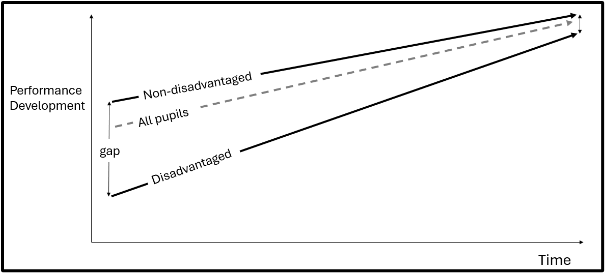
We recognise that some children carry more than most, have had less opportunity and experiences in their early childhood and so need us more. They neither lack ambition or ability, but they have less capacity, fewer resources and face barriers that tip odds against them. In difficult times education has the power to transform lives, which is the business we are in. The performance and development of these children is the most important measure of our worth.

“We need equity in education, not equality. If someone can’t see straight because the world is falling in around them, we need to raise them up to clearer skies.” Poor, Katriona O’Sullivan


Anchored by our Values

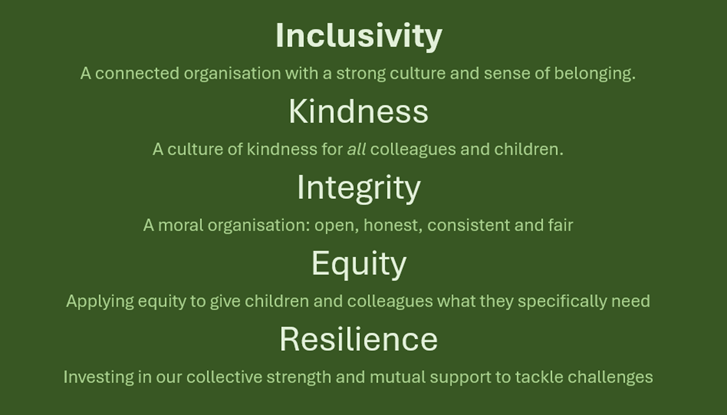
Everything we do is held by our shared values:


Our stable core enables our innovative edge

We continue to build a strong trust with great schools that focuses on getting every day right and building a stable core: consistently delivering high quality provision with effective systems and shared approaches, enables our frontline obsession.

We stand on our stable core and what we choose to do the same, so that we can innovate on the edge, expertly developing approaches to improve provision and inspire lives. This is a collective, connected and developmental endeavour through collaboration.


Towards 2030 | why we exist

To build a strong trust with great schools. Offering high quality education over 570-weeks that closes gaps for those that most need us. So that the trust exists in a higher performance space and exploits our collaborative advantage that yields a trust dividend.

Our focus on partnerships and places builds better communities for children to grow up in and flourish. Colleagues create greater opportunity through deliberate local and regional collaboration,seeking to improve other trusts and the sector.

The trust is deeply connected within itself. There is a strong collective desire and shared responsibility to add value for all children in every setting. This collaboration enables a level of innovation and shared approaches that add more value. As part of a human organisation colleagues are well connected, making a greater difference to others in and beyond our trust.

The consequence of our work over five years is that the trust becomes self-improving, the systems, shared approaches, trust improvement model, collaboration, horizontal leadership and empowerment is creating more value over time and is self-sustaining.

Colleagues enjoy more opportunity and are proud to do meaningful work that is enabling all children to flourish through an inclusive, all-through education that nurtures opportunity, equity, and agency for life


Higher performance space | in search of the trust dividend

There is an unswerving, shared responsibility and desire to raise standards. To build a strong trust and great schools that exist in a higher performance space that particularly enables disadvantaged learners to thrive and attain well.


So, where next… this year

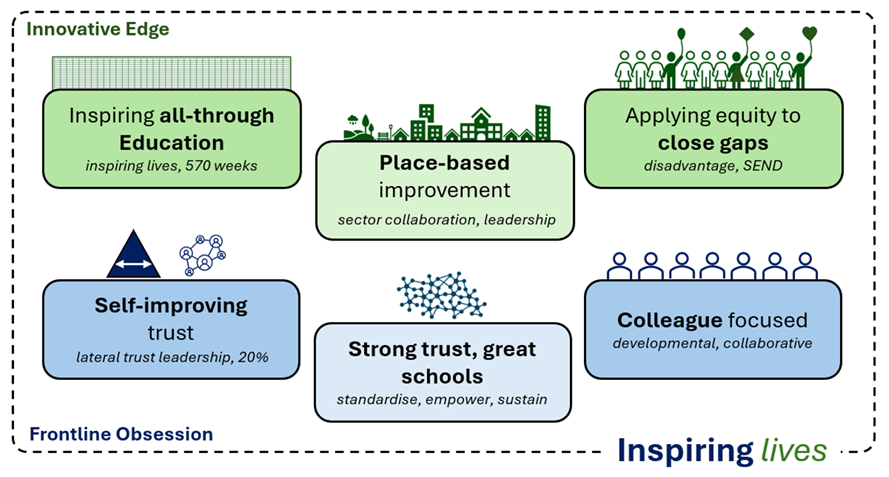
In the next phase, to summer 2026 we will prioritise these six areas:

Innovative Edge | Inspiring lives

This year we will invest in our inclusive all-through education (570-weeks) and apply greater equity to close gaps for children that need us most. A focus on place-based improvement will build strong community partnerships and support improvement beyond our trust.

Stable Core | frontline obsession

We will continue to invest in our stable core, by building a strong trust that enables great schools. Our colleague focused strategy will invest in all colleagues and create the conditions for our frontline obsession. Aiming to create a self-improving trust, investing in lateral leadership, connection, collaboration and strong systems.


570 Weeks | inspiring all-through education

To build an inspiring, inclusive, all-through education: as an entitlement for all children. Enacting excellent provision for every child throughout their 570 weeks of education. Prioritising:

  • Trust Curriculum | curating and enacting a shared curriculum across all year groups. (SDP)
  • Attendance, inclusion and transitions | to secure stronger attendance, strong inclusion and high-quality transitions, disadvantage first. (SDP)
  • Best Start in life | investing in the strongest possible start for all children through nursery and early years, enabled through a set of core commitments. (SDP)
  • Outstanding Personal Development | outstanding personal development curriculum builds character and offers greater opportunity for all children in every setting.

Closing gaps | seeking social justice

To apply equity and unswervingly commit to meeting the needs of children experiencing disadvantage and SEND, securing attainment and attendance that closes gaps and builds agency for each child. Securing greater social justice by prioritising:

  • The trust-wide development of teaching | systematic focus on the development of teaching to enact our shared curriculum. Our strongest lever for closing gaps. (SDP)
  • Disadvantage first | unswerving focus on the performance of disadvantaged pupils, through targets, data and quality assurance, as the indicator of the quality of our provision. (SDP)
  • Catch-up, Keep-up | systematic tracking all learners and applying equity, doing different and more, so that all children are caught up and kept up. (SDP)
  • All leaders, leaders of SEND | developing our SEND provision, focusing on ‘all leaders as leaders of SEND’ – securing a systematic strategy to meet SEND needs.

The importance of place | community partnerships

To build partnerships with educational and community partners to secure stronger communities and 570-week educations for all children. Using expertise in the trust to reach out and secure improvement in schools, trusts and the sector. Growing our reputation and influence by prioritising:

  • Strong recruitment built on growing reputation | securing stronger recruitment of pupils into our schools to inspire more lives and better serve our communities.
  • Trust Growth | securing appropriate and strategic growth of the trust to secure financial opportunities and grow our reputation and influence.
  • Collaboration with local trusts, local authorities and partners | seeking strong collaboration to secure improvement beyond the trust – seeking to influence all 570-weeks
  • Sector reputation and influence | playing an active role beyond the trust, including with the DfE and other partners, to influence policy, improve other trusts and the sector.

Colleague focused | developmental and collaborative

Investing in all colleagues to be connected, to collaborate, develop and grow to lead and contribute toward the mission and feel empowered to do meaningful work. Prioritising:

  • Recruitment and Retention | building a strategy to recruit well and to attract and retain strong colleagues. Considering our approach to flexible working.
  • Professional Development | creating on-going opportunities for professional development, held in a curriculum. Developing, inspiring and creating more opportunities for colleagues.
  • Induction | investing in and building strong induction to support all colleagues to have the best possible start to their career in our trust.
  • Well-being and mental health strategy | securing approaches across the trust to support all colleagues with their well-being and mental health.

Strong Trust, Great Schools | standardise, empower, sustain

Ensuring that the trust improvement model offers the foundation for colleagues to lead great schools. Complicated systems well embedded across the trust to drive effectiveness and efficiency. Prioritising:

  • Deliberate enactment of the Trust Improvement Model (SIM) | developing our standardised approaches, enabling empowered areas and sustaining the model to secure improvement.
  • Financial stability and clarity | Ensuring the trust maintains the present financial security, secures wider responsibility and enables greater investment in the trust.
  • Professional Services | developing professional services, to strengthen platform, offer capacity, expertise and secure the environment to empower all colleagues to deliver the mission.
  • IT Strategy | ensuring colleagues and pupils have the tools they need to thrive now and in the future. Developing our digital vision and cloud-first approach. Exploring the opportunities of AI.

Towards a self-improving trust | lateral trust leadership

Creating the expectation and conditions for horizontal improvement across the trust. Connectivity and collaboration that are more effective and efficient at driving the School Improvement. Prioritising:

  • Trust Leadership Curriculum | investing in and enacting a trust leadership curriculum and to extend the sense of leadership curriculum through networks and the layers of the trust.
  • Networks and Subject Communities | connecting colleagues with purpose, formally and informally, to enable the development of strategies that raise standards.
  • Lateral leadership, 20% time | creating the expectation and the structure for colleagues to work beyond setting to support lateral leadership and secure a self-improving trust.
  • Succession Planning | investing in succession planning and talent management to ensure the future leadership security for our trust.

First Steps… into Term 1

And our first steps in Term 1 will see us deepen our connection and collaboration and prioritise:

  1. Understanding performance and setting the ambition and targets for 2026.
  2. High quality Induction and line management, starting out strong.
  3. Strong start and focus on Attendance, disadvantage first.
  4. Best Start in Life, embedding our core commitments.
  5. Enacting our shared curriculum.
  6. Focus on the development of teaching through Steplab.
  7. Embedding the new Planergy software in Finance.

We choose to venture on this journey to 2030 not because it is easy, but because it is hard, and because our ambition will serve to organise and measure the best of our energies and skills, because the challenge is one that we are willing to accept, one we are unwilling to postpone, and one which we intend to win (adapted, John F. Kennedy)

So, breathe, commit … and go inspire lives with greater opportunity and choice.

Thank you, you make a difference


Dan Nicholls | August 2025

Human Organisations | alchemy and magic

The building of Trusts as Human Organisations offers the best opportunity to exploit the collaborative advantage created by deeply connecting colleagues and groups of schools. Human organisations are deliberately designed to be colleague-centred, relational, collaborative and generative. Aligning individual purpose with the collective mission, empowers colleagues to seek improvement.

Human organisations require deliberate ‘Trust’ leadership to orchestrate collaboration and to understand that Trusts are adaptive, living systems that with the right culture and architecture can trigger greater connection and value. This value is multiplied when peers connect with purpose to explore and exploit their collective imagination and expertise: alchemists creating magic. Too often the capacity and connection for improvement remains latent within Trusts.

“…magic should have a place in our lives – it is never too late to discover your inner alchemist.” Rory Sutherland

The following describes a human organisation—one that seeks a collaborative advantage so that groups of schools perform better than before and are more able to tackle the challenges of our time.


The power of purpose

Human organisations articulate why they exist. Leaders draw maps, set destinations, raise expectations and describe the desired future in technicolour. The narration of the journey and importance placed on it offers the cultural currency, the validation, the reward for collaborating toward the destination.

“Never doubt that a small group of thoughtful, committed citizens can change the world. Indeed, it is the only thing that ever has.” Margaret Mead

A shared quest, in something worthwhile, something meaningful, something that lights a fire, and something anchored in why we exist, creates a generative shared desire and motivation. It sustains and directs energy across the organisation, toward that which is worthy.

Built on relationships3

Human organisations are driven by an unswerving investment in relationships, to secure motivation and to connect peers with purpose, to seek our moral ambition.

“Leadership is communicating to colleagues their worth and potential so clearly that they are inspired to see it in themselves.” Stephen Covey

In human organisations colleagues need to feel the purpose, have enough empowerment and autonomy to seek mastery. It is this investment in colleagues as social beings that taps our deeply engrained tribalist desire, to belong and do meaningful things.

“The relationships we build with each other provide the foundations of change. We are social beings who thrive on connections.” Sir Hamid Patel

The investment in relationships directed toward the purpose is the life blood of human organisations where success is the sum of all decisions made, by all colleagues, every second, of everyday, everywhere in the Trust.

Hard wiring

Human organisations hard wire, design and develop networks and communities as fundamental to their being: seeking connectivity and conductivity. It is not just an exercise in bringing colleagues together, networks must create enough conductivity to shift behaviour and actions intelligently toward the purpose and higher standards.

The architecture and design of networks is very deliberate and requires colleagues to be open, critical and ego-less in the deliberate search for better.

Soft Wiring

“The stars we are given. The constellations we (and they) make.” Rebecca Solnit

Human organisations encourage, permit and expect colleagues to collaborate beyond the set piece networks; connecting in informal, organic and dynamic groups of colleagues motivated to share and solve, in service to the mission. This collaboration propagates value, horizontally and organically across the organisation, adding up to more than the sum of the parts and becoming self-improving.

“…forests are complex adaptive systems, comprised of many species that adjust and learn, …and these parts interact in intricate dynamic networks, with information feedback and self-organisation. System-level properties emerge from this that add up to more than the sum of the parts.” Suzanne Simard

Building a platform

Human organisations invest in platforms of shared approaches for colleagues to collaborate on. This liberates colleagues to add value and seek greater impact by getting much better at the same. Playing in one field, free to innovate and add value based on a foundation, rather than playing in the woods or on the hill or in the fields: where a thousand flowers fail to add value.

This is an intelligent dance, that balances standardised and empowered approaches, and connects colleagues to embed and improve both. For Trusts what should be standardised or empowered is largely objective not subjective, driven by the difference between complicated or complex. The dividend is derived from investing in both.

Empowerment

Standardised approaches liberate rather than stifle schools and enables attention on the quality of education. On this platform, empowerment, sensitive to context generates local ownership and accountability for improvement. Colleagues empowered on the platform to collaborate with colleagues, aligned to the purpose, toward the destination, to drive local improvement is the engine room of self-improvement.

Trusts of parallel ecosystems

Each school is an ecosystem within the wider Trust ecosystem. In their part they run ‘experiments’ in parallel with other schools, with roughly the same resources, on a platform of shared approaches and seeking the same goals (helpful controls). With greater horizontal collaboration between trust leaders and colleagues the conditions exist to compare, contrast, iterate, develop and learn what it takes to add value.

“A golden age is associated with a culture of optimism, which encourages people to explore new knowledge, experiment with new methods and technologies, and exchange the results with others.” Johan Norberg

Seeking improvement requires the transparent sharing of all performance data. A self-improving system requires open access to all performance information to identify the conditions and approaches that secure strong performance.

Alchemy and alloys

Within the ecosystem (a large enough ecosystem) there is the best of everything. With enough connectivity, alchemy, alloying and forging, magic is possible. This is the intelligent melding of contextually sensitive approaches, enhancing a theory of action that is deliberately implemented. This expects heads and colleagues to intelligently exploit the resource in the trust, implementing for impact, and not to blindly stagger from one initiative to another.

“The mythical “butterfly effect” does exist, but we don’t spend enough time butterfly hunting.” Rory Sutherland

Imitation + adaptation

Leaders as alchemists, seek to alloy new approaches and strategies, by iteration, combination and adaptation, to spark greater impact. Deeply connected, open, collaborative cultures can learn from each other and interrogate new ways, ideas and methods to imitate and adapt: utilising the wisdom of the forest in their part of the ecosystem.

“The basic raw materials are a wide variety of ideas and methods to learn from and to combine in new ways.” Johan Norberg

Crowdsourcing

Human organisations create the opportunity and expectation for leaders to crowdsource solutions, tapping into the expertise and approaches of others across the ecosystem: setting out challenges for others to solve. Within a culture of openness, shared responsibility and because we are playing the same game, the ability to crowdsource improvement is the advantage of connected, human organisations.


Self-improving (eco)system

Taken together this forms a blueprint for a human organisation that is purpose driven, relational, generative and seeking value, together. Leaders and colleagues formally and informally networked, often horizontally, engaged in the business of improvement, fuelled by collaborative intelligence and forest wisdom: propagating a high performing ecosystem.

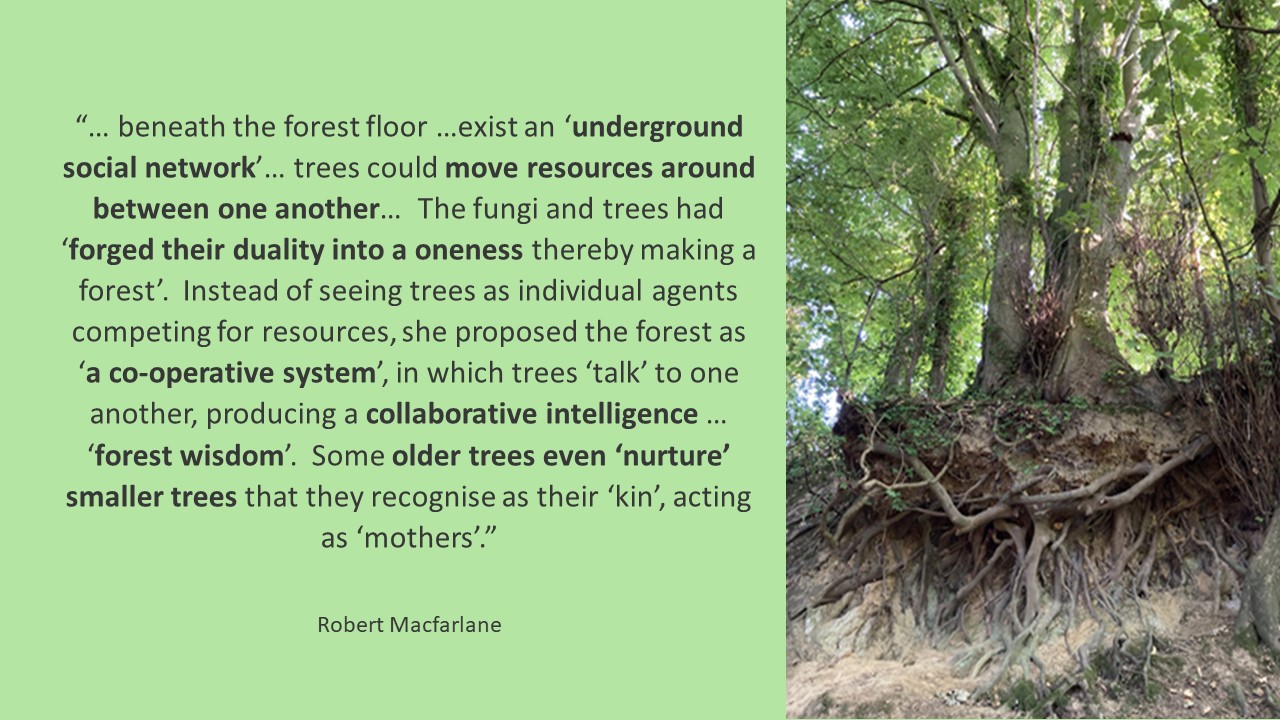
“… beneath the forest floor …exist an ‘underground social network’… trees could move resources around between one another…  ‘a co-operative system’, in which trees ‘talk’ to one another, producing a collaborative intelligence … ‘forest wisdom’.” Robert Macfarlane

So, seek greater connectivity to empower and permit colleagues to be alchemists, to collaborate, generate greater value and perhaps create a little magic.

Build human organisations.


Dan Nicholls | August 2025

Be More Pirate | time for good trouble

Amidst the turbulent waves of change we must re-imagine what education and our system can be; it is the opportunity of now, because next matters. It is at this point in our maturing sector that we should venture for greater coherence, collaboration and connection. By embarking on shared quests, we can better navigate toward a new North Star for all places and plunder our shared capability for all children. We need to be more pirate.

“Pirates trouble the edges of society and make enough shock waves to influence the middle ground. Trouble is their tool, although it’s more accurate to call it good trouble.” Sam Conniff Allende

Next needs to be more collective, more adjoined, more than the sum of the present parts, because too often, we are in parts. The view from the crow’s nest reveals inequity and that our pieces rarely fit well to serve our places and the children that need us most. It is the incongruousness of our pieces, the dominance of ‘I’ over ‘we’ and conditions that drive isolationism and competition that is constraining our collective potential. As system altruists, and sector architects we should rise and act on and not just in our system; seeking good trouble.

“…acting on the system gives us an opportunity to think differently. We should think of leadership as the ability to shape the system.” Leora Cruddas


Charting new waters | shared mutinies of good trouble

There are times in history when a group of like-minded individuals chart new waters and from the fringes find new ways to live and be; creating a movement based on new rules, a new code. Pirates challenged the world-order and flipped the accepted shared truths about how things could be, they created a movement so successful and agile that their approach and thinking might just influence and provoke us into our next-phase; toward better. This is our time to be a little more Pirate to strengthen and connect Trusts, to rebel, rewrite, reorganise, redistribute and retell the hell out of what could be.

Whilst pirates get a bad press, there is significant evidence that these merry men (and women) actually transformed the world and challenged the oppressive status quo. The golden age for pirating 1710-1740 was progressive and counter-establishment – it provided the basis and conditions for significant change. Now as it was then the need for change and a shift of ownership is required.” Sam Conniff Allende


We are the System | Charting new waters, re-finding old maps

There is a significant opportunity to re-imagine the future. There are waters, territories and opportunities, for plundering that could create an education system more aligned with the needs of all children and the places we serve. Whilst our educational landscape is fragmented, the forces that have pushed and pulled academies together have also created the conditions for leaders to better shape our system, to act on it, not just in it. And we must, because we are the system and these are our shared waters.

We exist in a period of uncommon opportunity, where there is now enough maturity in our system, beyond the stormy waters of early academisation, and within calmer waters, for greater horizontal collaboration and shared responsibility for all children and every place. There is no Armada coming over the horizon, so it is time to be more pirate and engage in good rebellion, small arrrrgh.

“I’d rather be a pirate than join the navy” Steve Jobs

The next phase requires greater alignment of the soft and hard power within our system. And more crucially secure a shift in our intrinsic motivation to collectively do better for all, attaching greater currency for collaborative place-based leadership. Stronger extrinsic motivators as part of the new code, held by us, alongside regulators will galvanise the change we seek.


Treasure worth seeking | next-phase thinking

Our sector needs to do more to address the inequity in our society and seek greater social justice. We must better balance the haphazard opportunities that are not evenly distributed in our communities or between peers even in the same neighbourhood. We need to be braver and bolder to build our system to liberate and empower those who find themselves adrift and stranded in life. A band of educators collectively motivated to apply equity and build provision for those that most need an anchor.

The next-phase must build ‘great Trusts’ driven by a Trust Improvement Model that places Trust and place-based improvement at the heart of our mutiny. As we seek to connect and collaborate for the good of all children and to ‘educate a place’ the increased openness and connection will concurrently build stronger Trusts within a more capable system. This is the real treasure worth seeking: Trusts, in partnership, unearthing and aligning much greater capacity for securing social justice and inclusion.

“A major benefit of effective ‘place-based’ reform is seen as the provision of essential “glue” or coordination, by mobilising a collective sense of responsibility to reduce competition which drives local hierarchies and decreases the effects of disadvantage.” Cousin and Crossley-Holland


A new look crew required | Pirating, banding and plundering more capacity

We need a new look crew, educators banding together, collectively questing, compelled by a stronger yearning for the endless immensity and possibility of the sea ahead of us.

“If you want to build a ship, don’t drum up people to collect wood and don’t assign them tasks and work, but rather teach them to long for the endless immensity of the sea.” Antoine de Saint-Exupery

Captains and crews must invest beyond the present boundaries, giving time and resource, committing to plunder and better directing the existing capacity towards those most adrift. New crews know that the real treasure is in levelling-up, in greater social justice for all, that is not constrained by our present boundaries. Re-finding geographic territories, places and communities across the land can offer greater opportunity and choice.

“There is one idea that whenever it has been applied has had the power to change the world. Cultures that shift from ‘I’ to ‘We’.” …restore the Common Good in divided times.” Jonathan Sacks


A new Pirate Code | seeking good trouble, a sector-led mutiny for our next phase

  1. “We, not I, Captain.” The next phase is one that must preference ‘We’ over ‘I’. To take shared responsibility for the education of all children across communities, not just those closest to us. A fundamental adoption of a ‘we’ mindset as the basis of our next phase.
  2. Build a values system that directs energy to that which is worth having. A sector that rewards those that connect and collaborate to achieve value beyond themselves and their time. A new values system that rewards those who close gaps for children and the gaps in our places, those who create coherence and partnerships to plunder resources and expertise for the greater good.
  3. Banding crews together. As system architects we must prioritise meaningful partnerships and collaboration between Trusts, Local Authorities and community partners. This is place-based collaborative leadership that connects crews who invest, across boundaries, in informal and formal alliances, releasing expertise. Place-based, because children grow-up in communities not in Trusts and their success and security is bound to that of their peers and their community.
  4. Unearthing old maps, seeking lost territories. We need to re-consider our boundaries, around the importance of ‘place’ to collectively “educate a city, a town, a county… a coherent locality.” By seeking to educate a locality we adjoin partners in shared endeavour to direct, release and use our collective resources and intelligence, to add more capacity and serve the whole. Kintsugi, repairing broken pottery by joining parts with gold, treating the repair as part of the history of a place, strengthening the whole; seeking gold.
  5. Captains and new crews needed. Into the next phase we need braver educators willing to navigate, beyond their waters, and venture into partnerships for the greater good of all children, in all communities. This requires stronger system leadership and collaborative structures that extend beyond settings and to depth, to educate a place.
  6. Connecting and strengthening Trusts. As Trusts work more in neighbouring waters, engaged in place-based improvement, with other crews, we have the basis for a Trust Improvement Model, a form of co-opetition. The next phase requires the development of great Trusts, improving in partnership, to secure greater social justice. Just as Roman concrete is strengthened by exposure to sea water, Trusts will improve through deeper connection beyond their waters: symbiotically.
  7. The treasure we seek, championing those unmoored and cast adrift. We should seek to win for all children. The success of our pirating and joint questing will be measured by how far we close gaps, particularly, the attainment and attendance of those under-resourced, lost at sea and those with needs that we are not yet meeting.  Our children and communities need a system and a collective quest for inclusive excellence. We should deliberately apply equity to close gaps across communities and not just seek the escape of a few.
  8. The laws of the sea. We care about what we measure and reward. Our accountability structures and regulators must align to reward the new code. Only if we align soft and hard power toward this quest and re-orientate the laws of the sea to articulate a new North Star, will we create the conditions where educators who boldly navigate by these stars are encouraged.

Setting Sail | being bolder and braver

“The moment we turn outward and concern ourselves with the welfare of others no less than with our own, we begin to change the world in the only way we can, one act at a time, one day at a time, one life at a time.”Jonathan Sacks

So, we should set sail, hold ourselves and each other to the new pirate code, seek good trouble and venture for greater coherence, collaboration and connection, so that we better serve those children stranded in our system and under-served by our places.

Of course, we don’t need everyone, we just need enough. Movements and mutinies tend to require surprisingly few pirates, engaged in counterintuitively small actions to transform our territories and secure greater social justice.

Time to be more pirate and seek good trouble, it is our time at the edge…

“It’s St. Elmo’s Fire. Electric flashes of light that appear in dark skies out of nowhere. Sailors would guide entire journeys by it … they thought they needed it to keep them going when times got tough. … We’re all going through this. It’s our time at the edge.” Billy


Dan Nicholls | March 2025

Growing Human Beans

We are in the business of growing human beans, and beans have dreams.

Some have dreams that are delicate, wispy-misty bubbles, but, more frightsome, some beans believe dreams are for others and not for them. So, whilst all kiddle beans have dreams, some are lost before they grow to be whunking. For the world has a habit of bursting the bubbles of beans.

“Dreams,” he said, “is very mysterious things. They is floating around in the air like little wispy-misty bubbles. And all the time they is searching for sleeping people.”  Roald Dahl


Tread softly | zozimus is fragile 

We grow beans and all beans spread their dreams under our feet.

But I, being poor, have only my dreams;
I have spread my dreams under your feet;
Tread softly because you tread on my dreams W.B. Yeats

So, tread softly, but do deliberately step and set the stage for dreams to appear, exist and grow. Dreams require our guardianship, for the moment a child ceases to believe, they step back and separate themselves from those whose dreams are well preserved and soundly protected. For the dreamless beans we are their only second chance: exunckly why we choose to be here, doing what we do.

“The moment you doubt whether you can fly, you cease for ever to be able to do it.”  Peter Pan


Leaders of Dreams | dealers in dreams

“Leadership is communicating to (human beans) their worth and potential so clearly that they are inspired to see it in themselves.” Stephen Covey

We must curate the conditions that convince beans of their worth and potential so clearly that they are inspired to see it in themselves. Leadership that deals in dreams and has the courage to apply equity, might just create the opportunities that change lives of human beans, because childhoods last a lifetime.

“Dreams is full of mystery and magic… Do not try to understand them.”  Roald Dahl


The land of less | surviving childhood

All human beans depend on supported opportunity to thrive. Opportunity, however, is largely a feature in the land of advantage. A place where beans go on quests, fueled by belief and held to high expectations. In their land, they stride sure-footedly, supported, resource laden, time enabled, in the direction of their dreams, with eyes affixed on the horizon.

Contrariwise, the land of disadvantage has less. Whilst, all beans are seeking to survive childhood, beans and often their grown-ups, in this land have less time, fewer resources and fleeting opportunity. Whilst ability and ambition are distributed equally in beans, dreams evaporate quicker in this land, quests revert to quiescence as under-resourced beans seek to survive, focused on the foreground, suspichy of their future.

Of course, the odd thing about the land of the less is that it is expensive to exist, to get by; there is a scarcity of money, and of resource and of time. But, we know this, and as educators we do have the resource and the expertise to offer the specific, targeted support that can lift horizons, to short cut and create cheat codes that close gaps and grow opportunity in the land of less. We are not yet brave or courageous enough to hack the system, one diddly and different bean at a time.

“Every human bean is diddly and different.” Roald Dahl


Igniting dreams | shifting self-image

Human beans are the sum of their experiences. Some of which are potent enough to ignite something deep inside making beans fall helplessly in love with their future passion. We are not yet experts in ignition; we pay too little attention to these life-changing moments and yet we are all shaped by them.

“Beneath every big talent lies an ignition story – the famously potent moment when a young person falls helplessly in love with their future passion.” Dan Coyle

All children are social beans, deeply sensitive to the words and actions of all adults. In every action, interaction and intonation we choose to construct or de-construct, to convey status, or not. Our role is to ignite and guard dreams, secure excellent provision and apply equity to gift beans a new notion of what is possible, daring them to dream, guiding them to look up and beyond.

“Once a student sees that he or she is capable of excellence, that student is never quite the same. There is a new self-image, a new notion of possibility.” Ron Berger


Fields of dreams | seeding serendipity

Only the application of equity in the right conditions can overcome the insidious influence and impact of having less. We must seed greater opportunity, deliberately to both specifically target and to increase the probability that unmoored beans will grow, flourish and accumulate advantage over time. For success is not a random act, it arises out of a predictable set of circumstances, more readily and typically evident in the advantaged realm.

“…success is not a random act. It arises out of a predictable and powerful set of circumstances and opportunities …replace the patchwork of lucky breaks, context and arbitrary advantages that determine success…with a system that provides opportunities and the conditions for all to feel success.” Malcolm Gladwell

To accumulate advantage for those with less, we should recreate the conditions of the land of more, being braver to give what is specifically needed so that beans do not feel unremarkable and separated from their world.


Full of Beans | inspiring lives with opportunity and choice

“Somewhere inside all of us is the power to change the world.” Matilda

We are full of beans, they are everywhere, and so are their dreams. Together, we have a responsibility, to grow both beans and dreams. To find that little bit of magic asleep inside each and everyone. In doing so we might just influence the lives of those who exist in the land of less, who carry more, who need, indeed rely upon, our expertise and our belief in them. As enthusiasts in life we can inspire the lives of those with less with greater opportunity and choice. But we should choose to close gaps at full speed, to embrace it with both arms, to become passionate about it, because lukewarm is no good.

“I began to realise how important it was to be an enthusiast in life. If you are interested in something, no matter what it is, go at it full speed, Embrace it with both arms, hug it, love it and above all else become passionate about it. Lukewarm is no good.” Roald Dahl


Dan Nicholls | January 2025

Poor | inspiring childhoods shaped by poverty

Pause. Before we launch into the new term, we should check we are prioritising what matters… serving those who need us most.


Childhoods that are constrained by poverty are shaped by steep challenges, limited resources, and few opportunities. Children surviving under the weight of hardship, cope with more, with less help, are more vigilant, anxious, and mistrusting of the world they navigate. Childhoods that are shaped by poverty lead to adulthoods that never quite escape the impact of growing up poor, because childhoods last a lifetime (Floella Benjamin).

“Even as an adult the ripples of that (poverty) still affect me.” (Katriona O’Sullivan)

As educators we must do more to understand what it is to grow up poor, to grasp some understanding of the lived experience and the visceral truth. We should cut through our own jargon, our own perceptions and assumptions to understand the barriers, the struggle and the occupying weight of what some children are forced to carry.

“‘Poor’ cuts through a lot of jargon – words like ‘disadvantaged’, ‘underprivileged’, ‘deprived’, ‘under-class’, ‘under-resourced’. Words that have their place but don’t capture the visceral truth of what it is to grow up the way I did. The way thousands of children are growing up right now.” (Katriona O’Sullivan)


We need equity | inspiring lives with greater opportunity and choice

“We need equity in education, not equality. If someone can’t see straight because the world is falling in around them, we need to raise them up to clearer skies.” (Katriona O’Sullivan)

In these times, as schools return, we must apply the equity required to enable all children to flourish, to clear their skies, and to not feel marginalised in their world. “We cannot keep pretending it’s an equal opportunities education system. It is not.” (Katriona O’Sullivan) Applying equity is giving what is needed, offering the opportunities for more children to thrive, to have greater choice in their lives, to open doors that let in the future.

“There is always one moment in childhood when the door opens and lets the future in.” (Graham Greene)

This is not about planning and plotting an escape for a few but creating the conditions for all children to feel success in their school and their community. Applying equity to create the opportunities and experiences that inspire lives and unlock doors.


Tipping the odds | valuing what matters

As educators, we need to choose to better use our power, to be braver, to tip the odds and create the conditions that enable more children to flourish in their lives, where they are. To do so requires us to value and measure what matters, high attainment and attendance for the most vulnerable. This reveals the quality of provision and the closing of gaps is the evidence of success. We can and should do better.

“I was lucky, the timing for me was right – I managed but so many others don’t. The world is less because of that. The education system can and should do better. We all should do better.” (Katriona O’Sullivan)

Children living in poverty are not problems to be solved, the system is mis-aligned, lop-sided and intransigent. An uneven playing field that starts from birth and is exacerbated though childhood. Our system creates adverse conditions, fails to value diversity and has narrow success measures that perpetuate the present order and condemns those with the least. Poor assumptions and preconceived views of ability and ambition fail to unleash the potential and contribution of too many children. We need to re-engineer and reconfigure our system, avoiding the traps of meritocracy.

Our deficit discourse, language and vocabulary, both intended and unintended is deafening and maintaining the status quo, ensuring that a child’s poverty extends into all aspects of their lives. Only the deliberate application of equity addresses the a-symmetry of childhoods. Equity, tips the odds.


The deeper implications of poverty | levelling up

“Most of the time being poor felt like a sodden blanket was lying heavy across my shoulders, dragging me down into dark waters.” (Katriona O’Sullivan)

Whilst poverty is fundamentally about having less money, the impact of poverty extends far beyond, eroding self-confidence and a sense of worth:

“… ‘poor’ for me was also feeling like I had no worth. It was poverty of mind, poverty of stimulation, poverty of safety and poverty of relationships. Being poor controls how you see yourself, how you trust and speak, how you see the world and how you dream.” (Katriona O’Sullivan)

If we are to influence how children see the world, how they dream and how they build their future, we need to be bolder, to call out our unhelpful narratives, excuses, and assumptions that fixate on escape and tales of rags to riches. We must enrich their world, create more opportunity, more experiences, offer greater belief in individual children so that they feel more success and have stronger self-belief. You’ve got this.

“… opportunity, money and support. The middle classes are born with those three things in spades; the poor are born with none of them. And the truth is, we are losing some brilliant minds in the trenches of poverty.” (Katriona O’Sullivan).

Beyond the brilliant minds, there is considerable benefit to society when we create conditions that include, that value diversity and broaden access to success. Conditions that privilege all children disproportionately levels-up those who are traversing a world that is loaded against them.

“Sometimes, even these days, I feel like an interloper. I need reassurance sometimes that I am okay. Deserving. Worthwhile.” (Katriona O’Sullivan)


The smallest act | surfing on the ripples of others

Our influence on those closest to us and those that depend on us is more significant than we believe. How we are, what we say, do, behave, deeply affect those around us; children particularly so, who seek clues and are vigilant of snakes…

Are there snakes here? …you become hyperaware. Mistrust becomes a tool of survival. Whenever I met anyone in authority, I was instantly suspicious, instantly mistrustful… it is actually a safety meter.” (Katriona O’Sullivan)

We have an opportunity as educators, as schools and trusts to shape and inspire lives, to remove snakes, hold ladders, create the conditions for children to feel secure, to belong, to have status, to feel less anxious, less wired, more trusting and to grow in an environment that values the uniqueness of each child. And one of our greatest gifts is to give children their voice, the oracy to confidently contribute, to step forward, and stop their lives being narrated by others.

“My life was narrated for me by others. Their voices were forceful, emphatic, absolute. It had never occurred to me that my voice might be as strong as theirs.” (Tara Westover)

Sadly, not our present system, which is perfectly designed to create the reverse, to exclude children from and within schools. Schools need to be riddled with details, interactions, and sparks that pivot young lives.

“Every development in life pivots on small, contingent details, ad infinitum. We’d like to pretend it isn’t true, but reality doesn’t care what we think. We forever surf on the ripples of others.” (Brian Klass)

But, here is the thing, whilst our influence on others carries significant responsibility, humans are beautifully contagious; And, amazingly, importantly, thankfully, even the simplest acts, set of words, an acknowledgement, a moment of belief in another, changes every constellation, shapes a life and creates ripples for others to surf.

“The smallest act in the most limited circumstances bears the seed of boundlessness, because one deed, and sometimes one word, suffices to change every constellation.” (Hannah Arendt)


Excellence | Expectation | Equity | Currency | Culture | …our identity

So, at the start of term, we should pause, and plan to create the conditions for more to flourish, to apply equity and build schools that privilege all children and disproportionately support those who need us most. Prioritising what matters…

…to seek excellent educational provision: the strongest curriculum, enacted well, inspiring thought and stalking awe, where assessment follows learning to meet need.

…to never lower our expectations of what a child can achieve, because if we let them off, we let them down. Focused on high attainment and attendance, to build belonging and gift agency so that all children possess the keys to thrive through childhood, into adulthood. Because there is no lack of ambition, and a significant desire for self-agency

“We don’t need to waste time raising people’s ambitions. Idleness and low aspiration have never explained the lack of mobility. Presented with greater opportunity, most people grasped them …(seeking) the control over their lives and (the) choices that offered.” (Selina Todd)

…to apply equity, the permission to give what is specifically needed, to meet need, remove barriers, do different for those that need us most and give strong, timely, specific feedback, the golden thread of an advantaged upbringing. To need want to do different, to create the pathways and encouragement for children to ‘play on’ (Jemima Montag).

“I am giving you this feedback because I believe in you.” (Jo Boaler)

…to create incentives, currency, performance indicators that place value and reward the closing of gaps and gap-closers, so that no child is left behind, written off or able to be discounted. The attainment and attendance of disadvantage, reveals the true quality of provision.

…to build culture that privileges disadvantage and those in poverty, unswervingly never giving up on a child, because it is who we are and what we do. A commitment etched into our identity.


Perhaps then…

…we can create the conditions for colleagues to wittingly and unwittingly inspire lives with more opportunity so that we create the conditions for those living in poverty to prosper in their world, in these times. It is why we are here … to be the Myles for others.

“If not for Myles, I wouldn’t have been on that train. As distant as he was, his impact on my life was still tangible – only wishing I had the chance to thank Myles for the path he unwittingly set me on.” (Ashley John-Baptiste)

so, breathe, commit … and go inspire lives


Much of this piece is inspired by Katriona O’Sullivan, whose book “Poor” is an extraordinary exploration of what it is to grow up in poverty. Read it.  

Dr Dan Nicholls | The White Horse Federation | August 2024

Our Future | building culture

The next stage of our Trust will seek to connect and empower all colleagues as one organisation. Colleagues trusted to transform lives, so that children thrive and flourish now and into adulthood. We will use the power of education to unlock and inspire young lives, particularly for those children who carry more than others, in these difficult times.

“There is no trust more sacred than the one the world holds with children.” (Kofi Annan)

Building on strong foundations

Your expertise and commitment have built the platform on which our Trust now stands. Because of this work, over time, you have developed provision and approaches that are making a difference to the lives of children and is the foundation for our next stage. On this maturity we will seek greater influence on the lives of colleagues and children, strategically plotting and shaping our path, together.

In the next stage there are key approaches and principles that will establish a cultural model that will inform our relationships, interactions and underpin the strategy. This will build the conditions, culture, and climate for colleagues to do meaningful work. We will prioritise psychological safety for colleagues, so that they feel greater belonging and to be given permission to do work that transforms lives. Offering the opportunities for more children to flourish, to have a sense of wonder and be wonder-smitten: I am here, that I may wonder.

“To live wonder-smitten with reality is the gladdest way to live.” (Maria Popova)

One organisation

We are one organisation, serving children, aged 2 to 19, responsible for all children, with every school and colleague woven into a collective cultural fabric: school is trust, trust is school. A collection of great schools, meeting need, held in a strong trust.

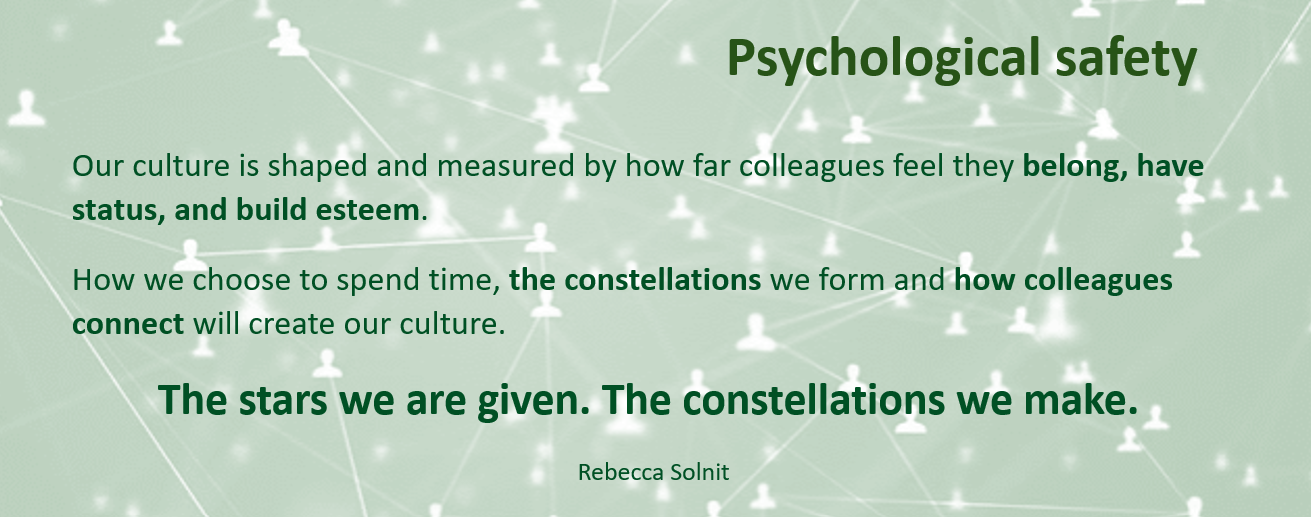
Our culture matters to us. It is built and shaped, in every interaction, everywhere, all the time and ever onward. Our cultural landscape is carved over time towards our shared purpose and is guided by deeply held lived values and shared rituals and routines. It is shaped and measured by how far colleagues feel they belong, have status, and build esteem. How we choose to spend time, the constellations we form and how colleagues connect will create our culture.

“The stars we are given. The constellations we make.” (Rebecca Solnit)

Making good decisions together

We make good decisions together. We seek and value expertise across our schools and the Trust as a whole. We are open and transparent as an organisation, making the best decisions we can, with the information we have, whilst seeking to do the right thing. We act without fear or favour.

First say yes. If a colleague feels the need to ask for support or resource, we should say yes, first, and work out how, later. Paying forward as an exercise in collective endeavour and shared responsibility.

The second mistake. It is rarely the case that the first mistake matters, it is often the second or third that turns mistake into problem. Because we make good decisions together, are open and transparent we share and resolve challenges at the first opportunity. Almost everything becomes easier when things are shared, it builds trust, and importantly avoids the second and third mistake.

A Human organisation, valuing relationships

We make time to listen, learn and build relationships. Being present. This is about ensuring colleagues are known as individuals, individuals with a unique story, a story that is heard. Understanding an individual’s story allows us to weave collective stories into the future; generating a greater sense of belonging. How we treat anyone, is how we treat everyone.

Humans are beautifully contagious

Use time well, seek simplicity

We will seek to use time well. Deliberately prioritising time towards the Main Thing(s). Logically sequencing our routines and networks and creating simple approaches that focus on making the greatest difference. We will work to reduce unnecessary burdens on individuals, to be as agile and nimble as is appropriate to our scale. As simple as possible, but not more so.

We will seek clarity because it is kind. Humans like rules, it is clarity that creates safety. We will share all data and information transparently to understand performance and drive improvement, part of our joint endeavour and collective responsibility for all children.

Primacy of Headteachers, the drivers of change

We understand the importance and primacy of Headteachers. The strongest Heads are great with people, understand provision and lead with purpose, prioritising and implementing key strategies and approaches, over time, to enable colleagues to change lives. They are open and able to utilise the capacity of the Trust, and to add into the strength of the Trust; a mutually beneficial symbiosis that adds value.

We are the sum of our decisions

Our effectiveness could be simplified as the sum of all decisions, by all colleagues, all the time, everywhere across our Trust that either accumulates value, or not. Our role as Trust Leaders is to influence, nudge, direct, enable better decisions to be made more often, to deliver a dividend. We will continue to dance between what we decide to do together and where we choose to empower colleagues to act.

Deliberately choosing where to standardise and where to empower colleagues

We will continue to standardise aspects of provision, to become more than the sum of our parts. Standardising, building things together, has tremendous power to liberate, support and give permission (and opportunity) for colleagues to focus on the Main Thing(s); creating a platform for colleagues. Our shared, common curriculum exemplifies the power of this collective endeavour.

Leadership is the art of giving people a platform for spreading ideas that work. (Seth Godin)

We will standardise and empower deliberately and strategically. Holding ideas in tension, informed by context, because context matters; it is not a compromise. Whilst recognising the importance of standardisation and of empowering colleagues on platforms, we will not seek to over dictate the complex areas of provision where experts and professionals make decisions, informed in the moment, in context, for their community.

“…under the conditions of true complexity – where unpredictability reigns – efforts to dictate every step from the centre will fail. People … require a seemingly contradictory mix of freedom and expectation.” (Atul Gawande)

We understand the influence we have on others

Back to the Future. Whilst Marty McFly travelled back in time and understood the future consequences of his actions, we are much less conscious of our influence on the future. Whilst we cannot foresee the future we can, together, create the conditions, sow the seeds, prepare the ground for humans to flourish and for more good than bad to happen. We, collectively create a crucible of serendipity where colleagues shape what is possible. Lives are shaped by opportunity. Our collective capacity can and will transform lives, evidenced in the smallest acts, every day.

“The smallest act in the most limited circumstances bears the seed of boundlessness, because one deed, and sometimes one word, suffices to change every constellation.” (Hannah Arendt)

We are collaborative by nature

We will build on our existing collaborative architecture, our co-operative system, to connect colleagues with purpose and to each other, seeking collaborative advantage. Connecting colleagues within professional networks and subject/year communities, where hard and soft-wired collaboration secures collaborative intelligence and wisdom that becomes self-improving and irreversible. The biggest influence on colleagues is colleagues.

Getting today right and building for the future

Two speed. As we forge forward, we will build our future, based on where we have been, where we are, and toward what we seek. We will seek to get today right and the future right. We will seek change and improvement in months and years, concurrently.

What do we seek? We decide, next, together.


Into our future

So, based on the platform that you have built, we will work with humanity, humility and openness, to shape the future, together. So, at this time, as I join you as CEO, my optimism, hope and determination for what we will achieve is galvanised by the brilliant people in our Trust.

“When we build a culture of people who eagerly seek out and take responsibility, we build a culture that enables a special kind of resilient freedom.” (Seth Godin)

We have an opportunity to enable all colleagues across our Trust to collaborate, connect and feel empowered to make a difference. To work as one organisation, sharing responsibility, engaged in collective endeavour to secure greater social justice, particularly for our most vulnerable children, those that carry the most through life, and particularly at this time. A worthy cause.

“To be hopeful in bad times is not just foolishly romantic.” (Howard Zinn)


Postscript

There is no way to build high-performing organisations without a cultural model that drives the strategy. Or to put it differently, strategy without culture is just wishful thinking.


Dan Nicholls | July 2024

Privileging disadvantage | Excellence, Equity, Culture

Securing provision that privileges disadvantaged children requires a deliberate balance of Excellence, Equity and Culture. A system in 3 dimensions. An excellent education made accessible by the application of equity held within a culture of high expectation closes gaps into adulthood for under-resourced children.  Shifting the identity of schools and organisations to systemically privilege those that need us most, because it is who they are and what they do.

Privileging disadvantage and closing gaps is futile without excellent provision. Effective enactment of a progressive, sequenced curriculum, every lesson, every day, as a universal entitlement, offers far greater opportunity for all. Whilst our strongest lever is an excellent education, this alone, is not enough. Schools also need to apply far greater equity, to be braver and fiercer to do different for under-resourced children, so that they are empowered and able to exploit the excellent education. An alchemy of excellence and equity.

“One measure of poverty is how little you have. Another is how difficult you find it to take advantage of what others try to give you.” (Michael Lewis)

When schools secure an excellent education, allied with the deliberate application of equity, children are enabled to, supported to, and expected to take the opportunity. This creates the conditions that disproportionately advantage disadvantaged learners. A potent mix of excellence and opportunity.

“…schools remain one of the few remaining trusted institutions equipped to help create a fairer society. -explicitly thinking about how teaching can be genuinely inclusive to benefit all pupils, while relentlessly identifying, understanding and overcoming barriers to learning outside (and inside) school – are the interlocking foundations of equity-based education.” (Lee Elliot Major)

Privileging disadvantage in three dimensions.

Sustaining this potent combination of excellence and equity requires a strong culture, where colleagues take responsibility for enacting the very best provision and to unlock it for all children (psychologically and structurally). Cultures of high expectation, never give up on individuals, let them down or off, they meet them there, step (push) them forward, in an ‘advantaged-like’ environment, upheld by all. Creating a culture that changes the life chances of those that have had the least, because childhoods last a lifetime, and we may be their only second chance.

“4.3 million children, 30% are growing up in poverty in the UK.” (Department of Work and Pensions)

Closing gaps and privileging disadvantage requires Excellence, Equity and Culture:


Excellence | Securing an excellent education for all learners – our strongest lever.

An excellent curriculum, sequenced, progressive and enacted to secure powerful knowledge and understanding, with eye-wateringly high expectations of all children, is our strongest lever. It requires our full attention to be uncompromising in pursuing social justice, confer power and an entitlement to the strongest possible provision. 

“Curriculum is all about power. Decisions about what knowledge to teach are an exercise of power and therefore a weighty ethical responsibility. What we choose to teach confers or denies power.” (Christine Counsell)

To disproportionately support disadvantage learners, we need all teachers and leaders to really understand the architecture of each subject, the most fundamental substantive core concepts, the most powerful knowledge and the key disciplinary concepts. We need to not stray far from this spine of the curriculum so that we weave baskets and schema that fundamentally support children to make links and learn more in the future. Arbitrary subject wanderings is kryptonite for disadvantage learners, confirming it is not for them and too abstract to connect and engage with.

Seeking to bounce up and down through a spiral curriculum, often, reinforces the spine, increases the proximity of the presently known to new knowledge and reinforces over time what is the most important and fundamental for learning. Do seek to inspire, expect much, and be geeky about the subject spine.

Excellent teaching must invest in strong explanation and direct instruction that assumes less about previous knowledge and experiences, tethered closely to the spine of the curriculum. Don’t hide explanation in slides or complicated context. Exposition is teaching and learning. Prioritise human explanation, modelling and analogy, enacted in real time, in plain sight, in simple language, visually accumulates advantage. High quality teaching triggers attainment mobility and realises potential.

Enabling disadvantaged learners to find their voice requires an effective school-wide systematic development of oracy. When there is strong oracy we privilege disadvantaged learners, because…

“… it is utterly transformative. It changes the way we feel about ourselves. It changes the way in which other people see us. It changes the way in which we relate to friends and family members. It changes our ideas about what we might go on to do in the future.” (James Mannion)

Seek to prioritise the building of vocabulary, particularly tier 2 vocabulary. This is key for joining thoughts and ideas together, deepens oracy and enables deeper thinking. Also actively lift the quality of all conversations, in all interactions, all the time, in the school. All colleagues have influence and skin in this game.

Reading and the development of reading is fundamental for accumulating advantageIt is hard to over-state the importance of reading: it develops cultural capital, comprehension, vocabulary, thinking, empathy, inference, confidence, concentration, oracy, writing, esteem, unlocks the world, quality of life, belonging…

“I didn’t know words could hold so much.” (Kya Clark)

Nudging, narrating, and coaching is a feature of an advantaged upbringing. From formative years advantaged children receive constant feedback and commentary that supports growth and is the driver for accumulating advantage. Formative assessment needs to be an intentional and deliberate part of an excellent education, it is a strong expression of care. I am giving you this feedback because I believe in you. The strongest teaching seeks to hunt, not fish, being precise about where individual children are and offering specific feedback. Follow learning to meet need.

Creating a strong culture of professional learning, with colleagues engaged in incremental coaching, often and specifically on aspects of teaching creates classrooms of opportunity for disadvantaged learners.

Children taught by the most effective teacher in that group of 50 teachers, learn in six months what those taught by the average teacher learn in a year. (Hanushek & Rivkin)


Equity | to enable all children to take advantage of an outstanding education.

“Fair doesn’t mean giving every child the same thing, it means giving every child what they need.” (Rick Lavoie)

We tend to under-use equity, in favour of equality, which often stops us giving what individual children really need. Applying equity, fiercely, bravely and deliberately, enables children to access and take advantage of excellent provision, but it requires us to understanding children as individuals. To do so requires us to genuinely walk in their shoes and see the world through their eyes and then to remove barriers and create an optimal environment. Applying the disadvantaged lens.

“90% of my time is spent thinking about and watching people … (to) genuinely get inside their shoes and see the world through their eyes … (to) create an optimal environment where a human being is going to have the best chance of being the best they could possibly be.” (David Brailsford)

To grow up advantaged is to exist in a world of opportunity and high expectation, it is demanding. We need to have the highest of expectations for disadvantaged learners, if we let them off, we will let them down. Each time we lower the bar we are complicit in widening the gap. Disadvantaged learners are not less able, it is an economic label only… and labels are dangerous.

To grow up advantaged is to be held to high expectations and encouraged to participate in supported opportunities over time. A childhood that encourages risk taking, a low safety bar (with safety net), offers commentary of the journey through life and reaffirms a child’s internal locus of control. We need a system where all children have someone who believes in them, someone (maybe many) to meet them there.

“The biggest benefit in being the child of a scientist? Low safety bar. As soon as Mad could walk, Elizabeth (Zott) encourages her to touch, taste, toss, bounce, burn, rip, spill, shake, mix, splatter, sniff, and lick nearly everything she encountered… Nevertheless, she lived.” (Bonnie Garmus)

Focus on Attendance first, compelling and engaging all colleagues to drive up attendance of disadvantaged children, as the priority. If children aren’t in, our influence is zero, they need us to reach out and pull them in.

Mentoring and tutoring, in addition, is an overt expression of equity and a typical feature of an advantaged upbringing.  Schools must focus on careers and future planning, so that disadvantaged learners see and know what is possible, because disadvantaged children are not less ambitious.

We need to apply equity to every transition point, to step in, hold disadvantaged learners and build a secure sense of psychological safety. It is within transitions that advantaged parents step in, navigate, and support children over the multiple transitions of childhood. It is not just between schools, or years, or terms, or days, it is all the time; our lives are punctuated by transitions. We need to be the bridge, to be the ladder.

Beware of being complicit in creating schools within schools. Too often schools inadvertently create pathways, perfectly designed to widen gaps and exacerbate disadvantage. Alternate realities do not exist in schools that privilege disadvantage. We measure ourselves and our status against those we spend time with. We should seek to create conditions for attainment mobility and wide social connection.


Culture | Privileging into the long term is about culture change, seeking irreversibility.

“Your goal is your desired outcome. Your system is the collection of daily habits that will get you there… you do not rise to the level of your goals. You fall to the level of your systems.” (James Clear)

In schools where under-resourced children thrive the strength of culture and shared responsibility is evident and tangible, you feel it. These schools have systems that entirely privilege all children, subconsciously carved into the expected norms, habits, routines, language and behaviour as an irreversible commitment to educate and apply equity to all children. Disadvantage even over

Schools that privilege disadvantage have exothermic systems that generate their own energy and subconsciously (but by design) close gaps, rather than endothermic systems that require external energy, conscious focus, initiative, strategy and tables on websites. The first is a permanent shift in identity and values, the latter is ill-equipped to close gaps. Schools becoming what they repeatedly do.

Our interactions, language, and the attention we give to others defines our attitude towards themand influences the way children see themselves. Language really matters, it warrants deep consideration and development over time, it is the artefact of any culture.You belong here. Systems that privilege disadvantage call out behaviours, attitudes, actions, language and intent that widen gaps.

Schools that close gaps measure what matters, because and what we measure, we care about. The true measure of the effectiveness of an education is revealed in the attainment, progress, and attendance of disadvantaged learners. The best schools prime the conditions, reward gap closers and gap closing as part of the values, even over other metrics.


Closing gaps in 3D | In brief

Step one: Seek to secure an excellent education, where great teaching of a well sequenced, progressive, conceptually driven curriculum, disproportionately supports learning of disadvantaged children, every lesson, every day to close gaps.

Step two: Really understand all children, remove barriers, maintain very high expectations, and apply equity to secure full access for all children to an excellent education (over privileging and applying equity as necessary).

Step three: Build a culture that ensures the excellent education is accessible and unavoidable for all children by applying equity. Shift the identity, to one that privileges disadvantage in everything.

Then: stop talking about disadvantage, disadvantage strategies, PP Plans and initiatives, instead talk about high quality provision, accessed by all, because it is who we are and it is what we do for all.

If we do so, we just might create the conditions that disproportionately support disadvantaged learners to accumulate advantage and close the gaps that we currently perpetuate. An education, where all children belong and feel success because it privileges disadvantage.

Seek Excellence, Equity, Culture | close gaps in 3D.


Dan Nicholls | May 2024

Unwarranted Optimism

    For there is always light,

    If only we’re brave enough to see it.

    If only we’re brave enough to be it.

    (Amanda Gorman)

    When everything around appears dark and it is hard to see the light, we need to be brave enough to have unwarranted optimism. It is unwarranted because of the number of challenges faced by colleagues working in education that push us into hopelessness and toward helplessness. And, perhaps worse, there is a real danger that this helplessness is increasingly learnt, mutually reinforced and influencing the stories we tell each other about our profession.

    “Do you have the resilience to show unwarranted optimism, and to regard crisis as the norm and complexity as fun, while maintaining a bottomless well of intellectual curiosity?” (Tim Brighouse)

    To work in our profession requires unwarranted optimism. It always has, but it feels harder than ever to view the future with hope. Optimism (particularly unwarranted) is the life blood of our sector, the fuel that drives good people to do good and change lives. We must not sink our profession by peddling pessimism, even if it is warranted.

    “The problem is that people mistake optimism for ‘blind optimism’.” (Hannah Ritchie)

    However, this is no time for ‘blind optimism’, a naive faith or passive hope that things will turn out well. We need a ‘conditional’, ‘urgent’ optimism that empowers us to act, to step forward and build together a future for all children. Even if optimism, at this time, is unwarranted, it is a far better basis for offering colleagues and children a sense of possibility.


    Warranted Optimism | Everyday acts of heroism.

    “Optimism is seeing challenges as opportunities to make progress; it’s having the confidence that there are things we can do to make a difference. We can shape the future, and we can build a great one if we want to.” (Hannah Ritchie)

    Our schools may well be performing better than ever, providing provision that is meeting the steepest of challenges, post pandemic, and in the face of the fracturing social contract. In all schools, heroic acts are changing lives, exemplifying the power of human connection, offering real hope and optimism for the future; a powerful force for good.

    Warranted Pessimism | poor choice for children and colleagues.

    Warranted pessimism is not an option. Despite the oppressive background music and the darkening light, if we choose to be pessimistic, we may well extinguish the fading light. Too much pessimism, warranted or unwarranted disturbs us deeply, encourages retreat and pushes us to become victims of circumstance. And whilst we can individually decide to retreat, it comes at a cost for all and our profession, as well as the children who need optimism, not pessimism, from the adults they trust.

    “There is no trust more sacred than the one the world holds with children.” (Kofi Annan)

    Skin in the game | our influence lives beyond us

    We all have an opportunity to be and bring the light to others. We cannot choose to sit outside the lives of others or be silent in the narratives that we tell each other; we have skin in other people’s lives. How we choose to move through life, reinforces or erodes the narrative and norms that set the stage far beyond ourselves, in schools, classrooms, and more broadly in life.  How we choose to live in this world, matters.

    How to live in a world where profound uncertainty is not a bug, but a feature? (Yuval Noah Harari)

    We are also hugely influenced by the need to fit in. It is coded deep in us that to be outside of a group hurts, is unsafe and a danger. So, we often take opportunities to align ourselves with the beliefs, attitudes, norms and behaviours of those closest to us. Often choosing against our independent beliefs to follow trend and fit in; a trend that is too often pessimistic. It matters, therefore, whether we choose unwarranted optimism or not, it radiates and infects beyond ourselves to other beings and happenings, all of the time.

    “Your response has to be to reject cynicism and reject pessimism and push forward, with a certain infectious and relentless optimism. Not blind optimism, not one that ignores the scale and scope of our challenges, but that hard-earned optimism, that’s rooted in the stories of very real progress.” (Barack Obama)

    Fairy Lights over Spotlights | a marvellous victory

    “What we choose to emphasise … will determine our lives. If we see only the worst, it destroys our capacity to do something… and at least the possibility of sending this spinning top of a world in a different direction. …to live now as we think human beings should live, in defiance of all that is bad around us, is itself a marvellous victory.” (Howard Zinn)

    To live with unwarranted optimism is to seek the joy of fairy lights over spotlights. A focus on fairy lights enables us to see the joy woven through life, to value the happenings and humans around us. Shifting our focus to the normal, everyday, magic that happens in schools, reveals the power of human relationships and places value on what really matters.

    “To be hopeful in bad times is not just foolishly romantic.” (Howard Zinn)

    The future then is built on an accumulation of small acts, a bottom-up movement, where change becomes possible and we have the chance to send this spinning top of a world in a different direction.

    meaningful movements start bottom-up.

    Seeking spotlights on the other hand is like waiting for big things or changes, often viewing them as a salvation that will save the day. It is the hope that kills, the waiting for the next station that stops us from living now and enjoying the journey.

    “I’ve very deliberately chosen to notice the smaller things, the joys I might have otherwise missed had I looked too broad, too big. The thousands of joys that lattice and join and thread into and around our daily school life.” (Claire Stoneman)

    Uncommon Opportunity | striving for what is worth having.

    There might just be an uncommon opportunity to re-evaluate what really matters in education. Some of the most courageous and heroic work is happening in unfavoured areas of our sector; areas where the challenge is steepest and recognition the lowest.

    “This is Vanity Fair a world where everyone is striving for what is not worth having.” (William Thackeray)

    The narrowness of what is valued in education belies the vibrance and range of opportunity that exists in our world and the eclectic abilities of human beings. It is this narrowness that disenfranchises the many. We must throw more light on what is worth having, what children need for their future; a system more geared towards those it serves.

    I deal my own deck, sometimes the ace, sometimes the deuces.” (Gloria Gaynor)

    When we are pushed by powers beyond our control we should strive to go in the opposite direction and enable others to take more control, to step forward and make a difference to their part of the world. We should continue to deal our own cards, and empower others, to deal from their decks, optimistically, regardless of what is dealt; because we have collective power and we are the system.

    Too many feel unremarkable | in a remarkable world.

    In a darkening world children, particularly under-resourced children, need us to have unwarranted optimism, to offer more light and a greater sense of possibility. Creating the conditions for children to adventure down rabbit holes of curiosity and to feel the wonder of our remarkable world. We seek this wonder, so that children have the chance to walk a step or two with genius and because childhoods last a lifetime.

    “Do you believe with a passion that brooks no denial that all pupils, whatever their background, can walk a step or two with genius and that your staff will embrace the aim that all students will grow up to think for themselves and act for others?” (Tim Brighouse)

    We must not allow a pervading pessimism to extinguish the light for children and create a self-fulfilling narrative that damages our profession. We must encourage more to serve in education to reveal the magic that exist in ordinary lives and to bring more light.

    “…treading the intriguing line between the everyday and the otherworldly, revealing the magic that exists in our ordinary lives.” (The Lost Bookshop)

    Not our story to finish | true but useless.

    We should not pretend to know the future or how this story plays out. We must tread carefully on the dreams of children and seek to create provision that is more born out of optimism than pessimism. It is the difference between setting the stage for children to stumble forward in the dark, steeped in pessimism, and stepping with confidence into a future that is full of optimism and possibility. Children need to grow up in a world where they feel remarkable, opportunity is unbound, and where children do not feel separate from the world.

    “…although her childhood, had left her feeling separate from the world.” (Steven Rogers)

    Lest we forget that children are vulnerable to the beliefs and narratives of the adults in their lives. The challenges we face are true but useless for the children we educate. They do not choose the conditions, location, or time that they inhabit, and they are largely unaware of pressures, turmoil, and upset of colleagues in our sector. They profit nothing from a sector that fights, argues, gives-up, or fails to work optimistically with the hand that they are dealt.


    Unwarranted optimism | An invitation to dance

    We choose our approach to life and to work. It is too easy to see the challenges that surround us and retreat into the security of pessimism, into narratives that reduce agency and reinforce helplessness. But, when we do, it is not an individual choice, the impact of this stance reverberates through other beings and happenings. It denies a sense of possibility.

    Conversely, to bravely choose optimism, conditional optimism, we offer a greater sense of possibility, to reassess what is valued and to see the magic and the light in the everyday. This is a stronger basis for the future, more generous and a greater investment in colleagues and children.

    “Ignore those who say that we are doomed. We are not doomed. We can build a better future for everyone.” (Hannah Ritchie)

    So, to choose individually, collectively, and organisationally to pursue unwarranted optimism is to contribute to a growing narrative that encourages us not just to see the light, but to be the light. To step forward rather than shy away from the future and collectively build it.

    And in this optimistic light perhaps all children and colleagues will accept an invitation to dance.


    Dan Nicholls | February 2024

    Collaborative Advantage | seeking a trust dividend

    Strong Trusts seek collaborative advantage by building an organisational structure and curating a culture that connects colleagues in shared endeavour. In these Trusts colleagues are empowered, on standardised platforms, to take collective responsibility for approaches and artefacts that enable connected schools to add value and secure a Trust dividend that sustains beyond their time. Trusts seek school improvement by making deliberate bets, laid as investments, that improve the life chances of all children, particularly those who are under-resourced. And in these dark times, it has never been more important for Trusts to seek greater equity through education, to be long-sighted and to invest in the future by planting trees, deeply rooted in their communities; the shade from which they may never benefit.

    “…leaders doing less but understanding more… can free themselves to focus on the future – which is, after all, the proper territory of leadership.” (Tracey Camilleri, et al.)

    Where Trusts choose to play and how they focus on the future, matters

    Defined by the decisions we make | Choosing where to play

    Whilst we might assume that there are many ways to run a Trust, there are surprisingly few. And it is ‘few’ because all Trusts are in the business of school improvement, held in a highly regulated system and seeking to improve the life chances of all children. There is a reassuring alignment between the challenges and opportunities that Trusts engage with to add value, moderated, a little, by maturity, scale and capacity. Where Trusts choose to play and how well this is enacted largely determines the success of a Trust.

    As Trusts grow, merge, mature and forge identities, their effectiveness could be simplified as the sum of all decisions made, by all colleagues, every second, of everyday, everywhere in a Trust that accumulates a dividend, or not. The role of Trust leaders is to influence, nudge, (direct), enable better decisions to be made more often, over time, the sum of which delivers the dividend. How Trusts influence this decision making, is a dance between what it decides to do together and where it decides to empower colleagues to act. An intelligent dance, that balances standardised and empowered approaches, and connects colleagues together seeking a collaborative advantage.

    Seeking collaborative advantage | Who’s on first base?

    Trust (and school) leaders “…are all playing Moneyball, all the time” (Seth Godin). Seeking the organisational design and strategy that will make a discernible difference and hold schools in a higher and more consistent performance space. For Bill James and the Oakland As it was: “…putting players on base at a higher rate, leads to more runs, which therefore, translates to more wins.” For Trusts, perhaps it is:

    “…putting colleagues together (with purpose) at a higher rate, leads to more value, which therefore, translates to a greater dividend.”

    Creating the architecture for colleagues to deliberately collaborate creates the conditions for a collaborative advantage. Connecting colleagues within professional networks and subject communities, empowers peers to co-construct and co-design beliefs, attitudes, approaches and artefacts that drive the dividend, for the long term. Strong Trusts understand the need to build antifragile organisations where the hard-wired (and soft wired) collaborative architecture strengthens under stress, secures wide ownership for improvement, is self-improving and irreversible. Effective collaboration is hard to create, what it is and what it isn’t and how it is designed, entirely determines the benefit felt. The biggest influence on teachers is teachers.

    “System leaders focus on creating the conditions that can produce change and that can eventually cause change to be self-sustaining.” (Senge et al.)

    The cultural landscape and fabric of the Trust

    It is hard to under-state the importance of culture in organisations. The deliberate design of the cultural landscape and the strength of the cultural fabric are necessary pre-requisites for the sustained success of any organisation; built ever onward.

    Colleagues need a contradictory mix of being part of something bigger (the cultural landscape), and to see themselves in the organisation (part of the cultural fabric), to have what they need and to be a unique part of the pattern.

    The cultural landscape of a Trust is shaped and carved over time towards the shared purpose, the mission of the Trust and is guided by deeply held (lived) values and enacted in shared rituals and routines. Walking and working in the cultural landscape reveal the values and character of the Trust; it determines and secures belonging, status, and esteem of colleagues, or not. How Trusts choose to spend time and how colleagues connect is a window into the soul of the organisation.

    “The stars we are given. The constellations we make.” (Rebecca Solnit)

    The strongest cultural landscapes are organised around the reason for existence. These Trusts clearly articulate the mission and the purpose of the Trust, which is held across the landscape by the North Star, guiding and moulding the norms and behaviours. Lit by this star the cultural fabric weaves colleagues together towards the mission, to do good and make a difference.

     “If everything is important, then nothing is… When you know your reason for existence, it should affect the decisions you make.” (Lencioni)

    The strongest cultural fabrics are held together by a shared language, vocabulary, norms, behaviours, attitudes, artefacts, standards, conversations, ideas… it holds colleagues, offering the psychological safety to bring their best selves. The fabric is deliberately, consciously and systematically woven in every action and conversation. It is the cultural landscape and fabric of a Trust, that sets the stage and the conditions for colleagues to do important work.

    When we build a culture of people who eagerly seek out and take responsibility, we build a culture that enables a special kind of resilient freedom.” (Seth Godin)

    In strong Trusts, culture is deeply linked to where it has been (true to founding) and where it is going (ambition for all) and its journey (the everyday culture). It is (un)surprisingly well designed and felt everywhere, from all colleagues; how we treat anyone, is how we treat everyone. One of those things that takes years to build and seconds to destroy. The culture and colleagues drive the dividend.

    Trust Mindedness | school is trust, trust is school. Priming the landscape.

    Strong Trusts seed and cultivate the landscape, to reward Trust mindedness, intrinsically so. A priming of culture that is conducive to collaboration, to understanding that all leaders, all colleagues are responsible for all children in the Trust. It is about creating an internal market where the stock price of schools, leaders and colleagues rises with altruism, collaboration, professional generosity, contributing to the shared artefacts, routines and rituals that live out the Trust values, towards the mission and secures the dividend.

    This is a Trust-wide mindset, within the cultural landscape and fabric that primes, promotes and rewards relationships and behaviours that fuel and sustain the School Improvement Model. It is the deep collaborative motivation that lives in the Trust, to depth, that encourages better decisions more often, so that the Trust is more than the sum of the parts. Under these conditions Trust leadership is increasingly about guardianship and stewardship.

    The primacy of Principals | The lead actors in mature (and immature Trusts)

    Strong Trusts recognise the primacy of Principals. Schools are significantly influenced by the quality of the headteacher (and teams they lead). If the culture and choices made by a Trust largely determines the potency and effectiveness, then the Headteachers are the key actors in school improvement. The effectiveness of the Headteacher is largely the determining factor in the quality of provision, influenced by the Trust, of course, but perhaps not as much as we would like to think.

    The strongest Principals are great with people, understand provision and lead with purpose, prioritising and implementing key strategies and approaches, over time to drive the effectiveness (and efficiency) of the school. Importantly they are open and able to utilise the resource and strength of the Trust; a symbiosis that adds value, and increasingly so. Strong Trusts invest deeply in Headteachers, designing curriculum, professional learning, opportunities, connectivity, collaboration and the conditions for Heads to lead well.

    Exploit the complicated | Standardised Provision

    Perhaps the biggest advantage afforded to Trusts is the ability to standardise aspects of provision to secure school improvement and greater consistency in provision. Despite some negative connotations or overly simplistic views of “standardisation,” it has tremendous power to liberate, support and give permission (and opportunity) for colleagues to focus on the Main Thing(s). The creation of standardised approaches, strategies and artefacts builds a platform for colleagues, to focus on meeting need, without the distraction of re-designing areas of provision that just need to happen reliably and consistently.

    Leadership is the art of giving people a platform for spreading ideas that work.” (Seth Godin)

    Strong Trusts intentionally and deliberately standardise ‘complicated’ areas of provision:  Complicated areas act largely the same way each time. These areas can often helpfully be reduced to a checklist; if this, then do that. Trusts should play in these areas and standardise as there is limited need for local decision making or creativity and, importantly, this offers the opportunity for a Trust to improve provision for all learners (and colleagues). Co-creating and co-designing shared curriculum and assessment are particularly potent areas for the dividend.  

    Empower and guide the complex | Empowered Provision

    Areas that are largely complex should be empowered to schools and colleagues. Complex areas respond differently each time and are typically influenced by the unpredictability of human action and interaction, requiring in the moment decision making. In complex areas of provision, we need to push decisions closer to the action where quality and outcomes are linked to the situation as it emerges, contextually influenced. 

    There are areas of provision in each academy that is better owned and empowered locally, they are largely complex, influenced by context and improved by local decision making. Of course, it is desirable to standardise aspects of these largely complex areas in academies to (fractally) create the standardised platform for colleagues in academies.

    Don’t overcook | Just because you could, does not mean you should.

    Standardise too far, and you remove the local decision making, professionalism and agency of colleagues to make good decisions, commensurate and appropriate to a profession, and being a professional.  This is the crux of effective Trust leadership, the dance between the complicated and complex, to standardise and to empower deliberately and purposefully. Held in tension, strong Trusts create routines, standardise areas of provision to support colleagues, but do not seek to over dictate the complex areas of provision where local decision making, near to the action, informed in the moment, adds the value and creates the sustainable behaviours that secures a self-improving organisation, beyond our time.

    Holding ideas in tension is not a compromise

    Trusts should not use their power to standardise without bound, there are limits to the effectiveness of standardisation when it steps over and on individual agency and professionalism.

    “…under the conditions of true complexity – where unpredictability reigns – efforts to dictate every step from the centre will fail. People … require a seemingly contradictory mix of freedom and expectation.” (Atul Gawande)

    Measure what matters, transparently and in the interest of school improvement

    Strong Trusts measure what matters and by doing so indicate what they care about. This is the transparent democratisation of data to all colleagues to enable a focus on learning and evaluation of provision, to depth. This reveals standards, informs school improvement and highlights high (and low) performance as well as expertise across the Trust.

    Trust leaders are guardians of standards, creating an insurance policy that holds and secures improvement for all children and schools in the Trust. A risk-led approach enables an agile and timely distortion of resource, school improvement capacity and expertise to ensure that all children, areas of provision and academies are supported to improve and level-up in a timescale that is quicker than the local resource capability. School is Trust, Trust is school; all colleagues responsible for all children.


    Whether Trusts become more than the sum of their parts and add a dividend for all children, families and communities is determined by the choices that they make and where they choose to play. Strong Trusts craft cultural landscapes and empower colleagues within a cultural fabric, on a standardised platform, to connect across the Trust to realise a collaborative advantage.

    “The role of the leader is to enable, facilitate, and cause peers to interact in a focused manner…but still only a minority of systems employ the power of collective capacity.” (Fullan)

    Strong Trusts build the conditions where the collective capacity is focused on addressing the steep challenges of our time and where the collaborative advantage drives a dividend that secures greater equity through education.

    …But, Trusts are not alone in the landscape, despite pressures that promote isolationism and competition, all parts of the sector are joined in a quest to build a better system. A system that will only meet the growing needs of all children when there is greater collaboration, stewardship, generosity and collective responsibility. We should seek together a sector that exploits a collective collaborative advantage for the good of all children.

    All Trusts working together for all children


    Dan Nicholls | February 2024

    The thinking presented here is based on the work, experience and thinking of colleagues across Cabot Learning Federation.