Fiercely educate…

… children who are presently disadvantaged.

If we are to overcome the forces in our society and schools that insidiously widen gaps, between those that have and those that have not, we need to be more ferocious, more tenacious in creating the conditions that enable our disadvantaged learners to flourish. This requires educators to be more honest, to ask uncomfortable questions and make braver decisions to fiercely educate those that need us the most.

Photo by Efe Yagiz Soysal on Unsplash

To fiercely educate is to replicate the stage-managed, high expectation and sharpened elbows of an advantaged childhood. Being fierce means guarding a child’s education, expecting much, staying alongside, pushing from behind, consistently and persistently championing individual children.

An advantaged childhood holds, expects and elevates children, who are fiercely loved and as a result feel more secure.

“Okay, well, Eleanor has this mother. She intimidated me at first actually because she just – she’s fierce. Fiercely loving. … but I could tell she felt safe in that house. She grew up feeling safe and fiercely loved.

“And you and I didn’t get that, not because we didn’t deserve it, we just got dealt something else. But the people who did get that love, they grew up to be different from us. More secure.

Coco Mellors | Cleopatra and Frankenstein

To be fiercely loved* is to be challenged, extended, stretched, to reach and risk, and at the same time, to be held tightly, more secure. “You will be brave, I have got you.”

*the emphasis is on fiercely rather than loved. Families who are socio-economically deprived do not love their children less, often quite the opposite, but the time, money, space to create opportunity and supported experiences to translate that love, ferociously, is compromised at every turn.

Advantaged families interpret the world for their children, translating experiences and interactions to maintain their sense of security and renew their agency. Setting and re-setting a desired narrative of what it is to be and feel successful, to step forward once more, even when the randomness of life and experiences intrude beyond the home. There is always an ongoing invitation to dance. Sitting out is not an option.

To grow up advantaged is to step forward through a life punctuated by opportunities, reaching, risking and stepping forward, it is a secure pursuit. These are childhoods, with guide ropes and safety harnesses, that see failure as an obstacle on the path to eventual success.

If you are lucky enough to be born in a world made in your image, you probably think of a failure as an obstacle on the path to eventual success. If you are a marginalised person in any way you internalise that failure more closely.

Elizabeth Day

Without a deep sense of security, a disadvantaged child is far more likely to internalise failure more closely. It is precisely this self-reflection, the connection of failure with self that perpetuates over time and maintains an inhibiting mindset that convinces that it would be safer not to try. Without the ferocity of expectation, the unwavering (taught) belief in their own agency, a child’s hand goes up fewer times, they step back rather than stride forward and live with a constraining belief that the world is not built in their image or for their circumstance.

If we step forward less we tend to surround ourselves with others who are also less likely to step forward in life. It is the five closest individuals with whom you measure your status, the ones that set the bar, the ones we compare against. And where we create schools within schools we set expectations of what is possible (and not possible). We must work harder to cross-connect social circles, orchestrating and intervening to be more inclusive.

Each starling is only ever aware of five other birds,” she said. “One above, one below, one in front and either side, like a star. They move with those five, and that’s how they stay in formation.”

Who are your five then?” asked Cleo. “The ones you watch?

Coco Mellors

It is an inconvenient truth that schools create these self-fulfilling groups, reinforce the conditions for advantage and disadvantage to accumulate. We are the problem more often than we admit, more often than we see, more often than we realise. To see the conditions we create, those that we have come to accept, we must apply the disadvantage lens on ourselves and our schools, be more honest and evaluate what we are willing to accept, what we hold up and measure as success. This is about confronting and tackling the perpetuating inequity, seeking to halt social fractures at a time when society is fracturing.

Hope: to want something to happen or to be true, and usually have a good reason to think that it might.

A childhood of advantage is one of agency and hope; a life on an exciting journey of opportunity, where what is wanted, sought after, is within reach and based on previous experiences, have a good reason to think it might be achieved. And if it does not, any failure slides off, it does not define. After all, the failure is not about me reaching out, because I act on the world. And yet for our disadvantaged children each failure is another hit on self-belief, self-image, another example of the world acting on them. “This world is not for me.”

An advantaged childhood also has purpose (one insisted on, and then internalised by the child), a beacon that directs effort and demands persistence. We must work harder to create, expect and articulate purpose so that it fuels the persistence required to close gaps.

“When we have a purpose, we are able not only to endure and persist but also to provide a beacon that reminds us of what’s important and to make the right decision at the right moment.”

Steve Magnus


Too many journeys through school are riddled with children being let off, in conditions of low expectation where interactions are compromised by collusion. We are prone to making poor assumptions about background, present levels of attainment, context, aspiration, resilience; missing the fact that we are both the problem and the solution.

We need to be more honest and braver as educationalists, guarding each child’s education and building great schools that deliberately step in to create pathways for disadvantaged learners to thrive and flourish. It takes the whole team to maintain provision that privileges disadvantage everywhere, only shared endeavour has any chance of systematically closing gaps; culture over lists of good intentions/interventions.

So:

  • There is little in this world more powerful than someone who deeply believes in you; educators have that power. An unconditional acceptance from a trusted adult gives a child the warm sense of belonging; a psychological safety that says we believe in you. Unpicking disadvantage is a team sport, focused on individuals to apply equity.
  • We are disproportionately influenced by those that we spend time with (sometimes chosen, sometimes destined, sometimes orchestrated); schools need to remove the school within school phenomenon – our choices around setting, staffing, curriculum either perpetuates disadvantage or removes it.
  • To fiercely educate is to have educational provision that reaches those that need us most. We need to measure what matters: the attendance and attainment of disadvantaged learners. Attendance first… we cannot fiercely educate any child we cannot see.
  • Our journey through education is disproportionately shaped by small acts; these are rare, often serendipitous experiences that shape us the most. How far do we purposefully engineer and create these moments of ignition within a child’s education so that they see themselves differently?

The disproportionate influence of five sentences within the novel of our lives.

  • Our interactions, language and the attention we give to others defines our attitude towards them and influences the way children see themselves. It is easy to understate the importance of culture and collective attitude in schools.
  • A child’s self-belief, self-confidence and self-image can be so fragile that inconsequential comments, experiences and actions can erode any belief that exists. As educators we can choose to fill or not fill these lockers. Removing deficit and neutral discourse in our shared language really matters; our words make a difference, both ways.
  • Simply adding “I am giving you this feedback because I believe in you,” changed students’ learning trajectories significantly (Cohen & Garcia, 2014).

“They may forget what you said, but they will never forget how you made them feel.”

Carl Buehner

  • We need great teaching in great schools to understand where children are in their learning and teach the next bit. Seeking to hunt not fish and to apply the equity that disadvantaged learners need. Weaving nets to catch the curriculum.
  • We are hard-wired to see success as talent and gift and not the expression of supported opportunity and accumulated hard work over time; it is the latter that disadvantage learners need, it is the former that perpetuate poor attitudes to individual potential and widens gaps.
  • We may well be witnessing a significant shift in the social contract. The contract held between families and school is eroding, relationships and attitudes are shifting. Whilst we wrestle with a whole range of challenges we must not forget, rather increase our investment in the individual children that walk into our schools everyday.
  • … you have the power to change lives, to weave a future for children, just as the threads of society are unravelling for too many children. You are the hope, for many the only second chance.

“History will judge us by the difference we make in the everyday lives of children.”

Nelson Mandela


Dan Nicholls | May 2023

Stretch and Challenge | CLF Conference

Slide1

It is probably true… that consistently, deliberately and purposefully pitching learning just beyond a child’s present ability, that point between confusion and boredom, is perhaps the hardest part of teaching. This requires a depth of awareness of where each child is and specifically what each individual needs to do next to learn and make progress.

It is also probably true… that good lessons have the ability to stretch and challenge 80+% of children, whereas a great set of lessons stretches and challenges a different 80% each lesson. This requires teachers to become expert coaches who have a depth of subject and age-related knowledge, formatively assesses and use effective feedback to know where each child is with their learning, has the ability to use this to plan for progress, has an in-built ethic of excellence and the in-lesson awareness to intervene with effective questioning, explanation and modelling. Effective coaching happens when there is a consistent application of these elements over time, so that…

“…success is not a random act. It arises out of a predictable and powerful set of circumstances and opportunities (provided by teachers and others).” (Malcolm Gladwell)

The following reflects some of the best practices across the Federation and identifies the key aspects for securing stretch and challenge in all classrooms…


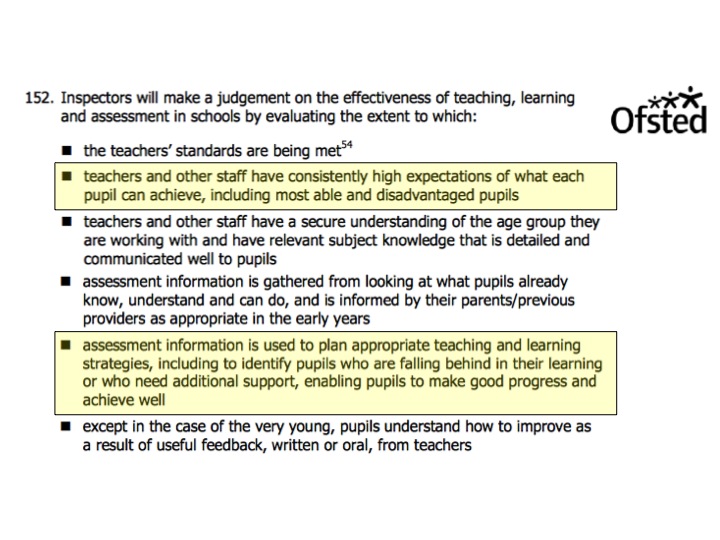
What if… Ofsted are right? that the stretch and challenge of all children should be based on having consistently high standards of what each pupil can achieve, including the most able and disadvantaged…and assessment that informs planning for pupils who are falling behind in their learning or who need additional support enabling pupils to make good progress and achieve well?

Slide1

…and that when looking at books… there is the level of challenge and evidence that pupils have to grapple appropriately with content, not necessarily “getting it right” first time the work is not too easy?

Slide2

What if… the ability to plan for and to challenge and stretch children is impossible without a depth of knowledge that encompasses…

  • subject/age-related understanding of standards and expectations – that enables appropriate pitch as well as igniting an interest and passion around specific and well-ordered content?
  • a deep understanding of the key concepts and importantly the key mis-conceptions that are built into the progression of a subject or area of learning?
  • knowledge of exam and age-related expectations to provide precise planning, task setting that ensure that children are stretched and challenged around the appropriate content?
  • Knowledge of pedagogy – how to plan to pitch learning, plan lessons, activities and other elements of pedagogy to secure progress.

What if.. one of the key levers in stretching and challenging children is the subject passion from teachers who inspire young people to achieve more. Teachers have huge influence – and with that opportunity comes great responsibility:

717296dd52443f5d014228877381418e

What if… this passion is particularly portrayed through the language we use? It is language that motivates and perhaps more importantly inspires interests that enhance young peoples lives. What if… we analysed our own use of language and identified phrases and approaches that automatically set limits (often unknowingly) on what children can achieve or indicate limits to what we believe is possible?

What if… planning to stretch and challenge requires:

  • lesson objectives that genuinely stretch children based on where they are in their learning.
  • feedback and previous progress is the basis for the planning of each lesson – teachers show the flexibility required to respond and pitch lessons by child.
  • flexibility within lessons enable learning, tasks, questioning to be altered to maintain challenge and pitch.
  • peer-to-peer learning is used to support and accelerate progress.
  • different tasks are required to stretch children who are at different points in their progression.
  • lessons and content need to increase in depth rather than breadth to support increased challenge and stretch.
  • absolute clarity around what the age-related or exam-expectations are to direct learning appropriately and stretch in the right areas.
  • have high expectations of what is possible and what children can achieve.
  • Build resilience in pupils who develop GRIT and a growth mindset to spend more time outside of their comfort zone.

comfort-zone-4

What if… children do not produce their best work often enough and tread water in the mediocre? It might be that we rarely stretch and challenge students to produce their very best work and that much of the work produced falls in the bottom quartile of what what they are capable of?

Slide1

What if… children were stretched and challenged to produce work that is skewed to the right, toward excellence and not left where it probably sits at present?

skewed

What if… there is an ongoing and accessible record of a child’s best pieces of work so that there is an immediate benchmark to build from (perhaps at the front of each book).

draft2

What if… children can fly if they truly believe they can? 

cc1ae1a0333adcd0ad428bd2046efa5d

The moment you doubt whether you can fly, you cease for ever to be able to do it.” (from, Peter Pan)

What if… teachers always started from the position that all children can achieve their potential? and What if… this was portrayed in the manner, language, optimism and challenge that teachers have for their classes/children?

What if… we understood that a child’s beliefs can limit what they believe to be possible and worse still that as teachers and educators our beliefs can also limit what others believe that can achieve?

“Tread carefully on the dreams of children; they are fragile”

“…and release them to achieve their podium position…”

podium

What if… to stretch and challenge individuals practise needs to be …intentional, aimed at improving performance, designed for (their) current skill level, combined with immediate feedback and repetitious.”  (Malcolm Gladwell) … enabling children to  over-perform.

What if… creating these conditions and the opportunity to stretch and challenge children requires teachers to be expert coaches who…

  1. Opportunity – creating the opportunity for children to learn and work just beyond their present ability.
  2. Competition from like-minded individuals – create a ethos and atmosphere of sharing and feedback that balances competition and co-operation.
  3. develop GRIT – supporting children to focus on long term goals, ignoring short-term distractions. Often re-doing and re-drafting for example.
  4. seek Deliberative practise – based on precise feedback support children to practise and apply understanding.

bell curve

What if… this seeks to…

“replace the patchwork of lucky breaks, context and arbitrary advantages that determine success…with a system (learning) that provides opportunities and the conditions for all to feel success.” (Malcolm Gladwell, adapted)

What if… planning, tasks and activities are informed by Blooms and SOLO taxonomy? That these frameworks support children to be appropriately stretched and challenged.

blooms_taxonomysolo-taxonomy-with-verbs

What if… we sought more often to escalate lessons and tasks from closed to open and (more often) to challenge children to apply, analyse, synthesis and evaluate their developing understanding. What if… too often children spend time doing what they can already do?

What if… we pitch lessons in the proximal zone? and that the real challenge is to plan learning so that as many children are kept in their proximal zone for as long as possible, just beyond what the child is capable of, supported by a peer) … or in a state of FLOW (that area between boredom and anxiety)?

What if… good lessons stretch and challenge 80% of students, but that in great lessons this is a different 80% each lesson? seeking to pitch and stretch all children over time… an ability that should not be under-estimated.

pz

figure1

What if… stretch and challenge also came from teaching to depth and seeking mastery around the key ideas and concepts.

More generally, in top performing education systems the curriculum is not mile-wide and inch-deep, but tends to be rigorous, with a few things taught well and in great depth.

stock-footage-deep-end-deep-end-of-the-pool-a-good-visual-metaphor-to-show-madness-forstock-footage-shallow-end-of-the-pool

What if… we stretched and challenged children based on a development of a growth mindset (Dweck) – where an anything is possible. What if… it was the absolute expectation that children had to meet the standards. …ensuring, of course, that we do not set the bar too low.

What if… we are prone to underestimating what children are capable of and that this can be highlighted through modest lesson objectives. What if… by setting the bar high and seeking marginal gains we can expect more from children.

“People with Growth Mindsets and who show GRIT achieve more when they engage in deliberative practice … it is this practice that achieve marginal gains (Steve Peters), inching toward excellence.”

marginal-gains

What if… teaching focused more on the journey; on stretching and challenging children to seek “near wins” (Sarah Evans)

“The pursuit of mastery is an ever onward almost.” … “Grit is not just simple elbow-grease term for rugged persistence. It is an often invisible display of endurance that lets you stay in an uncomfortable place, work hard to improve upon a given interest, and do it again and again.”(Sarah Evans)


Maybe then…  children will spend more time in their proximal zone thanks to the expertise and pedagogical understanding of the teacher. A teacher who consistently, deliberately and purposefully pitches learning just beyond a child’s present ability, that point between confusion and boredom, so that children are kept in flow more often. Teachers, as expert coaches, use assessment and formative feedback, strong subject and conceptual knowledge to use elements of pedagogy that stretch and challenge all children over time.

…and maybe then, as teachers, we can be the spark of numerous ignition stories that are born out of an unswerving desire to stretch and challenge pupils; increasing the chances of individuals to be inspired and fall helplessly in love with a future passion…

“Beneath every big talent lies an ignition story – the famously potent moment when a young person falls helplessly in love with their future passion.” Dan Coyle

Dan Nicholls

October 2015