
Our Mission
In the next phase we will strengthen our trust, deepen our connection and collaboration to add more value to each other and to all children. This is a venture in shared responsibility and joint endeavour to inspire lives with greater opportunity and choice. Succeeding in our mission:
Inspiring every child to flourish through an inclusive, all-through education that nurtures opportunity, equity, and agency for life.
A mission that ensures 11,000 children flourish and develop greater self-agency, becoming the masters of their fate. A worthy quest powered by 1,500 connected colleagues, empowered to do meaningful work.

For those that carry the most
We recognise that some children carry more than most, have had less opportunity and experiences in their early childhood and so need us more. They neither lack ambition or ability, but they have less capacity, fewer resources and face barriers that tip odds against them. In difficult times education has the power to transform lives, which is the business we are in. The performance and development of these children is the most important measure of our worth.
“We need equity in education, not equality. If someone can’t see straight because the world is falling in around them, we need to raise them up to clearer skies.” Poor, Katriona O’Sullivan
Anchored by our Values
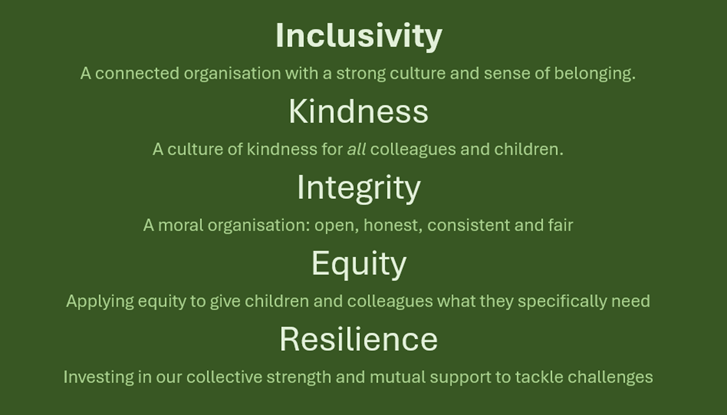
Everything we do is held by our shared values:
Our stable core enables our innovative edge

We continue to build a strong trust with great schools that focuses on getting every day right and building a stable core: consistently delivering high quality provision with effective systems and shared approaches, enables our frontline obsession.
We stand on our stable core and what we choose to do the same, so that we can innovate on the edge, expertly developing approaches to improve provision and inspire lives. This is a collective, connected and developmental endeavour through collaboration.
Towards 2030 | why we exist
To build a strong trust with great schools. Offering high quality education over 570-weeks that closes gaps for those that most need us. So that the trust exists in a higher performance space and exploits our collaborative advantage that yields a trust dividend.
Our focus on partnerships and places builds better communities for children to grow up in and flourish. Colleagues create greater opportunity through deliberate local and regional collaboration,seeking to improve other trusts and the sector.
The trust is deeply connected within itself. There is a strong collective desire and shared responsibility to add value for all children in every setting. This collaboration enables a level of innovation and shared approaches that add more value. As part of a human organisation colleagues are well connected, making a greater difference to others in and beyond our trust.
The consequence of our work over five years is that the trust becomes self-improving, the systems, shared approaches, trust improvement model, collaboration, horizontal leadership and empowerment is creating more value over time and is self-sustaining.
Colleagues enjoy more opportunity and are proud to do meaningful work that is enabling all children to flourish through an inclusive, all-through education that nurtures opportunity, equity, and agency for life
Higher performance space | in search of the trust dividend
There is an unswerving, shared responsibility and desire to raise standards. To build a strong trust and great schools that exist in a higher performance space that particularly enables disadvantaged learners to thrive and attain well.

So, where next… this year
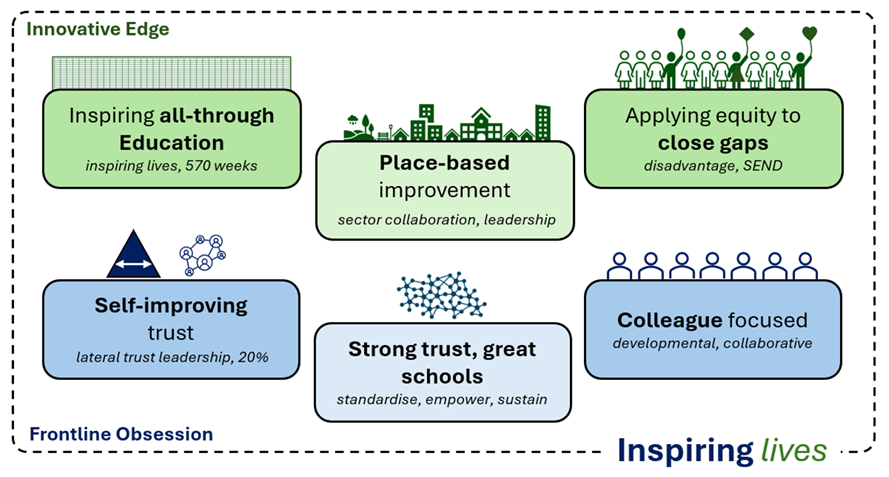
In the next phase, to summer 2026 we will prioritise these six areas:
Innovative Edge | Inspiring lives
This year we will invest in our inclusive all-through education (570-weeks) and apply greater equity to close gaps for children that need us most. A focus on place-based improvement will build strong community partnerships and support improvement beyond our trust.
Stable Core | frontline obsession
We will continue to invest in our stable core, by building a strong trust that enables great schools. Our colleague focused strategy will invest in all colleagues and create the conditions for our frontline obsession. Aiming to create a self-improving trust, investing in lateral leadership, connection, collaboration and strong systems.
570 Weeks | inspiring all-through education
To build an inspiring, inclusive, all-through education: as an entitlement for all children. Enacting excellent provision for every child throughout their 570 weeks of education. Prioritising:
- Trust Curriculum | curating and enacting a shared curriculum across all year groups. (SDP)
- Attendance, inclusion and transitions | to secure stronger attendance, strong inclusion and high-quality transitions, disadvantage first. (SDP)
- Best Start in life | investing in the strongest possible start for all children through nursery and early years, enabled through a set of core commitments. (SDP)
- Outstanding Personal Development | outstanding personal development curriculum builds character and offers greater opportunity for all children in every setting.

Closing gaps | seeking social justice
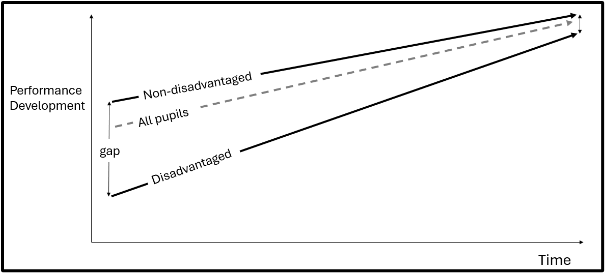
To apply equity and unswervingly commit to meeting the needs of children experiencing disadvantage and SEND, securing attainment and attendance that closes gaps and builds agency for each child. Securing greater social justice by prioritising:
- The trust-wide development of teaching | systematic focus on the development of teaching to enact our shared curriculum. Our strongest lever for closing gaps. (SDP)
- Disadvantage first | unswerving focus on the performance of disadvantaged pupils, through targets, data and quality assurance, as the indicator of the quality of our provision. (SDP)
- Catch-up, Keep-up | systematic tracking all learners and applying equity, doing different and more, so that all children are caught up and kept up. (SDP)
- All leaders, leaders of SEND | developing our SEND provision, focusing on ‘all leaders as leaders of SEND’ – securing a systematic strategy to meet SEND needs.
The importance of place | community partnerships
To build partnerships with educational and community partners to secure stronger communities and 570-week educations for all children. Using expertise in the trust to reach out and secure improvement in schools, trusts and the sector. Growing our reputation and influence by prioritising:
- Strong recruitment built on growing reputation | securing stronger recruitment of pupils into our schools to inspire more lives and better serve our communities.
- Trust Growth | securing appropriate and strategic growth of the trust to secure financial opportunities and grow our reputation and influence.
- Collaboration with local trusts, local authorities and partners | seeking strong collaboration to secure improvement beyond the trust – seeking to influence all 570-weeks
- Sector reputation and influence | playing an active role beyond the trust, including with the DfE and other partners, to influence policy, improve other trusts and the sector.
Colleague focused | developmental and collaborative
Investing in all colleagues to be connected, to collaborate, develop and grow to lead and contribute toward the mission and feel empowered to do meaningful work. Prioritising:
- Recruitment and Retention | building a strategy to recruit well and to attract and retain strong colleagues. Considering our approach to flexible working.
- Professional Development | creating on-going opportunities for professional development, held in a curriculum. Developing, inspiring and creating more opportunities for colleagues.
- Induction | investing in and building strong induction to support all colleagues to have the best possible start to their career in our trust.
- Well-being and mental health strategy | securing approaches across the trust to support all colleagues with their well-being and mental health.
Strong Trust, Great Schools | standardise, empower, sustain
Ensuring that the trust improvement model offers the foundation for colleagues to lead great schools. Complicated systems well embedded across the trust to drive effectiveness and efficiency. Prioritising:
- Deliberate enactment of the Trust Improvement Model (SIM) | developing our standardised approaches, enabling empowered areas and sustaining the model to secure improvement.
- Financial stability and clarity | Ensuring the trust maintains the present financial security, secures wider responsibility and enables greater investment in the trust.
- Professional Services | developing professional services, to strengthen platform, offer capacity, expertise and secure the environment to empower all colleagues to deliver the mission.
- IT Strategy | ensuring colleagues and pupils have the tools they need to thrive now and in the future. Developing our digital vision and cloud-first approach. Exploring the opportunities of AI.
Towards a self-improving trust | lateral trust leadership
Creating the expectation and conditions for horizontal improvement across the trust. Connectivity and collaboration that are more effective and efficient at driving the School Improvement. Prioritising:
- Trust Leadership Curriculum | investing in and enacting a trust leadership curriculum and to extend the sense of leadership curriculum through networks and the layers of the trust.
- Networks and Subject Communities | connecting colleagues with purpose, formally and informally, to enable the development of strategies that raise standards.
- Lateral leadership, 20% time | creating the expectation and the structure for colleagues to work beyond setting to support lateral leadership and secure a self-improving trust.
- Succession Planning | investing in succession planning and talent management to ensure the future leadership security for our trust.
First Steps… into Term 1
And our first steps in Term 1 will see us deepen our connection and collaboration and prioritise:
- Understanding performance and setting the ambition and targets for 2026.
- High quality Induction and line management, starting out strong.
- Strong start and focus on Attendance, disadvantage first.
- Best Start in Life, embedding our core commitments.
- Enacting our shared curriculum.
- Focus on the development of teaching through Steplab.
- Embedding the new Planergy software in Finance.

We choose to venture on this journey to 2030 not because it is easy, but because it is hard, and because our ambition will serve to organise and measure the best of our energies and skills, because the challenge is one that we are willing to accept, one we are unwilling to postpone, and one which we intend to win (adapted, John F. Kennedy)
So, breathe, commit … and go inspire lives with greater opportunity and choice.
Thank you, you make a difference
Dan Nicholls | August 2025



 Dan Nicholls