CLF Teaching Framework | empowering teachers to teach

It is probably true that when teachers are empowered to play with pedagogy, informed by assessment, within an inspiring curriculum, children learn and flourish.

It is also probably true that within a Trust or collection of schools a shared teaching framework offers the opportunity to deeply collaborate and develop approaches to pedagogy that accelerates learning.

Slide11

What if this Teaching Framework is delivered by experts to secure a shared inspiring curriculum that is designed and evolved by experts (3-19 Curriculum Curators) and supported by assessment that is used by experts to adapt pedagogy that follows the learning?

Slide4

What if  Pedagogy Developers from across the Trust build a shared Teaching framework? What if this Teaching Framework is built on a deep understanding of how we learn and how we construct our understanding of the world?

What if  it is important to understand what underpins the framework…


Basing the CLF Teaching Framework on How We Learn..

What if we teach, discuss practice, collaborate, investigate and play with our pedagogy against a deep understanding of how we learn? What if this is how we learn?…

Slide6

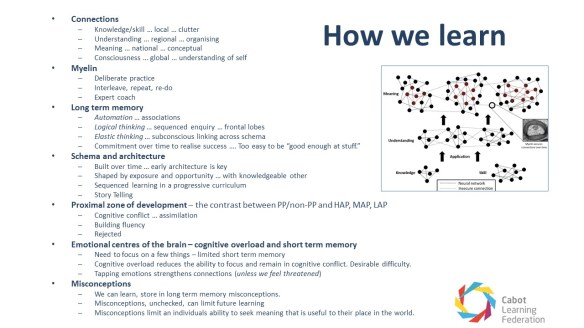
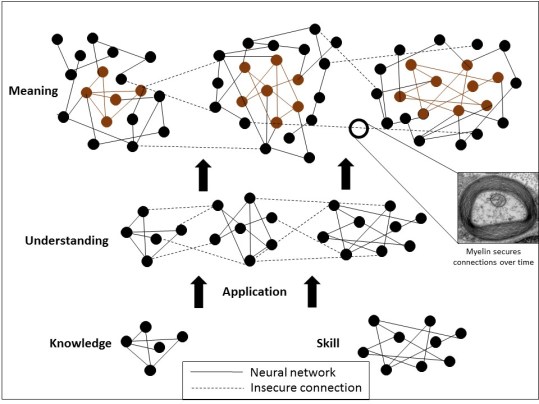
What if learning happens when we form and solidify connections in the brain; connections that are reliably fired as long term memories through the wrapping of myelin? A process that requires focused attention, deliberate practice and repetition within an interleaved curriculum. (see How we Learn)

What if this acquisition of knowledge requires application to build understanding that leads to an individual finding meaning and then developing a new sense of self? What if this goes from few connections (local; knowledge) to connecting schema (regional; understanding) to connecting across centres of the brain (national; finding meaning) to connecting across all areas of the brain (global; change in a sense of self; personal growth)

neural

What if the following underpins the purpose of teaching…

Slide5

What if the key outcome of teaching is also to achieve attainment mobility: “Enabling children to attain higher than would be expected based on their starting points.” … reversing delayed attainment, linguistic under-privilege and lack of early opportunity, so that children self select (not self de-select) and accumulate advantage (not disadvantage) through life?

What if collaboration, discussion and development of teaching across schools is hampered by not having a shared understanding of learning? What if this provides a good definition for learning? (from Hattie and Donoghue, 2016)

Slide7(Hattie and Donoghue, 2016)

Perhaps then the following provides a shared definition of learning…

Slide8What if we should also see it as a process by which we more fully understand our place in world, have an increasing sense of self and grow personally?


What if underpinning the teaching framework is an understanding of the different ways the brain works? …

  • Up to 40% of what we do is automated – triggered automatically by the subconscious as a response to routine triggers. This is how we cope with a small working memory and a complex world – this automation frees us to survive and think (it is everything from patterns of thinking, talking, emotional response, vocabulary, mannerisms as well breathing etc.). What if we understood better what we need children to automate?
  • Our frontal cortex is a logical, top down problem solving area of the brain. It runs scenarios about the future (what ifs). It comes up with multiple solutions and scenarios – the vast majority of which we are not conscious of because our brain is highly selective of what makes its way to our consciousness (it would otherwise be over-whelming). This internal censorship increases with age; reducing our creativity and adaptive thinking (and interestingly increasing our susceptibility for organisational blindness and being obstructed by our historic assumptions of what is possible. What if we support children to have the tools for logical thinking and the knowledge and understanding to solve problems… so that they know what to do when they do not know what to do?
  • Elastic thinking is bottom-up. It is what happens when we engage all parts of our brain to see a our world a fresh. This requires the development of connections across all areas of the brain. It is often what happens when we are not thinking specifically about a problem, or when we are engaged in thinking about something else – we get, what is often described as, light bulb moments. This critical aspect of our thinking is ever present (not always conscious due to the self-censorship). What if we consider how we can develop this thinking in young people to support connection between topics and ideas… seeking to support children to run what if scenarios, find connections (in the world and in their thinking), seek meaning, build a sense of self and their place in the world? What if this is enhanced by cluttering the corners of young minds with knowledge and increasing the development of connections across schema in the brain?

“While a bee brain has one million neurons, a human one has one hundred billion, … we’re privileged in another way too: not only in the quantity, but the organisation of those neurons. Specifically, we have more brain cells between sensation (what’s out there?) and action (this is what I’m going to do). This allows us to take in a situation, chew on it, think through alternatives, and (if necessary) take action. The majority of our lives take place in the neural neighbourhoods between sensing and doing . This is what allows us to move from the reflexive to the inventive.” (Brandt and Eagleman, 2017)

What if connections and schema are built over time and are the result of opportunity and the support of a knowledgeable other over time? What if this early architecture and opportunity is the key to early advantage and disadvantage? …that fuels our unhelpful cultural views of innate talent?

What if this means that ordering content, building understanding in logical sequences and securing a foundation of knowledge (connections) is key to building schema in children through our teaching? What if this is why story telling is so effective at supporting understanding and developing meaning? (and explanation and modelling etc.)

What if the proximal zone is key to understanding how we learn and the importance of how we teach? What if we need to experience cognitive conflict (ideally with others) to create connections and assimilate new connections within existing schemas (groups of neurons connected together).

slide9.jpg

What if we need to keep children in cognitive conflict as often as possible? What if it is also important to consolidate understanding and to build fluency and to extend beyond the proximal zone to offer a sense of awe and wonder?

What if we need to attend to things with a high level of focus to assimilate new knowledge or ideas? Then classroom climate becomes key. What if our emotional state also limits or increases are ability to attend to learning? What if tapping the emotions and teaching with passion, conviction and a sense of purpose increases a learners ability to make deep connections across the brain – learning becomes stickier?

What if concepts and misconceptions become the key ingredients in building coherent and helpful schema for children? What if explanation, modelling and logical construction of learning informed by key concepts will increase a child’s ability to find meaning and grow personally?


CLF Teaching Framework

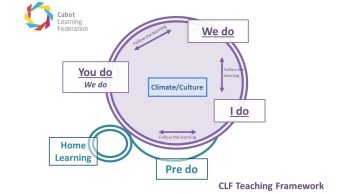
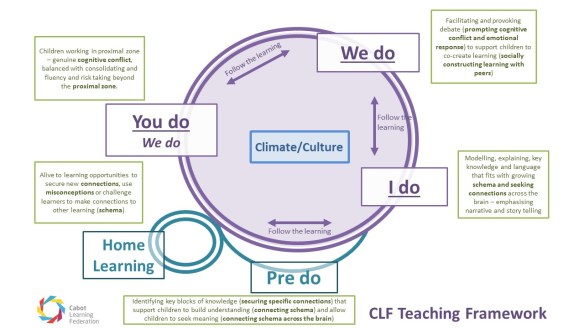
What if this understanding of how we learn is considered within a teaching framework: one that considers the key interactions of teacher-learner and learner-learner within a learning episode. What if this is demonstrated circularly to emphasise the role of on-going assessment and the need to follow the learning between the key teaching elements of I DO, WE DO and YOU DO (what if this is remarkably intuitive in application). The order, length and interplay of these elements are not defined and vary over time (the framework should not be viewed as a lesson). What if this provides the structure, framework and vocabulary to discuss and consider teaching, learning and progress across the Trust?

Slide12

Slide11

What if this teaching framework provides the basis for securing the key elements of How Children Learn?

Slide13

  • I DO: What if teacher explanation, modelling, instruction, use of language, development of knowledge directly supports the development of connections and grows schema? What if this builds on previous knowledge, exploits story telling and narratives to trigger interest? What if teachers expertly dance in and out of the proximal zone so that it … consolidates and builds the fluency of key knowledge and understanding already acquired AND creates cognitive conflict in the proximal zone with new knowledge, examples and build new connections AND touches on ideas beyond the proximal zone to generate awe and wonder, seed future learning and seek connections across the brain? What if this is key to the WE DO aspect of the framework?…
  • WE DO: What if this is the most important aspect of the framework? Where learning is a social enterprise prompted and provoked by questioning, debate and discussion facilitated by the teacher? What if this is often the area that has the greatest variability and where expert teachers shine? What if this is where teachers facilitate the co-construction of knowledge, understanding and thinking out loud (full response and precision of thinking)?  What if this is where learning predominantly happens in the proximal zone, where teachers support the learners to explore, debate and argue about the learning? What if this is also where students try a bit, get feedback and try a bit more? What if this is how connections are made, understanding built, meaning is sought and children have the opportunity to evolve their sense of self and place in the world? What if this is consolidated and developed in the YOU DO aspect of the framework?…
  • YOU DO: What if this is where children work in their proximal zone balancing between consolidating/fluency (within schema), developing (in cognitive conflict) and exploring (beyond the proximal zone) … balance of individual and paired working? What if this is meaningful work that maximises the use of time?
  • YOU DO : WE/I DO: What if teaching follows the learning during YOU DO, being alive to opportunities? What if teachers intervene with impact to support more children to be in cognitive conflict more often and for longer? What if this can be individual, group or whole class intervention to seize learning opportunities, follow the learning and use time purposefully? What if this is informed by conceptions, misconceptions, identifies links between learning and uses peers to support peers in their learning?
  • CLIMATE/CULTURE: What if culture (high expectations) and climate (attitudes to learning) are essential if children are to focus and attend to their learning? Wrestling in cognitive conflict to assimilate new knowledge or insight requires a non-distraction environment? What if cognitive (over) load drastically reduces are ability to learn … the brain cannot multi-task … when we try to do two things the brain has to power up and power down every time you switch focus?
  • PRE DO: What if planning for learning episodes is based on teachers following the learning? The careful and precise selection of content (in the right order) and approach to support acquisition of knowledge to build understanding and support children to seek meaning? What if this is an ever-onward within as well as between learning episodes?
  • Follow the Learning: What if the circular nature of the framework underlines the importance of formative assessment and the need to follow the learning? What if this is the art and craft of teaching? What if this is where the most effective teaching secures greater learning gains over time?

Maybe then…

  • We will share an understanding of what learning is, what teaching aims to achieve and how we learn.
  • We will share an understanding of how we learn (cognitively) that allows us to plan, teach and evaluate the impact on children.
  • We will have a shared teaching framework and vocabulary to deeply collaborate around teaching.
  • We will deepen our understanding of the teacher-learner and learner-learner relationships in the classroom through I DO, WE DO and YOU DO.
  • We will link these aspects to how children learn and deepen our understanding of the cognitive mechanics of learning.
  • We will empower teachers to have a shared framework that allows experts to play with pedagogy to follow learning.
  • We will have a standardised framework that seek to support teacher to have enough autonomy to follow learning and seek mastery in their practice.
  • We will support teachers to use the framework and underpinning cognitive science to develop their practice collaboratively; without greater specificity of approach or strategies.

We would have teachers who are empowered to play with pedagogy, informed by assessment that allows all children to learn and flourish.

September 2018 | Dr Dan Nicholls


Key Stage 3 Curriculum 2.0 (CLF)

Slide9

It is probably true that the removal of levels and the growth of Trusts and collaborating groups of schools presents an enormous opportunity for teachers and leaders at KS3 to be curators of a curriculum, with embedded assessment and pedagogy, that inspires children to learn, secure progress, find meaning and grow into successful individuals … to educate the whole being so they can face the future.

“With opportunity comes responsibility … there are few more important roles in education than to be responsible for designing a curriculum that inspires the next generation to find meaning in their lives.”

It is also true that KS3 has typically been defined by mediocrity and over-shadowed by KS4. The opportunity, then, is to develop a curriculum that builds from KS2 and avoids drawing grades and progress 8 down from KS4. It should be the foundation of what we choose, across a broad curriculum, to pass on to the next generation.

Which begs the question.. what does an effective KS3 curriculum look like? How can this be designed to inspire the next generation to learn and make good decisions about the future and throughout their lives?

And… how can Trusts and partnerships of schools collaborate to enhance the curriculum and drive up standards?


What if the following is an approach to Key Stage 3?… (and the approach of the Cabot Learning Federation (CLF)) (link to: life after levels, KS3 1.0)

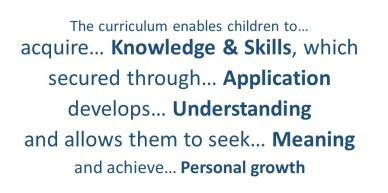
What if the intent of the curriculum is to enable children to acquire knowledge and skills, which are secured through application (over time and in different contexts) to develop understanding (change in long term memory) and allows children to seek meaning and achieve personal growth? (based on how we learn?)

slide6.jpgneural

“…our brains do something vastly more impressive, forming neural nets from billions of cells, each connected to thousands of others. And these networks are organized into larger structures, … and so on, in a complex hierarchical scheme..” (Leonard Mlodinow, 2018)

What if the KS3 curriculum builds-up from KS2 to secure a foundation for children to be successful in life (and KS4)? What if the curriculum is focused on the progression of key content, concepts and misconceptions through KS3 (in the right order) that are designed to accelerate progress within a progressive and purposeful 3-19 Curriculum? 

What if it is broad, balanced, conceptually stretching, relevant and contextually useful… and built on high expectations of what children should be capable of?

“Once a student sees that he or she is capable of excellence, that student is never quite the same. There is a new self-image, a new notion of possibility. There is an appetite for excellence.” (Ron Berger)

What if it is designed to develop a sense of awe and wonder that secures a joy for learning; supporting children to do more than they thought possible. Boldly opening minds to hitherto uncharted knowledge and experiences? What if it empowers children to make well-informed decisions through life, with built-in entitlement for all by age 3-19?

What if the curriculum is our opportunity to inspire children to be successful individuals, historians, mathematicians, geographers, musicians, authors, artist, sportspeople, scientists, writers, innovators, dreamers, magicians, mothers, fathers, citizens?

What if we developed an approach that used well defined and detailed Age Related Expectations (AREs), for Year 7 and Year 8, across each subject that secured and deepened learning; bringing the curriculum to life? What if the Age Related Expectations are organised like this… (starting with a justification of why the subject exists?)

ks3-curriculum-may-2018-blog.jpg

What if these are written by groups of CLF Curriculum Curators across the Trust? Those Curators of the Curriculum entrusted to evolve the curriculum for our children?

What if instead of levels or grades we were only interested in children working towards Age Related Expectations (following the primary model), achieving the Age Related Expectations and importantly being given the freedom to deepen their understanding to seek meaning for themselves so that they better understand their place in the world? We might describe a child’s attainment as.. (known as DOYA)

  • Deepening (D): child has reached the year group expectation and is now taking this deeper into more abstract work – following their passion within a broad curriculum that inspires the full range of attainment and interest.
  • On track (O) / Working At current age related expectation. The child is working at the age related expectation for their Year.
  • Yet to be on track (Y): the child shows some working at age related expectations, but is not yet on track to achieve them.
  • At an earlier stage (A) in their learning journey. The child is short of the age related expectation, typically around a year behind.

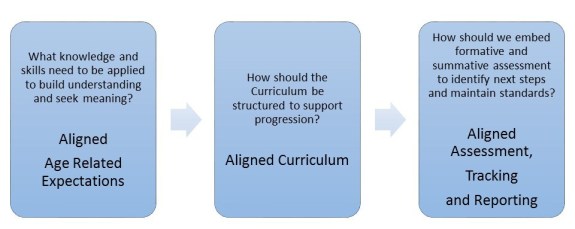
What if these Age Related Expectations were built into an aligned curriculum and assessment system that supported children (and teachers, and parents) to know what they can and cannot do/understand? What if these are the key questions?… and the three key elements: Age Related Expectations, Curriculum and assessment?

slide10.jpg

What if the transparency and publication of the Age Related Expectations gives ownership of learning to children and their families so that children are supported to keep-up, catch-up and deepen?

What if this is purposefully a knowledge-rich curriculum rather than a knowledge-based curriculum? What if there is a medium term curriculum plan in each subject across the Trust that identifies, quarterly, the key areas of age related expectations to be considered? What if this significantly enhances collaboration and focuses Networks across the Trust on planning and pedagogy?

What if the aligned Age Related Expectations, curriculum and assessment empowers teachers to collaborate across the Trust to focus on pedagogy and planning that secures and accelerates learning and progress to meet the needs of all children?

What if the curriculum provides the platform for teachers to teach, children to learn and to spread ideas (pedagogy and planning) that work?…

“Leadership is the art of giving people a platform for spreading ideas that work.” (Seth Godin)

What if we remain fully aware that there are distinct and important differences between the Planned Curriculum, the En-acted Curriculum and the Learnt Curriculum? What if we systematically evaluated the effectiveness of the learnt curriculum to inform teaching, pedagogy and learning episodes within the KS3 curriculum?

What if this is the purpose of Multi Academy Trusts? …to provide an aligned platform of curriculum and assessment so that experts are empowered to play with their pedagogy and planning to follow the learning and inspire children to achieve more than they believed was possible?

Alignment

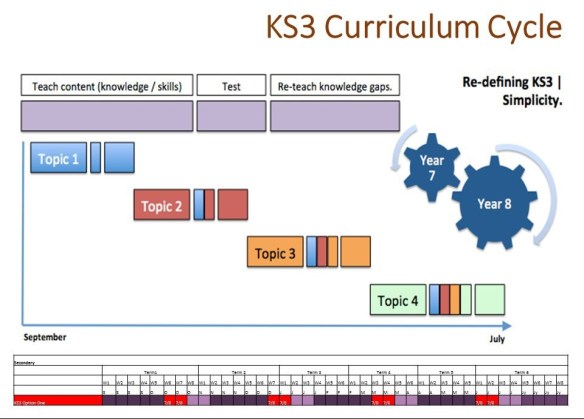
What if the content of the curriculum is progressive and is based on consolidating and revisiting content over time to secure changes in long term memory and progress over time? What if this shows how topics are taught, tested and re-taught over time; where gaps in the learnt curriculum are revisited in re-teaching and future testing?…

slide13-e1527871920602.jpg

What if the curriculum seeks depth of study rather than breadth to build understanding and to seek meaning; stretching and challenging children to think? stock-footage-deep-end-deep-end-of-the-pool-a-good-visual-metaphor-to-show-madness-for

What if The Age Related Expectations and exemplars are widely published to support the child, parent, teacher, leader and other staff to understand the expected standards and the content of the curriculum; enabling wider ownership of the curriculum? What if exemplars of At an Earlier Stage, Yet to be On Track, On Track and Deepening (DOYA) are used across all subjects to raise the bar and exemplify the the Age Related Expectations? What if these are used for moderation and professional development to consider pedagogy, inform planning and becoming experts at supporting students to gain understanding and seek meaning in their learning… securing progress?

What if the values, assessment cycle, Age Related Expectations and written exemplars for every subject in Year 7 and 8 are put together in one document to form the CLF KS3 Age Related Expectations syllabus?


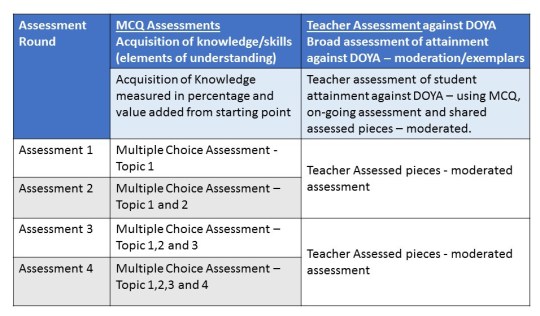
What if there are two key areas of assessment:

  • Shared on-line Multi-choice Quizzes (MCQs) assessments four times a year to assess knowledge/skills acquisition and elements of application and understanding. What if this provides immediate feedback to understand gaps in learning, to support planning and re-teaching? What if this reveals the level of knowledge acquisition and application across 1000 students; providing student, class, department, cohort and academy comparisons to support improvement and trigger discussion on the effectiveness of teaching, planning and pedagogy? (so that teachers can follow the learning?)
  • Teacher assessment of attainment that uses standardised exemplar material to support teachers to make an assessment of a child’s attainment against DOYA. What if we assess across the breadth of what children can do in any one subject to judge how far a child will achieve Age Related Expectations by the end of the year? What if this includes practicals, extended writing, presentation, oracy, performance, short assessments, long assessments etc. … to provide a rounded view of attainment based on DOYA, against the subject’s AREs? What if work scrutiny and student voice support moderation of the attainment of children across academies and the Trust? What if progress is seen in maintaining and improving a child’s DOYA and in the work (broadest sense) that a child is able to produce over time? (What if teacher assessment of DOYA is linked to broad standardised scores 100, 103, 105, 107, 110 etc. so that progress from a starting point can be measured?)

What if this is how the assessment within the KS3 curriculum works?

slide14.jpg

What if we could plot the attainment of over 1000 students (a benefit afforded by being part of a Multi Academy Trust)? What if this created a unique opportunity to moderate and standardise performance against a significant sample of children in each year, in each subject across all classes and groups? What if this was a significant nudge that raised standards at KS3?

neural2.jpg23


What if the shared AREs, curriculum and assessment cycle empowers and frees teachers to plan to meet need, follow the learning and deploy pedagogy that supports all children to feel and be successful? What if approaches to pedagogy and planning are based on how we learn? so that we:

  • Explicitly teach children to achieve the age related expectations. So that we secure the knowledge and skills through application that are the foundation for building understanding and seeking meaning – in line with how we learn and cognitive science…
    • Modelling that sought to build from knowledge/skills to understanding to seek meaning.
    • Questioning that prompted and provoked application and understanding to articulate meaning – deeply exploring concepts and mis-concepts and seeking to support children to explore and explain their developing schema.
    • Planning for children to experience desirable difficulty as they deepen and grapple with the curriculum. Thinking different and deeper for presently high attaining children.
    • Using explanation (in a variety of ways) to support connections and tell stories that allow children to accommodate greater understanding in their schema so that they better understand their place in the world.
    • Tell stories to support (with emotion) to support changes in a child’s long term memory, so that they secure progress. (tapping emotion and feelings secures understanding by anchoring connection across different areas of the brain)
    • Revisit and interleave so that children build myelin and strengthen connections to semi-permanence in the long term memory.
    • Specificity of feedback for impact so that children are more precisely supported to make connections and learn in real time, whilst they are is cognitive conflict. Emphasising live feedback and adapting teaching during learning episodes.
    • On-going teacher assessment followed the learning of children; emphasising medium term planning and aims.

What if there is also an emphasis on the development of reading (widely and often), oracy as well as the quality of writing?


Maybe then we would have a KS3 curriculum that…

…builds a sense of awe and wonder and a joy for learning up from KS2 that inspires children to be individuals, historians, mathematicians, geographers, musicians, authors, artist, sportspeople, scientists, writers, innovators, dreamers, magicians, mothers, fathers, responsible citizens… a curriculum that empowers and frees teachers to plan to meet need, follow the learning and deploy pedagogy that supports all children to feel and be successful… a curriculum developed and evolved by experts across the whole Trust and assessment that is both formative and summative so that we raise standards and accelerate progress as part of a progressive 3 to 19 curriculum.


Dan Nicholls | June 2018

Director of Education | Cabot Learning Federation

Seek attainment mobility

neurons-440660_1920

Create connections – reverse delayed attainment

What if the most important role of education is to enable attainment mobility? …to support presently low (or middle) attaining children to become high attaining.

What if we were better at reversing delayed attainment so that schools and academies genuinely secured attainment mobility?Maybe then we would have a world class education system.

Attainment mobility is the key challenge for education… but, we are far from securing this mobility… our system may well be preventing it.


What if we are beguiled by high ability and have a false belief that exceptional performance is due to innate talent? What if we are conditioned to explain demonstrations of ability in any discipline as a result of a God-given talent, a genetic pre-disposition or an innate gift? …ability is written in our genes prior to birth.What if this has limited our belief in what is possible or what children are capable of? What if our culture reinforces it?…

” I think the X factor is something that you are born with; you either have it or you don’t.” Nicole Sherzinger (Sept 2017)

“You spot that thing you cannot buy as soon as they sing.” Sharon Osbourne (Sept 2017)

IMG_0010

However, what if Anders Eriksson is right? That there is…

“…no such thing as predefined ability – the brain is adaptable and training can create skills that did not exist before. This is a game changer. Learning now becomes a new way of creating abilities rather than bringing people to the point where they can take advantage of their innate ones … People are not born with fixed reserves of potential; instead potential is an expandable vessel, shaped by the various things we do throughout our lives. Learning isn’t a way of reaching one’s potential but rather a way of developing it. We can create our own potential.”

What if after 40 years of research Anders Eriksson has been unable to find evidence of innate talent and that every example of exceptional performance that he has researched has its roots in opportunity, supported effort and deliberate practice over time? (Excepting that there are some physical traits, like height, for example that are advantageous in some fields)

“I have no special talents. I am only passionately curious.” (Albert Einstein)

What if education unwittingly reinforces present attainment as a limiting factor for children? What if we unwittingly create conditions for present attainment to be the determining factor for a child’s outcomes, their targets, aspirations and their future? Embarrassingly few low attaining on entry go on (through) education to gain the qualifications they really need to be successful in life?

What if this false underlying belief means that when we see differences in levels of attainment (for example on entry to EY, KS1, KS2) that we attribute this to differences in genetics and believe individuals are limited to certain levels of attainment; they have lower innate potential than presently high attaining children? Low attainers, will remain low attainers and high attainers have a natural predetermined ability that comes from birth. (or even that we assign differences to context and opportunity… but see this as immovable as “natural talent”)

What if we have become conditioned to believe (even if we do not deeply believe it) that attainment is largely fixed?

However, what if there is no innate talent? What if differences in levels of attainment are the result of the following conditions over time?

  1. growing up in a family that consistently provides opportunities, over time.
  2. where significant others support and encourage effort. Often an expert coach or tutor whose direction enables deliberate practice.
  3. where risk and failure is embraced.
  4. and where expectations are high; it is not ok to give up.

… and what if this leads to accumulated advantage over time that enables much higher performance and a reinforcing sense of ones ability over others. What if this self belief is further reinforced by the widely held assumption that this elevated performance is the result of innate talent?

What if the reverse of these conditions are hopelessly compromising and leads to delayed attainment? What if this leads to accumulated disadvantage over time? What if this is further reinforced by the widely held false assumption that this lower performance/attainment is the result of a differences in our genes?

What if the key limiter and barrier to attainment mobility is early linguistic under-privilege? What if we do not do enough to reverse this linguistic disadvantage?

Slide1

For all those who have, more will be given, and they will have an abundance; but from those who have nothing even what they have will be taken away. (Matthew Effect)

BUT…

What if… we foster a “delayed attainment” mindset for any attainment level that is not presently high attaining? Could this transform how we educate?

What if this means that presently low attaining children are not less able or less innately talented/gifted, they experience delayed attainment?

What if this delayed attainment leads to greater self de-selection to avoid failure; often leading to the development of sophisticated work avoidance, coping strategies and poor behaviour that only serves to reinforce our false beliefs about ability and innate talent?

What if we don’t understand this – or truly believe it .. and consciously or unconsciously label children and limit what we believe children with delayed attainment can achieve?

What if this false assumption of talent and the labelling based on ability (or present level of attainment) – becomes a self-fulfilling prophecy?…

“When people assume that talent plays a major, even determining, role in how accomplished a person can become … we assume that people who are not innately gifted are never going to be good at something, then children who don’t excel at something right away are encouraged to try something new.” We also do the reverse by supporting early advantage and enabling children to accumulate advantage, such that they begin to appear gifted or innately talented… proving that we were right all along.

What if we take early advantage and foster it, support it, put it in the top set, label it, ask it more questions, praise it, give more training time, send it to sporting academies? What if these accumulating advantages only reinforce our belief that innate talent triggers ability? What if society and education accelerates the gap between those who have early opportunity and supported effort and those who don’t? What if we do not even realise that we are doing this?

What if the keys to attainment mobility lie within curriculum, assessment and pedagogy? What if this should emphasise:

  • Knowledge: because knowledge is power. (limit discovery of knowledge and prioritise application of knowledge)
  • Understanding: supported deliberate practice.. meaningful and purposeful application of knowledge.
  • Interleave and spiral curriculum around a coherent narrative of learning – to address linguistic disadvantage and enable connections to be made as limited proximal zones develop. (Vygotsky)
  • Expectations: that all children can achieve given time… supporting children not to de-select themselves… (“meeting them there”)
  • Assessment that secures self-esteem, learner ownership, rewards and points to the next learning.
  • Create opportunities.. to spark interest and intrinsic motivation.

What if we should not insist that it is all about progress?.. and what if we are overly satisfied when children entering with low (delayed) attainment make better progress than similar national starting points?  What if this progress only really becomes relevant if children attain at a level/grade that supports good progression, opens opportunities and enriches their future lives? What if it is attainment that really matters to low attaining children over time?

What if we judge the effectiveness of education through the lens of its effectiveness to secure attainment mobility?


What if we…

  • never assigned ability, performance or attainment to genetic advantage or innate talent or some fulfilment pre-destined potential, and…
  • understood that ability is born out of opportunity, commitment, supported effort and deliberate practice over time, and consequently…
  • saw education as the vehicle for enabling attainment mobility by levelling up the playing field for all.
  • understood that teaching every lesson, every day is the key to attainment mobility.

Slide17

  • we expected more of individual children; ensuring that given opportunity and supported effort that there is no limit to a child’s potential, certainly not at GCSE levels of attainment.
  • actively recognised that society and education actively supports both accumulated advantage and accumulated disadvantage.
  • we do not use “ability” and only used present level of attainment. We acknowledged that presently low levels of attainment are the cause of delayed attainment. We changed our language so that we:never use… Low, middle or high ability
    • do use… presently low, middle or high attaining.
    • and consider these  significantly delayed attainment, delayed attainment or expected attainment (instead of LA, MA and HA)
  • we valued and measured attainment mobility as a measure of a Schools success: conversion of low attaining (LA) to middle attaining  (MA) and to high attaining (HA). Attainment of LAs and MAs at 9-4 Basics and HAs at 9-5 Basics.
  • recognised that it is attainment that triggers social as well as attainment mobility; it is attainment more than progress that is important to life chances and greater opportunity in a child’s future.

Maybe then:

  • we would evaluate education by how well schools/academies are genuinely places of attainment mobility that reverse delayed attainment.
  • we would replace the patchwork of lucky breaks and support all children to reach any potential they choose.

IMG_0009

Dan Nicholls | October 2017

Director of Education | Cabot Learning Federation

Is there Life after levels? – an approach using Age Related Expectations..

“We have.. come to believe that an individual’s rank on narrow metrics of attainment can be used to judge their talent ..and ability.. and potential.” (adapted from Rose, 2106, “The end of Average”)

fce193ace76044e716a3250e46ccda9d

“Typing and ranking (against the average) have come to seem so elementary, natural, and right that we are no longer conscious of the fact that every such judgement always erases the individuality of the person being judged.” (Rose, 2016)

Slide2

It is probably true that the removal of levels and Ofsted’s “no prescribed or preferred method” presents an enormous opportunity for teachers and leaders at KS3 (likely to refer to Year 7 and 8 for most – with the preference for three year KS4)  to own the curriculum, develop assessment, improve pedagogy and inspire students to learn and progress into rounded, successful individuals (who also achieve well at GCSE and A-level).

This opportunity is likely to be enhanced in Multi Academy Trusts where scale provides a unique chance to drive-up standards and create world-class, shared, moderated approaches to curriculum, assessment, reporting and teaching in an area of the curriculum without external benchmarks. A chance to define specifically and focus on what students need to know, understand and do as the foundation for being and feeling successful.

It is also probably true that it is hard to avoid recreating a levelled system or to simply drop GCSE grades (or numbers) down through Key Stage 3.

“There are no ladders (progress is not linear), instead, each one of us has our own web of development, where each step we take opens up a whole range of new possibilities that unfold according to our own individuality.” (Fischer quoted in Rose, 2016)

It is also true.. that to move from levels at KS3 requires a shift in what is valued; a letting go of reassuring and convenient level descriptors, ladders of progress and grades. There is also an inherent danger that we will drift into a time of mediocrity and low expectation as schools and academies introduce non-standardised approaches across KS3 – an area that is presently riddled with  underachievement, dips in progress and firmly in the shadow of performance measures at KS4. And.. there is additional danger that where KS3 is inept this will have a disproportionate impact on disadvantaged learners and those on the margins; widening gaps already open on entry to KS3.

And it is importantly true.. that primary colleagues have already moved to an age related / mastery approach. The 2016 results show 53% of students achieving the Age Related Expectations (AREs) in Reading, Maths and Writing (with the percentage achieving ARE in Reading (66%), Maths (70%), Writing (72% (TA)) and SPAG (72%)). Children entering secondary in September understand their attainment and to a lesser extent their progress against Age Related Expectations.

It is also true.. that the time for stalling on a life after levels approach at KS3 is over; not least because of the extraordinary opportunity that it provides. Almost half of all schools have dropped GCSE grades (or numbers) down through to Year 7 and 8 from GCSE (some dropping Progress 8 measures through the five years). Whilst this is both reassuring and convenient it offers no continuity with Primary approaches and essentially replaces levels with grades – particularly where these are fine graded and flipped to the new number grades… (replacing 4c with 4c, but less useful than the previous level because it relates to an equivalent performance projected to a distant summative exam, inherently narrowing the curriculum and experience of children)

However.. in a world without levels there is still a need to measure both the relative attainment and progress of students against a clearly defined age-related standards or expectations to measure the efficacy of the curriculum, teaching and to identify groups and individuals who fall behind, as well as ensuring that all students who need to deepen are stretched and challenged. And.. as Ofsted rightly identify there is a need to secure progress across all Years, in all subjects and across all groups and that where students fall behind they are caught up.

“When we are able to appreciate the jaggedness of other peoples talents – the jagged profile of our children – we are more likely to recognise their untapped potential, to show them how to use their strengths, and to identify and help them improve their weaknesses.” (Rose, 2016)


Which begs the question, what should an approach to life after levels seek to achieve at KS3?

What if.. we developed an approach that used well defined and rigorous Age Related Expectations across each subject and an assessment approach that measured both progress and attainment of children against these AREs and an approach to teaching and learning that inspired, deepened learning and brought the curriculum alive? What if.. was all enhanced through collaboration within a Multi Academy Trust?

What could that look like?..

What if.. this approach to KS3 had a fundamental influence on:

  • The curriculum – so that it becomes absolutely transparent what every child should know, understand and be able to do. As well as affording the space and time to support teaching that deepens and stretches all children within Age Related Expectations. Building a curriculum that inspires children to enjoy and find life long passions across a broad and balanced curriculum – that answers, “what do we want young people to become, how can we give them wings and purpose in life?” as opposed to, “how can we prepare children to achieve an A grade (or 9) in 5 years time on a narrow summative exam testing areas that do not translate well to success in life?”
  • Assessment – common summative assessments that test students against Age Related Expectations (requiring teachers and leaders to develop, create and moderate assessments, enhanced within a MAT or a Collaborative). Using  formative assessment to close gaps, accelerate progress as well as catching-up those short of or falling behind the Age  Related Expectations. Broadening our use of formative and summative assessment to include teacher assessment, coursework, book scrutiny, oral presentations, group working – to assess and support children to work at and deepen within ARE.
  • Teaching and learning: Secure learning and progress of all children against the age Related Expectations of knowledge, understanding and skills. But, and here is the real opportunity, inspire and stretch children so that they deepen within the Age Related Expectations within a flexible, broad and balanced curriculum. Built in Formative feedback that has a strong influence on lesson planning and closing gaps to and beyond the Age Related Expectations.

What if.. we no longer equate speed of learning with ability? (Rose, 2016) What if.. we stopped labelling children as less able or more able; recognising that the key thing is that all have potential to attain well, regardless of their present level of attainment? The present level of attainment of a child is much more likely the result of background, chance, opportunity, linguistic privilege, context etc. than innate talent or ability. What if.. Age Related Expectations made explicitly clear how to close attainment gaps? And that.. the assessment and feedback woven into (and not bolted onto) the curriculum celebrates the jaggedness of children’s abilities and talents?

What if.. this new approach championed all subjects; Art, Music, Drama, PE, writing, poetry, sculpture, design, craft, reading, languages … because when students are enthused in their learning and they value increasing parts of it, they will also progress in literacy and numeracy as the vehicles for them to pursue their passions?

“Good Schools get on and do things: dance, drama, music, art, using the outdoors, speaking in other languages, finding out about the past and other places, growing things, cooking, going places, using ICT and paint brushes, making things, experimenting, learning about their own bodies, working out how to get on with others in the real world. Above all, they use all these experiences as vehicles to do amazing English and Mathematics to support the structured literacy and numeracy programmes at the same time bring purpose to learning for pupils.” (Mick Waters, 2013)

What if.. this extended to extra-curricular opportunities, not least because this does can unpick disadvantage and has been shown to have a significant impact on grades and progress. As Angela Duckworth describes extra curricular activities are, the playing fields of Grit. (When we talk of curriculum at KS3 we should retain “curriculum” in its broadest sense).

“When kids are playing sports or music or rehearsing for the school play, they’re both challenged and having fun.” … “There are countless research studies showing that kids who are more involved in extracurriculars fare better on just about every conceivable metric – they earn better grades, have higher self esteem, are less likely to get in to trouble and so forth. … more participation in activities predicts better outcomes.” (Angel Duckworth, in Grit,2016)

“Talent begins with brief powerful encounters that spark motivation (ignition) by linking your identity to a high performing person or group (or self image). This is called ignition, and it consists of a tiny, world shifting thought lighting up your unconscious mind: I could be them (or do that, or achieve that)” (Dan Coyle)

What if.. the present Year 7 and 8 Curriculum is so opaque, directionless and random that it actually works to enhance accumulated disadvantage? What if.. there was real clarity and consistency for all about the Age Related Expectations so that.. only motivation is the limiting factor for a child’s attainment. What if.. this disrupted the loop of unequal opportunity for students at the margins?

What if.. all of this had the ability to tackle workload through:

  • The sharing of resources, SOW and curriculum planning.
  • We did not seek breadth and focused on quality and depth of learning; reducing the burden on teachers; freeing them from the need to skim and teach at pace. Reassuringly clear clear about the key concepts and misconceptions, as well as the required Knowledge, Understanding and Skills.
  • Centralised assessments and reporting to generate real clarity of expectation.
  • Curriculum groups and CPD to have clear direction around, for example, the key Year 7 concepts and misconceptions. This will bring shared purpose to departments across Academies.
  • Establishing shared exemplars for the Age Related knowledge, understanding and skills in Year 7 and 8 to support modelling and acquisition of AREs.

too-much


What if.. the very first question that we ask is, “what should students at the end of Year 7 (and 8) know, understand and be able to do?” ..in each subject? (and across the full curriculum?)

“Our task is to educate their whole being so they can face the future. We may not see the future, but they will and our job is to help them make something of it.” (Ken Robinson)

What if.. it is much more about developing successful individuals, historians, geographers, musicians, artist, sportspeople, scientist, writers, innovators, dreamers, mothers, fathers, positive citizens.. and that KS3 is about this grounding across all of these areas within a broad, balanced, inspiring, motivating curriculum … Then the question is what do we, as professional teachers, subject specialist and leaders, want our Year 7 (8, 9) children to know, understand and do? Ensuring that we set our expectations high enough.. (and on from Expectations at KS2)..

“The greater danger for most of us lies not in setting our aim too high and falling short; but in setting our aim too low, and achieving our mark.” (Michelangelo)

What if.. we also realised that there should be only one set of expectations – the Year 7 Age-related standard – And we avoided describing any sort of level on the way to this standard or beyond. We became comfortable that the Age Related Expectation is just that. And in a similar way to Ofsted who provide no descriptors for Requiring Improvement (it is not yet good) .. students are  “working towards age related expectations” (Of course it may well be helpful to use departing levels, KS2 Age Related Expectations and even GCSE descriptors to inform and support shared construction of the Year 7 Age Related Expectations and the Year 8 AREs … BUT we should resist on-going comparisons and remove levels and grades from assessment – there is no life after levels if levels or grades or a proxy still exist – AREs are single statements of what is expected by age, no ladder through them just distance from ARE and deepening within ARE)

What if.. it is also unhelpful to try to align the Age Related Expectations to GCSE grades or numbers. Whilst you would expect a child working at Age Related Expectations to go on and achieve at least a “good pass” (at least a 5 (1-9)) and that through deepening and pursuing excellence will access 6-9 at GCSE, we should resist placing age related expectations on a graduated scale or flight path across 7-11. Not least because KS3 should be about progress and preparation for life across a broad and balanced curriculum, that learning should spiral and interleave and that assigning a child as an F, G, H in Year 7 is a non-sensical descriptor of their attainment that ignores progression in learning. We should tread carefully if we try to force-fit summative GCSE grading down through to Year 7, even if there is a level of convenience in drawing on GCSE descriptors, questions, mark schemes etc. What if.. a better fit is to base all types of assessment to percentages or standardised scores of 100 and then determine percentage of performance that relates to working at Age Related Expectations? – (banding that can to planned into tests or derived through moderation post-assessment).

What if.. Knowledge is Power and that this should be a key focus for a Age Related Curriculum? What if.. the acquisition of knowledge allows the proximal zone of development to  widen so that progress accelerates as students are more able to assimilate new information/understanding/skill with their existing ability. What if.. this is more important from disadvantaged students who age 3 have half the words of children from professional families? (553 words v 1100 words) What if.. therefore, our KS3 curriculum and Age Related Expectations emphasised the required knowledge and this was made accessible, transparent and secured through quality first teaching .. so that effort (motivation) was the only barrier to acquiring the required age related knowledge?


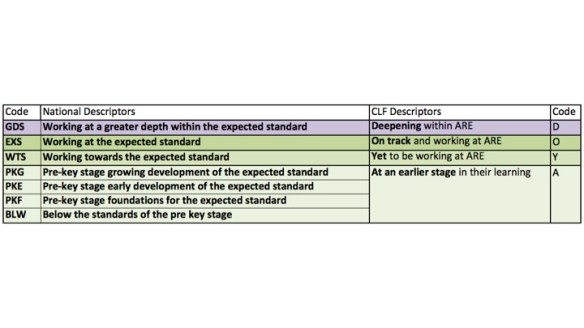
What if.. instead of levels or grades we were only interested in children working towards Age Related Expectations at KS3 (following the primary model), achieving the AREs and importantly being given the freedom to deepen their knowledge, understanding and skills within these Age Related Expectations? We might describe a child as..

  • Deepening (D): child has reached the year group expectation and is now taking this deeper into more abstract work – following their passion within a broad curriculum that inspires the full range of talent and interest.
  • On track (O) / Working At current age related expectation. Child is working at the age related expectation for the Year group.
  • Yet to be on track (Y): the child shows some working at age related expectations but is not on track to achieve them.
  • At an earlier stage (A) in their learning journey. The child is short of the age related expectation.

(…and we resisted trying to describe any stages before or beyond age related expectations, which would recreate levels)

What if.. these tracked onto the national criteria at KS2?..
Slide8

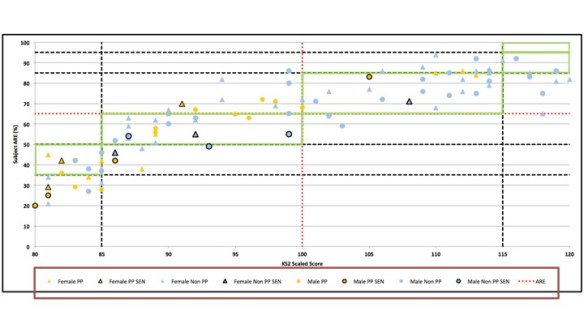
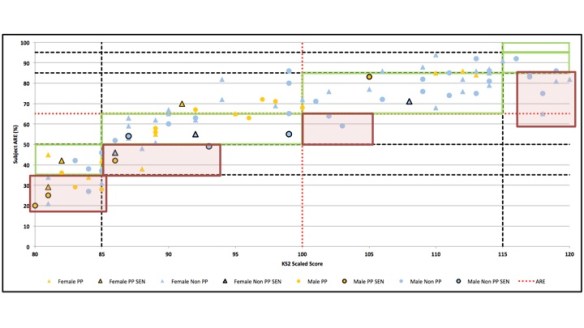
What if.. we tracked both attainment and progress against age related expectations (ARE) using the following?.. for whole cohort (Year group or MAT Year group), groups, subjects, classes etc. … enabling inter and intra Academy and subject and group comparisons.

Slide2

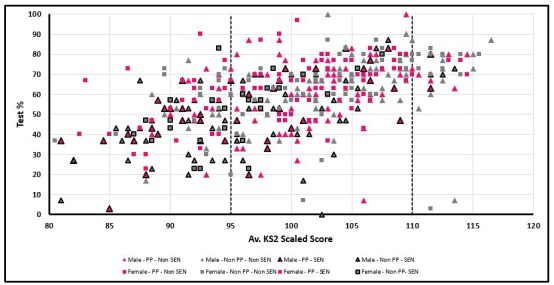
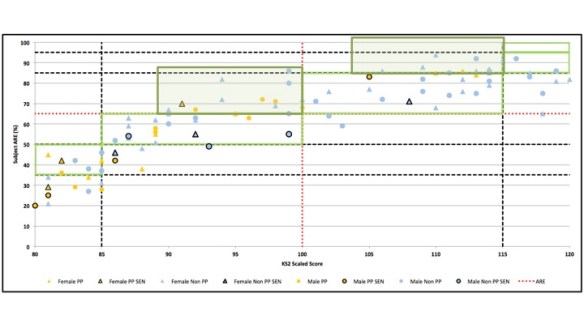
What if.. this shows where students enter year 7.. using the KS2 scaled score. (where >100 reflects “Working at Expected Standard” on the x-axis? That in-line with Progress 8 this is the average of Reading and Maths. (53% of students achieved >100 (scaled score) in Reading, Writing and Maths. (SPAG being the fourth area measured at the end of KS2.

What if.. we used blue to identify non-PP, orange to identify PP children, triangles for female and circles for male and that an SEND child is shown by a black border?..AND what if.. as you rolled over each symbol the name and class of the child popped up?
Slide3

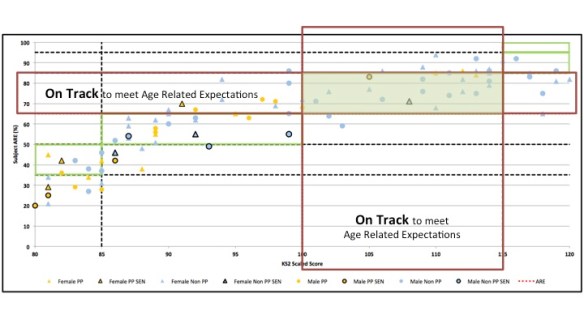
What if.. we used the y-axis as a 100-scale – most likely to be linked to a summative assessment (percentage) that identified children’s present attainment against Age Related Expectations.. What if.. the measure of a child’s attainment against Age Related Expectations could be given through teacher assessment, practical scores, oral presentation against set criteria?

What if.. the child’s vertical position identified their present attainment or distance from, on or beyond Age Related Expectation? AND that vertical movement up or down is a reflection of progress toward or away from the Age Related Expectation..
Slide4

What if.. we could plot over 1000 students against these Age Related Expectations (a benefit afforded by being part of a Multi Academy Trust)? What if.. this created a unique opportunity to moderate and standardise performance against a significant sample of children in each year (n.>1000), in each subject across all classes and groups? What if.. this was a significant nudge that raised standards at KS3?

What if.. we presented this data for each subject? ..or group? ..or class? So that..

  • We were able to track cohort percentages of the attainment of students – e.g. 63% at or above ARE
  • We were able to track the progress of students – e.g. of those starting at ARE and above at the start of Year 7, 40% are gaining ground against ARE, 52% are falling behind
  • We can visually and directly see who is falling behind … and intervene.
  • We can compare the attainment and progress of groups, particularly focused on groups.
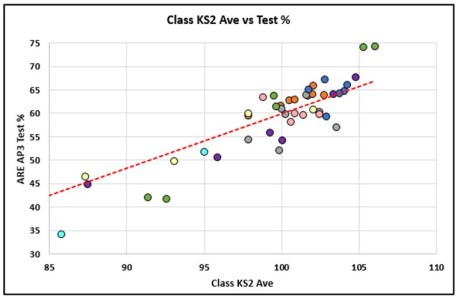
  • We can measure the progress of students by class – a class that is moderated across a number of schools – in a student cohort of >1000, across 8 Academies.

What if.. we described progress over time against Age Related Expectations as:

  • Accelerating progress against Age Related Expectations
  • Gaining ground against Age Related Expectations
  • Maintaining progress against Age Related Expectations
  • Falling behind against Age Related Expectations
  • Falling further behind against Age Related Expectations

And.. these could be used with the attainment against Age Related Expectations: Deepening ARE, At ARE, Yet to be at ARE or At an Earlier stage (as above).

What if.. this allowed very clear identification of the children who are falling behind from where they were against the clearly defined Age Related Expectations?.. what if.. this told us about PP or SEND or gender or academy or department or individual? what if.. we did a work scrutiny and student voice for those students falling behind, and actively caught them up?
Slide5

AND.. those that are gaining ground from where they were against the clearly defined Age Related Expectations.. so that we can grow bright spots, celebrate and share practice that accelerates the acquisition of knowledge, understanding and skills..
Slide6

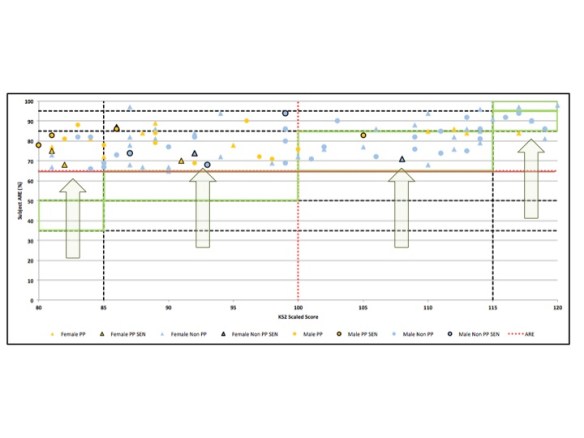
What if.. our job as educators just became very straight forward … all children regardless of present attainment need to be supported to reach the Age Related Expectations and for those who are secure to deepen and further bring alive and broaden the curriculum. So that the standard deviation shrinks and attainment rises (or deepens!)… seeking this…
Slide1

OR more simply.. to get all up to the standard and to deepen within the curriculum to inspire the next generation of mathematicians, writers, readers, sculptors, actors, artists, play writes, composers, biologists, astronauts, comedians and so on? against deepened AREs … and without levels and/or grades.

AND What if.. this just required:

  • a set of rigorous and well crafted Age Related Expectations – cleverly described and accessible…(to students, teachers, leaders and parents) Expectations that develop over time (through moderation and the professional dialogue of subject specialists) to articulate ever more clearly the expected knowledge, understanding and skills?
  • a set of common assessments that are 2/3 times a year sat across all Academies., as well as a suite of other summative and formative assessment techniques?

BUT we need to.. remember that we can also measure whether children are working at age related expectation through teacher assessment, through the quality of books, practicals, presentations, group working etc. After all this should really focus on the quality of formative feedback and importantly how this informs and shapes teacher’s planning.

What if.. the real benefit is that children, teachers, leaders, parents etc. will know much more precisely what they know, what they do not know, understand or can do … and importantly how they can close gaps in their learning. This may help to replace the patchwork of lucky breaks…

“(KS3 needs to…) replace the patchwork of lucky breaks, context and arbitrary advantages that determine success…with a system (curriculum and teaching) that provides opportunities and the conditions for all to feel success.” (Malcolm Gladwell, adapted)

What if.. ALL OF THIS is compromised if we do not invest time in establishing outstanding Age Related Expectations. AND what if.. even with this we need to support the development of teaching to secure deepening of ARE, the quality go feedback for planning lessons, feedback for children and the ability to broaden the curriculum to inspire and secure a passion for deeper learning.

What if.. we need to become excellent at setting ARE summative Assessments? as well as teacher assessment, coursework, practical assessments etc. to judge children against Age Related Expectations. Where Multi Academy Trusts have scale they become their own Exam Board for KS3 with paper setting, expectation setting, moderation, reporting and feedback. The moderation, CPD, sampling, ARE reporting, ARE data will grow our understanding of ARE over time; clarifying and improving the Age Related Expectations and the quality of Assessment (and feedback).

What if.. the age related expectations are clearly communicated on single sheets that show the specific gaps in what children know, understand and can do? – not dissimilar to PiXL Covey tables or PLC grids…a DTT approach. What if.. deliberate practice approach is then used in lessons, at parents evenings, in reports and through intervention to close gaps.

What if.. this allowed reporting and parents evenings to have the structure of…

  • Your child is gaining ground (or falling behind) in their learning towards age related expectations. (progress)
  • She is presently short of Age Related Expectations (Attainment)
  • What she specifically needs to do to secure Age Related Expectations is … and this … and that … (Targets)
  • And here is the specific Age Related Expectations that I have colour coded to show you where there are gaps and these link to specifically how you (and we) can support your child to go beyond ARE and deepen in these areas…
  • For every subject at KS3.

What if.. this enabled us to plan, teach and intervene to: catch-up those who fall behind, ensuring all achieve ARE, deepen children’s knowledge, understanding and skills within the Age Related Expectations and stretch and challenge all to release their passion for learning within a deep and challenging curriculum – inspiring excellence


What if.. all of this required great teaching … perhaps most importantly emphasising..

  • Feedback that inform planning of lessons against ARE and specifically what students can and cannot yet do. (More reading/marking for planning over marking to the individual)
  • Questioning that secures and deepens key concepts and challenges mis-concepts by age. Focusing on the acquisition of knowledge, understanding and application.
  • Deepening and challenging lessons that bring the curriculum to life and to depth to challenge all learners to ARE and to deepen beyond.

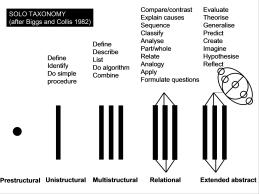
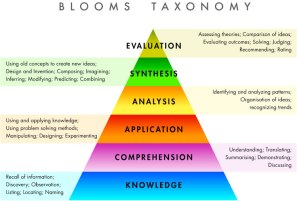
What if we then further embed ideas around Blooms and SOLO taxonomy? That “by age” we were very clear about what is expected (what competences children need to have or be able to do?)…and that this provides the framework for depth, teaching, questioning etc. as it already does in many classrooms.
blooms_taxonomysolo-taxonomy-with-verbs

What if we taught to depth around these age related expectations because the necessity to cover lots of content is removed. What if there was a real stickiness around redrafting and re-doing, such that children were challenged to do their best work and this enabled students to spend more time working at Age Related Expectations?

“More generally, in top performing education systems the curriculum is not mile-wide and inch-deep, but tends to be rigorous, with a few things taught well and in great depth.”


stock-footage-deep-end-deep-end-of-the-pool-a-good-visual-metaphor-to-show-madness-forstock-footage-shallow-end-of-the-pool


What if all of this also sought the ethic of excellence, because…

“Once a student sees that he or she is capable of excellence, that student is never quite the same. There is a new self-image, a new notion of possibility. There is an appetite for excellence.” (Ron Berger)

What if.. this seeking excellence required an unswerving expectation that all teachers were  purposeful, deliberate and precise around formative feedback and that this was within tasks and lessons and not bolted on. What if.. we judged the quality of feedback much more on the quality of what students produce and less on ticks or comments or forced dialogue in books.
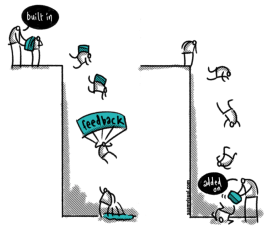
feedback


What if.. the curriculum was interleaved so that the Age Related Expectations are re-visited to embed and secure new knowledge and understanding? What if.. we developed a spiral nature to the curriculum?
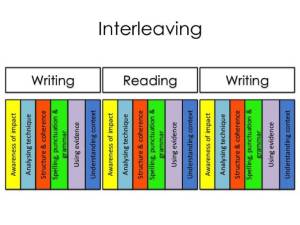
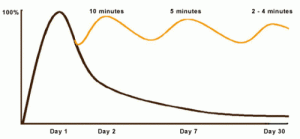
tharby6curve_0-500x231


Maybe then we would have an approach to life after levels that..

  • was focused on developing successful individuals, historians, geographers, musicians, artist, sportspeople, scientist, writers, innovators, dreamers, mothers, fathers, positive citizens.. as identified by subject specialists in our Academies.
  • took control of the curriculum, assessment and teaching against a clear set of Age Related Expectations that importantly allow teaching to deepen and inspire within the expectations.
  • built on the Primary experience of Ager Related Expectations and Mastery and provided a strong foundation across a broad curriculum – including
  • was able to measure attainment and progress to identify those that fall behind.
  • was clear about the precise Age Related Expectations for Year 7 and 8 – so that children understood the knowledge, understanding and skills that they can and cannot do and importantly the gaps in their learning and importantly how to close them.
  • did not recreate levels in a new format or simply use GCSE grades or numbers down through to Year 7. It did not seek to provide any other descriptors other than one set at Year 7 and one at Year 8 – the child is either at an earlier stage, yet to be at ARE, working at ARE, deepening within ARE.
  • took full advantage of Multi Academy Trusts and Collaboratives to own and develop standardised approaches that sought to raise the bar. That charged subject specialists with developing AREs and Common assessments (summative and other) that brought real ownership of what and how knowledge, understanding and skills are secured in our young people.
  • had a sophisticated way of visually showing the attainment and progress of all children, by year, group, class … Academy, department etc. So that progress of a child is identified as accelerating progress, gaining ground, maintaining progress, falling behind or falling further behind.
  • never forgot that it is still the quality of teaching in each lesson every day that is the transformative engine of education regardless of the curriculum.
  • had at its heart a drive to close gaps for the disadvantaged and children on the margins. In fact catching-up all those who are and fall behind.

“An individual is a high-dimensional system evolving over place and time.” (Molenaar, in Rose 2016) “…if we demand that social institutions value individuality over the average, then not only will we have greater individual opportunity, we will change the way we think about success – not on terms of our deviation from average, but on the terms we set for ourselves.” (Rose, 2016)

What if.. it was precisely this opportunity to take control of the curriculum, assessment and teaching that inspired us all to enter Education and seek to make a difference?

Dan Nicholls | August 2016

Thoughts and ideas largely my own and do not necessarily reflect that of the Cabot Learning Federation.

How can MATs be more than the sum of their parts?…

How can Multi Academy Trusts realise their potential in a rapidly changing educational landscape so that they become more than the sum of their parts and make a contribution to system leadership that transforms education as we know it?

1 + 1 = 3

It is probably true that education is going through rapid change through Academisation and the growth of Multi Academy Trusts (MATs); the temporarily weak academies get sponsored, the perceived stronger ones seek to form and grow their MATs. What happens within MATs and in particular their effectiveness at driving and sustaining academy improvement will determine the success of this educational transformation. Will the system become self-improving?

It is also probably true that there are key strategies and opportunities afforded by the scale and connection within MATs that have real potential to transform leadership, teaching, professional development, assessment, learning, outcomes and ultimately the life chances of children in our communities.


What if.. the following provides a useful framework and description of the key approaches, mindsets and strategies that will enable MATs to add value and raise standards beyond what was possible when the individual partners in a MAT stood alone…

Slide1


In a changing educational landscape stand-alone Academies can become increasingly isolated, organisationally blind and vulnerable to dips in performance. At the same time there is increasing evidence of the significant benefits and security that comes with being part of a group of Academies within a Multi Academy Trust. The last half-decade has seen an acceleration in the establishment of new MATs as well as the rapid expansion of the pioneer MATs. Whilst this has fundamentally altered the educational landscape, most MATs are presently immature and rapidly exploring the potential benefits of deep collaboration and collegiality. Additionally, maturing MATs are beginning to exploit system leadership to secure a wider impact and are seeking MAT to MAT collaboration to secure greater provision, opportunity and outcomes for our young people.

“The new generation of campaigners must be collaborative in a way their predecessors were not, and had far less need to be.” (Hayman and Giles, 2015)

There is an urgent need to understand this new dynamic and exploit the opportunities that this evolving landscape is providing. This considers eight areas and approaches that have the potential to add significant value to Academies within a MAT and ensure MATs secure greater impact and improvement.

“System leaders focus on creating the conditions that can produce change and that can eventually cause change to be self-sustaining.” (Senge et al., 2015)


Slide2

What if.. there is a deepening of moral purpose and the motivating notion of improving the system, with other Academies; influencing and improving the educational provision for a greater number of individuals. Reinforcing this shared purpose, collective goal and deeper ambition provides the fuel for collaboration and system-focused altruism required to add greater value to the system.

The attraction of joint initiative and collaboration, carefully fostered within a MAT, exploits the useful tension between co-operation and competition. Supported through regular connection and transparent performance data, academies push and pull each other to achieve greater success against this shared purpose to uplift communities and have an impact and this generation and those that follow.

“There are many strategic benefits…from aligning joint effort, and for combining collective investment for competitive gain. Uplifting leaders know that these (collaboration and competition) are the yin and yang of enduring success.” (Hargreaves et al., 2014)

What if.. the development and use of data across a MAT provides a unique opportunity to compare and contrast performance?

Matthew Syed considers Black Box Thinking (2015) and the benefit of deeply understanding and investigating performance. Where quantitative and qualitative data across all functions of Academies within a MAT are compared there is an opportunity to identify bright spots and positively deviant behaviours that have impact (Dan and Chip Heath, 2010). Centralised, shared and transparent data trawling, scrutiny and analysis allows greater focus on what matters as well as deepening accountability. As Jim Collins (2001) states, you cannot do anything without first confronting the brutal facts of your reality. For MATs this is the basis of a self-improving system and for the identification of trails, both at MAT and individual Academy level. Black box thinking and transparency of key indicators is a key advantage of collaboration for individual Academies within MATs, particularly where they…

“…have the discipline to confront the most brutal facts of your current reality, whatever they might be.” (Collins, 2001)

What if.. well-connected Academies within MATs have a unique opportunity to reduce organisational blindness and to bust silos? Gillian Tett, considers the impact of working in Silos, suggesting that:

“If we become blind creatures of habit our lives are poorer as a result.” (Tett, 2015)

There is significant value gained from leaders, teachers and wider staff moving between Academies within a MAT (permanently, seconded, temporarily or for reviews) that supports improvement and is a tangible element of deep collaboration. Importantly this supports Academies to learn from, evaluate, assimilate and adopt practices that are shown to have had impact in other Academies. Where fluidity of movement is high there is increasing alignment of practices across the MAT that can reduce the need for direct standardisation or imposition of practices. As MATs mature, this movement is increasingly strategic and increasingly extends through the organisation to balance resources and intervene to accelerate improvement. In a fragmented educational landscape this connection and collaboration afforded within a MAT allows for the removal of organisational blindness and a widened view that better informs improvement.

“Collaboration occurs when people work with others … to achieve a clearly understood and mutually beneficial, shared set of goals and outcomes that they could not achieve working by themselves.” (Sanaghan and Lohndorf, 2015)

What if.. Collaboration with purpose within MATs, particularly within networks is a key element for driving improvement? Collaboration is often only effective where it achieves a clear commitment and triggers action. Whilst it is typical for Principals to meet regularly within a MAT, deeper networks have a greater impact on middle leadership, teaching and the wider work of Academies. This is supported by John Kotter who describes the need to create duel operating systems, that maintain the hierarchy, whilst maintaining, cross-organisation groups that connect and innovate.

“The real challenge is to combine strong leadership and strong management and use each to balance each other.” (Kotter, 2014)

Subject networks provide a good example, particularly where these go beyond the sharing of effective practice, which can ultimately either be adopted, or otherwise admired and left behind in the room. In a MAT scenario such networks develop a profundity that lead to staff sharing best practice and also syllabi, planning and resources, as well as having Mock Exams that are marked, moderated and followed with examiner style feedback. Adam Grant (2014) highlighted the advantages of propagating and rewarding strategic-altruism within these networks that need to support and generate a culture that rewards strategic givers and giving.

“If you share your best ideas with your competition, it will stimulate you to keep inventing new ones in order to stay on the leading edge of innovation.” (Hargreaves, 2014)

What if.. growing Leadership Capital is a key catalyst for Academy improvement and central to deriving impact within a MAT and across the system? Whilst getting the right leaders on the bus is key, either internally or externally sourced, it is also important that leaders are in the right seats, at the right time. MATs enable the strategic movement, training and development of leaders that support accelerated improvement. The ability to develop, promote and second leaders and middle leaders between Academies provides the opportunity to balance skills and experience to intervene for the good of the wider community. As Fullan (2010) describes these leaders become influential change agents within the MAT.

“The fact is, most effective leaders want to make a contribution beyond their own borders….they are humble. But they want to learn more, and they want to think that they have something to offer that will benefit others…they make perfect change agents, because they push upwards and laterally.” (Fullan, 2010)

What if.. securing a deep and unswerving focus on effective Pedagogical leadership as central to turning the key educational flywheel of Academy improvement? It is this aspect that Academies and MATs need to be the “best in the world (at)” (Collins, 2001). This is an unswerving mission and drive that has the greatest leverage on outcomes and increasing the life chances of children. This is the standing item for all cross-MAT networks and groups.

Slide13

What if.. strategic system leadership needs to intervene to secure improvement? In any MAT each Academy performs differently and will be progressing on their own improvement journey. Where performance is strong a level of earned autonomy provides a level of freedom to an Academy. However, where performance dips or where an Academy underperforms there is a need to impose strategies and approaches that are shown to be effective. With high trust within a MAT there is an opportunity for executive leadership, scrutiny, review and peer challenge to disrupt and provoke improvement. The best MATs use this to seek a self-improving system that delivers discernible difference.

“(when) Schools pull together and share their best ideas, while simultaneously employing peer pressure to achieve more for the sake of all students (and the whole community).” (Hargreaves et al. 2014)

make_a_difference_sign

What if.. for the system to become self-improving there is a need to scrutinise, evaluate and to pursue discernible difference on the things that matter? This type of leadership seeks to execute change and tell narratives of improvement that propagate the shared moral purpose, grows bright spots and secures alignment and improvement that raises standards across the MAT.


Maybe then.. Taken together the eight areas interact to provide a description of system leadership within a MAT; a system that seeks to be self-improving and to add more value than its constituent parts. The Educational landscape has shifted through system-wide academisation to a point where MATs are forming and growing rapidly and with few parameters. Whilst this may require some rationalisation in the future there is presently a growing movement where MATs are collaborating and taking responsibility for their wider communities; forging MAT to MAT relationships which need to grow if we are to realise the potential of system leadership and to create a self-improving and self-regulating education system.

“The role of the leader is to enable, facilitate, and cause peers to interact in a focused manner…but still only a minority of systems employ the power of collective capacity.” (Fullan, 2010)

March 2016

Thunk #3 | What if… motivation needs to be ignited?

i-4e84ae6655ead4d2602ed030e890aa1f-ShuttleLiftOff

“Beneath every big talent lies an ignition story – the famously potent moment when a young person falls helplessly in love with their future passion.” Dan Coyle

We all have them; the moments in our past that have shaped the present and will influence the future. It may be a teacher, a sportsperson, a hero, a film, a piece of work, art, riding a bike, running, a poem, essay, a realisation, a chance encounter. It can be like a lightning bolt that ignites something deep inside that motivates a lifetime of passion for something; it causes the heart to flutter and captures the imagination.

“Success is not a random act. It arises out of a predictable and powerful set of circumstances and opportunities.” (Malcolm Gladwell)

It is probably true that there are moments in our lives that create core memories that have disproportionate influence on who we are, what we do and who we become. The Disney Pixar film Inside Out is a great tale that revolves around those forming experiences that shape each of us.

screen-shot-2015-06-22-at-7-00-43-pm

In the film each memory that Riley has is diligently stored in the short and long term memory, occasionally forgotten and removed (hoovered in the movie). There are however key core memories – it is these that shape Riley’s personality islands…those few things that define who  she is, what is important to her and what she is passionate about. The mind replays the key igniting memories that reinforce this passion and drives the intrinsic motivation for deep practice.

inside-out-personality-islands

“Talent begins with brief powerful encounters that spark motivation (ignition) by linking your identity to a high performing person or group (or self image). This is called ignition, and it consists of a tiny, world shifting thought lighting up your unconscious mind: I could be them (or do that, or achieve that)” Dan Coyle

The emerging thunk is that these moments are a lot like falling in love — we can’t force it, but we can increase the odds slightly by doing a few basic things. As teachers and leaders how do we create the conditions and the opportunities that are more likely to provoke these lightning bolt moments for children and our peers?

These moments are: (from Dan Coyle)

  1. Serendipitous. Happen by chance, and thus contain an inherent sense of noticing and discovery.
  2. They are joyful. Crazily, obsessively, privately joyful. As if a new, secret world is being opened.
  3. The discovery is followed directly by action. Not to just admire, but to act, do and practise.

One key lever in education is subject knowledge or rather subject passion from teachers who inspire. Teachers have huge influence – and with that opportunity comes great responsibility:

717296dd52443f5d014228877381418e

The language we use is also extremely powerful. It is language that can create ignition points and perhaps more importantly can confirm and propagate these sparks into passions that drive the motivation to shape and enhance young peoples lives…

Screen Shot 2015-03-10 at 9.18.46 AM

“Tread carefully on the dreams of children; they are fragile”

So, create moments of joy, inspiring facts, details and experiences that ignite a passion, perhaps not seen or witnessed early but for ever changing the individual. After all…

“Once a student sees that he or she is capable of excellence, that student is never quite the same. There is a new self-image, a new notion of possibility. There is an appetite for excellence.” (Ron Berger)

It just might be that supporting children to achieve the best work they have ever done ignites the sort of motivation that creates a personality island and the deep passion to engage in the practice that enriches a lifetime.

How do we create core memories, lightning bolts, ignition moments or at least the conditions for them to happen more often?

How do we use language to support children’s dreams and passions?

We may not create olympic medalists, chess grandmasters or a world-class composers, but the fun is in the journey, in having a passion, an interest and generating the kind of joy that sparks an interest – Teachers have no idea the influence they have on others.

Go create ignition opportunities and sparks that will enrich and empower young people to be passionately interested about stuff… and reinforce these passions with your language.

you have the privilege of sparking remarkable futures.

soulnote_heartflutter_grande

Main Menu

August 2015

Thunk #2 | What if… Mission + Campaigning = Momentum?

Untitled

Michael Hayman and Nick Giles identify: Mission: “A driving desire to change things, a higher purpose that drives (improvement).” (best expressed in 5 words) Campaigning: “Turning the mission into a powerful reality, the activist mentality.” Momentum: “The measure of success moving and growing faster than the competition.” Are you a campaigner, an activist, a disruptor? …on a mission to secure the momentum you require to change the piece of the world that you want to improve? This is a refreshing view of change (particularly the link to activism) and what it takes to move to action and secure the level of change that will make the difference. But what does it take to be an activist/campaigner? Hayman and Giles identify:

  1. Drive (or refusal to give in): Do you have the drive to keep going when it is easier to stop or when people tell you it will not work? Remember that there is a default movement against change and an inherent fear of new/different. Set your mission with care – it needs to be simply expressed and the focus of your drive.
  2. Self improvement: Do you build in enough time to reflect and learn? Treat experience and opportunity as stepping stones forward as part of the ups and downs of a campaign.
  3. Communication: Without communication there is no campaign. Reinforce the mission and the purpose often – drive the mission daily…this is the flywheel. If it is not simple and compelling there will be no followers.
  4. Disruption: To achieve change you need to disrupt the current status quo: If your mission is to address dissatisfaction or a need for change and this is multiplied by a Vision (Mission) and First Steps (Campaign) and this is greater than the Resistance you will achieve Momentum. (based on Gleicher formula)change-graphicOvercoming the Resistance of status quo requires a disruptive drive to succeed in achieving non-reversable change.
  5. Persuasion: You will not achieve your mission alone – persuasion is the key to securing followers – it is followers that transforms a lone nut into a leader. You need a tipping point to secure change – persuade through the strength of purpose, mission and ambition – people follow those with a deep and unshakable belief about what they seek to change. Unwavering commitment to change.
  6. Connection: Connect and network widely to secure support, seek feedback and make things happen.
  7. Optimism: To overcome the status quo activists and campaigners need to be optimistic. The vast majority of people will give up before they realise the change they seek. Develop the ability to bounce.

“Go big or go home. Because it’s true. What do you have to lose?” (Eliza Dushku)

Maybe then: As educators and leaders we should assume the role of activist and trigger campaigns to achieve missions. This language underlines the inertia of the status quo and that if we really want to trigger change and make a big difference – irreversible change – then activism and campaigning is more appropriate representation of the energy and commitment required to overcome the inherent resistance and secure the improvement we seek.

Go forth and disrupt, commit to a mission that you love, use ridiculous amounts of drive, communicate for buy-in, create a movement through persuasion and connect with others to achieve a level of momentum that makes the change stick and irreversible.

Go big or go home

Further Reading: (“Mission” by Michael Hayman and Nick Giles is excellent and very applicable to educational leadership)

and this blog: Great Leaders create movements that stick | Amazing is what spreads 

Main Menu

August 2015

Thunk #1 | What if… leading change and improvement is all about the nudge?

Nudge

“Nudges are ways of influencing choice” (Hausman & Welch 2010) …a fundamental aspect in education.

The behavioural insights team, led by David Halpern, commonly known as the “nudge unit” was set up by David Cameron to “help people make better choices for themselves… (by gentle prompting or nudging).” The art of leadership, teaching and sparking change is often in the ability of “nudging” new ways of acting, learning and thinking in others.

Nudges are similar in nature to other powerful change agents: butterflies (Brighouse), bright spots (Heaths) or positive deviants (Sternin)… those outliers present in any population that, when amplified, have the power to leverage change and improvement. Thaler et al. highlight that there are influential strategies (nudges) that leaders can use as choice architects to influence choice and behaviour.

So leaders are choice architects; determining the environment in which noticed and un-noticed features influence the decisions that staff and students make. Leaders have the ability to influence behaviours, create social epidemics and use “nudges” to influence individual and group behaviour.

We are surrounded by nudges; good leaders see them, look for them and use them (often automatically), great leaders have an increased awareness of nudges and use them to spark change; clever, cheap and effective ways that change behaviours intrinsically – without forcing choices. Perhaps some obvious nudges are:

  • What is placed onto observation forms and is therefore rewarded.
  • Telling students how many marks they are away from the next grade and not their actual grade.
  • Shifting Satisfactory to Requires Improvement.
  • Removing levels.
  • Any new performance measure  – nudging by shifting the goal to where you want it and not wasting time supporting the how it can improve.
  • Any new category that classifies performance of Academies or MATs – nudges improvement toward set criteria.
  • Asking (not telling) others what they will contribute.
  • Warning bell moved earlier to nudge punctuality.
  • Accepting that change is the norm and not saying things like, “we just need stability”
  • Never talking negatively as a leader – nudging that positive ethos that is desired.
  • Being in every classroom everyday.
  • Providing enough seating at lunchtime.
  • Finding and promoting teaching bright spots.
  • Removing all graffiti immediately.
  • Using “we” and not “I” or “you” when collaborating.
  • Investing in signage/branding that describes the accepted behaviour.
  • Leading with Why and telling emotive stories of a compelling future.
  • Not talking about behaviour and only about learning.
  • Praising the good habits, only highlighting that which is desirable.

…you will have other nudges. As the choice architect of your organisation, team, classroom… 

  • do you recognise the nudges around you? …the nudges that influence you as well as the nudges that you use to influence others?
  • how do you use nudges? Do we think and plan long enough to seek softer ways (nudges) to achieve the changes we wish to see?
  • how can you nudge improvement?

Main Menu

 August 2015

Delivering discernible difference

“If something is discernible, you can discern it – you can see it, smell it, taste it, or otherwise tell what it is.” (www.vocabulary.com)

It is probably true… that effective leaders and exceptional teachers have the ability to deliver discernible difference (improvement). It is this ability and awareness to focus in, move to action and deliver a discernible difference that stands these people out as great leaders and teachers. They have the ability to rationalise, prioritise, simplify, see the important, dismiss the clutter and move effortlessly and quickly to…

…secure meaningful improvement in areas that will leverage the most impact and improvement… triggering and delivering change that is both discernible and sticky…maybe even irreversible.

Perhaps… we should seek to tell stories and build narratives of improvement in identified areas or on trails where we deliberately place bets to transform practice and deliver discernible difference.

make_a_difference_sign


Which begs the question… what does it take to deliver discernible difference? How can we be more deliberate and focused on singling out the key levers of improvement; executing these changes, building a story and telling a narrative of improvement around the few things that matter?


What if… achieving discernible difference requires prioritisation of what matters? and that this takes thinking time and a careful consideration of what will leverage the greatest improvement? What if… we considered the following phrase when identifying where to play and achieve the discernible difference that we seek…

“What’s the ONE Thing you can do such that by doing it everything else will be easier or unnecessary?” (Gary Keller)

What if… great leaders and teachers understood that what you do not do, what you de-prioitise (the omissions) are as important as what is actioned? …that ability to place bets only on what counts and the mindset that reduces  crippling complexity and workload?

What if… we realised that trails and areas requiring improvement are often obvious and rarely require deep evaluation to be understood?; seek the trails that matter…

Slide4

What if… we spend too much time evaluating and applying QA to the whole population or provision instead of moving more quickly to action on the areas that require improvement; seeking discernible difference?

What if… we also realised that in any population there are outliers, bright spots and positive deviants who have that answer or exhibit behaviours that have the ability transform? …achieving discernible difference and improvement will often be within the population… seek the wisdom and grow it…

Slide3

What if…we were more aware of the fact that we can get over-excited or be prone to complacency when we measure and weigh stuff? That feeling we get when we complete the SEF, a round of observations, work scrutiny, achievement meeting, re-writing our to-do-list etc. – often confuses us into thinking we have achieved impact or improvement?

What if…we are prone to believing that things will just improve, or that if we apply a strategy more, or if we weigh stuff more, that we will achieve a different end point?

Insanity is doing the same thing over and over and expecting a different result.” Albert Einstein

What if… we only focused on the key trails and moved to action. What if… we are not quick enough to move to action (to start stories) and as a consequence rarely achieve the change that we desire and others need…

d3a6b2aafb7946d0ec5aacd42d4860e2

What if… we do not continue to commit to action during the implementation dip or when it is easier to go off and measure something else or when we can duck the difficult conversation or action?

seth-godin-the-dip

What if… we were in the habit of telling stories; and building a narrative of improvement? … around those areas that we have prioritised, that will have the greatest impact and deliver discernible difference?

Slide2

What if… a self-improving education system or academy or teacher has the ability to understand the brutal truths of the situation and embark on a set of deliberate actions that together tell a story and provide a narrative of improvement?

g2g-confront-facts

What if… these stories always have a start, a middle and an end…

Slide1

blogs.scholastic.com

What if… we are good at opening up stories, but much weaker at building plot and poor at writing great endings (happy or tragic)? What if… we do not stick around long enough on a story or move to action quick enough to realise the twist or truths or barriers to improvement that exist?

…stories motivate people to achieve more. They show what is possible and trigger other unintended improvement.

What if… milestones are a key aspect of delivering discernible difference? That these chart progress, point to the desired destination and importantly provide ongoing motivation to overcome implementation dips and secure discernible difference … perhaps even irreversibility (Barber).


gorsel-km-taslari

What if…this ability to place bets on the stuff that matters is born out of an acute awareness and a lack of organisational blindness achieved from beyond our present context (Academy, classroom, MAT, region…)

What if… delivering discernible difference has everything to do with execution, execution, execution… only this delivers transformation… and possibly irreversibility…

Slide2

What if… we…

…ensure that the choice architecture, nudges and culture provokes and rewards individuals and teams to chase their own narratives of improvement, growing the ability to tell stories of discernible difference.


Maybe then… leaders would have pride in telling their narrative of improvement – their motivating stories of the difference that they have made. Maybe then… leaders and teachers can point to examples of  discernible difference as evidence of impact on others and students.

Maybe then… leaders and teachers would move to action more quickly on the few things that matter – placing bets on the one thing(s) that make a discernible difference. Maybe this… level of focused action has the ability to add far greater value than blunt, catch-all, self-evalution.

What are your trails? where is your discernible difference? what stories of improvement can you tell – where have you achieved irreversibility? Has this become the lens through which you seek future improvement?

After all… the measure of our own impact should be judged through the stories of discernible difference that we can tell.

Dan Nicholls @DrDanNicholls

November 2015

Effective Feedback | CLF Conference

Slide1

It is probably true that effective feedback is the important aspect for improving performance and accelerating progress. Where an expert coach (teacher or other) offers feedback that is timely, specific, within the task and moves individuals to respond and take action, children see things differently and are supported to deliberately practise to make gains in knowledge, skill and understanding.

It is also probably true that we can be blinded into assuming that feedback is limited to the written variety in books (Silo effect). Whereas effective formative feedback should be used to inform all parts of teaching. This is the craft of teaching… where teachers use effective feedback to inform their pedagogy and base planning on an acute awareness of where children are and precisely what they require next to make progress.  Perhaps it is more a mindset and an approach rather than a strategy or a method.

blackbox-3

Which begs the question… what makes feedback effective so that it pervades all that we do and leverages gains in knowledge, understanding and skills?

The following reflects some of the best practices across the Federation and identifies the key aspects for securing effective feedback in all classrooms…


What if… effective feedback is more precise and leveraging when there is a depth of knowledge that teachers use as a framework/basis for feedback? What if… this knowledge encompassed…

  • subject/age-related understanding of standards and expectations – that also ignited an interest and passion around content?
  • a deep understanding of the key concepts and importantly the key mis-concepts that are built into a child’s progress in a subject or area?
  • Knowledge of exam and age-related expectations to provide precise feedback – with the end in mind?
  • Knowledge of pedagogy – the how do I teach for understanding?

What if… the Sutton Trust is right about the two key factors influencing great teaching, Content Knowledge (particularly concepts and misconceptions) and Quality Instruction (questioning and use of assessment – modelling, specific practice that is based on quality feedback)?…

Slide3

What if… feedback was focused within tasks and not bolted on to tasks?What if… we recognised that some of the best feedback happens within tasks…tweaking and suggesting … intervening (whole group, small group, individual) in the moment. Too often feedback is given outside of the event of learning and is not reflected in the planning of subsequent lessons –  so that students are unable to remember or link back to the cognitive challenge they were wrestling with.

Slide21

What if… Ofsted are right about the nature and required impact of assessment and feedback…

Slide1

What if… teachers spent more time planning lessons based on the formative assessment of present progress of pupils (perhaps always based on present progress in lessons and the learning demonstrated in books) to focus planning on closing gaps and addressing mis-conceptions … not just progressing through the scheme of work? Based on the precision of planning there is a discernible difference in the progress of each child. When lesson planning, details matter… (marking is feedback for planning.)

Slide28

What if… much of what is marked does not trigger the action and response required from the child to close gaps. In fact what if… a good proportion of written feedback is not read, not understood and not ultimately acted upon?

What if… the quality of books are judged on the progression in content, skills, understanding and application, rather than the amount and extent of marking – rewarding the closing of gaps, progression of learning and the quality of planning, whether this is achieved directly from written feedback, oral feedback, lesson planning or in the quality if teacher intervention within lessons and across lessons?

What if… teachers wrote less feedback and students wrote more in response – where feedback is responded to in lessons as a key part of the planning – time and commitment is made to close gaps by re-doing and redrafting, by consolidating and practising?

What if… Feedback was SMART –

  • specific – directly related to the skill gap, hole in knowledge, lack of understanding.
  • measurable – you will know when you can do this when…
  • achievable – set in the proximal zone for a child – it is the next step in their learning
  • realistic – specific enough and a gap that is closable in the next 20 minutes, lesson or two.
  • timed – it is acted upon in the present or as soon as possible after the event – and importantly actioned.

…and what if… the very best feedback has the potential to ignite motivation or better still enable a child to see the world, an idea, an approach through new eyes – so that it removes a barrier, unlocks a misconception and makes connections in the brain that support improvement. – seeking light bulb moments.

d3a6b2aafb7946d0ec5aacd42d4860e2

What if… effective feedback was clear with children so that they know what they are aiming for, the size of the gap and specifically what they need to do next to close the gap. (D. William) …children know what good performance looks like.

What if… summative assessment provides a very rich form of feedback – but that this is lost unless there is strong feedback, gap recognition and a move to action (DTT DIRT) that specifically closes gaps? What if…there is no opt out policy for individuals – who must use time in lessons to respond to feedback? (e.g. DTT, DIRT)

What if… we ensured that where feedback is given that this is not wasted … that subsequent lessons reflect the formative learning of the marking and feedback that has revealed exactly where each child is … so that lessons are well planned, crafted and directed to close the gaps … often re-doing and re-drafting to secure learning over time.

What if… we understood that learning is a physical process – that the development of myelin in the brain (layers in picture below) enables neurons to fire and for things to be remembered or skills to be hard-wired … such that only through effective feedback that engages in practise and repetition do we internalise and physically create connections in the brain that allows us to remember and master…making the most of the feedback?

Myelin1

What if…therefore, we used our understanding of the curve of forgetting to interleave curriculum and deliver a spiral curriculum that revisited and consolidated learning over time? Perhaps developing a layered, escalating spiral curriculum where children repeat and return to build on learning.

curve_0-500x231

What if… feedback needs to be in the proximal zone? and that the real challenge in teaching is to keep as many children in the proximal zone for as long as possible (explaining and applying knowledge just beyond what the child is capable of) … or in a state of FLOW (that area between boredom and anxiety)? What if… good lessons are pitched and challenging for 80% of students, but that in great lessons this is a different 80% each lesson? Pitch matters – sadly it varies by individual.

pz

figure1

What if… we understood that practise has to be deliberate to be effective and that this is accelerated where children are in the presence of an expert coach and effective feedback; a coach that…

  • maximises reachfulness in the presence of an expert.
  • supports children to embrace the struggle – “You will become clever through your mistakes.”
  • and encourages theft – using feedback and modelling to copy others.

What if… the real purpose of feedback is to support and engage children in purposeful practice or deep practice?….(Dan Coyle)

“We all have the ability to profoundly change our levels of talent, our level of skill. Where clusters of great talent emerge there has been a culture created where individuals are constantly reaching and repeating, making mistakes, receiving feedback, building better brains, faster more fluent brains…inside the brain myelin acts like insulation on the pathways and connections in the brain – each time we reach and repeat we earn another layer – signal speeds in the brain start to increase from 2 mph to 200 mph – neuro broadband – (or the difference between normal and great).”

Slide23

“…practice (is) intentional, aimed at improving performance, designed for (a student’s) current skill level, (aimed at excellence), combined with immediate feedback and repetitious.” (Malcolm Gladwell)

What if…teaching and feedback focused more on the journey; on the “near win?” (Sarah Evans)

“The pursuit of mastery is an ever onward almost.” … “Grit is not just simple elbow-grease term for rugged persistence. It is an often invisible display of endurance that lets you stay in an uncomfortable place,work hard to improve upon a given interest, and do it again and again.”(Sarah Evans)

What if… too often we give feedback and explanation that is not different from the first explanation or we ask children to simply re-do the same task – missing the opportunity to reframe and explain differently…increasing the chance of a child overcoming cognitive conflict?

What if.. questioning is one of the key ways to provide effective feedback and that through great explanation and modelling children receive on-going formative development and feedback based on exactly where the child is and what they need to know, do or understand next? – expert delivery of aspects of pedagogy that secures concepts and unlocks mis-concepts.

What if… when we have a really clear understanding of the curriculum, the journey, the key learning by age, the concepts and mis-concepts by stage – we can provide much more effective feedback against this wider framework?

What if… effective feedback is only secured where there is an ethic of excellence?

excellence

What if… effective feedback is everywhere – from a corridor conversation to our expectations to what is seen as acceptable in the Academy?


Maybe then…based on secure knowledge (subject/age related/exam/conceptual understanding) teaching will provide a range of formative feedback that importantly informs deeply the lesson planning, but also provides expert coaching to support children to actively respond and work in their proximal zone where repetition and deliberate practice supports progress.

Maybe then…there would be no opt-out for children who are compelled to respond and act-on feedback and that this is integral to the learning process as children receive feedback that is built in and not bolt-on to tasks (and takes many forms – is ubiquitous within the teaching – a thread through the employed pedagogy). Maybe then children will experience flow and, with the aid of an expert coach, improve through well targeted deliberate practice.

Perhaps that… describes the greatest challenge of pedagogy and that which transforms teaching effectiveness … delivered by practitioners whose awareness, knowledge and grasp of pedagogy and the integral role of effective feedback creates the conditions for over performance. (…for a different 80% in each lesson).

Dan Nicholls

October 2015