This is not about you

You are not that important, but your influence on others and the future is.

The influence we have as leaders to trigger change in others is what matters. The proliferation of influence beyond ourselves, through a deliberate investment in other human beings, pays forward. It is through this investment that leaders influence greater numbers and further into the future. Ego-less, values-driven leadership that knows it is not about them, but about how they extend their reach and influence.

paying forward, through others, for the future

The strongest leaders invest disproportionately in relationships and interactions that very intentionally influences the leadership of others, far-sightedly. Quietly and deliberately seeking micro and macro investments in others, who are better able to make a greater difference over time. Whilst some acts of influence are seen and purposefully public, most are unseen, systematic and deliberately enacted. It is what they do: the hidden work of leadership.


 (very) Intentional acts of influence

Too often we are taken by bold, shout about acts of leadership that serve the individual. In contrast effective leaders deliberately invest over time, seeking greater value through others, to achieve a common good. This leadership is effortful, thoughtful and deliberate. It calculates expected value and acts to increase returns in the long term. The reverse is lazy, wasteful and short-termist; no friend to our ancestors.

be the ancestor that our future generations need

Leadership is the influence we have on others, those near and far, to make a difference now and next. Effective leaders seek to develop the mental models in others focused on how to lead and pay forward so that they deepen their influence. In creating these models in others we might create the quality of leadership that grows capacity and inspires more lives.


Relationships, ad infinitum

Leadership is relationships, ad infinitum. Our ability to connect, influence, enable, inspire and leave residual value in those we meet, in those we lead, permeates our influence in and through the lives of others. Leaders who give time, are present, give thought, experience, expertise and who purposefully invest through others, seed possibility beyond themselves.  As social beings we thrive on the belief others have in us.

“The relationships we build with each other provide the foundations of change. We are social beings who thrive on connections.” Sir Hamid Patel

Leaders are emotional catalysts, experts in motivation (and motivations). They energise, inspire, elevate and encourage commitment from others, unleashing our natural biases to belong and do meaningful work. This orchestration requires leaders to create the conditions, opportunities and choices for colleagues to lead with purpose and take responsibility, to make a difference.


Our sphere of influence | through who and how far?

How far does your influence extend, to…

  • …self, a few, some, others, many?
    • …now, tomorrow, next, beyond your tenure, beyond your time?
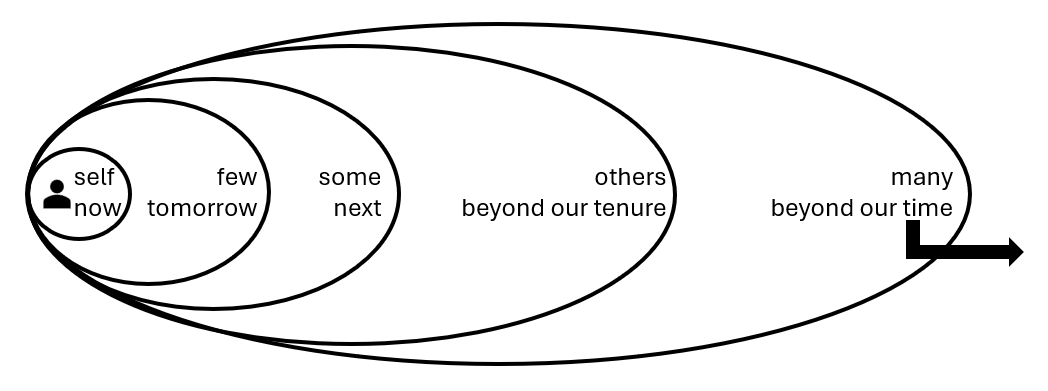
    It is a choice. The emphasis of your priorities and how you use time, with who, will determine the impact and the reach of your leadership. It is both proximal and longitudinal. How far your leadership travels and how contagious it becomes determines legacy: in the trails you leave and open for others.

    We do not just leave trails we create new trails, tread lightly.

    Some leaders are fixated on now, today, tomorrow, getting through (and sometimes that is ok), others lift horizons and seek future returns, seeding the ground and deeply investing in others to change more and into the future. Your leadership is the sum of the actions taken by others, because of your leadership. Most of the impact of which will never be seen or known by you, paying forward.

    “Become the ancestor you’d like to thank.” Seth Godin


    Eco-systems and overstory I the theatre of leadership

    Effective leadership is hyper-aware of the peer and cultural codes that influence the motivation of humans within their ecosystem. Deliberate leadership is sensitive to these codes and acts to trigger ripple effects that take hold and add value.

    “…as tribal animals, we are bound to our peers, heroes, and ancestors … understanding ourselves as tribal helps us see the ripple effects of our actions.” Micheal Morris

    Effective leaders know that in this theatre their role is to enable the ecosystem to thrive, enhancing symbiotic relationships and connections that see beyond survival, toward something worthy. Knowing that their worth is measured in the health of all parts of the ecosystem and after their time.

    Each ecosystem has an overstory, a canopy that guides and shapes norms, decisions, actions, language that create or subtract value. People like us (here) do things like this. The stories we tell, the destinations we describe influences the ecosystem, and the effectiveness of leadership. Leaders…

    “…tend to forget about the overstory because we’re so focused on the life going on in front of and around us. But overstories turn out to be really, really powerful. The overstory is specific. It is tied to a place. It is powerful. It shapes behaviour. And it does not emerge out of nowhere. It happens for a reason…” Malcolm Gladwell.

    To pay forward, with intent, through others, requires leaders to calculate the expected value of their influence through others into the future. To do so requires an understanding of the ecosystem, motivation, peer codes, the overstory… a study of how social costs and cultural codes shape the decisions and actions of others overtime.


    Our landscape | Far-sighted leaders required

    “Our challenge is to ‘build’ the future society we (they) wish to see. This has implications for the curriculum, partnerships and school communities we develop.” Sir Hamid Patel

    The petri dish that is our sector is growing and maturing, the cultures are separate and largely in survival or winning mode. The future, however, is not about successful individuals or individual organisations. It is in the collective leadership and the networks we grow, that influences the sector, through others, that just might generate the capacity to reach all children.

    “…humankind gains enormous power by building large networks of co-operation, but the way these networks are built predisposes us to use the power unwisely. Our problem, then, is a network problem.” Yuval Noah Harari

    It is leadership that builds capacity through networks and deeper collaboration that will determine our stewardship of the future. The future starts with us, in our understanding of why we exist, how far we wish to lift and enable others, close to us, far from us, now and way into the future.

    What if the challenges we face as a sector are, in large part, a leadership challenge, and we are coming up short?


    Catch-up mode

    Our worth is seen in our influence on the lives of others. Our choices and priorities determine the difference that we make not just now, but next. We need to influence others in a way that will travel into the future, beyond our time. Leadership that propagates and adds value, ever-onward. Paying forward, through others, into the future.

    And yet our leadership is in catch-up mode, a feature reflected in the immaturity of our sector. There is much to do, but we have what we need and importantly the permission and obligation to lead more effectively. This weighty responsibility requires us to use our power well and to transfer and pass it through others to multiply and maximise our influence.

    In catch-up mode we must re-imagine what educational leadership is, their future depends on it. Our leadership must be more potent, generative and farsighted so that we do better than now, much better. Or else, we will not reach those children scrabbling for a foot hold on the fringes of education. Our present leadership paradigm does not generate enough capacity to do so.

    It is time to elevate the conversation, align our actions with our rhetoric and deliver far stronger leadership across the sector. We have far more influence than we are willing to admit. But there is hope, leadership that pays forward, through others, for the future just might generatively add the value, tip the balance for those who need us most, the ones we know and the ones we will not know.

    For the sun is shining on us now.

    …it is about your leadership


    Dan Nicholls | December 2024

    Be Braver | heroes needed

    As educators, we choose to educate children, all children, and to make a difference to the lives of others; it is what brought us here. We do this surrounded by good people seeking to use the power of education, in darkening times, against the backcloth of a fracturing social contract and weak social justice, to do good. It is a noble quest, but for those that need us most, at this time, it is a quest that we are not winning, at least not collectively winning. We need to show greater courage, to be braver, to do more to close the gaps that tarnish our system; heroes needed.


    Being Braver

    Educators definitely do care, really care, about closing the disadvantage gap, we deeply do, and yet this care is not enough, because gaps are growing and our system is not working for too many children; far too many are becoming invisible. We are all involved, we all have skin in this game and we are all implicated in our inability to close the gap.

    We could choose the comfort of an external locus of control, and say too big, too ingrained, too difficult and seek comfort in our personal insignificance, against the magnitude of the prevailing system; a resigned acceptance of how life is. Or we could choose to become braver, recognising that small (and big), deliberate strategies, the application of equity, advocacy and action, challenging norms, attitudes and behaviours can tip the system. Adjoined effort of collective strength to change and transform provision that privileges all children. To call out, build provision and influence a system so that it disproportionately advantages disadvantaged children; levelling the playing field, viewing our world through the disadvantage lens.

    Whilst the forces that perpetuate the gaps, are insidious and part of the accepted fabric of schools and society, we have the power and agency to challenge our cultural norms, accepted truths, and attitudes that prevail in our system. We must be braver and bolder to build schools, provision and a system (including our accountability system) that addresses the chasm between those that have and those that have not; it will need to look and be quite different.


    Being more Ferocious | An active not passive process.  

    We need to be more ferocious, more tenacious in creating the conditions that enable our disadvantaged learners to flourish. This requires educators to be more honest, to ask uncomfortable questions and fiercely educate those that need us the most. To fiercely educate is to replicate the stage-managed, high expectation and sharpened elbows of an advantaged childhood. Being fierce means guarding a child’s education, expecting much, staying alongside, pushing from behind, consistently and persistently championing individual children. A shared endeavour to lift lives, one by one. Creating the conditions for a movement to lift-up a generation; a deeper, more ferocious, expression of care.

    We are being braver and more ferocious in some schools that deliberately act to build cultures and approaches that successfully privilege disadvantage, that exercise equity and create the conditions that close gaps. Cultures that privilege all children and not just those who benefit from an education system “…which has been constructed and is maintained primarily in the interests of those who find learning easy*.” (Ben Newmark)

    *an easiness born out of supported opportunity and experiences over time that present as more able (even talented).


    Apply Equity | to give what an individual actually needs.

    We must be braver and more courageous to apply equity, so that many more children get the care, focus, provision, resources, supported opportunities and experiences they, specifically, need. Adults willing to be braver, to question how things presently work to apply greater equity. This will require us to do different and feel happy to do differently; gaps are widening under the present conditions; equality achieved through equity, hunt don’t fish.

    “Fair doesn’t mean giving every child the same thing, it means giving every child what they need.” (Rick Lavoie)


    Privileging disadvantage | see through the lens, always.

    We need to try harder to really understand what it is to be disadvantaged (in each setting and individual circumstance). Understanding the impact of the system, of attitudes, norms and beliefs that accumulate disadvantage. To privilege disadvantage everywhere and in everything requires us to prioritise disadvantaged learners in all decision making, in provision, in opportunity, a culture of ambition for all children, going beyond just caring. A system that firmly privileges disadvantage in all that it does, such that it becomes the norm; a system perfectly designed to close gaps. How we do anything has an impact, positive or negative, on disadvantaged learners. It is written deep in the ‘cultural fabric‘ of any organisation.

    How we do anything, is how we do everything.


    Measure what matters | attainment mobility.

    “You should measure things you care about. If you’re not measuring, you don’t care and you don’t know.” (Steve Howard)

    How far do we evaluate our provision and performance based on the attendance, attainment, and progress of disadvantaged learners; even over? This is the true test of the quality of provision, as advantaged children bring much of what they need to school, whereas disadvantaged learners rely on schools to close the gaps.

    “…the evidence suggests that national education policy needs to be rebalanced to recognise the job many schools do in countering stark inequalities outside the school gates, while maintaining high expectations for under-resourced students.” (Lee Elliott Major)

    We need systems and the system to motivate, give greater permission and reward provision that chases disadvantage attainment (and attendance); attainment mobility as the truest measure of the quality of provision. Attainment Mobility is the reversing of delayed attainment, linguistic under-privilege and lack of early opportunity,so that children self-select (not self-de-select) and accumulate advantage (not disadvantage) through life.


    Attendance first | every day missed, widens the gap

    “One measure of poverty is how little you have. Another is how difficult you find it to take advantage of what others try to give you.” (Michael Lewis)

    One way to guarantee the gap widening, is to accept poor attendance, everyday a disadvantaged learner is not in school the gap grows, they cannot take advantage of what is offered to them. It takes a whole school to improve attendance, because it is a team sport, with an individual focus. Seeking preventative strategies based on really knowing our individual children and families, as well as our responsive actions, reaching out and building relationships that encourages/expects attendance. We must commit to persistently and insistently working to remove barriers to attendance. So that we, meet them there, apply equity, ensure that they are pushed and pulled to school, resisting the forces that encourage retreat.


    Give Status | it is free.

    Disadvantaged learners are more likely to have an external locus of control, to step back and to opt out of learning. Our sense of status determines how far we belong, connect, and ultimately whether we feel part of the game. If you do not see yourself as part of the game, you will opt out and protect yourself from further status harm by playing a different game or cutting losses to avoid playing and failing.

    As individuals, we have an un-ending well of status and to give status is a fundamental human gift. To give status is to be interested in every child, who they are, what they are doing, smiling, acknowledging, encouraging, noticing, being present. It costs us nothing, is a measure of our shared values and plays out in every interaction. How far are schools places of status how far are all colleagues truly on the side of children?


    I believe in you | An invitation to dance (always)

    Every child needs to have at least one adult who believes in them. Magic happens when all colleagues believe in all children.

    To grow up advantaged is to have adults who deeply believe in you, hold you to high expectations, encouraging (demanding) participation in supported opportunities over time. A childhood that encourages risk taking, whilst holding a safety net and offering commentary, narrating the journey through life, reaffirming and strengthening a child’s internal locus of control incrementally, day by day.

    And in this we see what must be done, to re-design the system to enable disadvantaged to participate, to have supported opportunity and wider social connectivity, with a back stop of someone who believes in them, who creates a safety net and supports them as they interpret life. Get up, go again, you have agency, you are always invited to dance.


    Lost in Transition mind the gap

    Children navigate many transitions as they move through their education. Advantaged children leap confidently across these transitions, whilst disadvantaged gingerly and uncertainly step across; this is not for me. Whether it is the summer break (any break), moving schools, moving years, options or pathway choices, advantaged families step forward, stage manage, resource and guide readiness and decision making. At the same time disadvantaged learners get lost in transitions and lose connection, disconnected from seizing opportunities. In these transitions they are reminded that this is a world that happens to them, they step back, not forward and the gap widens, on repeat. We need to be braver and apply equity to stage manage and connect children so they find (not lose) themselves in transition.


    Curriculum is the key lever | Quality of teaching the determining factor

    The curriculum, and particularly what we choose to value, how we structure it and how we enact it, is the key lever and our best bet for disadvantaged learners. This long-term investment seeks to secure the key substantive and disciplinary concepts and powerful knowledge required to achieve attainment mobility for all children; placing our chips on curriculum, the golden ticket. Securing the spine of the curriculum (and tight to the spine), the core concepts and powerful knowledge that weaves the warp and weft of children’s schema to accumulate more, later. Really understanding where children are and teaching the next bit, assuming less and adapting teaching to meet need. Measuring and targetting the attainment of disadvantaged learners (and progress) as the true (only) measure of teaching quality.


    Being braver

    Children need us to be braver, to be more ferocious, to use our power and agency to apply equity, to give status, to measure what matters, to build culture and curriculum that closes gaps; attendance first. And if we do so, we just might create the conditions that disproportionately support disadvantaged learners to accumulate advantage and close the gaps that we currently perpetuate.

    Are we brave enough to re-think, to be unswerving in building provision (schools and our system) to apply the equity and give the resource required to those children who are under-resourced, who need us to be braver?     

    A quest worth pursuing. Heroes needed.


    Dan Nicholls | December 2023