Our Future | building culture

The next stage of our Trust will seek to connect and empower all colleagues as one organisation. Colleagues trusted to transform lives, so that children thrive and flourish now and into adulthood. We will use the power of education to unlock and inspire young lives, particularly for those children who carry more than others, in these difficult times.

“There is no trust more sacred than the one the world holds with children.” (Kofi Annan)

Building on strong foundations

Your expertise and commitment have built the platform on which our Trust now stands. Because of this work, over time, you have developed provision and approaches that are making a difference to the lives of children and is the foundation for our next stage. On this maturity we will seek greater influence on the lives of colleagues and children, strategically plotting and shaping our path, together.

In the next stage there are key approaches and principles that will establish a cultural model that will inform our relationships, interactions and underpin the strategy. This will build the conditions, culture, and climate for colleagues to do meaningful work. We will prioritise psychological safety for colleagues, so that they feel greater belonging and to be given permission to do work that transforms lives. Offering the opportunities for more children to flourish, to have a sense of wonder and be wonder-smitten: I am here, that I may wonder.

“To live wonder-smitten with reality is the gladdest way to live.” (Maria Popova)

One organisation

We are one organisation, serving children, aged 2 to 19, responsible for all children, with every school and colleague woven into a collective cultural fabric: school is trust, trust is school. A collection of great schools, meeting need, held in a strong trust.

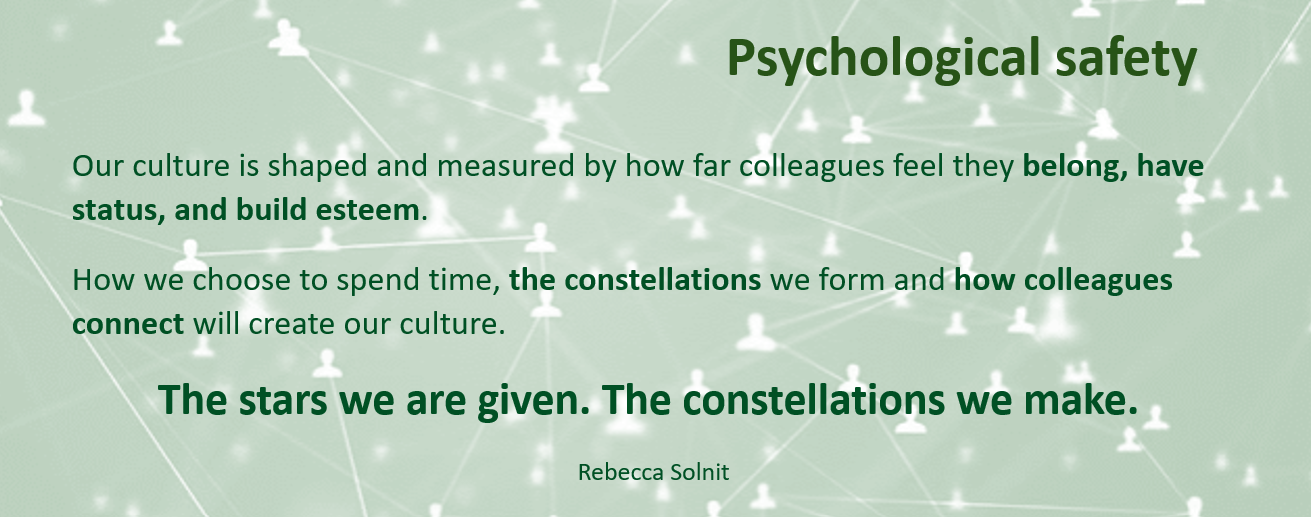
Our culture matters to us. It is built and shaped, in every interaction, everywhere, all the time and ever onward. Our cultural landscape is carved over time towards our shared purpose and is guided by deeply held lived values and shared rituals and routines. It is shaped and measured by how far colleagues feel they belong, have status, and build esteem. How we choose to spend time, the constellations we form and how colleagues connect will create our culture.

“The stars we are given. The constellations we make.” (Rebecca Solnit)
Making good decisions together

We make good decisions together. We seek and value expertise across our schools and the Trust as a whole. We are open and transparent as an organisation, making the best decisions we can, with the information we have, whilst seeking to do the right thing. We act without fear or favour.

First say yes. If a colleague feels the need to ask for support or resource, we should say yes, first, and work out how, later. Paying forward as an exercise in collective endeavour and shared responsibility.

The second mistake. It is rarely the case that the first mistake matters, it is often the second or third that turns mistake into problem. Because we make good decisions together, are open and transparent we share and resolve challenges at the first opportunity. Almost everything becomes easier when things are shared, it builds trust, and importantly avoids the second and third mistake.

A Human organisation, valuing relationships

We make time to listen, learn and build relationships. Being present. This is about ensuring colleagues are known as individuals, individuals with a unique story, a story that is heard. Understanding an individual’s story allows us to weave collective stories into the future; generating a greater sense of belonging. How we treat anyone, is how we treat everyone.

Humans are beautifully contagious

Use time well, seek simplicity

We will seek to use time well. Deliberately prioritising time towards the Main Thing(s). Logically sequencing our routines and networks and creating simple approaches that focus on making the greatest difference. We will work to reduce unnecessary burdens on individuals, to be as agile and nimble as is appropriate to our scale. As simple as possible, but not more so.

We will seek clarity because it is kind. Humans like rules, it is clarity that creates safety. We will share all data and information transparently to understand performance and drive improvement, part of our joint endeavour and collective responsibility for all children.

Primacy of Headteachers, the drivers of change

We understand the importance and primacy of Headteachers. The strongest Heads are great with people, understand provision and lead with purpose, prioritising and implementing key strategies and approaches, over time, to enable colleagues to change lives. They are open and able to utilise the capacity of the Trust, and to add into the strength of the Trust; a mutually beneficial symbiosis that adds value.

We are the sum of our decisions

Our effectiveness could be simplified as the sum of all decisions, by all colleagues, all the time, everywhere across our Trust that either accumulates value, or not. Our role as Trust Leaders is to influence, nudge, direct, enable better decisions to be made more often, to deliver a dividend. We will continue to dance between what we decide to do together and where we choose to empower colleagues to act.

Deliberately choosing where to standardise and where to empower colleagues

We will continue to standardise aspects of provision, to become more than the sum of our parts. Standardising, building things together, has tremendous power to liberate, support and give permission (and opportunity) for colleagues to focus on the Main Thing(s); creating a platform for colleagues. Our shared, common curriculum exemplifies the power of this collective endeavour.

Leadership is the art of giving people a platform for spreading ideas that work. (Seth Godin)

We will standardise and empower deliberately and strategically. Holding ideas in tension, informed by context, because context matters; it is not a compromise. Whilst recognising the importance of standardisation and of empowering colleagues on platforms, we will not seek to over dictate the complex areas of provision where experts and professionals make decisions, informed in the moment, in context, for their community.

“…under the conditions of true complexity – where unpredictability reigns – efforts to dictate every step from the centre will fail. People … require a seemingly contradictory mix of freedom and expectation.” (Atul Gawande)

We understand the influence we have on others

Back to the Future. Whilst Marty McFly travelled back in time and understood the future consequences of his actions, we are much less conscious of our influence on the future. Whilst we cannot foresee the future we can, together, create the conditions, sow the seeds, prepare the ground for humans to flourish and for more good than bad to happen. We, collectively create a crucible of serendipity where colleagues shape what is possible. Lives are shaped by opportunity. Our collective capacity can and will transform lives, evidenced in the smallest acts, every day.

“The smallest act in the most limited circumstances bears the seed of boundlessness, because one deed, and sometimes one word, suffices to change every constellation.” (Hannah Arendt)

We are collaborative by nature

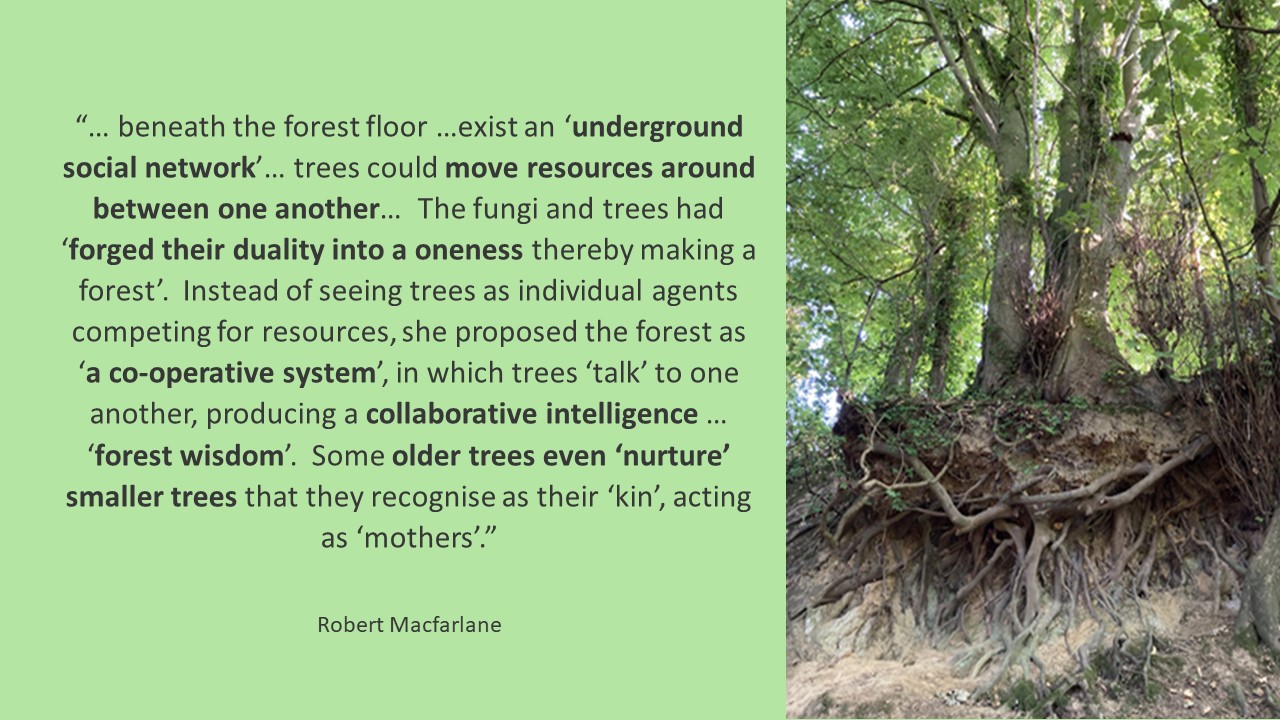
We will build on our existing collaborative architecture, our co-operative system, to connect colleagues with purpose and to each other, seeking collaborative advantage. Connecting colleagues within professional networks and subject/year communities, where hard and soft-wired collaboration secures collaborative intelligence and wisdom that becomes self-improving and irreversible. The biggest influence on colleagues is colleagues.
Getting today right and building for the future

Two speed. As we forge forward, we will build our future, based on where we have been, where we are, and toward what we seek. We will seek to get today right and the future right. We will seek change and improvement in months and years, concurrently.

What do we seek? We decide, next, together.


Into our future

So, based on the platform that you have built, we will work with humanity, humility and openness, to shape the future, together. So, at this time, as I join you as CEO, my optimism, hope and determination for what we will achieve is galvanised by the brilliant people in our Trust.

“When we build a culture of people who eagerly seek out and take responsibility, we build a culture that enables a special kind of resilient freedom.” (Seth Godin)

We have an opportunity to enable all colleagues across our Trust to collaborate, connect and feel empowered to make a difference. To work as one organisation, sharing responsibility, engaged in collective endeavour to secure greater social justice, particularly for our most vulnerable children, those that carry the most through life, and particularly at this time. A worthy cause.

“To be hopeful in bad times is not just foolishly romantic.” (Howard Zinn)


Postscript

There is no way to build high-performing organisations without a cultural model that drives the strategy. Or to put it differently, strategy without culture is just wishful thinking.


Dan Nicholls | July 2024

Disadvantaged children | think low attainment not low ability

ATT00031

“What if… we view disadvantaged children as low attaining and not as low ability, instil a deep and widely held belief in what is possible and then set eye-watering targets that underline our ambition to overcome the inertia of context.”

It is probably true that… Primary and Secondary schools need to do more to close the gap in attainment between disadvantaged and advantaged children; perhaps seeing it more as low attainment and not low ability or delayed progress and not that there is a limit to a child’s potential. We know that gaps appear early (ages 0-4) and widen through a child’s education. All of which has a deep impact on the child’s life chance and success that ultimately leads to generational cycles of poverty and disadvantage.

Which begs the question… what does it take to close these gaps and disrupt the loop of unequal opportunity and outcomes?

believe-in-kids


What if… education reinforces early advantage and accumulated advantage for advantaged students and inadvertently creates conditions where early attainment gaps widen?… do we disadvantage the disadvantaged?

Malcolm Gladwell identifies in Outliers that we often perpetuate early advantage. He exemplifies through the Canadian Ice Hockey League where those children selected at 4 and 5 years old, are generally the oldest and largest children; having their birthdays in Jan, Feb and March. These children enter the hockey Academies, experience great coaching, many hours of practise (largely deliberate in nature) and of course they thrive, out-strip their slightly younger peers and go on to be professionals. Not because they are more gifted or talented than those children born later in the year, but because they were a quarter to fifth older and larger than their peers when selected…what happened next just served to prove the selectors and scouts right.

“Autumn born students showed higher attainment and made more academic progress over KS3.” (DfE, 2012)

What if… as educators and teachers we are complicit in the widening of gaps and perpetuating the early advantage of students from advantaged backgrounds?

“Within the complex landscape of differential attainment, socio- economic disadvantage appears to be the most consistent predictor of attainment, particularly for children and young people from white ethnic groups.” (Ofsted)

What if… we recognise that low attaining disadvantaged children on entry to Primary and Secondary school are actually low attaining and not low ability. What if we are actually see “delayed progress” and not fixed ability or limit our belief in what disadvantaged children can achieve.

What if… there is a wide-held and embedded belief in the ability of all disadvantaged to achieve and attain – life enhancing qualifications and skills that will break the generational cycle of poverty? What if… we did not assume that this belief exists? The type of belief that enables and levers success for disadvantaged students needs to be to depth and has to live and breath in the organisation – it has to be felt and ubiquitous in all that happens.

What if… we build in greater ambition for disadvantaged students? At the start of secondary why do we not set low attaining disadvantaged children a full level of progress each year?

What if… we understand that this higher ambition and action seeks to close early gaps in literacy and numeracy for example – because these gaps disenfranchise children from their education and maintain the loop of poor outcomes, with each generation.

What if… we understood that disadvantaged students are prone to “self de-selection”. They are more likely to see an opportunity, chance or activity as not for them and de-select themselves. What if we had a policy of “meeting them there” – to ensure that disadvantaged children attend extra-curricular events and attend trips etc. … and to deliberately plan lift the cultural capital for each child.

What if… we understand that disadvantaged students are more likely to have an external locus of control and more likely to assume that their experiences and opportunities in life are determined by others and that they are not in control of their own destiny (internal locus of control). All of which links to the self-esteem and self-confidence that is more prevalent in advantaged households, where there is an assumed progression and a greater internal locus that expects individuals to take control of their future; making things happen.

What if… we understood that not all disadvantaged students are disadvantaged and that there are many advantaged students who are disadvantaged? Do we use our own understanding and soft intelligence to identify our actual disadvantaged cohort?

What if… we sense-checked our pupil premium spending to ensure that the strategies we are using are not in fact enabling advantaged students to flourish further,(obviously no bad thing) but that they targeted at enabling disadvantaged to close the gap and achieve. This can only be born out of a deep understanding of what being disadvantaged really means.

What if… we realise that pupils premium spending should be proportionate to the numbers of disadvantaged and that only by measuring impact can we truly understand what and how we close the attainment gaps?

What if… we gained a deeper understanding of what it means to be disadvantaged – not because we intend to mis-understand the complexity of socio-economic disadvantage by creating unhelpful generalisations, but so we can find a language, approaches, strategies and teaching that unlocks and reverses the disadvantaged inertia that slows/delays progress.

Key factors can include: worklessness, low parental education, lower ambition, less well informed choices, poor home study routines, poor diet, overcrowding, alcoholism, violence, chaotic homes, lower access to books, tables, further resources, reduced cultural capital, visits, newspapers, discussion, debate… (obviously these are generalisations – there are many disadvantaged backgrounds that support and provide conditions for children to thrive and achieve beyond that achieved in advantaged households.)

“Students’ academic attainment and progress are strongly influenced by the education level of their parents. Influence of Fathers’ qualification levels only half as strong as mothers. Positive parenting experiences, especially the early years Home Learning Environment (HLE) helps to promote better longer term outcomes.” (DfE, 2012)

By understanding context we can inform the quality of provision that enables all children to exploit their one chance.

Slide08

What if… we understood that gaps in attainment happen early ages 0-4 and that these gaps typically widen through Primary and Secondary education. “Success is what sociologist would call accumulative advantage.” (Gladwell, 2008)

“Overall, attainment gaps are present from the early stages of education and progressively worsen during transition and through each phase.” (Ofsted)

What if… we understood that these gaps widen because of the Matthew Effect: “it is those who are successful, in other words, who are most likely to be given the kinds of special opportunities that lead to further success.” (Gladwell, 2008)

Differences in academic attainment and social-behavioural development related to background emerged early (at age 3) and remained fairly stable to age 14. (DfE, 2012)

What if…  the quality of Nursery education is a key determining factor. It is not uncommon for gaps to be significant at Reception and that this often directly relates to whether the child has attended Nursery and then whether this is of good quality.

What if… we understood that the summer holiday break (in this instance in the US) has a greater impact on disadvantaged children than advantaged children exemplify the home-advantage of advantaged children…

“The wealthiest kids come back in September and their reading scores have jumped more than 15 points. The poorest kids come back from their holidays and their reading scores have dropped almost four points. Poor kids may out-learn rich kids during the school year. But during the summer, they fall far behind.” … “Virtually all of the advantage that wealthy students have over poor students is the result of differences in the way that privileged kids learn while they are not in school.” (Gladwell, Outliers, 2008)

What if… we took seriously our collective system leadership responsibility for supporting families and by extension all children to make strong progress between 0 and 4. Fully exploiting the potential offered by all-through Academies. This connects the dots and works to remove/improve damaging transitions.

What if… all leaders and teachers are leaders of learning? And that this is never divorced from an on-going and deep dialogue about how we best-teach and support all children to close gaps. Indeed we have a moral obligation as leaders to close these gaps, because only then do we enhance life chances, break the generational cycle of poverty and leave a legacy that we can be proud of.

“Disrupt the loop of unequal outcomes.” (Ofsted)

What if… targets for disadvantaged students were set to close gaps (not to maintain them)? Too often we set targets that simply maintain the gap (for example 4 levels progress for all). And in this moment we limit what is possible and set our ambition for disadvantaged students – we are confirming previous disadvantage – we are seeing disadvantaged students attainment as their potential and limiting our ambition for them. Disadvantaged students need the opposite of this … to be offered a deep belief in them and their ability and that with the appropriate provision delayed progress can be reversed – not least because we should see low attainment not ability and that progress is delayed not a reflection on the child’s ability or potential.

What if… we understand that quality first teaching is what matters for exploiting potential and enabling accelerated progress of disadvantaged students? Indeed quality teaching has a disproportionate impact on disadvantaged children (and in contrast to summer holiday progress, above)…

Slide17

…underlining that disadvantaged students make greater progress than advantaged students when they receive quality teaching – perhaps highlighting the appetite of disadvantaged children to learn, again reflecting delayed progress not innate ability.

“The effects of high-quality teaching are especially significant for pupils from disadvantaged backgrounds: over a school year, such pupils gain 1.5 years’ worth of learning with very effective teachers, compared with 0.5 years with poorly performing teachers … For poor pupils the difference between a good teacher and a bad teacher can result in a deficit of a whole year’s learning.” (Ofsted)

What if… we realised that where Academies only go as far as identifying disadvantaged students on seating plans (or similar) that this could be limiting potential of disadvantaged students; as teachers make unhelpful assumptions about the child’s potential and become content that this child is keeping pace (or slightly behind the progress of advantaged children!)? Quite the opposite is required; disadvantaged children need to outstrip the progress of advantaged children – targets need to reflect greater gains in progress.

What if… we enabled a continuous discussion and strategy-sharing between teachers and pastoral staff to identify strategies and approaches that specifically support disadvantaged children – and that these are made explicit and employed to support students to make accelerated progress.

What if… we recognised that it is the quality of feedback (built-in, not after the event – that is particularly important for disadvantaged children) and what is done with it as well as the quality of differentiation that has the strongest opportunity to accelerate the progress of disadvantaged students.

“To build a better world we need to replace the patchwork of lucky breaks and arbitrary advantages today that determine success–the fortunate birth dates and the happy accidents of history–with a society that provides opportunities for all.” (Malcolm Gladwell)

What if… we considered the language that we use in lessons and across the Academy when talking about children with low attainment or delayed progress? How often do we talk about ability as if it is fixed or imply that there are limits and ceilings for some children. How far do we employ a growth mindset approach and a language of effort and opportunity?

What if… we remember that effort and opportunity are the greatest determinant on success in almost every area of life? Dweck, Coyle and Gladwell provide compelling evidence that learning and progress is achieved through effort, deliberate practice and the development of myelin within the brain. Disadvantaged students are not wired differently or born less clever…all of which demonstrates that (almost) all gaps can be closed and rates of progress increased. (Accepting that extreme neglect in early childhood can create physical changes in the brain).

Perhaps all of this will help to disrupt the loop of unequal opportunity that hold disadvantaged children back; reversing the cycle of poverty.

“Children experiencing poverty face multiple disadvantages that often continue throughout their lives and all too often continue on to the next generation.” (Child Poverty Strategy 2014-17)


Maybe then…

  • There would be a deep and wide-held belief in the possibility of closing all gaps. That there is eye-watering ambition for all students.
  • We would not equate low attainment as low ability. Such that our targets should reflect an acknowledgement that this is delayed progress.
  • We would develop  a greater understanding of what it means to be disadvantaged.
  • We understand that the educational system actually reinforces and perpetuates gaps, because cultural capital and early advantage enables advantaged students flourish.
  • We use system leadership and connections to equalise access to early advantage when children are 0-4 and through Primary into Secondary.
  • We no longer set targets for disadvantaged that simply maintain or worse open gaps wider for disadvantaged students.
  • We would realise that we often put into place strategies and approaches (perhaps through pupil premium funding) that simply enable advantaged students to continue their “accumulated advantage.”
  • We continue to invest in quality first teaching (particularly feedback and differentiation) so that disadvantaged children are freed and supported to make progress.
  • We remind and promote that ability is not fixed and that through effort and deliberate practise everything is possible.

“Education and organisations should be judged by how well it supports its most vulnerable and disadvantaged to achieve and feel success.”

May 2015