The building of Trusts as Human Organisations offers the best opportunity to exploit the collaborative advantage created by deeply connecting colleagues and groups of schools. Human organisations are deliberately designed to be colleague-centred, relational, collaborative and generative. Aligning individual purpose with the collective mission, empowers colleagues to seek improvement.
Human organisations require deliberate ‘Trust’ leadership to orchestrate collaboration and to understand that Trusts are adaptive, living systems that with the right culture and architecture can trigger greater connection and value. This value is multiplied when peers connect with purpose to explore and exploit their collective imagination and expertise: alchemists creating magic. Too often the capacity and connection for improvement remains latent within Trusts.
“…magic should have a place in our lives – it is never too late to discover your inner alchemist.” Rory Sutherland
The following describes a human organisation—one that seeks a collaborative advantage so that groups of schools perform better than before and are more able to tackle the challenges of our time.
The power of purpose
Human organisations articulate why they exist. Leaders draw maps, set destinations, raise expectations and describe the desired future in technicolour. The narration of the journey and importance placed on it offers the cultural currency, the validation, the reward for collaborating toward the destination.
“Never doubt that a small group of thoughtful, committed citizens can change the world. Indeed, it is the only thing that ever has.” Margaret Mead
A shared quest, in something worthwhile, something meaningful, something that lights a fire, and something anchored in why we exist, creates a generative shared desire and motivation. It sustains and directs energy across the organisation, toward that which is worthy.
Built on relationships3
Human organisations are driven by an unswerving investment in relationships, to secure motivation and to connect peers with purpose, to seek our moral ambition.
“Leadership is communicating to colleagues their worth and potential so clearly that they are inspired to see it in themselves.” Stephen Covey
In human organisations colleagues need to feel the purpose, have enough empowerment and autonomy to seek mastery. It is this investment in colleagues as social beings that taps our deeply engrained tribalist desire, to belong and do meaningful things.
“The relationships we build with each other provide the foundations of change. We are social beings who thrive on connections.” Sir Hamid Patel
The investment in relationships directed toward the purpose is the life blood of human organisations where success is the sum of all decisions made, by all colleagues, every second, of everyday, everywhere in the Trust.
Hard wiring
Human organisations hard wire, design and develop networks and communities as fundamental to their being: seeking connectivity and conductivity. It is not just an exercise in bringing colleagues together, networks must create enough conductivity to shift behaviour and actions intelligently toward the purpose and higher standards.
The architecture and design of networks is very deliberate and requires colleagues to be open, critical and ego-less in the deliberate search for better.
Soft Wiring
“The stars we are given. The constellations we (and they) make.” Rebecca Solnit
Human organisations encourage, permit and expect colleagues to collaborate beyond the set piece networks; connecting in informal, organic and dynamic groups of colleagues motivated to share and solve, in service to the mission. This collaboration propagates value, horizontally and organically across the organisation, adding up to more than the sum of the parts and becoming self-improving.
“…forests are complex adaptive systems, comprised of many species that adjust and learn, …and these parts interact in intricate dynamic networks, with information feedback and self-organisation. System-level properties emerge from this that add up to more than the sum of the parts.” Suzanne Simard
Building a platform
Human organisations invest in platforms of shared approaches for colleagues to collaborate on. This liberates colleagues to add value and seek greater impact by getting much better at the same. Playing in one field, free to innovate and add value based on a foundation, rather than playing in the woods or on the hill or in the fields: where a thousand flowers fail to add value.
This is an intelligent dance, that balances standardised and empowered approaches, and connects colleagues to embed and improve both. For Trusts what should be standardised or empowered is largely objective not subjective, driven by the difference between complicated or complex. The dividend is derived from investing in both.
Empowerment
Standardised approaches liberate rather than stifle schools and enables attention on the quality of education. On this platform, empowerment, sensitive to context generates local ownership and accountability for improvement. Colleagues empowered on the platform to collaborate with colleagues, aligned to the purpose, toward the destination, to drive local improvement is the engine room of self-improvement.
Trusts of parallel ecosystems
Each school is an ecosystem within the wider Trust ecosystem. In their part they run ‘experiments’ in parallel with other schools, with roughly the same resources, on a platform of shared approaches and seeking the same goals (helpful controls). With greater horizontal collaboration between trust leaders and colleagues the conditions exist to compare, contrast, iterate, develop and learn what it takes to add value.
“A golden age is associated with a culture of optimism, which encourages people to explore new knowledge, experiment with new methods and technologies, and exchange the results with others.” Johan Norberg
Seeking improvement requires the transparent sharing of all performance data. A self-improving system requires open access to all performance information to identify the conditions and approaches that secure strong performance.
Alchemy and alloys
Within the ecosystem (a large enough ecosystem) there is the best of everything. With enough connectivity, alchemy, alloying and forging, magic is possible. This is the intelligent melding of contextually sensitive approaches, enhancing a theory of action that is deliberately implemented. This expects heads and colleagues to intelligently exploit the resource in the trust, implementing for impact, and not to blindly stagger from one initiative to another.
“The mythical “butterfly effect” does exist, but we don’t spend enough time butterfly hunting.” Rory Sutherland
Imitation + adaptation
Leaders as alchemists, seek to alloy new approaches and strategies, by iteration, combination and adaptation, to spark greater impact. Deeply connected, open, collaborative cultures can learn from each other and interrogate new ways, ideas and methods to imitate and adapt: utilising the wisdom of the forest in their part of the ecosystem.
“The basic raw materials are a wide variety of ideas and methods to learn from and to combine in new ways.” Johan Norberg
Crowdsourcing
Human organisations create the opportunity and expectation for leaders to crowdsource solutions, tapping into the expertise and approaches of others across the ecosystem: setting out challenges for others to solve. Within a culture of openness, shared responsibility and because we are playing the same game, the ability to crowdsource improvement is the advantage of connected, human organisations.
Self-improving (eco)system
Taken together this forms a blueprint for a human organisation that is purpose driven, relational, generative and seeking value, together. Leaders and colleagues formally and informally networked, often horizontally, engaged in the business of improvement, fuelled by collaborative intelligence and forest wisdom: propagating a high performing ecosystem.
“… beneath the forest floor …exist an ‘underground social network’… trees could move resources around between one another… ‘a co-operative system’, in which trees ‘talk’ to one another, producing a collaborative intelligence … ‘forest wisdom’.” Robert Macfarlane
So, seek greater connectivity to empower and permit colleagues to be alchemists, to collaborate, generate greater value and perhaps create a little magic.
Strong Trusts seek collaborative advantage by building an organisational structure and curating a culture that connects colleagues in shared endeavour. In these Trusts colleagues are empowered, on standardised platforms, to take collective responsibility for approaches and artefacts that enable connected schools to add value and secure a Trust dividend that sustains beyond their time. Trusts seek school improvement by making deliberate bets, laid as investments, that improve the life chances of all children, particularly those who are under-resourced. And in these dark times, it has never been more important for Trusts to seek greater equity through education, to be long-sighted and to invest in the future by planting trees, deeply rooted in their communities; the shade from which they may never benefit.
“…leaders doing less but understanding more… can free themselves to focus on the future – which is, after all, the proper territory of leadership.” (Tracey Camilleri, et al.)
Where Trusts choose to play and how they focus on the future, matters…
Defined by the decisions we make | Choosing where to play
Whilst we might assume that there are many ways to run a Trust, there are surprisingly few. And it is ‘few’ because all Trusts are in the business of school improvement, held in a highly regulated system and seeking to improve the life chances of all children. There is a reassuring alignment between the challenges and opportunities that Trusts engage with to add value, moderated, a little, by maturity, scale and capacity. Where Trusts choose to play and how well this is enacted largely determines the success of a Trust.
As Trusts grow, merge, mature and forge identities, their effectiveness could be simplified as the sum of all decisions made, by all colleagues, every second, of everyday, everywhere in a Trust that accumulates a dividend, or not. The role of Trust leaders is to influence, nudge, (direct), enable better decisions to be made more often, over time, the sum of which delivers the dividend. How Trusts influence this decision making, is a dance between what it decides to do together and where it decides to empower colleagues to act. An intelligent dance, that balances standardised and empowered approaches, and connects colleagues together seeking a collaborative advantage.
Seeking collaborative advantage | Who’s on first base?
Trust (and school) leaders “…are all playing Moneyball, all the time” (Seth Godin). Seeking the organisational design and strategy that will make a discernible difference and hold schools in a higher and more consistent performance space. For Bill James and the Oakland As it was: “…putting players on base at a higher rate, leads to more runs, which therefore, translates to more wins.” For Trusts, perhaps it is:
“…putting colleagues together (with purpose) at a higher rate, leads to more value, which therefore, translates to a greater dividend.”
Creating the architecture for colleagues to deliberately collaborate creates the conditions for a collaborative advantage. Connecting colleagues within professional networks and subject communities, empowers peers to co-construct and co-design beliefs, attitudes, approaches and artefacts that drive the dividend, for the long term. Strong Trusts understand the need to build antifragile organisations where the hard-wired (and soft wired) collaborative architecture strengthens under stress, secures wide ownership for improvement, is self-improving and irreversible. Effective collaboration is hard to create, what it is and what it isn’t and how it is designed, entirely determines the benefit felt. The biggest influence on teachers is teachers.
“System leaders focus on creating the conditions that can produce change and that can eventually cause change to be self-sustaining.” (Senge et al.)
The cultural landscape and fabric of the Trust
It is hard to under-state the importance of culture in organisations. The deliberate design of the cultural landscape and the strength of the cultural fabric are necessary pre-requisites for the sustained success of any organisation; built ever onward.
Colleagues need a contradictory mix of being part of something bigger (the cultural landscape), and to see themselves in the organisation (part of the cultural fabric), to have what they need and to be a unique part of the pattern.
The cultural landscape of a Trust is shaped and carved over time towards the shared purpose, the mission of the Trust and is guided by deeply held (lived) values and enacted in shared rituals and routines. Walking and working in the cultural landscape reveal the values and character of the Trust; it determines and secures belonging, status, and esteem of colleagues, or not. How Trusts choose to spend time and how colleagues connect is a window into the soul of the organisation.
“The stars we are given. The constellations we make.” (Rebecca Solnit)
The strongest cultural landscapes are organised around the reason for existence. These Trusts clearly articulate the mission and the purpose of the Trust, which is held across the landscape by the North Star, guiding and moulding the norms and behaviours. Lit by this star the cultural fabric weaves colleagues together towards the mission, to do good and make a difference.
“If everything is important, then nothing is… When you know your reason for existence, it should affect the decisions you make.” (Lencioni)
The strongest cultural fabrics are held together by a shared language, vocabulary, norms, behaviours, attitudes, artefacts, standards, conversations, ideas… it holds colleagues, offering the psychological safety to bring their best selves. The fabric is deliberately, consciously and systematically woven in every action and conversation. It is the cultural landscape and fabric of a Trust, that sets the stage and the conditions for colleagues to do important work.
“When we build a culture of people who eagerly seek out and take responsibility, we build a culture that enables a special kind of resilient freedom.” (Seth Godin)
In strong Trusts, culture is deeply linked to where it has been (true to founding) and where it is going (ambition for all) and its journey (the everyday culture). It is (un)surprisingly well designed and felt everywhere, from all colleagues; how we treat anyone, is how we treat everyone. One of those things that takes years to build and seconds to destroy. The culture and colleagues drive the dividend.
Trust Mindedness | school is trust, trust is school. Priming the landscape.
Strong Trusts seed and cultivate the landscape, to reward Trust mindedness, intrinsically so. A priming of culture that is conducive to collaboration, to understanding that all leaders, all colleagues are responsible for all children in the Trust. It is about creating an internal market where the stock price of schools, leaders and colleagues rises with altruism, collaboration, professional generosity, contributing to the shared artefacts, routines and rituals that live out the Trust values, towards the mission and secures the dividend.
This is a Trust-wide mindset, within the cultural landscape and fabric that primes, promotes and rewards relationships and behaviours that fuel and sustain the School Improvement Model. It is the deep collaborative motivation that lives in the Trust, to depth, that encourages better decisions more often, so that the Trust is more than the sum of the parts. Under these conditions Trust leadership is increasingly about guardianship and stewardship.
The primacy of Principals | The lead actors in mature (and immature Trusts)
Strong Trusts recognise the primacy of Principals. Schools are significantly influenced by the quality of the headteacher (and teams they lead). If the culture and choices made by a Trust largely determines the potency and effectiveness, then the Headteachers are the key actors in school improvement. The effectiveness of the Headteacher is largely the determining factor in the quality of provision, influenced by the Trust, of course, but perhaps not as much as we would like to think.
The strongest Principals are great with people, understand provision and lead with purpose, prioritising and implementing key strategies and approaches, over time to drive the effectiveness (and efficiency) of the school. Importantly they are open and able to utilise the resource and strength of the Trust; a symbiosis that adds value, and increasingly so. Strong Trusts invest deeply in Headteachers, designing curriculum, professional learning, opportunities, connectivity, collaboration and the conditions for Heads to lead well.
Exploit the complicated | Standardised Provision
Perhaps the biggest advantage afforded to Trusts is the ability to standardise aspects of provision to secure school improvement and greater consistency in provision. Despite some negative connotations or overly simplistic views of “standardisation,” it has tremendous power to liberate, support and give permission (and opportunity) for colleagues to focus on the Main Thing(s). The creation of standardised approaches, strategies and artefacts builds a platform for colleagues, to focus on meeting need, without the distraction of re-designing areas of provision that just need to happen reliably and consistently.
“Leadership is the art of giving people a platform for spreading ideas that work.” (Seth Godin)
Strong Trusts intentionally and deliberately standardise ‘complicated’ areas of provision: Complicated areas act largely the same way each time. These areas can often helpfully be reduced to a checklist; if this, then do that. Trusts should play in these areas and standardise as there is limited need for local decision making or creativity and, importantly, this offers the opportunity for a Trust to improve provision for all learners (and colleagues). Co-creating and co-designing shared curriculum and assessment are particularly potent areas for the dividend.
Empower and guide the complex | Empowered Provision
Areas that are largely complex should be empowered to schools and colleagues. Complex areas respond differently each time and are typically influenced by the unpredictability of human action and interaction, requiring in the moment decision making. In complex areas of provision, we need to push decisions closer to the action where quality and outcomes are linked to the situation as it emerges, contextually influenced.
There are areas of provision in each academy that is better owned and empowered locally, they are largely complex, influenced by context and improved by local decision making. Of course, it is desirable to standardise aspects of these largely complex areas in academies to (fractally) create the standardised platform for colleagues in academies.
Don’t overcook | Just because you could, does not mean you should.
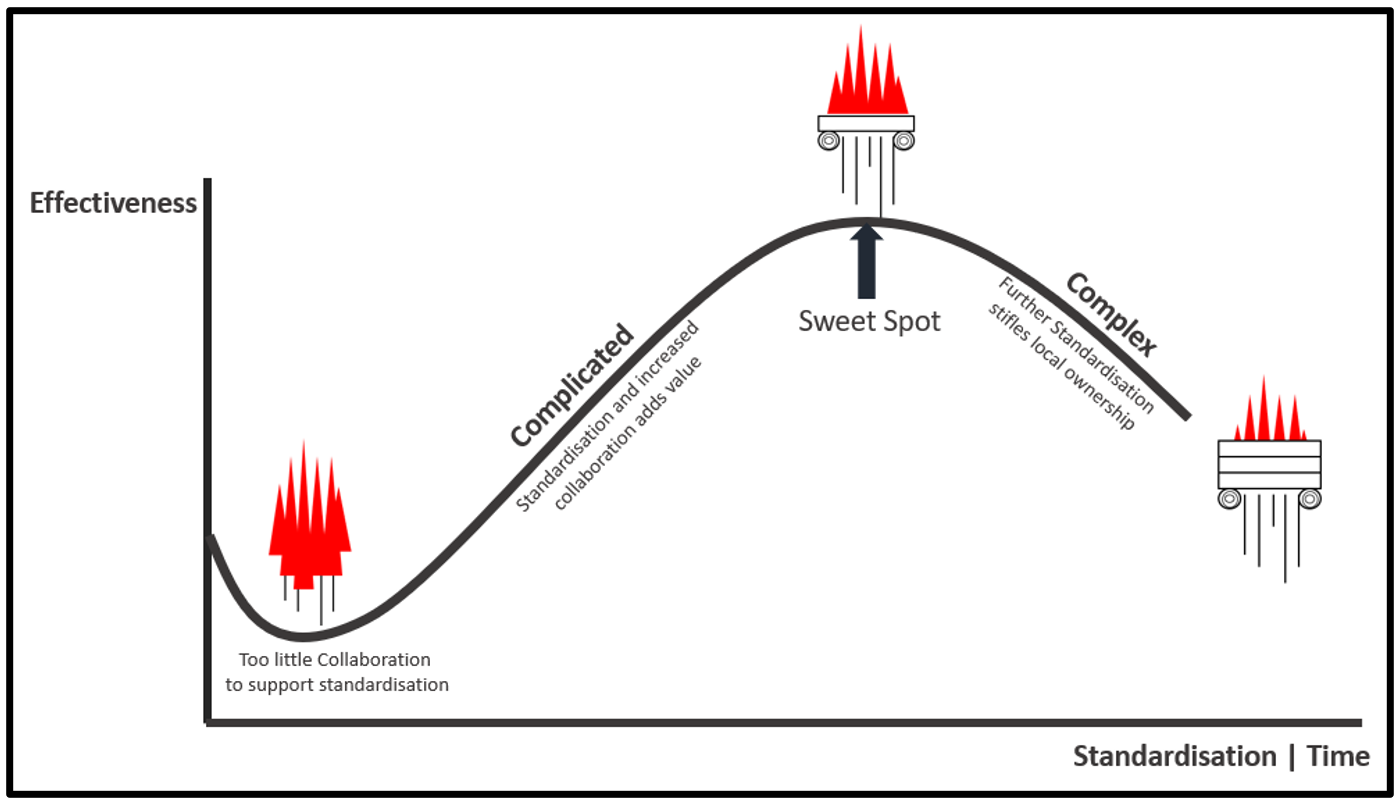
Standardise too far, and you remove the local decision making, professionalism and agency of colleagues to make good decisions, commensurate and appropriate to a profession, and being a professional. This is the crux of effective Trust leadership, the dance between the complicated and complex, to standardise and to empower deliberately and purposefully. Held in tension, strong Trusts create routines, standardise areas of provision to support colleagues, but do not seek to over dictate the complex areas of provision where local decision making, near to the action, informed in the moment, adds the value and creates the sustainable behaviours that secures a self-improving organisation, beyond our time.
Holding ideas in tension is not a compromise
Trusts should not use their power to standardise without bound, there are limits to the effectiveness of standardisation when it steps over and on individual agency and professionalism.
“…under the conditions of true complexity – where unpredictability reigns – efforts to dictate every step from the centre will fail. People … require a seemingly contradictory mix of freedom and expectation.” (Atul Gawande)
Measure what matters, transparently and in the interest of school improvement
Strong Trusts measure what matters and by doing so indicate what they care about. This is the transparent democratisation of data to all colleagues to enable a focus on learning and evaluation of provision, to depth. This reveals standards, informs school improvement and highlights high (and low) performance as well as expertise across the Trust.
Trust leaders are guardians of standards, creating an insurance policy that holds and secures improvement for all children and schools in the Trust. A risk-led approach enables an agile and timely distortion of resource, school improvement capacity and expertise to ensure that all children, areas of provision and academies are supported to improve and level-up in a timescale that is quicker than the local resource capability. School is Trust, Trust is school; all colleagues responsible for all children.
Whether Trusts become more than the sum of their parts and add a dividend for all children, families and communities is determined by the choices that they make and where they choose to play. Strong Trusts craft cultural landscapes and empower colleagues within a cultural fabric, on a standardised platform, to connect across the Trust to realise a collaborative advantage.
“The role of the leader is to enable, facilitate, and cause peers to interact in a focused manner…but still only a minority of systems employ the power of collective capacity.” (Fullan)
Strong Trusts build the conditions where the collective capacity is focused on addressing the steep challenges of our time and where the collaborative advantage drives a dividend that secures greater equity through education.
…But, Trusts are not alone in the landscape, despite pressures that promote isolationism and competition, all parts of the sector are joined in a quest to build a better system. A system that will only meet the growing needs of all children when there is greater collaboration, stewardship, generosity and collective responsibility. We should seek together a sector that exploits a collective collaborative advantage for the good of all children.
All Trusts working together for all children
Dan Nicholls | February 2024
The thinking presented here is based on the work, experience and thinking of colleagues across Cabot Learning Federation.
“Everyone participates in the social contract every day, and we rarely stop to think about it. Yet social contracts shape every aspect of our lives, including how we raise our children and engage in education.” (Minouche Shafik)
We live in difficult and darkening times. The growing gloom is becoming oppressive, encouraging retreat and reducing belonging. The social contract that shapes and guides every aspect of our lives is fracturing. For far too many children and families this is fundamentally altering their relationship with society, authority, and how we value and engage in education.
The “social contract” is a theoretical agreement between individuals and society wherein people relinquish certain freedoms and abide by agreed-upon rules and norms in exchange for social order and mutual benefits.
These are dark ages, characterised by challenging economics and social inequity, that are presenting both a psychological and material challenge. This is infecting and altering the narratives we tell ourselves and each other about what is important and what our contributions to society should be.
“We all … listen for an account of who we are and where we stand.” (George Monbiot)
Increasing numbers of children and adults are opting out from a world that finds multiple ways of challenging their sense of self, place, and agency. Whilst for some the light is not fading, for too many others, often the most vulnerable, the gloom is encouraging retreat from the agreed contract. Schools are at the heart of the maelstrom, open, available, and trusted enough for some families to fight against, because few others are listening, available or there. Schools stretch and respond to the needs that walk into school every day, attempting to fulfil their duty of care, often without the resource or expertise.
For increasing numbers of pupils and families, school is seen as optional, far from being irresistible or a place of opportunity. The prevailing narrative is replacing long held norms around the value of education, driven by a weakening social contract and the entrenched inequities in society. The disadvantage gap, on any measure, is wide and widening, embarrassingly so. Fundamentally, the social contract is built on trust– when the returns from society diminish or disappear, or where we become increasingly priced out of life, we see the contract weakening and the trust we hold erodes.
“Trusting others puts us in an inherently vulnerable position… the proof of the importance of trust is the intense emotional pain that accompanies it being broken.” (Owen Eastwood)
We need a revised and reinforced social contract that seeks greater cohesion, strengthens belonging and places education at the heart of this nation. This needs to secure far greater equity through education and a much stronger architecture of opportunity. An architecture enacted by stronger trust and system leadership, greater connectivity and purposeful collaboration between trusts and schools so that we take collective responsibility and stewardship for our sector. All Trusts working together for all children.
“It is only through building a connected system that we will be able to address the multiple challenges facing our communities” (Leora Cruddas)
Building the effectiveness of our trust, civic and system leadership to build an education system that is able to address the multiple challenges, redistribute esteem and enable many more children to live lives of decency and dignity.
“…we need a redistribution of esteem… to live lives of decency and dignity, winning social esteem. …(to) travel the road to 2045 with purpose, dignity and accomplishment.” (Peter Hennessy)
Seeking together to build strong trusts with great schools that meet need. Enabling more children and families to belong and benefit from a renewed social contract, gaining a greater sense of agency in their lives and contributing towards the common good.
“Agency gives us control over our time, and it encourages us to choose what our contribution looks like.” (Seth Godin)
In the eye of the storm
The lines between school and society have blurred. Schools are trying to respond to the fracturing of the social contract. Where deprivation bites and societal problems leak into schools, colleagues can become overwhelmed. They take increasing amounts of time to support, resolve, and cope with difficult and widening societal issues of children and families, obligated to fulfil their deeply held duty of care for the communities they serve.
The present level of attendance, suspensions and disenfranchisement, particularly of those presently disadvantaged, is a national crisis – a social epidemic. As the narrative falters, individuals are making pragmatic decisions around survival and choosing to opt out, to not conform, to challenge authority, avoid commitment and to escape the perceived risk of failing in class.
If life is a game, too many are deciding not to play.
Fracturing built on entrenched inequity
It is not that the social contract has suddenly fractured, it has been creaking over time and is evident in the inequalities that characterise our society. Just as there are triggers for climate change, where it becomes irreversible and the impact is catastrophic, the same is true of the social contract. Multiple factors have triggered descent to this crisis point with our social contract.
Strong Trusts, Great Schools, Meeting Need | An architecture of opportunity
“There is no trust more sacred than the one the world holds with children.” (Kofi Annan)
The present architecture of opportunity in our sector, exists within a developing Trust landscape. It is timely, urgent and imperative for Trusts and groups of schools to work together within stronger collaborative structures to build strong trusts capable of supporting more great schoolsthat are well placed to meet need. The sector should grasp the opportunity to create a stronger architecture of opportunity that addresses the societal challenges and particularly the widening disadvantage gap. Trusts and schools need to work much more collaboratively to realise the promise of academisation and to secure greater equity through education.
We are the system
The development of great schools across the sector that enable all children to lead full, flourishing lives is at that heart of the renewal we seek.
“We need a broader and more ambitious vision of what a good life is. Human flourishing and dignity for all, requires us to have a wide set of success measures. Placing greater value on things such as contribution, difference, common values, and the process of learning and work itself.” (Ben Newmark, Tom Rees)
The collaborative structures we need to build within and across the sector are required to secure a greater dividend, one that rises the tide for all children. Schools need to grow good humans through strong culture and inspire young minds through great teaching held within a progressive, sequenced curriculum that liberates agency and meets the needs of children now and for their future. This requires us to develop leaders(hip) that understands how to improve schools within the collaborative structure of Trusts, accelerated by Trusts working closer together. This will demand a move from silos to deliberate collaboration, so that we, together, take greater collective stewardship of our sector.
The deficit narrative in society is reflected within our sector and in our schools. It is no accident that the current recruitment and retention challenges, the catastrophic decline in ITT applications and weakening working conditions are linked to the deficit narrative around schools and the value that our nation places on education. It is not that there isn’t an appetite to meet and reverse the challenges of the failing social contract, it is that it feels progressively more futile given the available funding, resourcing, staffing, and expertise that is required to meet the ever-increasing demand.
Stewardship and Longtermism
The investment in education needs to be long-term and it requires a commitment over generational timescales that inconveniently span timescales longer than political terms of office. We are prone to shortermism and this struggles to keep up with the complex needs of a growing number of children and families.
“We should shift our energies upstream: personally, organisationally, nationally and globally. We can, and should, stop dealing with the symptoms of problems, again and again, and start fixing them.” (Dan Heath)
This is urgent; it is not just about now, it is fundamentally about the future and the future health of our society and the standing, place and importance of education. Great schools are the hope, and increasingly the only hope, but they are exposed and creaking under the weight of the failing social contract. Schools and Trusts need to consider deeply their role in society and the educational offer that will better meet the needs of all children, now and into their adulthood.
The weather is oppressive
The prevailing climate is increasingly oppressive and characterised by profound uncertainty.
“How to live in a world where profound uncertainty is not a bug, but a feature?” (Yuval Noah Harari)
Our response to this uncertainty and the challenges of our time has influenced the national psyche and altered our narratives. So much has shifted in our lived experience…
The global pandemic, Brexit, standards in public life (Nolan Principles), high inflation, high interest rates, energy costs, mortgage rates, loan rates, cost of living, AI, inaccessible first homes, decline in living standards, shifting employment types and longevity, climate change, political turmoil, social media, conflicts across the world (including Europe), long waiting lists, funding crisis, erosion of local services and multi-agency services, mental health challenges, public service strikes, recruitment, retention…
… disconcerting, oppressive, challenging; encouraging retreat and a deafening backdrop to life.
All of which play out unevenly across society. Except that, this is not true for everyone. These oppressive conditions tend to maintain the status quo for those who have means and power.
The shifting locus of control; retreating from the noise
“Nations and peoples are largely the stories they feed themselves.” Ben Okri
Our society has always been divided into those who have and those who have not. Typically, the most disadvantaged in society have an external locus of control, one that encourages retreat, and one that negates a sense of agency. The current challenges are pushing more children into believing and acting as if they have an external locus of control. When this happens, they look to the contract that is meant to hold them, meant to say to them that they belong, and they pragmatically choose retreat and make decisions about their contribution to society; becoming more invisible.
Ubuntu: “I am a person through other people; my humanity is tied to yours.” (Zulu proverb)
We must reinforce, redesign and improve the social contract. It is fractured and faltering. We must not stand-by and in doing so collude with this erosion. We need a society and an education system that builds back the social contract for the common good and creates an architecture of opportunity, so that more are invited to dance.
Architecture of Opportunity | an invitation to dance
1. We need to renew the invitation to dance, so that individuals contribute and benefit from the social contract. We need a new national and educational narrative around schools that places education at the heart of social renewal. This should seek to create a greater sense of belonging, status and esteem, a more just society and communities where children and families flourish.
“Those who imagine the ground beneath their feet is solid are probably managing the present, not leading into the future.” (Tracey Camilleri, et al.)
2. We are the system. As educators we have an opportunity and responsibility to make a difference, to tell a stronger narrative and to influence the national position of education. We need to review the present paradigm and ensure that we are keeping our side of the contract. We need to ensure that Trusts and schools develop organisational leadership to build a sector that rises the tide. Strong Trusts with Great Schools that Meet Need.
“You cannot take away someone’s story without giving them a new one. Whether the systems that emerge from this rupture are better or worse than the current dispensation depends on our ability to tell a new story.” (George Monbiot)
3. We need to invest more in education; an investment that yields a long-term dividend to our society and nation. The pay off will not just boost the economy, but it will improve well-being, mental health, community cohesion and deliver social justice. This investment will support schools to fulfil their duty of care and create an architecture of opportunity where the power of education will secure greater equity. Not for us, for them.
4. We need to take a longer-term view on the role of education in society, as the moral priority of our time. Taking greater stewardship of the future, building collaborative structures where all educationalist can share responsibility for all children. It is what we owe their future.
“Longtermism is about taking seriously just how big the future could be and how high the stakes are in shaping it. We need to act wisely.” (William Macaskill)
5. We need to invest more in the first 1001 days from conception and in readying children for school. This lights the fire, sets the stage and reinforces, at the earliest possible moment, that education and investing in human potential is part of the fabric of our social contract. This includes educating and influencing parenting and the nations understanding of key developmental stages. We need to follow through on that investment into early years to give the best possible start in life, to secure the importance of school, where children belong and where we genuinely work upstream to prevent downstream problems.
“We have the opportunity to help people become significant… build a culture of affiliation and status.” (Seth Godin)
6. We need more great schools that meet the needs of all children. Schools that secure strong culture and great teaching to build great humans and bestow the very best curriculum, for our children in these times. Trusts need to work together to develop system leadership and purposeful collaboration that accelerates our impact on the everyday experience of every child. So that together we realise and enhance the collective Trust Dividend on children and society. We should seek to secure greater attainment mobility, to close gaps for those presently disadvantaged, and meet the needs of those with SEND.
“There should be a national strategy to close the attainment gaps that have opened since the pandemic. Addressing these gaps should be a national priority, with a long-term plan in place, based on evidence.” (Sutton Trust)
7. We need to urgently address the attendance crisis in this country. Seeking to tackle the entrenched challenges of our time, to strengthen our narrative around the importance of education and build back the social contract. Improving attendance is urgent; the damage and implications for this generation will play out across society and over decades.
“Culture can change. And it is schools and school systems that have the power to change it.” (Lucy Crehan)
8. We need to invest in ‘place’, work in strong partnerships and fulfil our civic responsibilities. We need Trusts and schools to collaborate and develop civic leadership to takegreater stewardship for the places that we educate. Without these collaborative structures in place, we will not create the architecture of opportunity and the multi-agency working required to serve the communities where children grow up.
“Civic leadership is about the protection and promotion of public values and addressing issues of place …creat(ing) the conditions for collective impact by addressing complex issues affecting children … that require different actors to work together.” (Leora Cruddas)
9. We need to invest in wider services, and find ways to effectively work in closer partnerships with others, including social care that sit in and around schools – renewing and reinforcing the broken contract, as an expression of care and duty. Taking greater opportunity to understand and meet the needs of all children and adults. Funding and supporting schools to realise their civic duty, with enough resource and expertise to meet demand and fulfil our duty of care.
10. We need to be clear on where the boundaries of the social contract sit between schools and society. This clarity is required to understand where responsibilities sit and to reduce the flow of societal issues into schools. We need to either rebuild the agencies, services and expertise in our communities or significantly invest in schools as community hubs to meet the needs of society.
Through joint enterprise and shared responsibility we can build a society and an education system that renews the social contract for the common good and create an architecture of opportunity so that more are invited to dance.
“It is a matter of shared purpose and sustained application.” (Peter Hennessy)
Strong Trusts build collaborative structures and platforms for great schools to create more value for all children, over time. This trust dividend enables groups of schools to achieve more than the sum of their parts, and more than before. Strong Trusts are values-led, purpose-driven, learning organisations who establish the conditions for colleagues to create collaborative intelligence that becomes trust wisdom that strengthens great schools.
“Instead of seeing trees (schools) as individual agents competing for resources, she proposed the forest as ‘a co-operative system’, in which trees ‘talk’ to one another, producing a collaborative intelligence she described as ‘forest (trust) wisdom’. Some older trees even ‘nurture’ smaller trees.” (Robert Macfarlane)
There is now enough maturity in our system to identify how strong Trusts create enough value to sustain groups of great schools; school is Trust, Trust is school. Deepening this understanding will enable educators to take greater stewardship of the sector and build strong Trusts that work together for all children. The following identifies five functions of a strong Trust that, taken together, create a trust dividend that supports, empowers and sustains great schools.
The five functions of a strong Trust | in brief
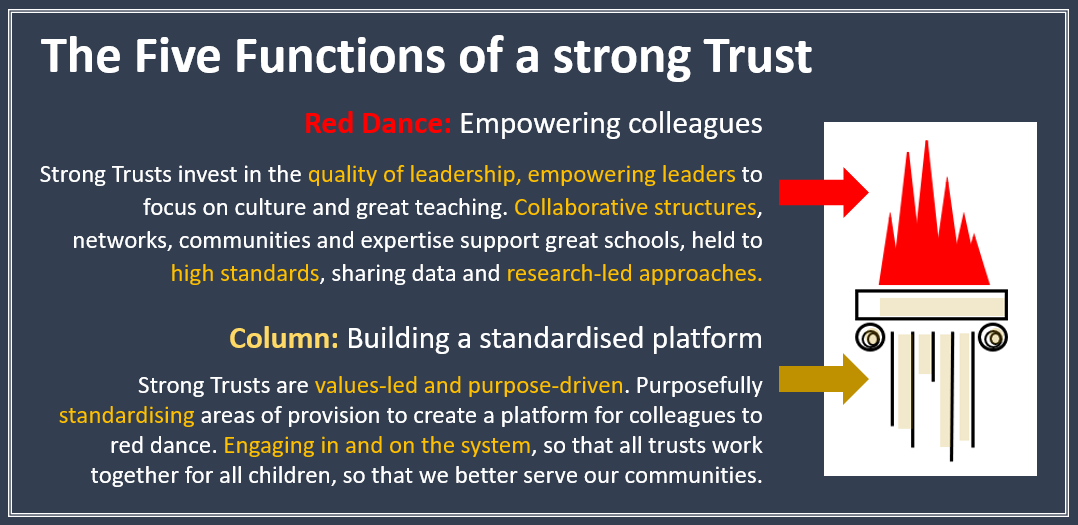
One: Strong Trusts are values-led and purpose-driven, they understand why they exist, live out their values, achieve their purpose, tell stories of the future, create coherence and clarity to establish a climate where colleagues belong to something bigger and are empowered to add value.
Two: Strong Trusts standardise areas of provision that build platforms for colleagues to stand on and exploit, areas that are high dividend and rise the tide, particularly a shared curriculum, shared assessment and wider professional services. These are significant investments in high dividend areas, over time, that add future value.
Three: Strong Trusts invest in leadership, particularly of headteachers, so that there is a deep investment in relationships, setting direction and implementation within schools. Leadership that builds and sustains a strong culture and great teaching, hallmarks of great schools and areas that are largely empowered to and owned by schools.
Four: Strong Trusts create collaborative structures, an architecture enabling colleagues to collaborate across the Trust in networks and communities, creating, designing, developing and aligning approaches that add value. Trusts are risk-informed, distorting resource and expertise to tackle underperformance.
Five: Strong Trusts maintain high standards creating the conditions for healthy competition, great schools joined in the shared endeavour of raising standards, transparently using trust-wide data, building shared intelligence and using research-led approaches to inform implementation and school improvement.
+One: Strong Trusts act within and on the system, working together with other Trusts, to create a collective dividend and take responsibility for the education system, serving communities as anchor institutions and working with other civic partners to support all children.
The Five Functions of a Strong Trust, the next level of detail
One: Values-led, purpose-driven | building culture and belonging
Strong Trusts know and understand why they exist. They have a set of compelling values and clarity of purpose that galvanises colleagues into shared endeavour and collective responsibility. This clarity aligns colleagues, informs the strategic investments and paints a compelling future, that guides the big and small decisions made across the Trust by all colleagues every day. It is in these actions, over time, and not in the written words, that culture emerges.
“…understanding the “cultural magic” that makes an organisation feel truly human, and creates a sense of connection and belonging.” (Tracey Camilleri, et al.)
Without this clarity of purpose, colleagues struggle to place themselves and their work within the Trust. Strong Trusts create a sense of belonging, give status and build esteem, because the rules of the game are clear, colleagues understand the journey and are empowered to add value. This is a significant investment in people, actively building well-being to create psychologically safe, high trust, heart felt collegiality that holds people in the Trust.
“To feel a sense of belonging is to feel accepted, to feel seen and to feel included by a group of people… to not feel belonging is to experience the precarious and insecure sense of an outsider.”(Owen Eastwood, 2021)
Strong Trusts bring coherence and clarity on how we do things here, what is standardised, empowered, the routines and collaborative structures that secure school improvement at scale. Deepening understanding of the Trust’s Theory of Action empowers colleagues to build great schools on the platform of the Trust.
Two: Standardisation | creating a platform for colleagues
Strong Trusts deliberately standardise areas of provision, typically complicated areas, that add value and create platforms for colleagues to focus on the Main Thing(s). Amongst the most important to standardise: a shared curriculum, shared assessment, syllabi and professional services.
A shared curriculum where learning is progressive, sequenced, and coherent over time is one of the most important levers available to Trusts; being experts and collaborating on one curriculum, rather than many.
A shared assessment system across all year groups, based on the shared curriculum and shared examination syllabi create an accountability framework and the intelligence for raising standards. This provides the elements required for co-opetition and the transparent sharing of data for the purposes of school improvement; school is Trust, Trust is school.
Three: Trust Leadership | empowering leadersto build great schools
Strong Trusts invest in leaders, particularly Headteachers, as the key agents in building and sustaining great schools, investing in their knowledge, development and wellbeing. Great leadership builds relationships, sets direction and implements well. Strong Trusts seek to drive-up the quality of this leadership, they build a curriculum for it and create the conditions that empower leaders to lead great schools, within a strong Trust.
Strong Trusts understand where to standardise (complicated) and where to empower (complex). Whilst great schools are great at many things, two areas stand out. Firstly, great schools propagate a strong cultureof high expectation that is scholarly and builds character. Secondly, they secure greatteaching, through professional learning and developing individual teachers. Both areas are largely empowered to schools as they require contextualising and local decision making, to follow learning to meet need and to build culture in context.
Four: Deliberate collaboration I networks, communities and expertise
Strong Trusts create collaborative structures for colleagues to build collective intelligence and understanding; an investment in people. Networks and communities connect colleagues horizontally across the Trust and within and beyond phases to create the conditions for improvement, the sharing of practice and alignment; moving towards a self-improving Trust. Creating the architecture, time, artefacts and purpose of collaboration that empower colleagues to focus together on the Main Thing(s).
“…we can speed this process (trial and error) up by creating systems and platforms where we search for new knowledge systematically… integrate the result into our body of knowledge, and apply it into new ways of doing things.” (Johan Norberg)
Strong Trusts deliberately build expertise and improvement tools that support school improvement, particularly in areas of provision that are specialist and in high demand; one of the key advantages of Trusts. The accessibility and use of expertise commissioned and utilised by schools and headteachers creates the conditions for a self-improving Trust.
“The stars we are given. The constellations we make.” (Rebecca Solnit)
Strong Trusts are risk-informed, use information, intelligence and data to concentrate and distort the resources developed by the Trust to improve areas of underperformance. They develop expertise and capacity over time, commensurate with scale, and use school improvement teams and specific expertise to improve schools in a timely, proportionate and deliberate way.
Five: High Standards | competition and transparent performance data
Strong Trusts balance co-operation and competition to drive up trust standards; co-opetition. The transparent, deliberate use of data (democratised data) to understand performance and school improvement, in high-trust environments, builds intelligence and informs improvement. Great schools invest in quality assurance as part of strong implementation practices, supported by the trust and accessing trustworthy expertise, resources and tools.
Strong Trusts are research-led, often working in cognitive dissonance, holding opposing ideas in tension; resisting simplified swings based on trend; tempering influences and instead leaning on seminal readings and peer-reviewed research. They are learning organisations who use the Trust as a test-bed to understand performance and deliberately share intelligence.
+One: Sector engaged| all trusts working together for all children
Strong Trusts work within and on the wider system. They understand that the success of the Trust hinges on the success of other Trusts and that we all have a shared responsibility and stewardship for the education system as a whole; all trusts working together for all children. By working in partnership and with a sense of altruism, Trusts can better understand how to add value, achieve dividend, and take greater collective responsibility for our system.
By building strong, resilient Trusts that are connected as partner Trusts, we can seize our opportunity to serve communities, build partnerships and exploit the opportunities afforded by civic leadership, anchor trusts and investing in place. This creates a stronger education system, better able to secure equity through education, social mobility, justice and to reach those presently disadvantaged; disadvantaged even over.
Great schools, strong Trust |the five functions
The five functions seek to create a trust dividend, establishing a strong Trust with great schools. The functions create the opportunity for Trusts to be self-improving, with leaders empowered and connected to lead on the platform of the Trust. This long-term investment builds strong Trusts who can work with partner Trusts to add a collective dividend that transforms the life chances of children. All trusts working together for all children.
Dan Nicholls | February 2023
The thinking presented here is based on the work, experience and thinking of colleagues across Cabot Learning Federation.
“We need a social contract that is about pooling and sharing more risks with each other to reduce the worries we all face while optimising the use of talent across our sector … It also means caring about the well-being not just of our own pupils, but of others’ too, since they will all occupy the same world in the future.” (Minouche Shafik)
For just over a decade, schools have been coalescing and forming into multi-academy trusts. The forces that push and pull these schools together are born as much out of circumstance and chance, than intelligent design. As Trusts mature, there is an ever-increasing responsibility falling on educators to find coherence, to create more value and to secure a Trust Dividend. A dividend that enables groups of schools to achieve more than the sum of their parts, and more than before.
Whilst Trusts have grown and matured, the sector remains under development, with trust leaders building purposeful collaboration across groups of schools to seek additional value. There is now enough maturity in our system, to understand and explore how Trusts create the conditions and climate for higher performance. This will require us to lift our horizon, to think beyond the immediate distractions, including growth and to take a longer-term view. So that together, altruistically, far-sightedly, we continue to build Trusts that make a difference now and into the future. It is a moment of uncommon opportunity to take greater stewardship and together build a stronger education system, where all Trusts, work together for all children.
“I would contend that now is a moment of uncommon opportunity, and we should seize it.” (Jon Yates)
By building strong, resilient Trusts that are connected as partner Trusts, we can seize our opportunity to serve communities and exploit the opportunities afforded by civic leadership, anchor trusts and investing in place. Seeking far greater equity through education, for all children in these challenging times and creating a stronger education system that creates social mobility, justice and reaches those presently disadvantaged; disadvantaged even over.
“Whether the systems that emerge… are better or worse than the current dispensation depends on our ability to tell a new story, a story that learns from the past, places us in the present and guides the future.” (George Monbiot)
We should continue to seek a story and a sector that is developed more through joint enterprise, than tribalism, and invest deeply in people and partnerships. A shared endeavour that explores how best to secure a trust dividend, adding value that is significant, persistent and contingent on the existence of the Trust, and a collective trust dividend that transforms our system now and into the future. We may need to re-orientate from a sector where Trusts struggle for existence to one where Trusts are joined in a struggle for performance. Creating an education system that is values driven and built on a collaborative model that transforms lives; the real promise of academisation and Multi Academy Trusts.
“History will judge us by the difference we make in the everyday lives of children.” (Nelson Mandela)
The following seeks to explore how Trusts can intelligently implement high dividendapproaches and strategies to secure a trust dividend. Decisions made in these spaces on what is standardised, empowered and how these are sustained and intelligently implemented will determine the long-term trust dividend. It is not a framework or a checklist. It seeks to offer a language for discussing and thinking coherently about what Trusts are, what they need to be and what they can achieve.
“In these difficult times of upheaval and uncertainty, it is up to us now to build a resilient school system that has the capacity and can create the conditions to keep getting better. We believe that is the potential of a trust-based system.” (Leora Cruddas)
The Trust Dividend
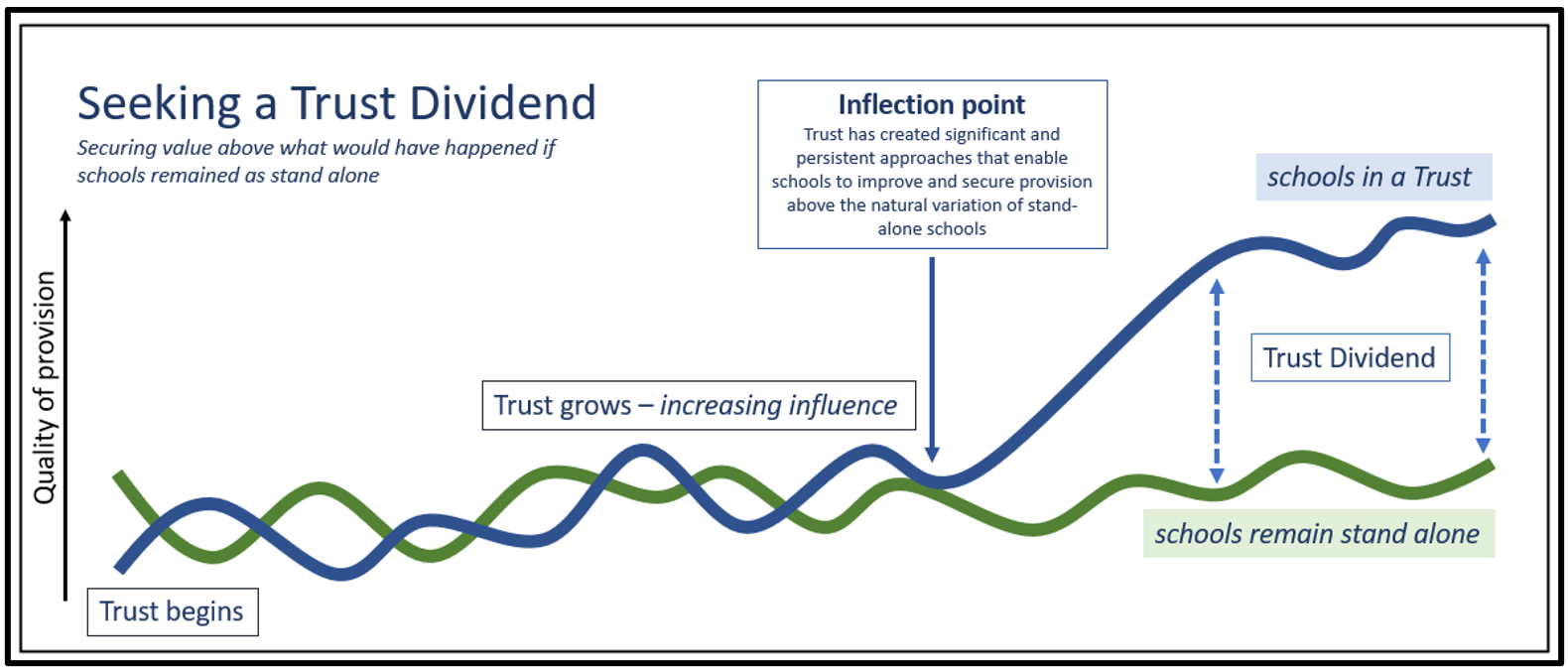
The purpose of a Trust is to add more value than the sum of the parts and more than before. This additional value is the Trust Dividend: A significant and persistent level of performance that is contingenton the existence of the Trust and enables schools to work in a higher performance space over time, above that which would have been achieved without the Trust.
Securing a trust dividend, is contingent on the actions taken by a Trust, typically including a level of standardisation, empowerment and collaboration that creates value. As a Trust matures and makes good decisions about where to invest in high dividend strategies there is an inflection point when a discernibledividend is evident that holds the Trust in a higher performance space.
The following diagram compares the impact of a Trust (in blue) with the performance of the same schools if they had not become a Trust (in green). Over time, if the Trust successfully implements approaches that are significant and persistent a trust dividend is created above that of the original schools.
As a rule of thumb, a dividend is hard to achieve and to sustain, we should assume young and maturing Trusts have relatively low influence and capacity to secure a dividend. We should seek evidence of systemic and sustained influence of the Trust on performance and provision to build confidence in the existence of a dividend. The timing of the inflection point is dependent on a range of factors, including scale of trust, strategic decisions, founding principles, values, capacity, capital (intellectual and financial), geography etc. Engaging as knowledge building organisations, Trusts can build a body of knowledge that informs decision making to create stronger dividends.
“…we can speed this process (trial and error) up by creating systems and platforms where we search for new knowledge systematically… integrate the result into our body of knowledge, and apply it into new ways of doing things.” (Johan Norberg)
A Trust Dividend is a composite suite of strategies and approaches that Trusts employ to add value over time. Consequently, some actions and strategies add value sooner, some are stubborn, and barely add value, and a few unintentionally decrease value.
The Trust Dividend needs to be significant and persistent
We need to exercise caution, too often we over-estimate the impact of the Trust, too often mis-understanding cause and effect and attributing impact where it is not warranted. Achieving a trust dividend is a high bar it requires Trusts to implement high dividend strategies and approaches that are significant and persistent.
Where it is neither significant or persistent it approximates to normal to status quo. If it is significant, but not persistent, it may have an impact, but not over time, may be dependent on transient conditions, inputs or specific people (Teflon). Something that is persistent and not significant, sticks, but is of low value (Velcro).
A higher performance space | seeking the signal in the noise and antifragility
The Trust Dividend holds schools in higher performance space that may become irreversible and ultimately self-improving (where normal routines hold the trust in the higher performance space) beyond that of stand-alone schools and the previous system. A dividend should be sought across provision and in schools within a Trust, it should act to reduce variance and improve standards within a Trust over time. A dividend that is identifiable, and undeniably contingent on the actions of the Trust. Whilst quantitative measures are the easiest to interrogate for evidence of a Trust Dividend, qualitative dividends add significant value and are often the foundation for quantitative measures.
Reliably identifying a trust dividend requires that we search for signal in the noise. The dividend that emerges from the noise needs to be beyond the noise of normal variations in performance over time. The emergence of a dividend is likely to not happen across a Trust at the same time or with the same potency. An evaluation of positive deviants in the population may indicate early dividend and/or where we should seek future value. Understanding the causes of variation between schools, particularly over time, in the same Trust is invaluable in understanding how value is added and dividends created.
Whilst a trust dividend should be significant and persistent, we should seek dividends that display antifragility, the dividend becomes stronger not weaker under stress. This indicates that the Trust is moving into a self-improving space that sustains and holds up performance that will go beyond our time and become a long-term dividend.
Seeking Expected Value (EV) and Future Value (FV)
As trusts seek a dividend it is helpful to consider the Expected Value (EV) and Future Value (FV) of strategic moves. Whilst this pushes us to think in bets, these are not one-off punts, more a strategic identification of areas of work (in the right order) that the Trust invests in deeply, to secure irreversible improvement and conditions for performance. It is an inconvenient truth that seeking this added value is typically high effort for lasting impact and, annoyingly, it is rarely quick to pay-off. Areas including shared curriculum, shared assessment, deep investment in Trust culture, professional services and building trust leadership are considerable undertakings, but carry high expected and future value.
Why do you (your Trust) exist?
If a Trust is to secure a dividend it needs to know where it is going and what it seeks to achieve; to know why it exists.
It is the reason for existence that directs the dividend. Too often values, mission statements and visions are cliché ridden, assumed, taken for granted and superficial. Unless you know where and what you specifically aim to achieve, where you want the trust to go, then anywhere will do. Leaders who paint the clearest picture of the preferred future, who tell stories of what will be, in high-definition, inspire movements, create greater value, and create the climate for stronger dividends.
“If everything is important, then nothing is… When you know your reason for existence, it should effect the decisions you make.” (Lencioni)
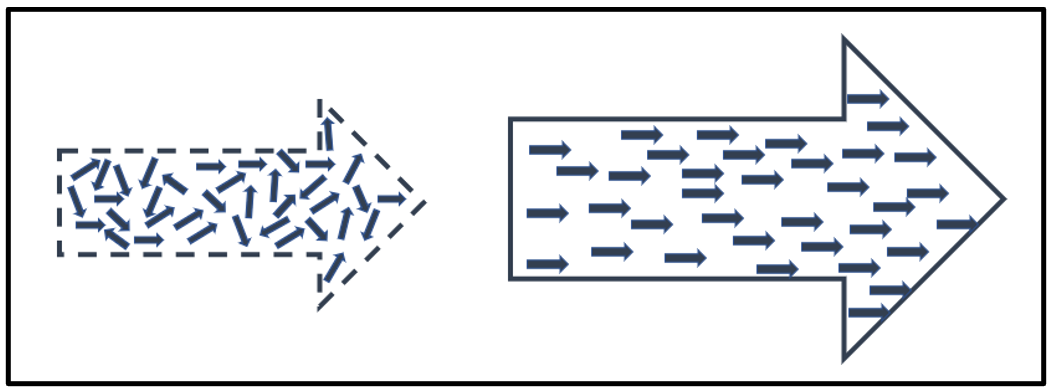
If the values, collective purpose and direction of the Trust is widely owned, this creates the climate, language, habits and behaviours that secure a dividend that is more self-sustaining; pointing colleagues in the right direction, joined in a shared endeavour and mission to make a difference.
Mis-aligned energies will weaken the force and dilute the dividend, we tend to approximate the value that would have been achieved if the Trust did not exist.
A Trust dividend acts like a force that holds the trust in a higher performance and cultural space. The values, principles, ethos and culture of a Trust creates psychological safety to colleagues, a place of belonging and one that gives status and esteem. This gives identity, motivates and encourages discretionary effort that taken together lifts the Trust into a self-improving space; creating the purpose and the autonomy to seek mastery.
Where to play? | Standardise the complicated, empower the complex
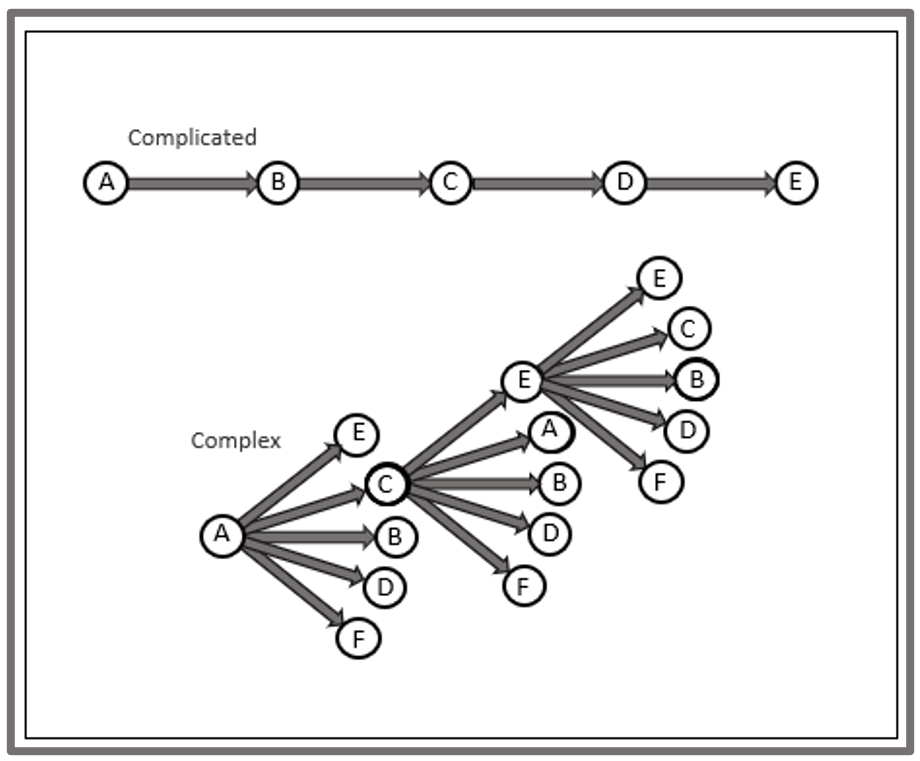
Achieving a significant dividend requires Trusts to make good decisions about how they work. Aspects of provision can be broadly divided in to complicated or complex. Understanding this difference supports decisions about where Trusts (and academies, departments or any team) should standardise and where they should empower colleagues.
Areas that are largely complicated are open to standardisation. Complicated areas act largely the same way each time. These areas can often be reduced to a checklist; if this, then do that. Trusts should play in these areas and standardise as there is limited need for local decision making or creativity. For example, shared curriculum, shared assessment, professional services, data, Trust values, Trust leadership, governance…
Areas that are largely complex should be empowered to schools and colleagues. Complex areas respond differently each time and are typically influenced by the unpredictability of human action and interaction, requiring in the moment decision making. In complex areas of provision, we need to push decisions closer to the action where quality and outcome is linked to the situation as it emerges. For example, academy culture, ethos, behaviour, teaching and learning, academy leadership, quality assurance…
…under the conditions of true complexity – where the knowledge required exceeds that of any individual and unpredictability reigns – efforts to dictate every step from the centre will fail. People need room to act and adapt. …they require a seemingly contradictory mix of freedom and expectation …and also to measure progress towards common goals. (Atul Gawande)
“You can mandate to get the system from awful to adequatebut not from adequate to great. To do that you have to unleash potential and creativity. This cannot be centrally mandated but has to be locally enabled.” (Michael Barber)
Where should Trusts standardise and empower?
“Leadership is the art of giving people a platform for spreading ideas that work” (Seth Godin)
As Trusts standardise areas of provision a column is built on which colleagues can lean and stand upon to focus on the Main Thing(s). Where these standardised areas are developed by teachers for teachers (curating curriculum and designing assessment), we move to a self-improving system owned by colleagues across the Trust. On this platform all colleague across the Trust are empowered to Red Dance, to do what they do best and what they signed-up for; to make a difference to the lives of children.
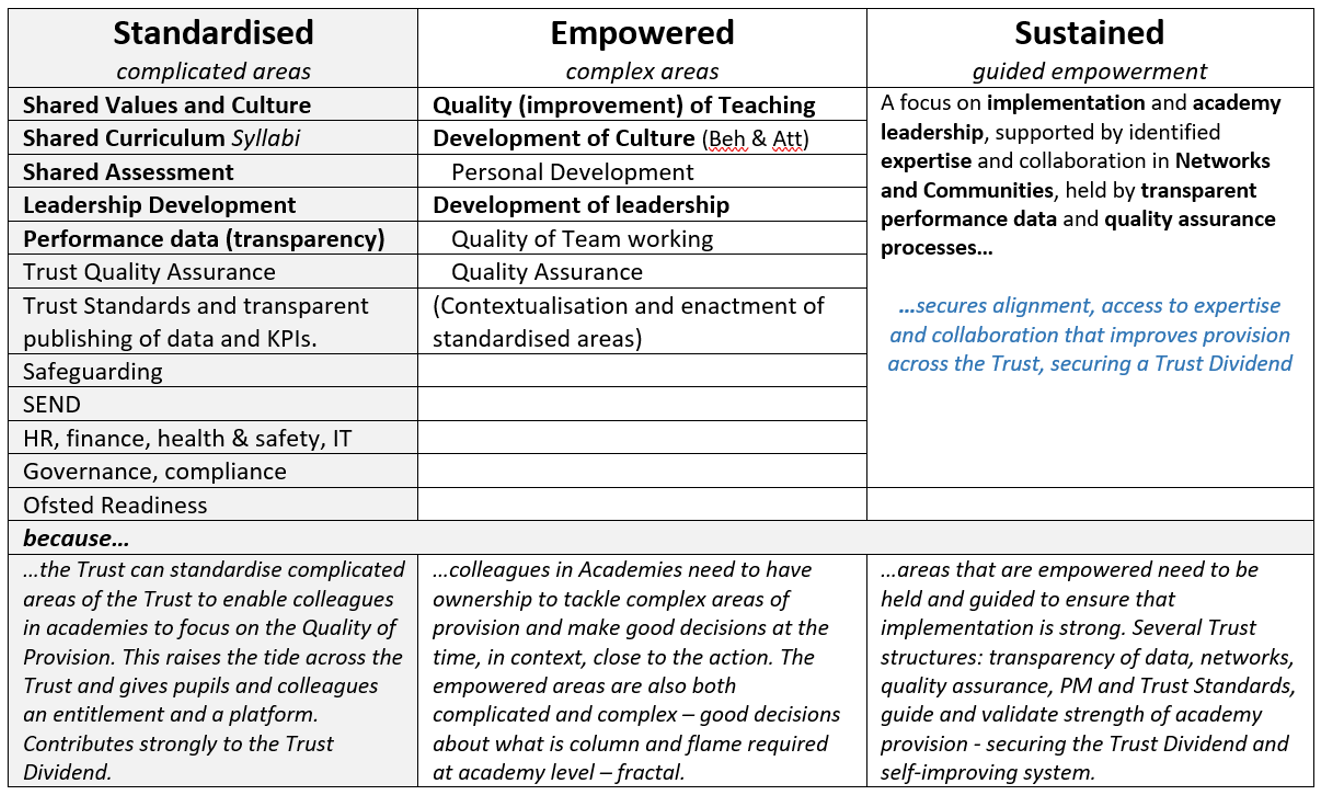
Areas of provision that are standardised and empowered need to be sustained, guided, held and validated. Empowerment can be supported and magnified by strong values, principles, trust standards, co-opetition, transparent data, horizontal collaboration and a deliberate development of trust leadership and implementation. It is the investment from the Trust in these sustained areas that reinforce the high dividend areas of work and create the conditions for a persistent Trust Dividend.
The following table identifies the key areas that are standardised (typically complicated) and areas where Trusts should empower (typically complex). Contextualisation ensures that standardised and empowered areas strengthen the dividend, owned locally; how we do things here.
The need to standardise, empower and sustain works at all levels within the trust, it is fractal, relevant at Trust, academy, team-level.
Creating the column holds colleagues, simplifies approaches and builds a platform for red dancing, to do what they do best, reducing workload and removing the need to re-invent complicated provision. Empowering colleagues is an expression of trust, it says that they are best placed to make decisions in complex areas and make a difference. We create the sustaining collaborative structures, invest in trust leadership, networks and communities, democratise data and quality assurance to create the conditions for colleagues to feel secure and feel success. This investment is about belonging, giving status and building esteem.
Overcooking Standardisation into the complex areas
It is desirable for Trusts to build standardised approaches that raise the tide and create Trust effectiveness. As the level of standardisation increases it reaches a sweet spot where there is a desirable balance. Beyond the sweet spot further standardisation stifles local decision making and reduces effectiveness.
Trust Leadership | Headteachers as the key agents of improvement
In any Trust it is hard to understate the importance of headteachers. Whilst a number of things separate high and low performing schools, it typically hinges on the quality of leadership and particularly that of the Head.
This is still very much true within Trusts. Seeking and securing a Trust Dividend is strongly hinged on the colleagues that turn up in schools every day. Great heads are experts in relationships and implementation, understanding the complicated and the complex and standardising, empowering and sustaining to seek a dividend. Trusts need to invest in an on-going leadership curriculum the secures and develops trust leadership, focused on Headteachers. Michael Barber’s model is useful for considering implementation, the importance of execution and the boldness/promise of a strategy.
Trusts and headteachers need to place a few bets well, principled innovation on high dividend strategies, that are executed well to achieve improvement and transformation, a dividend. Multiple initiatives that promise much (or little) that are not well executed will be ignored or cause controversy; if this happens too often it weakens the credibility of leadership.
Sustaining and enhancing a Trust Dividend requires strong collaborative structures within a Trust that purposefully connects colleagues to collaborate, creating the conditions for intensely focused collaboration. This is perhaps the greatest advantage that Trusts have. Expert Networks allow the sharing of expertise and development of practice across the Trust, aligning and strengthening the standardised as well as the empowered. Subject Communities, curate curriculum, design assessment and focus on enactment and pedagogy: by teachers for teachers. The sum of this connectivity and collaboration enhances and develops practice that adds dividend and becomes self-sustaining, self-improving.
“Communities of Practice are groups of people who share a concern or a passion for something they do and learn how to do it better as they interact regularly.” (Etienne Wenger)
All Trusts working together for all children
We have an uncommon opportunity as educators to build an education systemthat is more about joint enterprise and shared endeavour. Trusts working together for all children, seeking trust and collective dividends that exploit our collaborative structures within and between Trusts to bring greater coherence and effectiveness; reaching all children and bringing light in these gloomy times.
A greater understanding of why we exist, what constitutes a trust dividend, and what does not, the nature of complicated and complex, how this links to standardisation, empowerment and how this can be sustained as well as the importance of Headteachers, implementation and collaborative networks and communities can secure dividends. Seeking a sector that is a co-operative system, where collaborative intelligence becomes wisdom and we enable groups of schools to achieve more than the sum of their parts, and more than before.
“Instead of seeing trees as individual agents competing for resources, she proposed the forest as ‘a co-operative system’, in which trees ‘talk’ to one another, producing a collaborative intelligence she described as ‘forest wisdom’. Some older trees even ‘nurture’ smaller trees that they recognise as their ‘kin’, acting as ‘mothers’.” (Robert Macfarlane)
Dan Nicholls | February 2023
The thinking and ideas in this piece are heavily influenced and created by colleagues across Cabot Learning Federation.


















 Dan Nicholls