Toward the future | inspiring lives

Our Mission

In the next phase we will strengthen our trust, deepen our connection and collaboration to add more value to each other and to all children. This is a venture in shared responsibility and joint endeavour to inspire lives with greater opportunity and choice. Succeeding in our mission:

Inspiring every child to flourish through an inclusive, all-through education that nurtures opportunity, equity, and agency for life.

A mission that ensures 11,000 children flourish and develop greater self-agency, becoming the masters of their fate. A worthy quest powered by 1,500 connected colleagues, empowered to do meaningful work.


For those that carry the most

We recognise that some children carry more than most, have had less opportunity and experiences in their early childhood and so need us more. They neither lack ambition or ability, but they have less capacity, fewer resources and face barriers that tip odds against them. In difficult times education has the power to transform lives, which is the business we are in. The performance and development of these children is the most important measure of our worth.

“We need equity in education, not equality. If someone can’t see straight because the world is falling in around them, we need to raise them up to clearer skies.” Poor, Katriona O’Sullivan


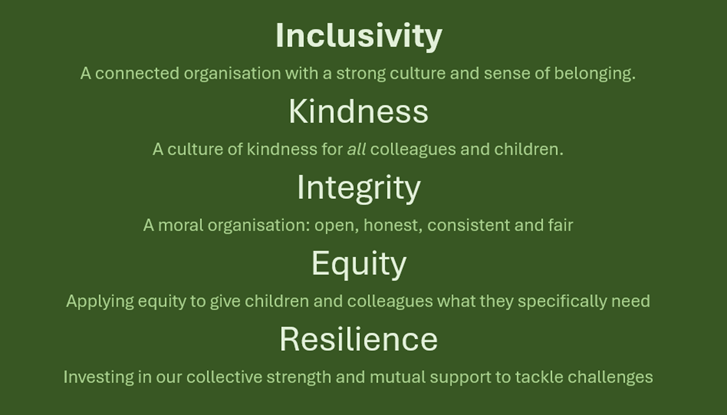
Anchored by our Values

Everything we do is held by our shared values:

Our stable core enables our innovative edge

We continue to build a strong trust with great schools that focuses on getting every day right and building a stable core: consistently delivering high quality provision with effective systems and shared approaches, enables our frontline obsession.

We stand on our stable core and what we choose to do the same, so that we can innovate on the edge, expertly developing approaches to improve provision and inspire lives. This is a collective, connected and developmental endeavour through collaboration.


Towards 2030 | why we exist

To build a strong trust with great schools. Offering high quality education over 570-weeks that closes gaps for those that most need us. So that the trust exists in a higher performance space and exploits our collaborative advantage that yields a trust dividend.

Our focus on partnerships and places builds better communities for children to grow up in and flourish. Colleagues create greater opportunity through deliberate local and regional collaboration,seeking to improve other trusts and the sector.

The trust is deeply connected within itself. There is a strong collective desire and shared responsibility to add value for all children in every setting. This collaboration enables a level of innovation and shared approaches that add more value. As part of a human organisation colleagues are well connected, making a greater difference to others in and beyond our trust.

The consequence of our work over five years is that the trust becomes self-improving, the systems, shared approaches, trust improvement model, collaboration, horizontal leadership and empowerment is creating more value over time and is self-sustaining.

Colleagues enjoy more opportunity and are proud to do meaningful work that is enabling all children to flourish through an inclusive, all-through education that nurtures opportunity, equity, and agency for life


Higher performance space | in search of the trust dividend

There is an unswerving, shared responsibility and desire to raise standards. To build a strong trust and great schools that exist in a higher performance space that particularly enables disadvantaged learners to thrive and attain well.


So, where next… this year

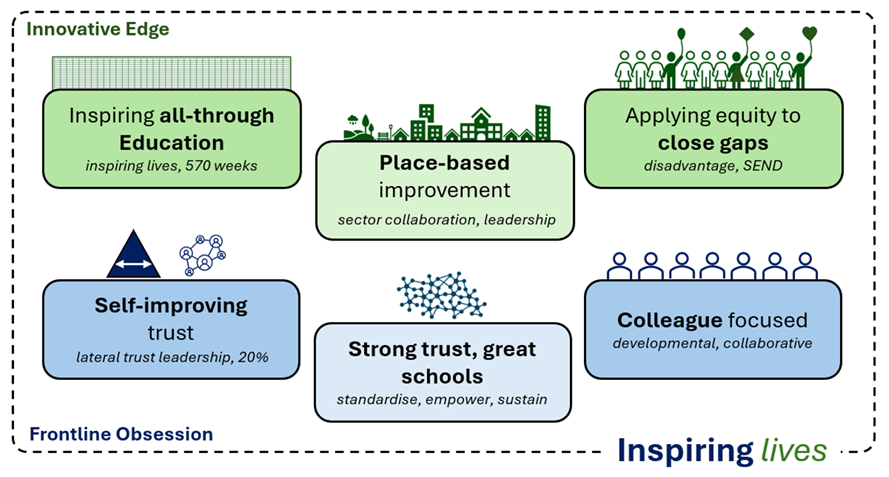
In the next phase, to summer 2026 we will prioritise these six areas:
Innovative Edge | Inspiring lives

This year we will invest in our inclusive all-through education (570-weeks) and apply greater equity to close gaps for children that need us most. A focus on place-based improvement will build strong community partnerships and support improvement beyond our trust.

Stable Core | frontline obsession

We will continue to invest in our stable core, by building a strong trust that enables great schools. Our colleague focused strategy will invest in all colleagues and create the conditions for our frontline obsession. Aiming to create a self-improving trust, investing in lateral leadership, connection, collaboration and strong systems.


570 Weeks | inspiring all-through education

To build an inspiring, inclusive, all-through education: as an entitlement for all children. Enacting excellent provision for every child throughout their 570 weeks of education. Prioritising:

  • Trust Curriculum | curating and enacting a shared curriculum across all year groups. (SDP)
  • Attendance, inclusion and transitions | to secure stronger attendance, strong inclusion and high-quality transitions, disadvantage first. (SDP)
  • Best Start in life | investing in the strongest possible start for all children through nursery and early years, enabled through a set of core commitments. (SDP)
  • Outstanding Personal Development | outstanding personal development curriculum builds character and offers greater opportunity for all children in every setting.

Closing gaps | seeking social justice

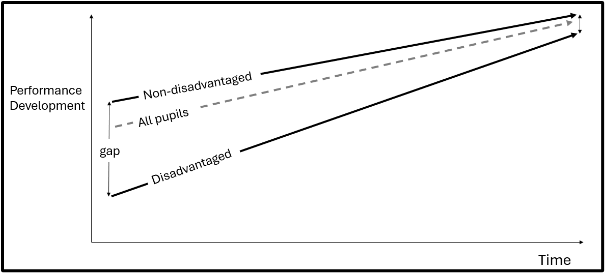
To apply equity and unswervingly commit to meeting the needs of children experiencing disadvantage and SEND, securing attainment and attendance that closes gaps and builds agency for each child. Securing greater social justice by prioritising:

  • The trust-wide development of teaching | systematic focus on the development of teaching to enact our shared curriculum. Our strongest lever for closing gaps. (SDP)
  • Disadvantage first | unswerving focus on the performance of disadvantaged pupils, through targets, data and quality assurance, as the indicator of the quality of our provision. (SDP)
  • Catch-up, Keep-up | systematic tracking all learners and applying equity, doing different and more, so that all children are caught up and kept up. (SDP)
  • All leaders, leaders of SEND | developing our SEND provision, focusing on ‘all leaders as leaders of SEND’ – securing a systematic strategy to meet SEND needs.
The importance of place | community partnerships

To build partnerships with educational and community partners to secure stronger communities and 570-week educations for all children. Using expertise in the trust to reach out and secure improvement in schools, trusts and the sector. Growing our reputation and influence by prioritising:

  • Strong recruitment built on growing reputation | securing stronger recruitment of pupils into our schools to inspire more lives and better serve our communities.
  • Trust Growth | securing appropriate and strategic growth of the trust to secure financial opportunities and grow our reputation and influence.
  • Collaboration with local trusts, local authorities and partners | seeking strong collaboration to secure improvement beyond the trust – seeking to influence all 570-weeks
  • Sector reputation and influence | playing an active role beyond the trust, including with the DfE and other partners, to influence policy, improve other trusts and the sector.

Colleague focused | developmental and collaborative

Investing in all colleagues to be connected, to collaborate, develop and grow to lead and contribute toward the mission and feel empowered to do meaningful work. Prioritising:

  • Recruitment and Retention | building a strategy to recruit well and to attract and retain strong colleagues. Considering our approach to flexible working.
  • Professional Development | creating on-going opportunities for professional development, held in a curriculum. Developing, inspiring and creating more opportunities for colleagues.
  • Induction | investing in and building strong induction to support all colleagues to have the best possible start to their career in our trust.
  • Well-being and mental health strategy | securing approaches across the trust to support all colleagues with their well-being and mental health.

Strong Trust, Great Schools | standardise, empower, sustain

Ensuring that the trust improvement model offers the foundation for colleagues to lead great schools. Complicated systems well embedded across the trust to drive effectiveness and efficiency. Prioritising:

  • Deliberate enactment of the Trust Improvement Model (SIM) | developing our standardised approaches, enabling empowered areas and sustaining the model to secure improvement.
  • Financial stability and clarity | Ensuring the trust maintains the present financial security, secures wider responsibility and enables greater investment in the trust.
  • Professional Services | developing professional services, to strengthen platform, offer capacity, expertise and secure the environment to empower all colleagues to deliver the mission.
  • IT Strategy | ensuring colleagues and pupils have the tools they need to thrive now and in the future. Developing our digital vision and cloud-first approach. Exploring the opportunities of AI.

Towards a self-improving trust | lateral trust leadership

Creating the expectation and conditions for horizontal improvement across the trust. Connectivity and collaboration that are more effective and efficient at driving the School Improvement. Prioritising:

  • Trust Leadership Curriculum | investing in and enacting a trust leadership curriculum and to extend the sense of leadership curriculum through networks and the layers of the trust.
  • Networks and Subject Communities | connecting colleagues with purpose, formally and informally, to enable the development of strategies that raise standards.
  • Lateral leadership, 20% time | creating the expectation and the structure for colleagues to work beyond setting to support lateral leadership and secure a self-improving trust.
  • Succession Planning | investing in succession planning and talent management to ensure the future leadership security for our trust.

First Steps… into Term 1

And our first steps in Term 1 will see us deepen our connection and collaboration and prioritise:

  1. Understanding performance and setting the ambition and targets for 2026.
  2. High quality Induction and line management, starting out strong.
  3. Strong start and focus on Attendance, disadvantage first.
  4. Best Start in Life, embedding our core commitments.
  5. Enacting our shared curriculum.
  6. Focus on the development of teaching through Steplab.
  7. Embedding the new Planergy software in Finance.

We choose to venture on this journey to 2030 not because it is easy, but because it is hard, and because our ambition will serve to organise and measure the best of our energies and skills, because the challenge is one that we are willing to accept, one we are unwilling to postpone, and one which we intend to win (adapted, John F. Kennedy)

So, breathe, commit … and go inspire lives with greater opportunity and choice.

Thank you, you make a difference


Dan Nicholls | August 2025

The Social Contract is fracturing

“Everyone participates in the social contract every day, and we rarely stop to think about it. Yet social contracts shape every aspect of our lives, including how we raise our children and engage in education.” (Minouche Shafik)

We live in difficult and darkening times. The growing gloom is becoming oppressive, encouraging retreat and reducing belonging. The social contract that shapes and guides every aspect of our lives is fracturing. For far too many children and families this is fundamentally altering their relationship with society, authority, and how we value and engage in education.

The “social contract” is a theoretical agreement between individuals and society wherein people relinquish certain freedoms and abide by agreed-upon rules and norms in exchange for social order and mutual benefits.

These are dark ages, characterised by challenging economics and social inequity, that are presenting both a psychological and material challenge. This is infecting and altering the narratives we tell ourselves and each other about what is important and what our contributions to society should be.

“We all … listen for an account of who we are and where we stand.” (George Monbiot)

Increasing numbers of children and adults are opting out from a world that finds multiple ways of challenging their sense of self, place, and agency. Whilst for some the light is not fading, for too many others, often the most vulnerable, the gloom is encouraging retreat from the agreed contract. Schools are at the heart of the maelstrom, open, available, and trusted enough for some families to fight against, because few others are listening, available or there. Schools stretch and respond to the needs that walk into school every day, attempting to fulfil their duty of care, often without the resource or expertise.

For increasing numbers of pupils and families, school is seen as optional, far from being irresistible or a place of opportunity. The prevailing narrative is replacing long held norms around the value of education, driven by a weakening social contract and the entrenched inequities in society. The disadvantage gap, on any measure, is wide and widening, embarrassingly so. Fundamentally, the social contract is built on trust– when the returns from society diminish or disappear, or where we become increasingly priced out of life, we see the contract weakening and the trust we hold erodes.

“Trusting others puts us in an inherently vulnerable position… the proof of the importance of trust is the intense emotional pain that accompanies it being broken. (Owen Eastwood)

We need a revised and reinforced social contract that seeks greater cohesion, strengthens belonging and places education at the heart of this nation. This needs to secure far greater equity through education and a much stronger architecture of opportunity. An architecture enacted by stronger trust and system leadership, greater connectivity and purposeful collaboration between trusts and schools so that we take collective responsibility and stewardship for our sector. All Trusts working together for all children.

“It is only through building a connected system that we will be able to address the multiple challenges facing our communities” (Leora Cruddas)

Building the effectiveness of our trust, civic and system leadership to build an education system that is able to address the multiple challenges, redistribute esteem and enable many more children to live lives of decency and dignity.

“…we need a redistribution of esteem… to live lives of decency and dignity, winning social esteem. …(to) travel the road to 2045 with purpose, dignity and accomplishment.” (Peter Hennessy)

Seeking together to build strong trusts with great schools that meet need. Enabling more children and families to belong and benefit from a renewed social contract, gaining a greater sense of agency in their lives and contributing towards the common good.

“Agency gives us control over our time, and it encourages us to choose what our contribution looks like.” (Seth Godin)


In the eye of the storm

The lines between school and society have blurred. Schools are trying to respond to the fracturing of the social contract. Where deprivation bites and societal problems leak into schools, colleagues can become overwhelmed. They take increasing amounts of time to support, resolve, and cope with difficult and widening societal issues of children and families, obligated to fulfil their deeply held duty of care for the communities they serve.

The present level of attendance, suspensions and disenfranchisement, particularly of those presently disadvantaged, is a national crisis – a social epidemic. As the narrative falters, individuals are making pragmatic decisions around survival and choosing to opt out, to not conform, to challenge authority, avoid commitment and to escape the perceived risk of failing in class.

If life is a game, too many are deciding not to play.


Fracturing built on entrenched inequity

It is not that the social contract has suddenly fractured, it has been creaking over time and is evident in the inequalities that characterise our society. Just as there are triggers for climate change, where it becomes irreversible and the impact is catastrophic, the same is true of the social contract. Multiple factors have triggered descent to this crisis point with our social contract.  


Strong Trusts, Great Schools, Meeting Need | An architecture of opportunity

“There is no trust more sacred than the one the world holds with children.” (Kofi Annan)

The present architecture of opportunity in our sector, exists within a developing Trust landscape. It is timely, urgent and imperative for Trusts and groups of schools to work together within stronger collaborative structures to build strong trusts capable of supporting more great schools that are well placed to meet need. The sector should grasp the opportunity to create a stronger architecture of opportunity that addresses the societal challenges and particularly the widening disadvantage gap. Trusts and schools need to work much more collaboratively to realise the promise of academisation and to secure greater equity through education.

We are the system

The development of great schools across the sector that enable all children to lead full, flourishing lives is at that heart of the renewal we seek.

“We need a broader and more ambitious vision of what a good life is. Human flourishing and dignity for all, requires us to have a wide set of success measures. Placing greater value on things such as contribution, difference, common values, and the process of learning and work itself.” (Ben Newmark, Tom Rees)

The collaborative structures we need to build within and across the sector are required to secure a greater dividend, one that rises the tide for all children. Schools need to grow good humans through strong culture and inspire young minds through great teaching held within a progressive, sequenced curriculum that liberates agency and meets the needs of children now and for their future. This requires us to develop leaders(hip) that understands how to improve schools within the collaborative structure of Trusts, accelerated by Trusts working closer together. This will demand a move from silos to deliberate collaboration, so that we, together, take greater collective stewardship of our sector.

The deficit narrative in society is reflected within our sector and in our schools. It is no accident that the current recruitment and retention challenges, the catastrophic decline in ITT applications and weakening working conditions are linked to the deficit narrative around schools and the value that our nation places on education. It is not that there isn’t an appetite to meet and reverse the challenges of the failing social contract, it is that it feels progressively more futile given the available funding, resourcing, staffing, and expertise that is required to meet the ever-increasing demand.


Stewardship and Longtermism

The investment in education needs to be long-term and it requires a commitment over generational timescales that inconveniently span timescales longer than political terms of office. We are prone to shortermism and this struggles to keep up with the complex needs of a growing number of children and families.

“We should shift our energies upstream: personally, organisationally, nationally and globally. We can, and should, stop dealing with the symptoms of problems, again and again, and start fixing them.” (Dan Heath)

This is urgent; it is not just about now, it is fundamentally about the future and the future health of our society and the standing, place and importance of education. Great schools are the hope, and increasingly the only hope, but they are exposed and creaking under the weight of the failing social contract. Schools and Trusts need to consider deeply their role in society and the educational offer that will better meet the needs of all children, now and into their adulthood.


The weather is oppressive

The prevailing climate is increasingly oppressive and characterised by profound uncertainty.

“How to live in a world where profound uncertainty is not a bug, but a feature?” (Yuval Noah Harari)

Our response to this uncertainty and the challenges of our time has influenced the national psyche and altered our narratives. So much has shifted in our lived experience…

The global pandemic, Brexit, standards in public life (Nolan Principles), high inflation, high interest rates, energy costs, mortgage rates, loan rates, cost of living, AI, inaccessible first homes, decline in living standards, shifting employment types and longevity, climate change, political turmoil, social media, conflicts across the world (including Europe), long waiting lists, funding crisis, erosion of local services and multi-agency services, mental health challenges, public service strikes, recruitment, retention…

… disconcerting, oppressive, challenging; encouraging retreat and a deafening backdrop to life.

All of which play out unevenly across society. Except that, this is not true for everyone. These oppressive conditions tend to maintain the status quo for those who have means and power.


The shifting locus of control; retreating from the noise

“Nations and peoples are largely the stories they feed themselves.” Ben Okri

Our society has always been divided into those who have and those who have not. Typically, the most disadvantaged in society have an external locus of control, one that encourages retreat, and one that negates a sense of agency. The current challenges are pushing more children into believing and acting as if they have an external locus of control. When this happens, they look to the contract that is meant to hold them, meant to say to them that they belong, and they pragmatically choose retreat and make decisions about their contribution to society; becoming more invisible.  

Ubuntu: “I am a person through other people; my humanity is tied to yours.” (Zulu proverb)

We must reinforce, redesign and improve the social contract. It is fractured and faltering. We must not stand-by and in doing so collude with this erosion. We need a society and an education system that builds back the social contract for the common good and creates an architecture of opportunity, so that more are invited to dance.


Architecture of Opportunity | an invitation to dance

1. We need to renew the invitation to dance, so that individuals contribute and benefit from the social contract. We need a new national and educational narrative around schools that places education at the heart of social renewal. This should seek to create a greater sense of belonging, status and esteem, a more just society and communities where children and families flourish.

“Those who imagine the ground beneath their feet is solid are probably managing the present, not leading into the future.” (Tracey Camilleri, et al.)

2. We are the system. As educators we have an opportunity and responsibility to make a difference, to tell a stronger narrative and to influence the national position of education. We need to review the present paradigm and ensure that we are keeping our side of the contract. We need to ensure that Trusts and schools develop organisational leadership to build a sector that rises the tide. Strong Trusts with Great Schools that Meet Need.

“You cannot take away someone’s story without giving them a new one. Whether the systems that emerge from this rupture are better or worse than the current dispensation depends on our ability to tell a new story.” (George Monbiot)

3. We need to invest more in education; an investment that yields a long-term dividend to our society and nation. The pay off will not just boost the economy, but it will improve well-being, mental health, community cohesion and deliver social justice. This investment will support schools to fulfil their duty of care and create an architecture of opportunity where the power of education will secure greater equity. Not for us, for them.

4. We need to take a longer-term view on the role of education in society, as the moral priority of our time. Taking greater stewardship of the future, building collaborative structures where all educationalist can share responsibility for all children. It is what we owe their future.

“Longtermism is about taking seriously just how big the future could be and how high the stakes are in shaping it. We need to act wisely.” (William Macaskill)

5. We need to invest more in the first 1001 days from conception and in readying children for school. This lights the fire, sets the stage and reinforces, at the earliest possible moment, that education and investing in human potential is part of the fabric of our social contract. This includes educating and influencing parenting and the nations understanding of key developmental stages. We need to follow through on that investment into early years to give the best possible start in life, to secure the importance of school, where children belong and where we genuinely work upstream to prevent downstream problems.

“We have the opportunity to help people become significant… build a culture of affiliation and status.” (Seth Godin)

6. We need more great schools that meet the needs of all children. Schools that secure strong culture and great teaching to build great humans and bestow the very best curriculum, for our children in these times. Trusts need to work together to develop system leadership and purposeful collaboration that accelerates our impact on the everyday experience of every child. So that together we realise and enhance the collective Trust Dividend on children and society. We should seek to secure greater attainment mobility, to close gaps for those presently disadvantaged, and meet the needs of those with SEND.

“There should be a national strategy to close the attainment gaps that have opened since the pandemic. Addressing these gaps should be a national priority, with a long-term plan in place, based on evidence.” (Sutton Trust)

7. We need to urgently address the attendance crisis in this country. Seeking to tackle the entrenched challenges of our time, to strengthen our narrative around the importance of education and build back the social contract. Improving attendance is urgent; the damage and implications for this generation will play out across society and over decades.

“Culture can change. And it is schools and school systems that have the power to change it.” (Lucy Crehan)

8. We need to invest in ‘place’, work in strong partnerships and fulfil our civic responsibilities. We need Trusts and schools to collaborate and develop civic leadership to take greater stewardship for the places that we educate. Without these collaborative structures in place, we will not create the architecture of opportunity and the multi-agency working required to serve the communities where children grow up.

“Civic leadership is about the protection and promotion of public values and addressing issues of place …creat(ing) the conditions for collective impact by addressing complex issues affecting children … that require different actors to work together.” (Leora Cruddas)

9. We need to invest in wider services, and find ways to effectively work in closer partnerships with others, including social care that sit in and around schools – renewing and reinforcing the broken contract, as an expression of care and duty. Taking greater opportunity to understand and meet the needs of all children and adults. Funding and supporting schools to realise their civic duty, with enough resource and expertise to meet demand and fulfil our duty of care.

10. We need to be clear on where the boundaries of the social contract sit between schools and society.  This clarity is required to understand where responsibilities sit and to reduce the flow of societal issues into schools. We need to either rebuild the agencies, services and expertise in our communities or significantly invest in schools as community hubs to meet the needs of society.


Through joint enterprise and shared responsibility we can build a society and an education system that renews the social contract for the common good and create an architecture of opportunity so that more are invited to dance.

“It is a matter of shared purpose and sustained application.” (Peter Hennessy)


Dan Nicholls | July 2023

Five functions of a strong Trust | strong Trust, great schools

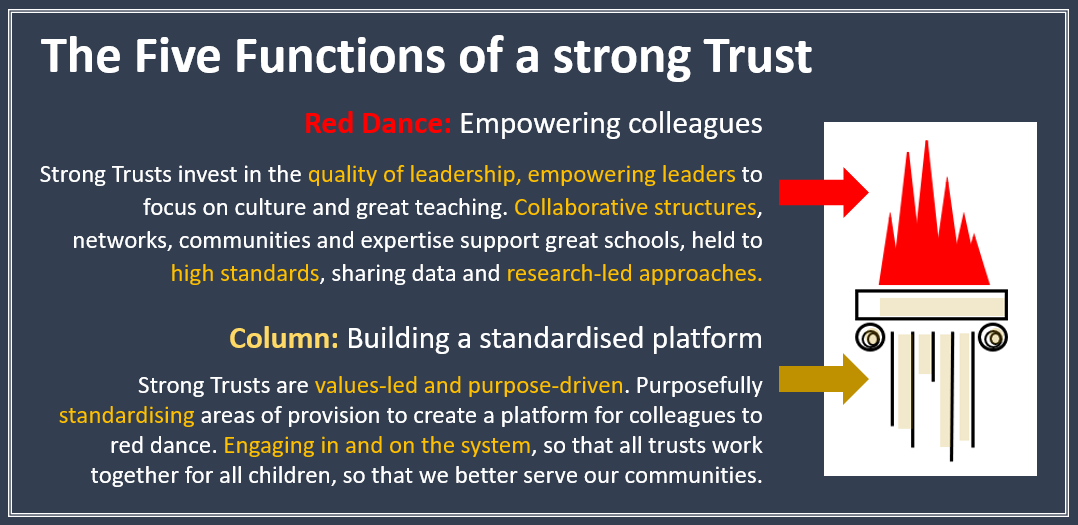
Strong Trusts build collaborative structures and platforms for great schools to create more value for all children, over time. This trust dividend enables groups of schools to achieve more than the sum of their parts, and more than before. Strong Trusts are values-led, purpose-driven, learning organisations who establish the conditions for colleagues to create collaborative intelligence that becomes trust wisdom that strengthens great schools.

“Instead of seeing trees (schools) as individual agents competing for resources, she proposed the forest as ‘a co-operative system’, in which trees ‘talk’ to one another, producing a collaborative intelligence she described as ‘forest (trust) wisdom’.  Some older trees even ‘nurture’ smaller trees.” (Robert Macfarlane)

There is now enough maturity in our system to identify how strong Trusts create enough value to sustain groups of great schools; school is Trust, Trust is school. Deepening this understanding will enable educators to take greater stewardship of the sector and build strong Trusts that work together for all children. The following identifies five functions of a strong Trust that, taken together, create a trust dividend that supports, empowers and sustains great schools.


The five functions of a strong Trust | in brief

One: Strong Trusts are values-led and purpose-driven, they understand why they exist, live out their values, achieve their purpose, tell stories of the future, create coherence and clarity to establish a climate where colleagues belong to something bigger and are empowered to add value.

Two: Strong Trusts standardise areas of provision that build platforms for colleagues to stand on and exploit, areas that are high dividend and rise the tide, particularly a shared curriculum, shared assessment and wider professional services. These are significant investments in high dividend areas, over time, that add future value.

Three: Strong Trusts invest in leadership, particularly of headteachers, so that there is a deep investment in relationships, setting direction and implementation within schools. Leadership that builds and sustains a strong culture and great teaching, hallmarks of great schools and areas that are largely empowered to and owned by schools.

Four: Strong Trusts create collaborative structures, an architecture enabling colleagues to collaborate across the Trust in networks and communities, creating, designing, developing and aligning approaches that add value. Trusts are risk-informed, distorting resource and expertise to tackle underperformance.

Five: Strong Trusts maintain high standards creating the conditions for healthy competition, great schools joined in the shared endeavour of raising standards, transparently using trust-wide data, building shared intelligence and using research-led approaches to inform implementation and school improvement.

+One: Strong Trusts act within and on the system, working together with other Trusts, to create a collective dividend and take responsibility for the education system, serving communities as anchor institutions and working with other civic partners to support all children.


The Five Functions of a Strong Trust, the next level of detail

One: Values-led, purpose-driven | building culture and belonging

Strong Trusts know and understand why they exist. They have a set of compelling values and clarity of purpose that galvanises colleagues into shared endeavour and collective responsibility. This clarity aligns colleagues, informs the strategic investments and paints a compelling future, that guides the big and small decisions made across the Trust by all colleagues every day. It is in these actions, over time, and not in the written words, that culture emerges.

“…understanding the “cultural magic” that makes an organisation feel truly human, and creates a sense of connection and belonging.” (Tracey Camilleri, et al.)

Without this clarity of purpose, colleagues struggle to place themselves and their work within the Trust. Strong Trusts create a sense of belonging, give status and build esteem, because the rules of the game are clear, colleagues understand the journey and are empowered to add value. This is a significant investment in people, actively building well-being to create psychologically safe, high trust, heart felt collegiality that holds people in the Trust.

“To feel a sense of belonging is to feel accepted, to feel seen and to feel included by a group of people… to not feel belonging is to experience the precarious and insecure sense of an outsider.” (Owen Eastwood, 2021)

Strong Trusts bring coherence and clarity on how we do things here, what is standardised, empowered, the routines and collaborative structures that secure school improvement at scale. Deepening understanding of the Trust’s Theory of Action empowers colleagues to build great schools on the platform of the Trust.


Two: Standardisation | creating a platform for colleagues

Strong Trusts deliberately standardise areas of provision, typically complicated areas, that add value and create platforms for colleagues to focus on the Main Thing(s). Amongst the most important to standardise: a shared curriculum, shared assessment, syllabi and professional services.

A shared curriculum where learning is progressive, sequenced, and coherent over time is one of the most important levers available to Trusts; being experts and collaborating on one curriculum, rather than many.

A shared assessment system across all year groups, based on the shared curriculum and shared examination syllabi create an accountability framework and the intelligence for raising standards. This provides the elements required for co-opetition and the transparent sharing of data for the purposes of school improvement; school is Trust, Trust is school.


Three: Trust Leadership | empowering leaders to build great schools

Strong Trusts invest in leaders, particularly Headteachers, as the key agents in building and sustaining great schools, investing in their knowledge, development and wellbeing. Great leadership builds relationships, sets direction and implements well. Strong Trusts seek to drive-up the quality of this leadership, they build a curriculum for it and create the conditions that empower leaders to lead great schools, within a strong Trust.

Strong Trusts understand where to standardise (complicated) and where to empower (complex). Whilst great schools are great at many things, two areas stand out.  Firstly, great schools propagate a strong culture of high expectation that is scholarly and builds character. Secondly, they secure great teaching, through professional learning and developing individual teachers. Both areas are largely empowered to schools as they require contextualising and local decision making, to follow learning to meet need and to build culture in context.


Four: Deliberate collaboration I networks, communities and expertise

Strong Trusts create collaborative structures for colleagues to build collective intelligence and understanding; an investment in people. Networks and communities connect colleagues horizontally across the Trust and within and beyond phases to create the conditions for improvement, the sharing of practice and alignment; moving towards a self-improving Trust. Creating the architecture, time, artefacts and purpose of collaboration that empower colleagues to focus together on the Main Thing(s).

“…we can speed this process (trial and error) up by creating systems and platforms where we search for new knowledge systematically… integrate the result into our body of knowledge, and apply it into new ways of doing things.” (Johan Norberg)

Strong Trusts deliberately build expertise and improvement tools that support school improvement, particularly in areas of provision that are specialist and in high demand; one of the key advantages of Trusts. The accessibility and use of expertise commissioned and utilised by schools and headteachers creates the conditions for a self-improving Trust.

“The stars we are given. The constellations we make.” (Rebecca Solnit)

Strong Trusts are risk-informed, use information, intelligence and data to concentrate and distort the resources developed by the Trust to improve areas of underperformance. They develop expertise and capacity over time, commensurate with scale, and use school improvement teams and specific expertise to improve schools in a timely, proportionate and deliberate way.


Five: High Standards | competition and transparent performance data

Strong Trusts balance co-operation and competition to drive up trust standards; co-opetition. The transparent, deliberate use of data (democratised data) to understand performance and school improvement, in high-trust environments, builds intelligence and informs improvement. Great schools invest in quality assurance as part of strong implementation practices, supported by the trust and accessing trustworthy expertise, resources and tools.

Strong Trusts are research-led, often working in cognitive dissonance, holding opposing ideas in tension; resisting simplified swings based on trend; tempering influences and instead leaning on seminal readings and peer-reviewed research. They are learning organisations who use the Trust as a test-bed to understand performance and deliberately share intelligence.


+One: Sector engaged | all trusts working together for all children

Strong Trusts work within and on the wider system. They understand that the success of the Trust hinges on the success of other Trusts and that we all have a shared responsibility and stewardship for the education system as a whole; all trusts working together for all children. By working in partnership and with a sense of altruism, Trusts can better understand how to add value, achieve dividend, and take greater collective responsibility for our system.

By building strong, resilient Trusts that are connected as partner Trusts, we can seize our opportunity to serve communities, build partnerships and exploit the opportunities afforded by civic leadership, anchor trusts and investing in place. This creates a stronger education system, better able to secure equity through education, social mobility, justice and to reach those presently disadvantaged; disadvantaged even over.


Great schools, strong Trust | the five functions

The five functions seek to create a trust dividend, establishing a strong Trust with great schools. The functions create the opportunity for Trusts to be self-improving, with leaders empowered and connected to lead on the platform of the Trust. This long-term investment builds strong Trusts who can work with partner Trusts to add a collective dividend that transforms the life chances of children. All trusts working together for all children.


Dan Nicholls | February 2023

The thinking presented here is based on the work, experience and thinking of colleagues across Cabot Learning Federation.