This is not about you

You are not that important, but your influence on others and the future is.

The influence we have as leaders to trigger change in others is what matters. The proliferation of influence beyond ourselves, through a deliberate investment in other human beings, pays forward. It is through this investment that leaders influence greater numbers and further into the future. Ego-less, values-driven leadership that knows it is not about them, but about how they extend their reach and influence.

paying forward, through others, for the future

The strongest leaders invest disproportionately in relationships and interactions that very intentionally influences the leadership of others, far-sightedly. Quietly and deliberately seeking micro and macro investments in others, who are better able to make a greater difference over time. Whilst some acts of influence are seen and purposefully public, most are unseen, systematic and deliberately enacted. It is what they do: the hidden work of leadership.


 (very) Intentional acts of influence

Too often we are taken by bold, shout about acts of leadership that serve the individual. In contrast effective leaders deliberately invest over time, seeking greater value through others, to achieve a common good. This leadership is effortful, thoughtful and deliberate. It calculates expected value and acts to increase returns in the long term. The reverse is lazy, wasteful and short-termist; no friend to our ancestors.

be the ancestor that our future generations need

Leadership is the influence we have on others, those near and far, to make a difference now and next. Effective leaders seek to develop the mental models in others focused on how to lead and pay forward so that they deepen their influence. In creating these models in others we might create the quality of leadership that grows capacity and inspires more lives.


Relationships, ad infinitum

Leadership is relationships, ad infinitum. Our ability to connect, influence, enable, inspire and leave residual value in those we meet, in those we lead, permeates our influence in and through the lives of others. Leaders who give time, are present, give thought, experience, expertise and who purposefully invest through others, seed possibility beyond themselves.  As social beings we thrive on the belief others have in us.

“The relationships we build with each other provide the foundations of change. We are social beings who thrive on connections.” Sir Hamid Patel

Leaders are emotional catalysts, experts in motivation (and motivations). They energise, inspire, elevate and encourage commitment from others, unleashing our natural biases to belong and do meaningful work. This orchestration requires leaders to create the conditions, opportunities and choices for colleagues to lead with purpose and take responsibility, to make a difference.


Our sphere of influence | through who and how far?

How far does your influence extend, to…

  • …self, a few, some, others, many?
    • …now, tomorrow, next, beyond your tenure, beyond your time?
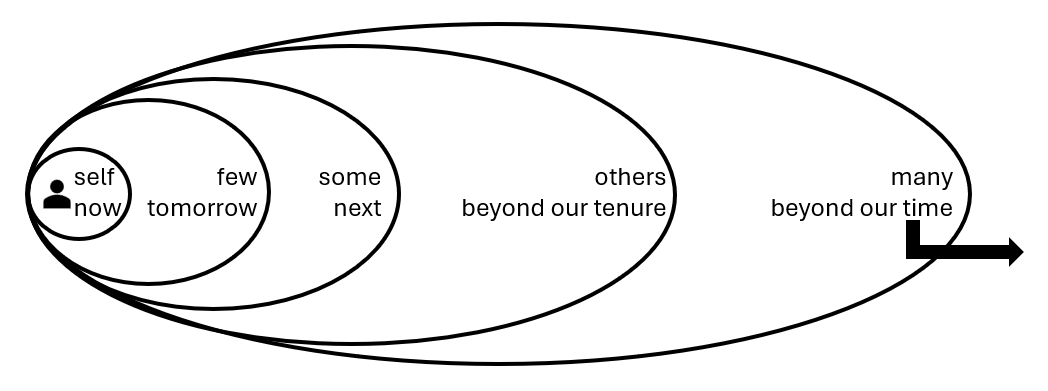
    It is a choice. The emphasis of your priorities and how you use time, with who, will determine the impact and the reach of your leadership. It is both proximal and longitudinal. How far your leadership travels and how contagious it becomes determines legacy: in the trails you leave and open for others.

    We do not just leave trails we create new trails, tread lightly.

    Some leaders are fixated on now, today, tomorrow, getting through (and sometimes that is ok), others lift horizons and seek future returns, seeding the ground and deeply investing in others to change more and into the future. Your leadership is the sum of the actions taken by others, because of your leadership. Most of the impact of which will never be seen or known by you, paying forward.

    “Become the ancestor you’d like to thank.” Seth Godin


    Eco-systems and overstory I the theatre of leadership

    Effective leadership is hyper-aware of the peer and cultural codes that influence the motivation of humans within their ecosystem. Deliberate leadership is sensitive to these codes and acts to trigger ripple effects that take hold and add value.

    “…as tribal animals, we are bound to our peers, heroes, and ancestors … understanding ourselves as tribal helps us see the ripple effects of our actions.” Micheal Morris

    Effective leaders know that in this theatre their role is to enable the ecosystem to thrive, enhancing symbiotic relationships and connections that see beyond survival, toward something worthy. Knowing that their worth is measured in the health of all parts of the ecosystem and after their time.

    Each ecosystem has an overstory, a canopy that guides and shapes norms, decisions, actions, language that create or subtract value. People like us (here) do things like this. The stories we tell, the destinations we describe influences the ecosystem, and the effectiveness of leadership. Leaders…

    “…tend to forget about the overstory because we’re so focused on the life going on in front of and around us. But overstories turn out to be really, really powerful. The overstory is specific. It is tied to a place. It is powerful. It shapes behaviour. And it does not emerge out of nowhere. It happens for a reason…” Malcolm Gladwell.

    To pay forward, with intent, through others, requires leaders to calculate the expected value of their influence through others into the future. To do so requires an understanding of the ecosystem, motivation, peer codes, the overstory… a study of how social costs and cultural codes shape the decisions and actions of others overtime.


    Our landscape | Far-sighted leaders required

    “Our challenge is to ‘build’ the future society we (they) wish to see. This has implications for the curriculum, partnerships and school communities we develop.” Sir Hamid Patel

    The petri dish that is our sector is growing and maturing, the cultures are separate and largely in survival or winning mode. The future, however, is not about successful individuals or individual organisations. It is in the collective leadership and the networks we grow, that influences the sector, through others, that just might generate the capacity to reach all children.

    “…humankind gains enormous power by building large networks of co-operation, but the way these networks are built predisposes us to use the power unwisely. Our problem, then, is a network problem.” Yuval Noah Harari

    It is leadership that builds capacity through networks and deeper collaboration that will determine our stewardship of the future. The future starts with us, in our understanding of why we exist, how far we wish to lift and enable others, close to us, far from us, now and way into the future.

    What if the challenges we face as a sector are, in large part, a leadership challenge, and we are coming up short?


    Catch-up mode

    Our worth is seen in our influence on the lives of others. Our choices and priorities determine the difference that we make not just now, but next. We need to influence others in a way that will travel into the future, beyond our time. Leadership that propagates and adds value, ever-onward. Paying forward, through others, into the future.

    And yet our leadership is in catch-up mode, a feature reflected in the immaturity of our sector. There is much to do, but we have what we need and importantly the permission and obligation to lead more effectively. This weighty responsibility requires us to use our power well and to transfer and pass it through others to multiply and maximise our influence.

    In catch-up mode we must re-imagine what educational leadership is, their future depends on it. Our leadership must be more potent, generative and farsighted so that we do better than now, much better. Or else, we will not reach those children scrabbling for a foot hold on the fringes of education. Our present leadership paradigm does not generate enough capacity to do so.

    It is time to elevate the conversation, align our actions with our rhetoric and deliver far stronger leadership across the sector. We have far more influence than we are willing to admit. But there is hope, leadership that pays forward, through others, for the future just might generatively add the value, tip the balance for those who need us most, the ones we know and the ones we will not know.

    For the sun is shining on us now.

    …it is about your leadership


    Dan Nicholls | December 2024

    Unwarranted Optimism

      For there is always light,

      If only we’re brave enough to see it.

      If only we’re brave enough to be it.

      (Amanda Gorman)

      When everything around appears dark and it is hard to see the light, we need to be brave enough to have unwarranted optimism. It is unwarranted because of the number of challenges faced by colleagues working in education that push us into hopelessness and toward helplessness. And, perhaps worse, there is a real danger that this helplessness is increasingly learnt, mutually reinforced and influencing the stories we tell each other about our profession.

      “Do you have the resilience to show unwarranted optimism, and to regard crisis as the norm and complexity as fun, while maintaining a bottomless well of intellectual curiosity?” (Tim Brighouse)

      To work in our profession requires unwarranted optimism. It always has, but it feels harder than ever to view the future with hope. Optimism (particularly unwarranted) is the life blood of our sector, the fuel that drives good people to do good and change lives. We must not sink our profession by peddling pessimism, even if it is warranted.

      “The problem is that people mistake optimism for ‘blind optimism’.” (Hannah Ritchie)

      However, this is no time for ‘blind optimism’, a naive faith or passive hope that things will turn out well. We need a ‘conditional’, ‘urgent’ optimism that empowers us to act, to step forward and build together a future for all children. Even if optimism, at this time, is unwarranted, it is a far better basis for offering colleagues and children a sense of possibility.


      Warranted Optimism | Everyday acts of heroism.

      “Optimism is seeing challenges as opportunities to make progress; it’s having the confidence that there are things we can do to make a difference. We can shape the future, and we can build a great one if we want to.” (Hannah Ritchie)

      Our schools may well be performing better than ever, providing provision that is meeting the steepest of challenges, post pandemic, and in the face of the fracturing social contract. In all schools, heroic acts are changing lives, exemplifying the power of human connection, offering real hope and optimism for the future; a powerful force for good.

      Warranted Pessimism | poor choice for children and colleagues.

      Warranted pessimism is not an option. Despite the oppressive background music and the darkening light, if we choose to be pessimistic, we may well extinguish the fading light. Too much pessimism, warranted or unwarranted disturbs us deeply, encourages retreat and pushes us to become victims of circumstance. And whilst we can individually decide to retreat, it comes at a cost for all and our profession, as well as the children who need optimism, not pessimism, from the adults they trust.

      “There is no trust more sacred than the one the world holds with children.” (Kofi Annan)

      Skin in the game | our influence lives beyond us

      We all have an opportunity to be and bring the light to others. We cannot choose to sit outside the lives of others or be silent in the narratives that we tell each other; we have skin in other people’s lives. How we choose to move through life, reinforces or erodes the narrative and norms that set the stage far beyond ourselves, in schools, classrooms, and more broadly in life.  How we choose to live in this world, matters.

      How to live in a world where profound uncertainty is not a bug, but a feature? (Yuval Noah Harari)

      We are also hugely influenced by the need to fit in. It is coded deep in us that to be outside of a group hurts, is unsafe and a danger. So, we often take opportunities to align ourselves with the beliefs, attitudes, norms and behaviours of those closest to us. Often choosing against our independent beliefs to follow trend and fit in; a trend that is too often pessimistic. It matters, therefore, whether we choose unwarranted optimism or not, it radiates and infects beyond ourselves to other beings and happenings, all of the time.

      “Your response has to be to reject cynicism and reject pessimism and push forward, with a certain infectious and relentless optimism. Not blind optimism, not one that ignores the scale and scope of our challenges, but that hard-earned optimism, that’s rooted in the stories of very real progress.” (Barack Obama)

      Fairy Lights over Spotlights | a marvellous victory

      “What we choose to emphasise … will determine our lives. If we see only the worst, it destroys our capacity to do something… and at least the possibility of sending this spinning top of a world in a different direction. …to live now as we think human beings should live, in defiance of all that is bad around us, is itself a marvellous victory.” (Howard Zinn)

      To live with unwarranted optimism is to seek the joy of fairy lights over spotlights. A focus on fairy lights enables us to see the joy woven through life, to value the happenings and humans around us. Shifting our focus to the normal, everyday, magic that happens in schools, reveals the power of human relationships and places value on what really matters.

      “To be hopeful in bad times is not just foolishly romantic.” (Howard Zinn)

      The future then is built on an accumulation of small acts, a bottom-up movement, where change becomes possible and we have the chance to send this spinning top of a world in a different direction.

      meaningful movements start bottom-up.

      Seeking spotlights on the other hand is like waiting for big things or changes, often viewing them as a salvation that will save the day. It is the hope that kills, the waiting for the next station that stops us from living now and enjoying the journey.

      “I’ve very deliberately chosen to notice the smaller things, the joys I might have otherwise missed had I looked too broad, too big. The thousands of joys that lattice and join and thread into and around our daily school life.” (Claire Stoneman)

      Uncommon Opportunity | striving for what is worth having.

      There might just be an uncommon opportunity to re-evaluate what really matters in education. Some of the most courageous and heroic work is happening in unfavoured areas of our sector; areas where the challenge is steepest and recognition the lowest.

      “This is Vanity Fair a world where everyone is striving for what is not worth having.” (William Thackeray)

      The narrowness of what is valued in education belies the vibrance and range of opportunity that exists in our world and the eclectic abilities of human beings. It is this narrowness that disenfranchises the many. We must throw more light on what is worth having, what children need for their future; a system more geared towards those it serves.

      I deal my own deck, sometimes the ace, sometimes the deuces.” (Gloria Gaynor)

      When we are pushed by powers beyond our control we should strive to go in the opposite direction and enable others to take more control, to step forward and make a difference to their part of the world. We should continue to deal our own cards, and empower others, to deal from their decks, optimistically, regardless of what is dealt; because we have collective power and we are the system.

      Too many feel unremarkable | in a remarkable world.

      In a darkening world children, particularly under-resourced children, need us to have unwarranted optimism, to offer more light and a greater sense of possibility. Creating the conditions for children to adventure down rabbit holes of curiosity and to feel the wonder of our remarkable world. We seek this wonder, so that children have the chance to walk a step or two with genius and because childhoods last a lifetime.

      “Do you believe with a passion that brooks no denial that all pupils, whatever their background, can walk a step or two with genius and that your staff will embrace the aim that all students will grow up to think for themselves and act for others?” (Tim Brighouse)

      We must not allow a pervading pessimism to extinguish the light for children and create a self-fulfilling narrative that damages our profession. We must encourage more to serve in education to reveal the magic that exist in ordinary lives and to bring more light.

      “…treading the intriguing line between the everyday and the otherworldly, revealing the magic that exists in our ordinary lives.” (The Lost Bookshop)

      Not our story to finish | true but useless.

      We should not pretend to know the future or how this story plays out. We must tread carefully on the dreams of children and seek to create provision that is more born out of optimism than pessimism. It is the difference between setting the stage for children to stumble forward in the dark, steeped in pessimism, and stepping with confidence into a future that is full of optimism and possibility. Children need to grow up in a world where they feel remarkable, opportunity is unbound, and where children do not feel separate from the world.

      “…although her childhood, had left her feeling separate from the world.” (Steven Rogers)

      Lest we forget that children are vulnerable to the beliefs and narratives of the adults in their lives. The challenges we face are true but useless for the children we educate. They do not choose the conditions, location, or time that they inhabit, and they are largely unaware of pressures, turmoil, and upset of colleagues in our sector. They profit nothing from a sector that fights, argues, gives-up, or fails to work optimistically with the hand that they are dealt.


      Unwarranted optimism | An invitation to dance

      We choose our approach to life and to work. It is too easy to see the challenges that surround us and retreat into the security of pessimism, into narratives that reduce agency and reinforce helplessness. But, when we do, it is not an individual choice, the impact of this stance reverberates through other beings and happenings. It denies a sense of possibility.

      Conversely, to bravely choose optimism, conditional optimism, we offer a greater sense of possibility, to reassess what is valued and to see the magic and the light in the everyday. This is a stronger basis for the future, more generous and a greater investment in colleagues and children.

      “Ignore those who say that we are doomed. We are not doomed. We can build a better future for everyone.” (Hannah Ritchie)

      So, to choose individually, collectively, and organisationally to pursue unwarranted optimism is to contribute to a growing narrative that encourages us not just to see the light, but to be the light. To step forward rather than shy away from the future and collectively build it.

      And in this optimistic light perhaps all children and colleagues will accept an invitation to dance.


      Dan Nicholls | February 2024

      Fiercely educate…

      … children who are presently disadvantaged.

      If we are to overcome the forces in our society and schools that insidiously widen gaps, between those that have and those that have not, we need to be more ferocious, more tenacious in creating the conditions that enable our disadvantaged learners to flourish. This requires educators to be more honest, to ask uncomfortable questions and make braver decisions to fiercely educate those that need us the most.

      Photo by Efe Yagiz Soysal on Unsplash

      To fiercely educate is to replicate the stage-managed, high expectation and sharpened elbows of an advantaged childhood. Being fierce means guarding a child’s education, expecting much, staying alongside, pushing from behind, consistently and persistently championing individual children.

      An advantaged childhood holds, expects and elevates children, who are fiercely loved and as a result feel more secure.

      “Okay, well, Eleanor has this mother. She intimidated me at first actually because she just – she’s fierce. Fiercely loving. … but I could tell she felt safe in that house. She grew up feeling safe and fiercely loved.

      “And you and I didn’t get that, not because we didn’t deserve it, we just got dealt something else. But the people who did get that love, they grew up to be different from us. More secure.

      Coco Mellors | Cleopatra and Frankenstein

      To be fiercely loved* is to be challenged, extended, stretched, to reach and risk, and at the same time, to be held tightly, more secure. “You will be brave, I have got you.”

      *the emphasis is on fiercely rather than loved. Families who are socio-economically deprived do not love their children less, often quite the opposite, but the time, money, space to create opportunity and supported experiences to translate that love, ferociously, is compromised at every turn.

      Advantaged families interpret the world for their children, translating experiences and interactions to maintain their sense of security and renew their agency. Setting and re-setting a desired narrative of what it is to be and feel successful, to step forward once more, even when the randomness of life and experiences intrude beyond the home. There is always an ongoing invitation to dance. Sitting out is not an option.

      To grow up advantaged is to step forward through a life punctuated by opportunities, reaching, risking and stepping forward, it is a secure pursuit. These are childhoods, with guide ropes and safety harnesses, that see failure as an obstacle on the path to eventual success.

      If you are lucky enough to be born in a world made in your image, you probably think of a failure as an obstacle on the path to eventual success. If you are a marginalised person in any way you internalise that failure more closely.

      Elizabeth Day

      Without a deep sense of security, a disadvantaged child is far more likely to internalise failure more closely. It is precisely this self-reflection, the connection of failure with self that perpetuates over time and maintains an inhibiting mindset that convinces that it would be safer not to try. Without the ferocity of expectation, the unwavering (taught) belief in their own agency, a child’s hand goes up fewer times, they step back rather than stride forward and live with a constraining belief that the world is not built in their image or for their circumstance.

      If we step forward less we tend to surround ourselves with others who are also less likely to step forward in life. It is the five closest individuals with whom you measure your status, the ones that set the bar, the ones we compare against. And where we create schools within schools we set expectations of what is possible (and not possible). We must work harder to cross-connect social circles, orchestrating and intervening to be more inclusive.

      Each starling is only ever aware of five other birds,” she said. “One above, one below, one in front and either side, like a star. They move with those five, and that’s how they stay in formation.”

      Who are your five then?” asked Cleo. “The ones you watch?

      Coco Mellors

      It is an inconvenient truth that schools create these self-fulfilling groups, reinforce the conditions for advantage and disadvantage to accumulate. We are the problem more often than we admit, more often than we see, more often than we realise. To see the conditions we create, those that we have come to accept, we must apply the disadvantage lens on ourselves and our schools, be more honest and evaluate what we are willing to accept, what we hold up and measure as success. This is about confronting and tackling the perpetuating inequity, seeking to halt social fractures at a time when society is fracturing.

      Hope: to want something to happen or to be true, and usually have a good reason to think that it might.

      A childhood of advantage is one of agency and hope; a life on an exciting journey of opportunity, where what is wanted, sought after, is within reach and based on previous experiences, have a good reason to think it might be achieved. And if it does not, any failure slides off, it does not define. After all, the failure is not about me reaching out, because I act on the world. And yet for our disadvantaged children each failure is another hit on self-belief, self-image, another example of the world acting on them. “This world is not for me.”

      An advantaged childhood also has purpose (one insisted on, and then internalised by the child), a beacon that directs effort and demands persistence. We must work harder to create, expect and articulate purpose so that it fuels the persistence required to close gaps.

      “When we have a purpose, we are able not only to endure and persist but also to provide a beacon that reminds us of what’s important and to make the right decision at the right moment.”

      Steve Magnus


      Too many journeys through school are riddled with children being let off, in conditions of low expectation where interactions are compromised by collusion. We are prone to making poor assumptions about background, present levels of attainment, context, aspiration, resilience; missing the fact that we are both the problem and the solution.

      We need to be more honest and braver as educationalists, guarding each child’s education and building great schools that deliberately step in to create pathways for disadvantaged learners to thrive and flourish. It takes the whole team to maintain provision that privileges disadvantage everywhere, only shared endeavour has any chance of systematically closing gaps; culture over lists of good intentions/interventions.

      So:

      • There is little in this world more powerful than someone who deeply believes in you; educators have that power. An unconditional acceptance from a trusted adult gives a child the warm sense of belonging; a psychological safety that says we believe in you. Unpicking disadvantage is a team sport, focused on individuals to apply equity.
      • We are disproportionately influenced by those that we spend time with (sometimes chosen, sometimes destined, sometimes orchestrated); schools need to remove the school within school phenomenon – our choices around setting, staffing, curriculum either perpetuates disadvantage or removes it.
      • To fiercely educate is to have educational provision that reaches those that need us most. We need to measure what matters: the attendance and attainment of disadvantaged learners. Attendance first… we cannot fiercely educate any child we cannot see.
      • Our journey through education is disproportionately shaped by small acts; these are rare, often serendipitous experiences that shape us the most. How far do we purposefully engineer and create these moments of ignition within a child’s education so that they see themselves differently?

      The disproportionate influence of five sentences within the novel of our lives.

      • Our interactions, language and the attention we give to others defines our attitude towards them and influences the way children see themselves. It is easy to understate the importance of culture and collective attitude in schools.
      • A child’s self-belief, self-confidence and self-image can be so fragile that inconsequential comments, experiences and actions can erode any belief that exists. As educators we can choose to fill or not fill these lockers. Removing deficit and neutral discourse in our shared language really matters; our words make a difference, both ways.
      • Simply adding “I am giving you this feedback because I believe in you,” changed students’ learning trajectories significantly (Cohen & Garcia, 2014).

      “They may forget what you said, but they will never forget how you made them feel.”

      Carl Buehner

      • We need great teaching in great schools to understand where children are in their learning and teach the next bit. Seeking to hunt not fish and to apply the equity that disadvantaged learners need. Weaving nets to catch the curriculum.
      • We are hard-wired to see success as talent and gift and not the expression of supported opportunity and accumulated hard work over time; it is the latter that disadvantage learners need, it is the former that perpetuate poor attitudes to individual potential and widens gaps.
      • We may well be witnessing a significant shift in the social contract. The contract held between families and school is eroding, relationships and attitudes are shifting. Whilst we wrestle with a whole range of challenges we must not forget, rather increase our investment in the individual children that walk into our schools everyday.
      • … you have the power to change lives, to weave a future for children, just as the threads of society are unravelling for too many children. You are the hope, for many the only second chance.

      “History will judge us by the difference we make in the everyday lives of children.”

      Nelson Mandela


      Dan Nicholls | May 2023