Our Future | building culture

The next stage of our Trust will seek to connect and empower all colleagues as one organisation. Colleagues trusted to transform lives, so that children thrive and flourish now and into adulthood. We will use the power of education to unlock and inspire young lives, particularly for those children who carry more than others, in these difficult times.

“There is no trust more sacred than the one the world holds with children.” (Kofi Annan)

Building on strong foundations

Your expertise and commitment have built the platform on which our Trust now stands. Because of this work, over time, you have developed provision and approaches that are making a difference to the lives of children and is the foundation for our next stage. On this maturity we will seek greater influence on the lives of colleagues and children, strategically plotting and shaping our path, together.

In the next stage there are key approaches and principles that will establish a cultural model that will inform our relationships, interactions and underpin the strategy. This will build the conditions, culture, and climate for colleagues to do meaningful work. We will prioritise psychological safety for colleagues, so that they feel greater belonging and to be given permission to do work that transforms lives. Offering the opportunities for more children to flourish, to have a sense of wonder and be wonder-smitten: I am here, that I may wonder.

“To live wonder-smitten with reality is the gladdest way to live.” (Maria Popova)

One organisation

We are one organisation, serving children, aged 2 to 19, responsible for all children, with every school and colleague woven into a collective cultural fabric: school is trust, trust is school. A collection of great schools, meeting need, held in a strong trust.

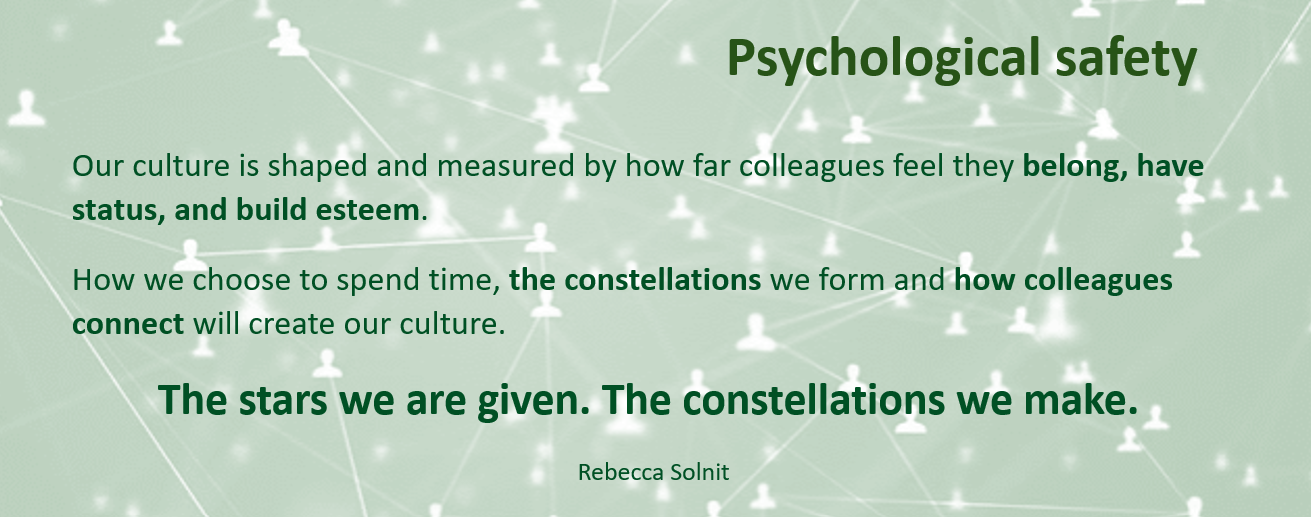
Our culture matters to us. It is built and shaped, in every interaction, everywhere, all the time and ever onward. Our cultural landscape is carved over time towards our shared purpose and is guided by deeply held lived values and shared rituals and routines. It is shaped and measured by how far colleagues feel they belong, have status, and build esteem. How we choose to spend time, the constellations we form and how colleagues connect will create our culture.

“The stars we are given. The constellations we make.” (Rebecca Solnit)
Making good decisions together

We make good decisions together. We seek and value expertise across our schools and the Trust as a whole. We are open and transparent as an organisation, making the best decisions we can, with the information we have, whilst seeking to do the right thing. We act without fear or favour.

First say yes. If a colleague feels the need to ask for support or resource, we should say yes, first, and work out how, later. Paying forward as an exercise in collective endeavour and shared responsibility.

The second mistake. It is rarely the case that the first mistake matters, it is often the second or third that turns mistake into problem. Because we make good decisions together, are open and transparent we share and resolve challenges at the first opportunity. Almost everything becomes easier when things are shared, it builds trust, and importantly avoids the second and third mistake.

A Human organisation, valuing relationships

We make time to listen, learn and build relationships. Being present. This is about ensuring colleagues are known as individuals, individuals with a unique story, a story that is heard. Understanding an individual’s story allows us to weave collective stories into the future; generating a greater sense of belonging. How we treat anyone, is how we treat everyone.

Humans are beautifully contagious

Use time well, seek simplicity

We will seek to use time well. Deliberately prioritising time towards the Main Thing(s). Logically sequencing our routines and networks and creating simple approaches that focus on making the greatest difference. We will work to reduce unnecessary burdens on individuals, to be as agile and nimble as is appropriate to our scale. As simple as possible, but not more so.

We will seek clarity because it is kind. Humans like rules, it is clarity that creates safety. We will share all data and information transparently to understand performance and drive improvement, part of our joint endeavour and collective responsibility for all children.

Primacy of Headteachers, the drivers of change

We understand the importance and primacy of Headteachers. The strongest Heads are great with people, understand provision and lead with purpose, prioritising and implementing key strategies and approaches, over time, to enable colleagues to change lives. They are open and able to utilise the capacity of the Trust, and to add into the strength of the Trust; a mutually beneficial symbiosis that adds value.

We are the sum of our decisions

Our effectiveness could be simplified as the sum of all decisions, by all colleagues, all the time, everywhere across our Trust that either accumulates value, or not. Our role as Trust Leaders is to influence, nudge, direct, enable better decisions to be made more often, to deliver a dividend. We will continue to dance between what we decide to do together and where we choose to empower colleagues to act.

Deliberately choosing where to standardise and where to empower colleagues

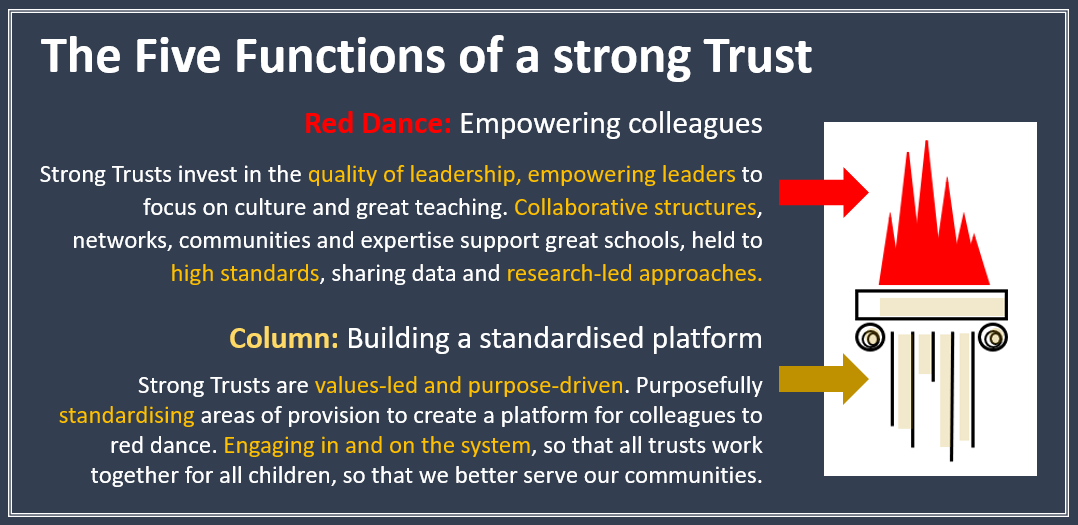
We will continue to standardise aspects of provision, to become more than the sum of our parts. Standardising, building things together, has tremendous power to liberate, support and give permission (and opportunity) for colleagues to focus on the Main Thing(s); creating a platform for colleagues. Our shared, common curriculum exemplifies the power of this collective endeavour.

Leadership is the art of giving people a platform for spreading ideas that work. (Seth Godin)

We will standardise and empower deliberately and strategically. Holding ideas in tension, informed by context, because context matters; it is not a compromise. Whilst recognising the importance of standardisation and of empowering colleagues on platforms, we will not seek to over dictate the complex areas of provision where experts and professionals make decisions, informed in the moment, in context, for their community.

“…under the conditions of true complexity – where unpredictability reigns – efforts to dictate every step from the centre will fail. People … require a seemingly contradictory mix of freedom and expectation.” (Atul Gawande)

We understand the influence we have on others

Back to the Future. Whilst Marty McFly travelled back in time and understood the future consequences of his actions, we are much less conscious of our influence on the future. Whilst we cannot foresee the future we can, together, create the conditions, sow the seeds, prepare the ground for humans to flourish and for more good than bad to happen. We, collectively create a crucible of serendipity where colleagues shape what is possible. Lives are shaped by opportunity. Our collective capacity can and will transform lives, evidenced in the smallest acts, every day.

“The smallest act in the most limited circumstances bears the seed of boundlessness, because one deed, and sometimes one word, suffices to change every constellation.” (Hannah Arendt)

We are collaborative by nature

We will build on our existing collaborative architecture, our co-operative system, to connect colleagues with purpose and to each other, seeking collaborative advantage. Connecting colleagues within professional networks and subject/year communities, where hard and soft-wired collaboration secures collaborative intelligence and wisdom that becomes self-improving and irreversible. The biggest influence on colleagues is colleagues.
Getting today right and building for the future

Two speed. As we forge forward, we will build our future, based on where we have been, where we are, and toward what we seek. We will seek to get today right and the future right. We will seek change and improvement in months and years, concurrently.

What do we seek? We decide, next, together.


Into our future

So, based on the platform that you have built, we will work with humanity, humility and openness, to shape the future, together. So, at this time, as I join you as CEO, my optimism, hope and determination for what we will achieve is galvanised by the brilliant people in our Trust.

“When we build a culture of people who eagerly seek out and take responsibility, we build a culture that enables a special kind of resilient freedom.” (Seth Godin)

We have an opportunity to enable all colleagues across our Trust to collaborate, connect and feel empowered to make a difference. To work as one organisation, sharing responsibility, engaged in collective endeavour to secure greater social justice, particularly for our most vulnerable children, those that carry the most through life, and particularly at this time. A worthy cause.

“To be hopeful in bad times is not just foolishly romantic.” (Howard Zinn)


Postscript

There is no way to build high-performing organisations without a cultural model that drives the strategy. Or to put it differently, strategy without culture is just wishful thinking.


Dan Nicholls | July 2024

Five functions of a strong Trust | strong Trust, great schools

Strong Trusts build collaborative structures and platforms for great schools to create more value for all children, over time. This trust dividend enables groups of schools to achieve more than the sum of their parts, and more than before. Strong Trusts are values-led, purpose-driven, learning organisations who establish the conditions for colleagues to create collaborative intelligence that becomes trust wisdom that strengthens great schools.

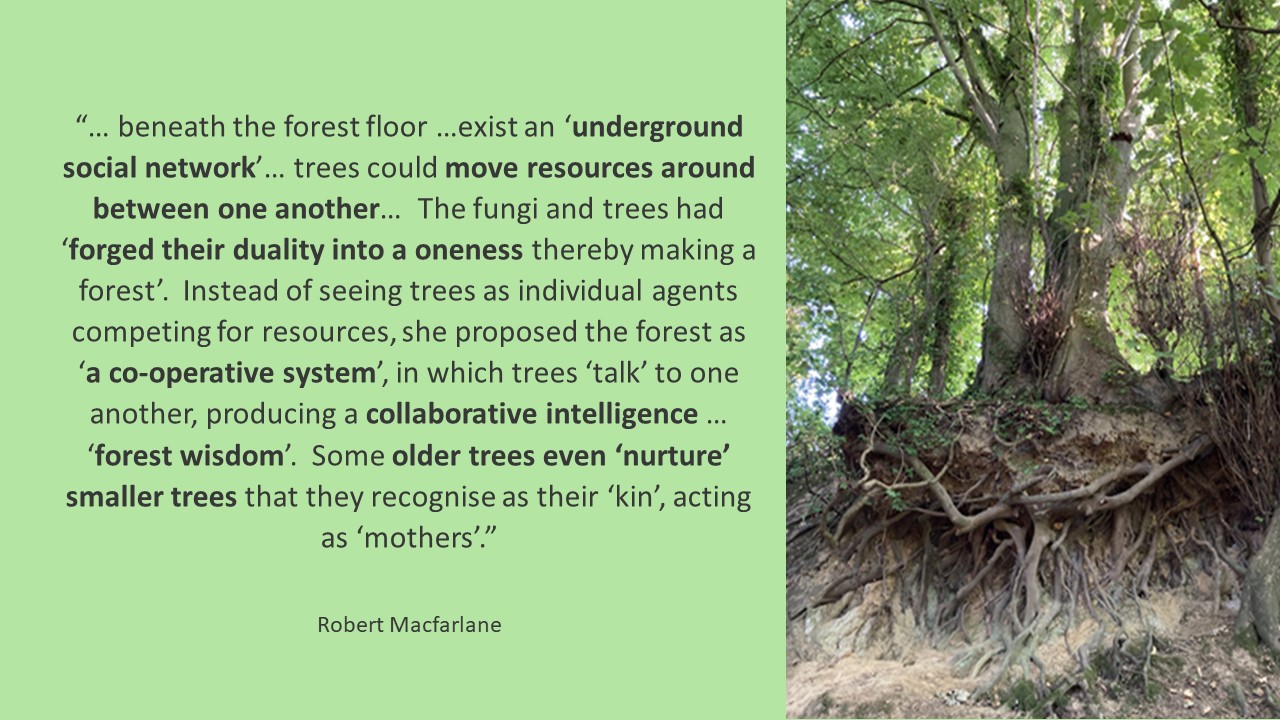
“Instead of seeing trees (schools) as individual agents competing for resources, she proposed the forest as ‘a co-operative system’, in which trees ‘talk’ to one another, producing a collaborative intelligence she described as ‘forest (trust) wisdom’.  Some older trees even ‘nurture’ smaller trees.” (Robert Macfarlane)

There is now enough maturity in our system to identify how strong Trusts create enough value to sustain groups of great schools; school is Trust, Trust is school. Deepening this understanding will enable educators to take greater stewardship of the sector and build strong Trusts that work together for all children. The following identifies five functions of a strong Trust that, taken together, create a trust dividend that supports, empowers and sustains great schools.


The five functions of a strong Trust | in brief

One: Strong Trusts are values-led and purpose-driven, they understand why they exist, live out their values, achieve their purpose, tell stories of the future, create coherence and clarity to establish a climate where colleagues belong to something bigger and are empowered to add value.

Two: Strong Trusts standardise areas of provision that build platforms for colleagues to stand on and exploit, areas that are high dividend and rise the tide, particularly a shared curriculum, shared assessment and wider professional services. These are significant investments in high dividend areas, over time, that add future value.

Three: Strong Trusts invest in leadership, particularly of headteachers, so that there is a deep investment in relationships, setting direction and implementation within schools. Leadership that builds and sustains a strong culture and great teaching, hallmarks of great schools and areas that are largely empowered to and owned by schools.

Four: Strong Trusts create collaborative structures, an architecture enabling colleagues to collaborate across the Trust in networks and communities, creating, designing, developing and aligning approaches that add value. Trusts are risk-informed, distorting resource and expertise to tackle underperformance.

Five: Strong Trusts maintain high standards creating the conditions for healthy competition, great schools joined in the shared endeavour of raising standards, transparently using trust-wide data, building shared intelligence and using research-led approaches to inform implementation and school improvement.

+One: Strong Trusts act within and on the system, working together with other Trusts, to create a collective dividend and take responsibility for the education system, serving communities as anchor institutions and working with other civic partners to support all children.


The Five Functions of a Strong Trust, the next level of detail

One: Values-led, purpose-driven | building culture and belonging

Strong Trusts know and understand why they exist. They have a set of compelling values and clarity of purpose that galvanises colleagues into shared endeavour and collective responsibility. This clarity aligns colleagues, informs the strategic investments and paints a compelling future, that guides the big and small decisions made across the Trust by all colleagues every day. It is in these actions, over time, and not in the written words, that culture emerges.

“…understanding the “cultural magic” that makes an organisation feel truly human, and creates a sense of connection and belonging.” (Tracey Camilleri, et al.)

Without this clarity of purpose, colleagues struggle to place themselves and their work within the Trust. Strong Trusts create a sense of belonging, give status and build esteem, because the rules of the game are clear, colleagues understand the journey and are empowered to add value. This is a significant investment in people, actively building well-being to create psychologically safe, high trust, heart felt collegiality that holds people in the Trust.

“To feel a sense of belonging is to feel accepted, to feel seen and to feel included by a group of people… to not feel belonging is to experience the precarious and insecure sense of an outsider.” (Owen Eastwood, 2021)

Strong Trusts bring coherence and clarity on how we do things here, what is standardised, empowered, the routines and collaborative structures that secure school improvement at scale. Deepening understanding of the Trust’s Theory of Action empowers colleagues to build great schools on the platform of the Trust.


Two: Standardisation | creating a platform for colleagues

Strong Trusts deliberately standardise areas of provision, typically complicated areas, that add value and create platforms for colleagues to focus on the Main Thing(s). Amongst the most important to standardise: a shared curriculum, shared assessment, syllabi and professional services.

A shared curriculum where learning is progressive, sequenced, and coherent over time is one of the most important levers available to Trusts; being experts and collaborating on one curriculum, rather than many.

A shared assessment system across all year groups, based on the shared curriculum and shared examination syllabi create an accountability framework and the intelligence for raising standards. This provides the elements required for co-opetition and the transparent sharing of data for the purposes of school improvement; school is Trust, Trust is school.


Three: Trust Leadership | empowering leaders to build great schools

Strong Trusts invest in leaders, particularly Headteachers, as the key agents in building and sustaining great schools, investing in their knowledge, development and wellbeing. Great leadership builds relationships, sets direction and implements well. Strong Trusts seek to drive-up the quality of this leadership, they build a curriculum for it and create the conditions that empower leaders to lead great schools, within a strong Trust.

Strong Trusts understand where to standardise (complicated) and where to empower (complex). Whilst great schools are great at many things, two areas stand out.  Firstly, great schools propagate a strong culture of high expectation that is scholarly and builds character. Secondly, they secure great teaching, through professional learning and developing individual teachers. Both areas are largely empowered to schools as they require contextualising and local decision making, to follow learning to meet need and to build culture in context.


Four: Deliberate collaboration I networks, communities and expertise

Strong Trusts create collaborative structures for colleagues to build collective intelligence and understanding; an investment in people. Networks and communities connect colleagues horizontally across the Trust and within and beyond phases to create the conditions for improvement, the sharing of practice and alignment; moving towards a self-improving Trust. Creating the architecture, time, artefacts and purpose of collaboration that empower colleagues to focus together on the Main Thing(s).

“…we can speed this process (trial and error) up by creating systems and platforms where we search for new knowledge systematically… integrate the result into our body of knowledge, and apply it into new ways of doing things.” (Johan Norberg)

Strong Trusts deliberately build expertise and improvement tools that support school improvement, particularly in areas of provision that are specialist and in high demand; one of the key advantages of Trusts. The accessibility and use of expertise commissioned and utilised by schools and headteachers creates the conditions for a self-improving Trust.

“The stars we are given. The constellations we make.” (Rebecca Solnit)

Strong Trusts are risk-informed, use information, intelligence and data to concentrate and distort the resources developed by the Trust to improve areas of underperformance. They develop expertise and capacity over time, commensurate with scale, and use school improvement teams and specific expertise to improve schools in a timely, proportionate and deliberate way.


Five: High Standards | competition and transparent performance data

Strong Trusts balance co-operation and competition to drive up trust standards; co-opetition. The transparent, deliberate use of data (democratised data) to understand performance and school improvement, in high-trust environments, builds intelligence and informs improvement. Great schools invest in quality assurance as part of strong implementation practices, supported by the trust and accessing trustworthy expertise, resources and tools.

Strong Trusts are research-led, often working in cognitive dissonance, holding opposing ideas in tension; resisting simplified swings based on trend; tempering influences and instead leaning on seminal readings and peer-reviewed research. They are learning organisations who use the Trust as a test-bed to understand performance and deliberately share intelligence.


+One: Sector engaged | all trusts working together for all children

Strong Trusts work within and on the wider system. They understand that the success of the Trust hinges on the success of other Trusts and that we all have a shared responsibility and stewardship for the education system as a whole; all trusts working together for all children. By working in partnership and with a sense of altruism, Trusts can better understand how to add value, achieve dividend, and take greater collective responsibility for our system.

By building strong, resilient Trusts that are connected as partner Trusts, we can seize our opportunity to serve communities, build partnerships and exploit the opportunities afforded by civic leadership, anchor trusts and investing in place. This creates a stronger education system, better able to secure equity through education, social mobility, justice and to reach those presently disadvantaged; disadvantaged even over.


Great schools, strong Trust | the five functions

The five functions seek to create a trust dividend, establishing a strong Trust with great schools. The functions create the opportunity for Trusts to be self-improving, with leaders empowered and connected to lead on the platform of the Trust. This long-term investment builds strong Trusts who can work with partner Trusts to add a collective dividend that transforms the life chances of children. All trusts working together for all children.


Dan Nicholls | February 2023

The thinking presented here is based on the work, experience and thinking of colleagues across Cabot Learning Federation.